Victoria 3
Straight to the point — I liked the game; I played it with pleasure. In my feeling, there isn't much to add, and there's not much point in overanalyzing specific game mechanics and such. Therefore, instead of a standard review, I'll simply write my report on my last run, and that will probably make it clear why I liked the game.
I started as Russia; my goal was to create the highest possible standards of living, and as a bonus, grant plenty of civil liberties. I love fantastic scenarios.
At first, everything went well—or rather, I sat there amazed at the state of the country: many regions had limited access to the internal market, tax collection was barely functioning anywhere, many territories were not incorporated, and the entire economy relied on the most inefficient grain production and its total sale abroad, leaving the own population starving—in short, a very historical start. I began slowly undermining the nobility. This process consisted of two elements: on one hand, weakening the nobles themselves (and, if possible, their eternal ally, the church), and on the other, creating new social groups that could serve as a counterweight to them. Additionally, I needed to start pulling the people up from the rock bottom they were at. To do this, I tried to solve at least the food problem; I imposed higher tariffs on grain exports (didn't help), and began mass-building farms instead of those garden plots worked by serfs—that didn't help either. I decided that for a real leap forward, I would need to research intensive farming, and without it, there was nothing to be gained, so I continued building farms and such by inertia, and while waiting for the technology (which was far off), I focused on legislative reforms.
Since abolishing serfdom right away would have angered the nobility, I started approaching from other angles. First, professional army and police were created instead of peasant conscription. This, firstly, took away one of the nobles' levers of pressure, and secondly, created a class of professional military personnel who would be loyal to the government regardless of the peasants' serfdom status. The police, however, proved useful not only as an addition to the army but also for solving very real problems on the other side—initially, the standard of living in the country began to get slightly worse, so the gendarmes went in to perform damage control. Besides laws, I also paid attention to the army generalship—when old noble generals retired or died, I tried to replace them either with career military men or left the positions vacant if there were no alternatives. Among other reforms, I introduced public schools—this was absolutely necessary since our literacy rate was one of the lowest in Europe, which in the long run meant no engineers. But the absence of a capitalist class in the early stages turned out to be a plus—before I had time to fatten them up myself, I quickly pushed through a law on compulsory primary schools instead of legalized child labor. And I began to quietly push the church aside, starting by declaring freedom of religion in the country, though without making a final break yet (priests still had the right to work in government institutions).
At some point, we finally unlocked the intensive farming technology; here it is worth explaining why the mass construction of farms yielded no results. The thing is, Victoria has a free market (unless you introduce total isolationism), which means anyone who wants can buy goods from your market. Therefore, the more grain I produced, the more our esteemed Western partners bought for a pittance. Since isolationism was not an option—not only because of the need to purchase certain goods abroad, but also because tariffs provide huge opportunities for earning revenue for the state budget—my solution was to raise grain production to a level where there was enough both for sale (so they could choke on it) and for domestic needs. In principle, my hopes were more or less justified; of course, the intensive production method alone was not enough, but the expansion of the construction sector, as well as new technologies within it, made it possible to build farms en masse, and collectively these measures helped create a grain surplus. Having a surplus was important not only because it led to lower prices for the domestic consumer, but also because while the nobles utilized serfdom, they could squeeze extra grain from the peasants for sale, and after its abolition, there was a forecast for a significant decrease in bread production. Nevertheless, I decided it was enough, and around '58 (I don't remember exactly), I carried out that most famous of Alexander II's reforms (but in my case, Nicholas I did it because he turned out to be long-lived). Perhaps this reform acted as a true turning point, as it heavily impacted the power of the nobility and gave a significant boost to the growth of the standard of living in the country—it turned out that peasants live better when they don't have to perform corvée labor and when they work for themselves. From that moment on, the nobility began to wither, and as time passed, they had fewer chances to ever again become a real threat or even just a political force. I also decided to finally sideline the church and implemented a complete separation of state and religion. For a while, it seemed that a golden age had arrived.
Growth in the country occurred across all indicators. New factories and enterprises were constantly being built, new deposits were developed, and the country began to become a world leader not only in grain production but also in the production of more complex goods—fertilizers, explosives. More productive production methods were implemented as quickly as possible at all levels, because the stronger the economy grew, the more raw materials it needed—iron, lead, sulfur, wood, coal. Fortunately, within the territory of the Russian Empire (which by '70 had become the Russian Republic with the exit of the Grand Duchy of Finland), all necessary resources were in full abundance. All except rubber. Creating a source of rubber for my industry was set as a task for the future, and meanwhile, I continued to develop the internal strength of the country. Discrimination against small nations was abolished, the independence of the Caucasus was finally suppressed (mostly for pretty borders, not due to actual necessity), the right to free speech was introduced, pensions based on age, public hospitals, there was a rejection of traditionalism in the economy and we moved to mercantilism, and a progressive tax was introduced, which would place the main burden on the wealthy. This last measure, combined with taxes being set at a minimum, led to the lowest strata of society paying no taxes at all, which further accelerated the growth of their quality of life. The tax on alcohol consumption had been abolished long before this. Money from tariffs flowed like a river; I didn't know what to spend it on, salaries for officials and the military were set to maximum, there was a huge expansion and modernization of the army, the construction sector was expanded to the limit, and still, the treasury was overflowing with money. The level of satisfaction with the situation in the country was the highest; unfortunately, I didn't take screenshots, but one random one from that period was found:
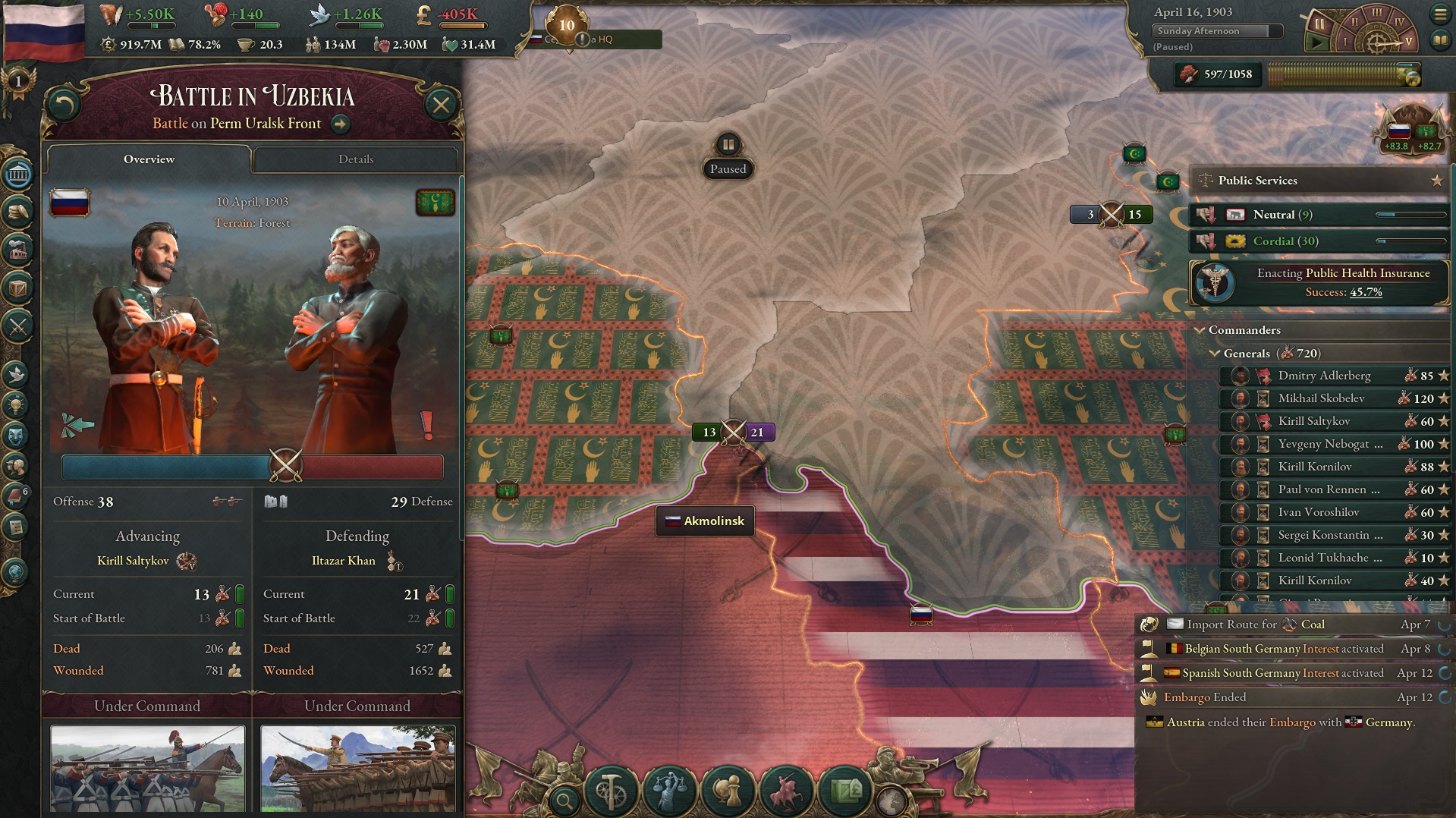
In the screenshot, a war is taking place in Central Asia for the purpose of annexing these territories to Russia and growing opium there—no, not for what you're thinking; this was one of the consequences of the army's modernization. I created a system of field hospitals that used morphine as a painkiller, the synthesis of which required opium, one of the few goods unavailable for mass production on Russian territory. Of course, after creating these fields, opium use quickly extended beyond just the army, but that is a completely different story. And yes, looking at the screenshot, I realized that I lied above and the public healthcare system was only just being introduced at that time, but those are just nuances.
Something else is important, namely this line:

From left to right — GDP, percentage of literate population, standard of living, population, number of radicals, number of loyalists. For comparison — in 1836, Russia's GDP was 39.2M, literacy 19.6%, population 58.8M. Now for the less obvious things — the standard of living in the screenshot is the national average, but it is still different for the lower, middle, and upper classes. I don't have specific data per class for that period, but most likely for the poor it was something around 19. A bit more context — in most countries, including Russia, a standard of living of 20 at the start is held by the middle class, i.e., officers and officials. That is, by 1900, I managed to raise peasants and laborers to the level once enjoyed by the middle class. More on this later; lastly, I'll just say that at the start, Russia's average standard of living is 9.4, and specifically for the lower classes 8.6, which corresponds to survival. Radicals and loyalists are those who are respectively ready at any moment to take to the streets to overthrow the regime (but they still won't go anywhere until a leader is found, so their number itself is not a threat) and those who are ready to defend the current regime in the event of a civil war. By itself, this is not an indicator of the standard of living; for example, if you have, ahem, a population with not very liberal views
there should have been another word here, then extremely liberal laws will turn them into radicals. However, these groups also depend heavily on the standard of living — as long as it grows and exceeds the expected level, there is a high chance of loyalty increasing, and vice versa. Therefore, I like to use the number of radicals and loyalists as a measure of population satisfaction, and in this regard, without false modesty, I achieved stunning success — for most players, there are always more radicals than loyalists.
Now about the standard of living, I promised to explain in more detail. To grow it, you first need to work with the lower classes, since the middle and upper classes will buy everything they need themselves. In the later game, you can think about their needs, but at first — the poor. Their needs are small — bread, vodka, clothes, and some firewood for heating. And my economic growth, which was by no means an end in itself, began precisely with attempts to satisfy these needs. I already mentioned farms; for vodka production, food factories were built, for clothing, textile mills, for firewood — sawmills. At the same time, an extremely important note — in this game, goods are not produced by the state (unless you have a command economy) and the state does not manage their flow at all. Therefore, to provide the population with a product, you must ensure low prices for it — then the population will buy it on the market themselves. And to ensure low prices, it was necessary to build all these productions that would produce a lot of goods and lead to a price drop. But these productions were needed in great quantities, and to keep this system in order, railroads had to be built; railroads need coal and locomotives, so we build coal mines; locomotives need steel, so we build factories plus steel mills; for those, iron is needed, so we build iron mines. Once all this was built, a bunch of jobs appeared, people went there to earn money, and owners began to make income from them. Western partners saw that I had developed industries where they lagged behind — they began buying the produced products, and tariffs flowed into the treasury. To satisfy demand, all existing enterprises expand, more wages for workers, more income for capitalists, more tariffs for the state. Just a win-win-win situation. Unfortunately, the AI in the game is too stupid to develop its own industries the way a player does, so the most effective way to obtain raw resources is to seize lands and build resource structures yourself. And if opium could be grown in Uzbekistan without violating pretty borders, then for rubber I had to go to Africa, seizing territories first from the locals, and then from France:
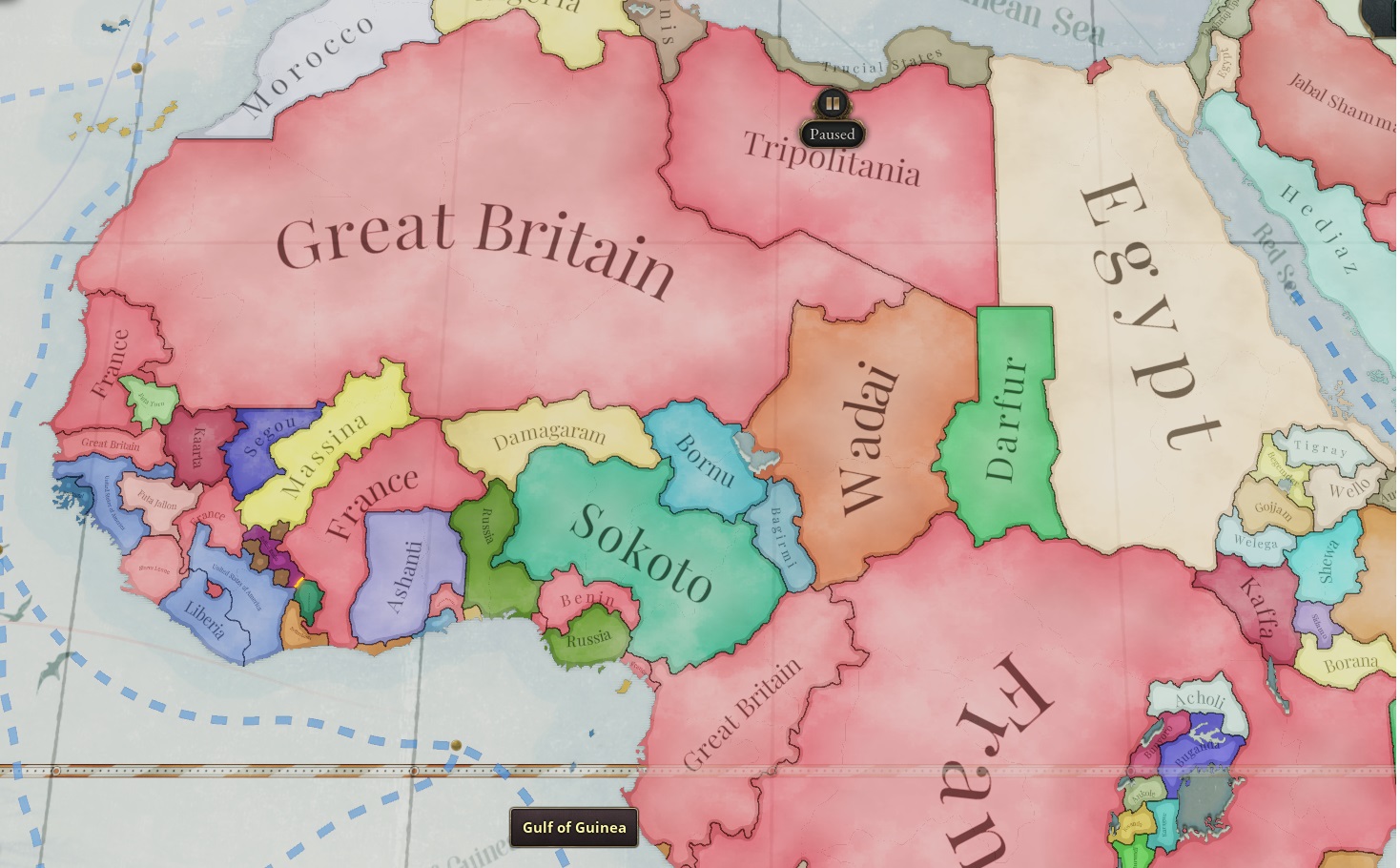
As a result, I got these modest colonial possessions, which aren't very pretty in terms of borders. But don't worry, all local residents were granted civil rights equal to other Russians, and provision was ensured as in the metropolis. It turned out quite amusing — initially, after conquering those territories that were independent, the natives dreamed of returning their local "pynya" and rebelled, but literally within a few months after providing cheap food, vodka, and clothes, all riots instantly vanished and the population became absolutely loyal. Over time, they were fully incorporated as territories of Russia, so in this happy world, there are perfectly natural Afro-Russians, to the delight of Russian Natashas.
Frankly speaking, around 1890, I started wondering if the game was becoming too easy; I mean, yes, of course, I had access to almost all natural resources in the world and thanks to that I was able to build a strong economy, but isn't that too simple? But in the screenshot from a prosperous 1900, you might have noticed a figure that I ignored in my story, namely
-405K. At that time, I wasn't worried about it because there was still plenty of money in the treasury and I was sure it was just temporary market fluctuations. But years passed, and the problem remained unsolved. Gradually, I had to raise taxes back to normal and lower the salaries of civil servants. But all this helped only temporarily, and then the budget deficit returned. In a panic, I studied various expenditure items, decided to cut benefits and completely ban migration — thinking that too much money was going toward unemployment benefits, and also that unemployed migrants create new dissatisfied people (this was already after '10 and the number of radicals was growing rapidly, by a million a year). However, the migration ban changed absolutely nothing — the economic decline neither accelerated nor slowed down, but continued at exactly the same speed as before. So it turns out that the decline was caused not by migrants at all, but by the reckless economic policy of the government? Oh, video games — a thing where the most fantastic scenarios become reality...
Until the very end of the game, I never understood what caused this decline. It reached the population a bit later; the growth of the standard of living continued and peaked at 25 — this was the highest standard of living in the world — and then it began to fall. After the game ended, I tried to analyze the reasons for what happened and came up with several possible causes:
1) Too aggressive expansion of the farming sector. Since the population's standard of living rose, so did their needs. As a result, I massively replaced the peasant class with farmers, producing mass construction of slaughterhouses and vineyards. Peasants, deprived of their native plot of land and forced to work for farmers, were unhappy with what happened and heavily boosted the number of radicals. But this doesn't explain the economic decline, only the growth of discontent.
2) Too aggressive foreign policy. I didn't seize that many lands, but overall I imagined myself as the guy with the biggest, ahem, army in the neighborhood, and therefore ignored the opinion of Western partners. And when digging into the details of market prices, I discovered that France and Germany had placed embargos on me — and that's just among the Great Powers. Not only did this severely limit tariff income, but it also cut off access to sulfur from Germany; they were a major supplier upon whom an entire sector of my economy relied.
3) The most interesting theory was put forward not by me, but by another player with whom I discussed the situation. He suggested that by 1900, an economy under a player's control undergoes "overheating." Due to constant economic growth, incomes of all population strata increase, and as a result, wages rise. Wages rise, and prices for goods fall — I mentioned above that low prices for consumer goods are needed so the population can buy them. However, at some point, this starts working against the economy — expected wages became so high, and prices for goods so low, that their production ceases to be profitable. Enterprises begin laying off workers, workers cannot buy goods, demand falls, prices for goods fall even further, and the economy enters a spiral. The only way out is to stop expansion at some point so that prices for goods rise slightly. Honestly, I don't know how true this is, but it sounds extremely curious and perfectly explains why, despite continuing to expand production, the situation only got worse and worse.
In the end, Russia entered the end-game on a far less optimistic note than I had hoped for. Yes, the economy is simply huge, but GDP has already begun to fall, as has the standard of living. Discontent is simmering in many regions, a huge number of dissatisfied people are held back only by an expanded police apparatus, and an open rebellion has begun in Turkmenistan. What awaits this country in the future? Could it be that history repeats itself with a 30-year delay and a revolution occurs, plunging the country back into poverty? Who knows...
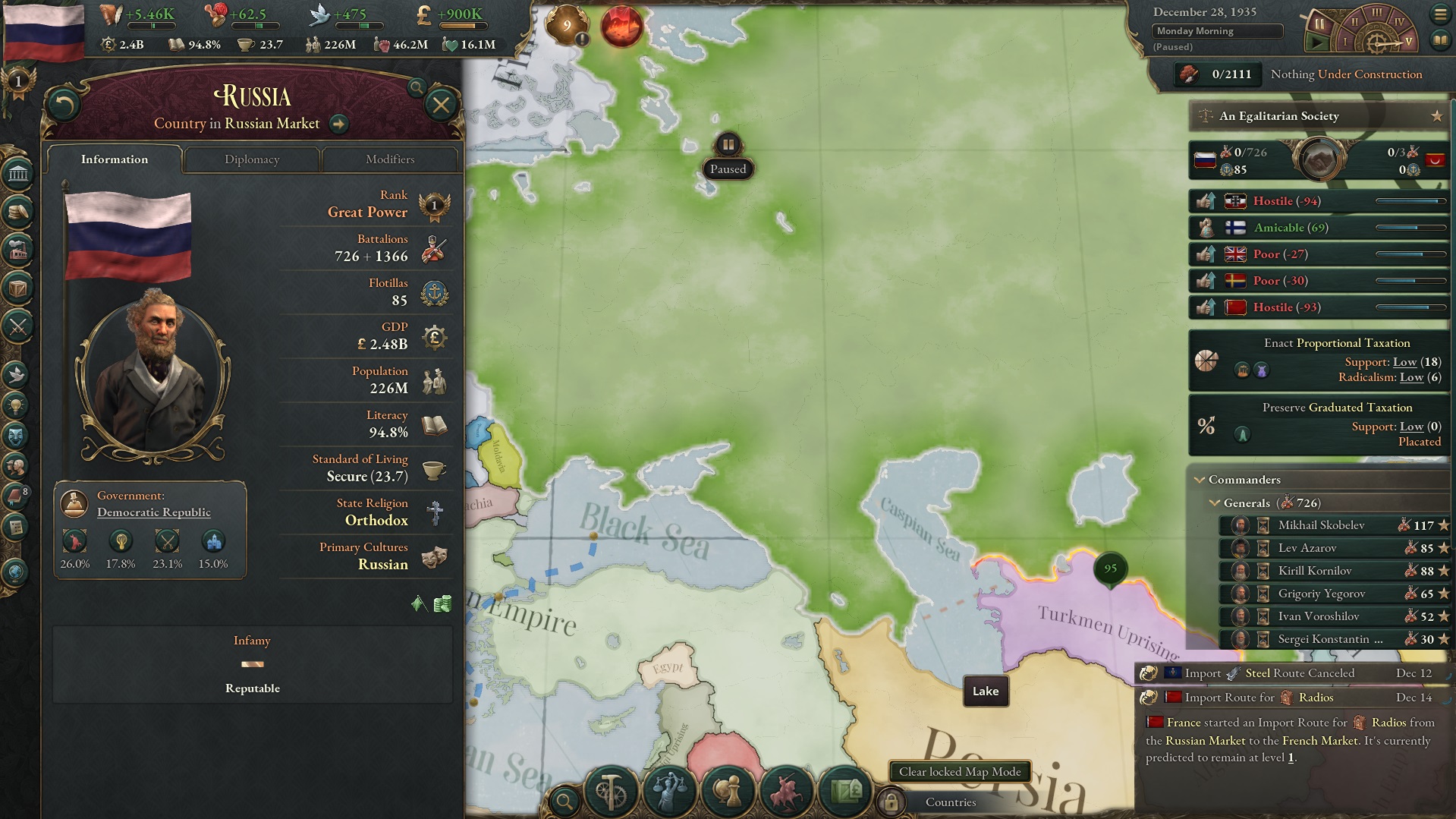
Rebellious Turkmens on the bottom right. And yes, the huge budget income is not at all because I managed to return the economy to its former glory. I simply introduced taxes on all types of services provided in the country...
If you haven't realized, Victoria 3 turned out to be a great game for me, otherwise I wouldn't have spent time writing all this. And a few more screenshots:
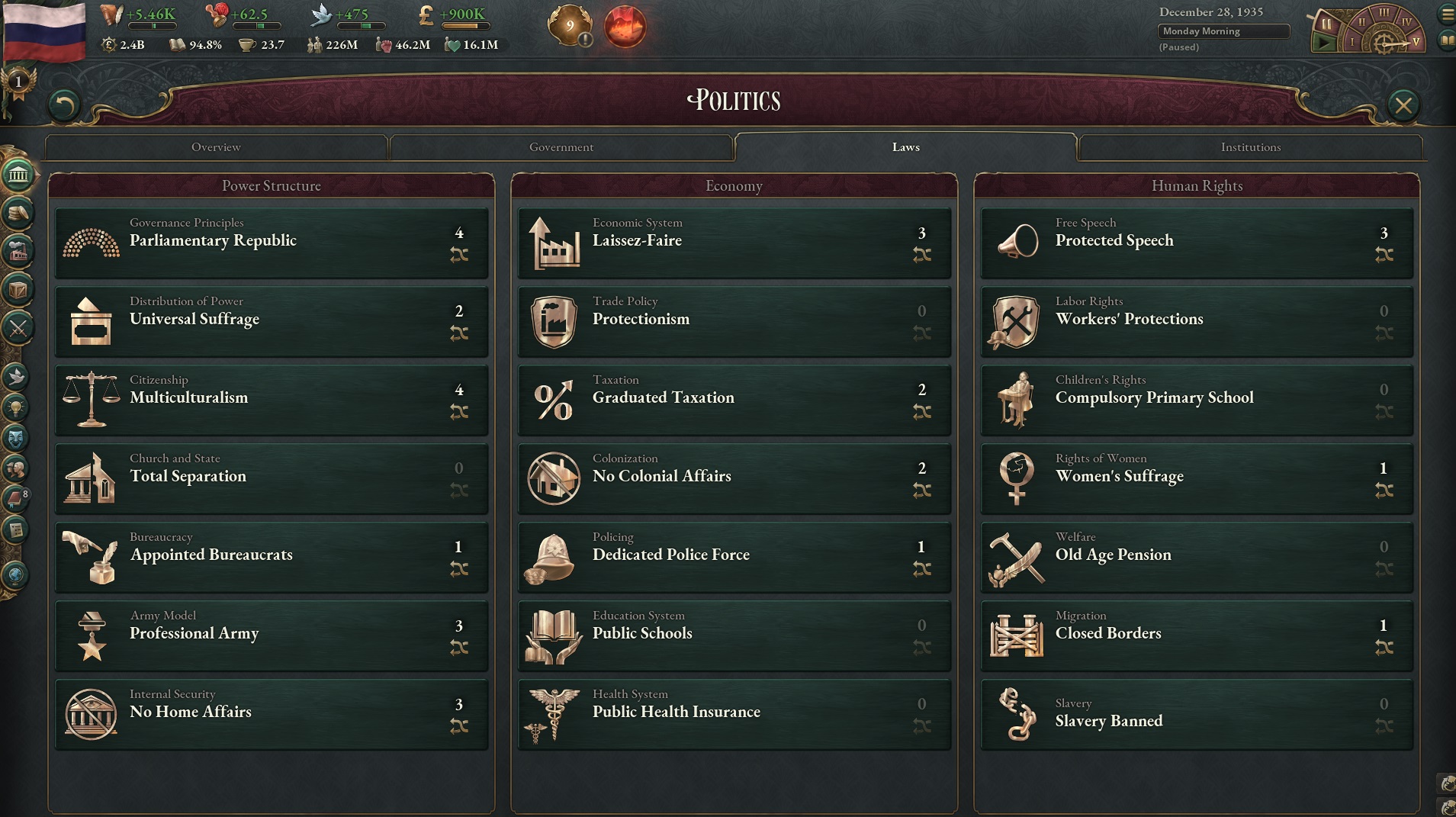
These are the laws. Everything is very liberal, but you may notice that I never reopened the borders for migrants.
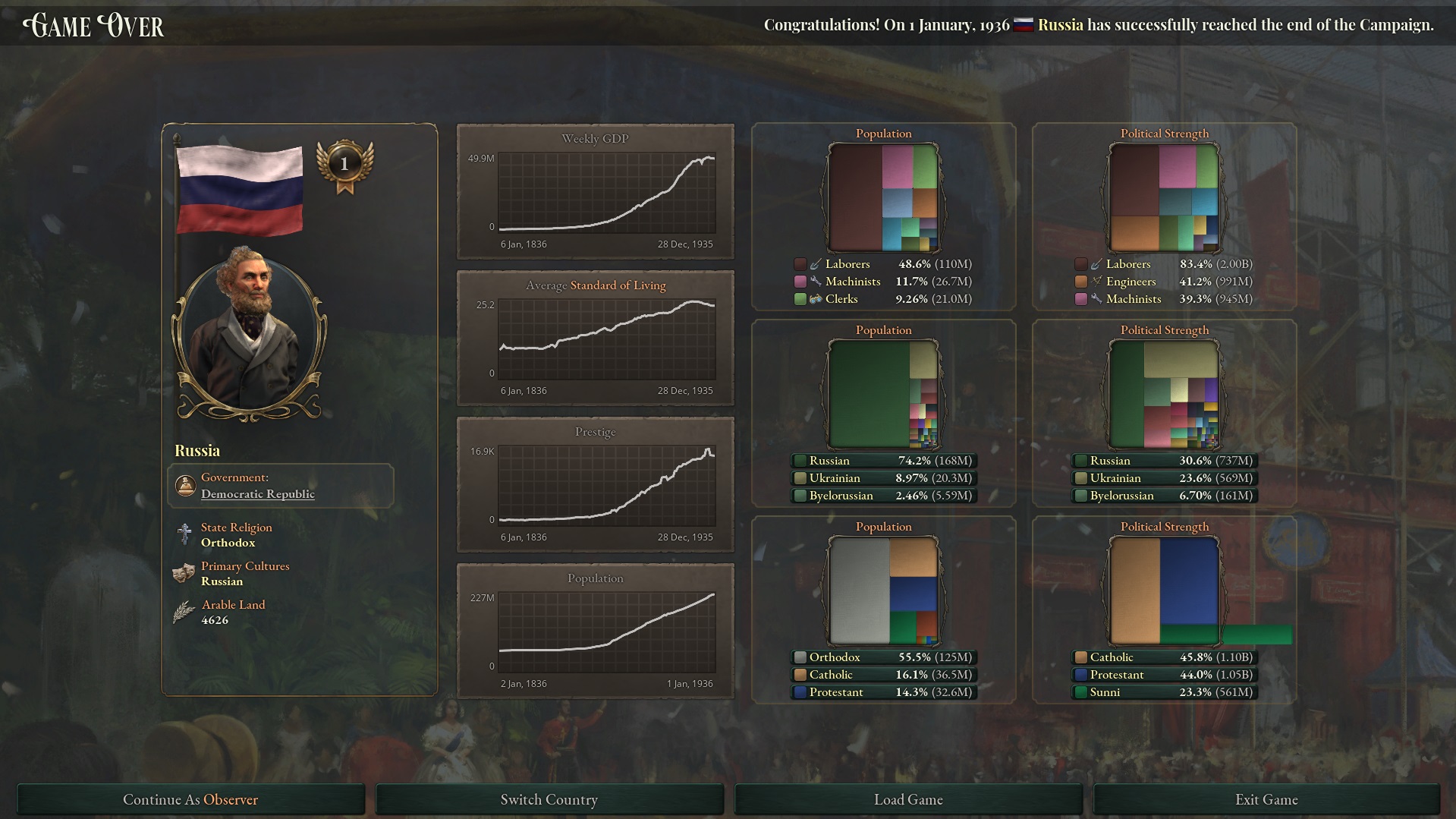
The final screen; it's important because it shows that the decline in standard of living and economic growth has begun, but it was so great before that.
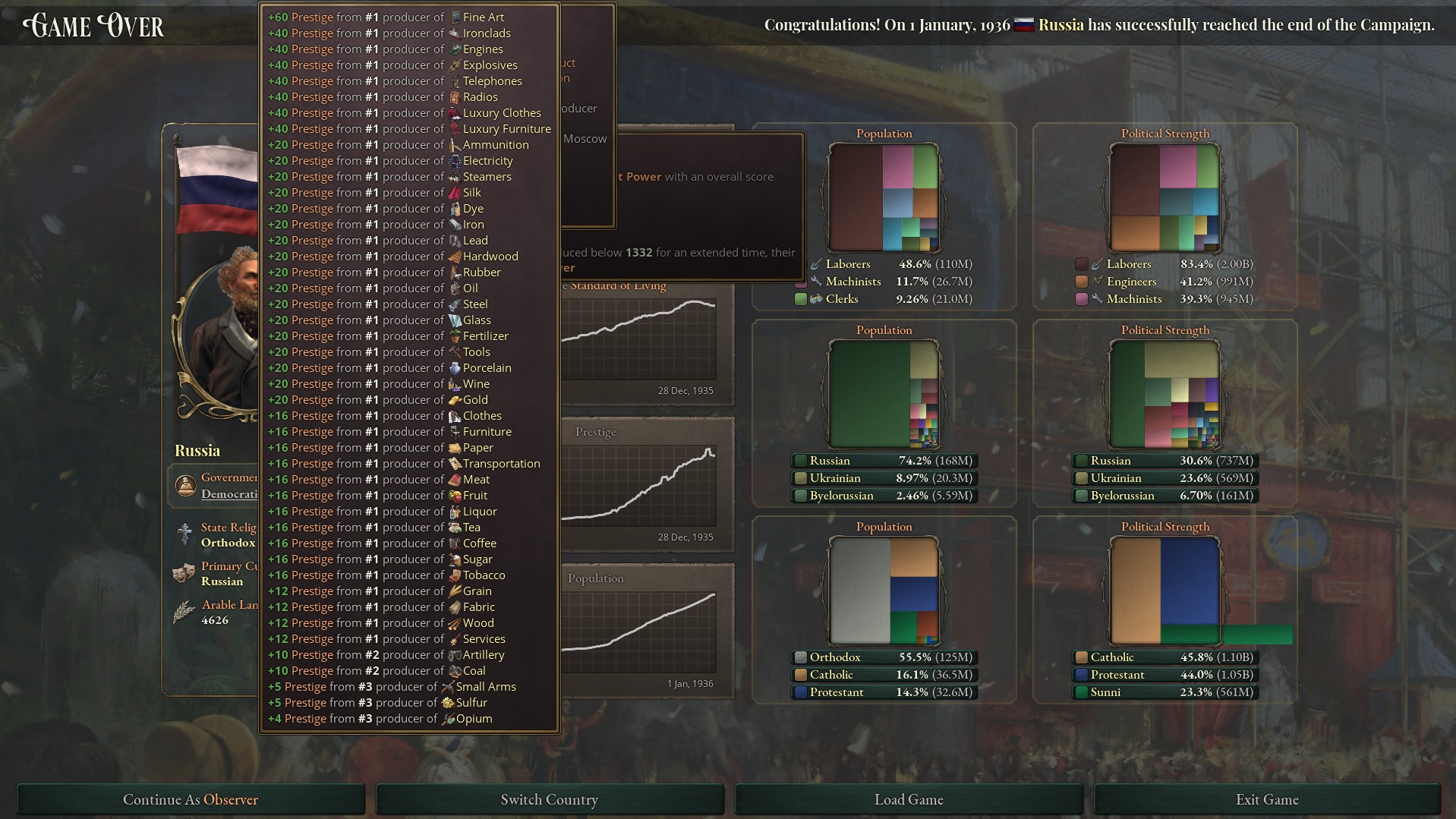
In this world, the meme phrase on goods is "Made in Russia".



 Happy Life