Лазурный дракон рабочий

Auto-translated
Town Name: Village.
Alignment: Good
State: Erathia (demand freedom)
Magic: None. Imagine a peasant casting Armageddon :) :smile08:
Main Enemies: Deyaa, Erathia.
Native Terrain: earth, grass.
Tactics: The town is characterized by weak (very weak!) units, but cheap construction and high growth. No magic - so it's not cheating! It's alright.
Creatures:
1. Peasant Dwelling: Izba

Well, this is an ordinary peasant.
Health 1, attack 1, defense 1, damage 1, speed 3. Properties: works (each worker in a mine garrison increases its productivity by +10%, rounded down, maximum productivity increase - three times).
1.5. Worker Dwelling: Izba-Reading Room
A more powerful peasant.
Health 2, attack 2, defense 1, damage 1-2, speed 5. Properties: Enemy does not retaliate, works
2. Halfling Dwelling: Reed Hut

Halflings are weaker Hobbits.
Damage 3-4, attack 4, defense 0, health 15, speed 8. Properties: shooter, works
2.5. Hobbit Dwelling: Hut

Hobbits are those who were neutrals. He is very strong.
Damage 4, attack 4, defense 0, health 17, speed 8. Properties: shooter, always good luck, works
2. alternative - Huntsman Dwelling: Forest
These are peasants hunting game. During battles, they shot crossbows at enemies. Damage 2-3, attack 3, defense 1, health 20, speed 8. Properties: taxpayer (every day the player receives 1 gold for each taxpayer in the army), Animal enemies (Centaurs, harpies, griffins, all dragons, Behemoths, Phoenixes, Leopards, Wyverns, gorgons, rocs,
scorpiaks, dogs, shepherds, horses, vasinkas etc.) take double damage, works
2.5 alternative. Hunter Dwelling: Clearing with a trap
Damage 2-4, attack 3, defense 1, health 21, speed 8. Properties: taxpayer (every day the player receives 1 gold for each taxpayer in the army), Animal enemies take double damage, works
3. Dog dwelling: Kennel
Simple dogs that guard settlements. They hate felines (Manticoras, Scorpiaks, Vasinkas). If you cross them with Hellhounds/Cerberi, you get a Fire Dog.
Damage 5, attack 6, defense 8, health 25, speed 4. Properties: coward (runs away instead of retaliating)
3.5. Shepherd dwelling: Telephone Booth
Damage 6, attack 6, defense 8, health 24, speed 5. Properties: coward
3. alternative Bandit Dwelling: Bandits' Lair

There were such people in the settlements too.
damage 2 - 4, attack 8, defense 6, health 24, speed 6 , properties: none
3.5 alternative Thief Dwelling: Thieves' Lair

damage 4, attack 8, defense 6, health 26, speed 6 , properties: Stealing (When capturing an enemy mine, a player with 10 thieves receives 1000 gold, with 20 thieves 2000 gold, and with 100 thieves 10000 gold, 5 ore and 5 wood; 1000 thieves - 10000 gold, 5 ore, 5 wood, 1 gem)
4 - Shepherd dwelling: khata

Damage 6-12, attack 10, defense 6, health 40, speed 5. Properties: cavalry bonus, works
4.5. Farmer dwelling: Zucchini Warehouse
No comments...
Damage 8-12, attack 10, defense 8, health 45, speed 8. Properties: cavalry bonus, works
4, alternative - Krigan-miner dwelling: mine
Everything is clear!
Damage 7-9, attack 10, defense 8, health 30, speed 7 Properties:
+ 1 ore per day, works
4.5 alternative - Krigan-shaft-miner dwelling: Shaft
Damage 8-10, attack 10, defense 8, health 34, speed 7 Properties: +7 ore and gems per week, works double.
5 - Wealthy Peasant dwelling: Skyscraper

A richer peasant.
Damage: 5-15, attack 8, defense 12, health 50, speed 5. Properties: enemy does not retaliate on attack; saves money (the amount of gold the player has at the start of a game day never falls below a value equal to the number of wealthy peasants in his army multiplied by one hundred; simply put - if on the sixth day you spent all your money, your daily income is 500 gold, but you have 9 wealthy peasants in your army - at the beginning of the seventh day you will have not 500, but 900 gold).
5.5. Kulak Dwelling: Destroyed skyscraper:smile17: :smile17:

Damage: 5-20, attack 8, defense 15, health 60, speed 7. Properties: enemy does not retaliate on attack; saves money.
5, alternative - Volkhv dwelling: Junkyard
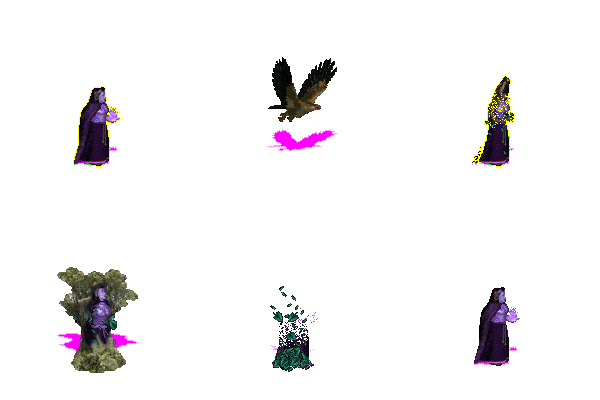
5.5 alternative. Herbalist dwelling: Garbage truck
Some were interested in herbs and magic. Magic didn't work out for them, but they know how to heal an ally and how to poison an enemy.
6 - Sheep
Damage: 10-23, attack 15, defense 12, health 60, speed 12. Properties: enemy does not retaliate on attack, works
6.5. Super-Sheep
Damage: 18-25, attack 16, defense 14, health 69, speed 12. Properties: enemy does not retaliate on attack, works, superhero (kills at least one creature in armies 1-6 of evil towns)
6, alternative - Sniper

Damage: 10-28, attack 13, defense 18, health 100, speed 5. Properties: works, shooter
6.5 alternative - Hardened Sniper
Damage: 15-30, attack 10, defense 23, health 150, speed 5. Properties: enemy does not work, shooter, double strike
7 - Defender of the People dwelling: Red Flag
Damage: 25-55, attack 22, defense 20, health 300, speed 9. Properties: double strike, shooter
7.5. Militiaman Dwelling: Communist Flag
Damage: 55-58, attack 32, defense 10, health 300, speed 9. Properties:
double damage, shooter
7, alternative - Cat dwelling: Cat Chair
Damage: 58, attack 38, defense 10, health 210, speed 10. Properties:
fly
7.5 alternative - Vasinka Dwelling: Vasinka's Chair
Damage: 60, attack 40, defense 20, health 250, speed 10. Properties: fly, 10% chance to eat enemy
Neutrals:
Level 6. Landowner
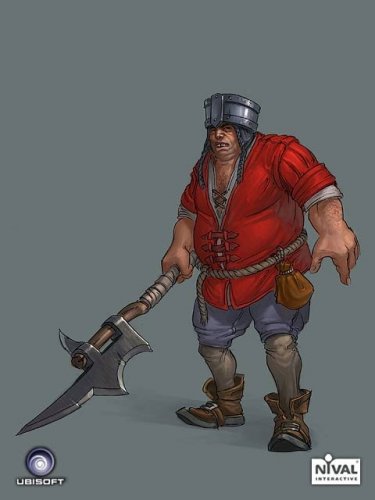
Damage: 7-23, attack 10, defense 15, health 60, speed 7. Properties: enemy does not retaliate on attack; saves money.
Level 8 - Guardian. Muzhik

Level 8, alternative Guardian - Catotitan
, how the Village differs from towns.
1. The Village does not save the player from seven-day death (after building the Administration aka Village hall it saves).
2. The Village has no fort (but there are structures that partially replace its functions). Accordingly, a siege of the village always takes place not on "native" ground, but on the corresponding territory where the village stands (reminder: battles for other towns without a fort take place "on site", and with a fort — on the native field of the castle, which is clear of obstacles).
3. The Village cannot appear as a random castle. Thus, if a player, starting the game, chose "random castle" as the starting castle, he will never start the game with a village. However, he can choose the Village from the list of towns (where it will occupy the last position) and intentionally start the game with it. This is done, firstly, because the Village gameplay-wise differs greatly from other castles (some maps may be impassable when starting as a Village), secondly, to emphasize its antagonism toward towns.
4. Each town corresponds to two classes of heroes — warrior and mage. The Village, due to underdeveloped magic (have you ever seen a peasant casting fireballs? Various strongholds can afford special battle mages, but our town is democratic, all heroes came from the people and fight for the benefit of the people), will have only one class of heroes: People.
5. The Village is characterized by extremely low prices for everything. A captured neutral Village will be an excellent secondary town, built up quickly and almost for free.
Village Buildings. Draft version.
Village Square.
Brings 250 gold per day. Can be upgraded to the Village Administration (there is no ordinary building screen; by clicking on the Village Square, the player receives an offer to build the Village Administration for 1250 gold). Adds several decorative houses to the town screen (between which the square itself is located).
Always built.
Village Administration.
Upgrade of the Village Square. Brings 500 gold per day. Allows building structures. Relieves the player from the seven-day limit. Increases the number of decorative houses.
Construction cost — 1250 gold (in accordance with general patterns). Requirements: Village Square.
Location on construction screen: first from left in top row.
Armory.
When defending the town, turns all Kulaks in the defending army into militiamen. After the battle, they return to their normal state.
Construction cost — 50000 gold, 18 wood, 20 ore.
Requirements: Smithy, Tavern, Khata.
Location on construction screen: first from left in top row.
Banya (Bathhouse).
Allows hiring the town guardian (Muzhik). Thus it performs a third of the Capitol's functionality (the other two thirds — increasing income and adding a third flag to the town; we don't need income, and there is nowhere to put a flag in my idea of the Village's appearance). Furthermore, since this is not a Capitol (although it takes its place), the rule "cannot build more than one Capitol" does not apply to the Banya — if desired, you can have a guardian in every village. However, this luxury is not cheap, and the daily income of the Village cannot be called large.
Construction cost — 10000 gold, 30 wood, 50 ore. Requirements: Absence of Celestial Cat Chair.
Location on construction screen: first from left in top row.
Celestial Cat Chair.
Allows hiring the town guardian (Catotitan). Thus it performs a third of the Capitol's functionality (the other two thirds — increasing income and adding a third flag to the town; we don't need income, and there is nowhere to put a flag in my idea of the Village's appearance). Furthermore, since this is not a Capitol (although it takes its place), the rule "cannot build more than one Capitol" does not apply to the Celestial Cat Chair — if desired, you can have a guardian in every village. However, this luxury is not cheap, and the daily income of the Village cannot be called large.
Construction cost — 10000 gold, 30 wood, 50 ore. Requirements: Absence of Banya.
Location on construction screen: first from left in top row.
Well.
Increases growth of all creatures in the town by 2. Clicking on the well opens the creature recruitment screen (which appears in towns when clicking on the fort and its upgrades).
Construction cost — 500 gold. Requirements: Village Administration.
Location on construction screen: second from left in top row.
Palisade.
When attacking a village, provides a defensive structure of the same name. The Palisade as a defensive structure is an analog of a moat; it is located exactly the same way (with the exception that it has a one-cell gap) as an ordinary (not "doubled", like in the Fortress) moat, just as it stops the movement of an enemy who falls into it, reduces its defense and deals damage. Appearance is identical to the Conflux moat (river). In the middle (on the line where gates are located in castles), it has a gap through which both attackers and defenders can pass; the width of the gap is one cell (meaning it can be simply plugged). The Palisade cannot be destroyed.
Construction cost — 2 wood, 1000 gold. Requirements: Well.
Location on construction screen: second from left in top row.
Gates.
If gates are built in the village, during the defense of the village, the hole in the middle of the palisade will be occupied by gates. They differ from ordinary castle gates in both appearance and properties. In terms of appearance: if ordinary castle gates look "vertical" and open by "falling" forward (forming a bridge), then our gates look quite low and open by sliding to the sides. On both sides they attach to the palisade. In terms of properties: they cannot be destroyed (neither by catapult, nor cyclopes, nor earthquake; if they could be destroyed, due to the absence of other destructible elements on the battlefield, this would happen on the first turn). Naturally, they open only for the defenders of the village. Thus, defenders can leave the town without hindrance (and enter it if necessary), while attacking infantry (flyers don't care) will have to go through the palisade with all the consequences. Unless, of course, the defenders are foolish enough to die in the opening of the open gates (blocking their closing).
Construction cost — 1000 gold. Requirements: Palisade.
Location on construction screen: second from left in top row.
Tavern.
Allows hiring heroes, learning rumors, increases defenders' morale by 1, provides thieves' guild services. Everything as usual.
Construction cost: 5 wood, 500 gold. Requirements: Village Administration.
Location on construction screen: third from left in top row.
Monolith
Upgrade of the Tavern. Possesses all its properties. Also possesses an additional property: During battle, you can flee to any town belonging to the defender :smile17: .
Construction cost: 5 wood, 500 gold. Requirements: Tavern.
Location on construction screen: third from left in top row.
Smithy.
Standard properties. Produces ballistas.
Construction cost: 5 wood, 1000 gold. Requirements: Village Administration, Well
Location on construction screen: fourth from left in top row.
Healer's House.
Allows buying first aid tents. Also protects the village from plague week (if this building is in the village, plague week does not affect growth).
Construction cost: 5 wood, 1500 gold, 1 crystal, 1 gem. Requirements: Smithy, Skyscraper or Junkyard, 5th chamber.
Location on construction screen: fourth from left in top row.
Market.
Standard properties.
Construction cost: 5 wood, 500 gold. Requirements: Village Administration.
Location on construction screen: first from left in second row.
Mill.
Every day brings the state one measure of that resource which is least in the treasury (except gold).
Construction cost: 10 wood, 10 ore, 5000 gold. Requirements: Market.
Location on construction screen: first from left in second row.
Fifth chamber:D :D .
Allows a hero to purchase a spellbook for 500 gold and adds level 1 spells to it. Also increases the morale of a guest hero by 1; effect lasts until the next battle.
Construction cost: 5 wood, 5 ore, 1 sulfur, 1 mercury, 1 crystal, 1 precious stone, 2000 gold. Requirements: Village Administration.
Location on construction screen: second from left in second row.
Seer's Hut.
Allows a guest hero to exchange experience for village creatures
Construction cost: 5 wood, 5 ore, 1 sulfur, 1 mercury, 1 crystal, 1 precious stone, 2000 gold. Requirements: Market.
Location on construction screen: first from left in third row.
Izba
Allows hiring peasants
Construction cost: 2 wood, 3 ore, 300 gold. Requirements: Village Administration
Izba Reading Room
Allows hiring Workers and upgrading Peasants to them.
Construction cost: 700 gold. Requirements: Izba, Reed Hut
Reed Hut:
Allows hiring Halflings
Construction cost: 1000 gold, 5 wood. Requirements:
Reed House:
Construction cost: 1000 gold
Allows hiring Hobbits
and so on....
Field.
Increases growth of shepherds/farmers by 4.
Construction cost: 2000 gold, 5 wood. Requirements: Khata.
Location on construction screen: second from left in third row.
Fruit Orchard.
Increases growth of halflings/hobbits by 50.
Construction cost: 1000 gold. Requirements: Reed Hut
Location on construction screen: third from left in third row.
marvel comics:
Increases growth of Peasants/Workers by 100 and Cats/Vasinkas by 3
cost: 1000 gold, 1 crystal requirements: Absence of Red Flag, Izba, Cat Chair
Grail - Cozy Cat Town. Summons 5 Vasinkas for the duration of the battle.
Alignment: Good
State: Erathia (demand freedom)
Magic: None. Imagine a peasant casting Armageddon :) :smile08:
Main Enemies: Deyaa, Erathia.
Native Terrain: earth, grass.
Tactics: The town is characterized by weak (very weak!) units, but cheap construction and high growth. No magic - so it's not cheating! It's alright.
Creatures:
1. Peasant Dwelling: Izba
Well, this is an ordinary peasant.
Health 1, attack 1, defense 1, damage 1, speed 3. Properties: works (each worker in a mine garrison increases its productivity by +10%, rounded down, maximum productivity increase - three times).
1.5. Worker Dwelling: Izba-Reading Room
A more powerful peasant.
Health 2, attack 2, defense 1, damage 1-2, speed 5. Properties: Enemy does not retaliate, works
2. Halfling Dwelling: Reed Hut
Halflings are weaker Hobbits.
Damage 3-4, attack 4, defense 0, health 15, speed 8. Properties: shooter, works
2.5. Hobbit Dwelling: Hut
Hobbits are those who were neutrals. He is very strong.
Damage 4, attack 4, defense 0, health 17, speed 8. Properties: shooter, always good luck, works
2. alternative - Huntsman Dwelling: Forest
These are peasants hunting game. During battles, they shot crossbows at enemies. Damage 2-3, attack 3, defense 1, health 20, speed 8. Properties: taxpayer (every day the player receives 1 gold for each taxpayer in the army), Animal enemies (Centaurs, harpies, griffins, all dragons, Behemoths, Phoenixes, Leopards, Wyverns, gorgons, rocs,
scorpiaks, dogs, shepherds, horses, vasinkas etc.) take double damage, works
2.5 alternative. Hunter Dwelling: Clearing with a trap
Damage 2-4, attack 3, defense 1, health 21, speed 8. Properties: taxpayer (every day the player receives 1 gold for each taxpayer in the army), Animal enemies take double damage, works
3. Dog dwelling: Kennel
Simple dogs that guard settlements. They hate felines (Manticoras, Scorpiaks, Vasinkas). If you cross them with Hellhounds/Cerberi, you get a Fire Dog.
Damage 5, attack 6, defense 8, health 25, speed 4. Properties: coward (runs away instead of retaliating)
3.5. Shepherd dwelling: Telephone Booth
Damage 6, attack 6, defense 8, health 24, speed 5. Properties: coward
3. alternative Bandit Dwelling: Bandits' Lair
There were such people in the settlements too.
damage 2 - 4, attack 8, defense 6, health 24, speed 6 , properties: none
3.5 alternative Thief Dwelling: Thieves' Lair
damage 4, attack 8, defense 6, health 26, speed 6 , properties: Stealing (When capturing an enemy mine, a player with 10 thieves receives 1000 gold, with 20 thieves 2000 gold, and with 100 thieves 10000 gold, 5 ore and 5 wood; 1000 thieves - 10000 gold, 5 ore, 5 wood, 1 gem)
4 - Shepherd dwelling: khata
Damage 6-12, attack 10, defense 6, health 40, speed 5. Properties: cavalry bonus, works
4.5. Farmer dwelling: Zucchini Warehouse
No comments...
Damage 8-12, attack 10, defense 8, health 45, speed 8. Properties: cavalry bonus, works
4, alternative - Krigan-miner dwelling: mine
Everything is clear!
Damage 7-9, attack 10, defense 8, health 30, speed 7 Properties:
+ 1 ore per day, works
4.5 alternative - Krigan-shaft-miner dwelling: Shaft
Damage 8-10, attack 10, defense 8, health 34, speed 7 Properties: +7 ore and gems per week, works double.
5 - Wealthy Peasant dwelling: Skyscraper
A richer peasant.
Damage: 5-15, attack 8, defense 12, health 50, speed 5. Properties: enemy does not retaliate on attack; saves money (the amount of gold the player has at the start of a game day never falls below a value equal to the number of wealthy peasants in his army multiplied by one hundred; simply put - if on the sixth day you spent all your money, your daily income is 500 gold, but you have 9 wealthy peasants in your army - at the beginning of the seventh day you will have not 500, but 900 gold).
5.5. Kulak Dwelling: Destroyed skyscraper:smile17: :smile17:
Damage: 5-20, attack 8, defense 15, health 60, speed 7. Properties: enemy does not retaliate on attack; saves money.
5, alternative - Volkhv dwelling: Junkyard
5.5 alternative. Herbalist dwelling: Garbage truck
Some were interested in herbs and magic. Magic didn't work out for them, but they know how to heal an ally and how to poison an enemy.
6 - Sheep
Damage: 10-23, attack 15, defense 12, health 60, speed 12. Properties: enemy does not retaliate on attack, works
6.5. Super-Sheep
Damage: 18-25, attack 16, defense 14, health 69, speed 12. Properties: enemy does not retaliate on attack, works, superhero (kills at least one creature in armies 1-6 of evil towns)
6, alternative - Sniper
Damage: 10-28, attack 13, defense 18, health 100, speed 5. Properties: works, shooter
6.5 alternative - Hardened Sniper
Damage: 15-30, attack 10, defense 23, health 150, speed 5. Properties: enemy does not work, shooter, double strike
7 - Defender of the People dwelling: Red Flag
Damage: 25-55, attack 22, defense 20, health 300, speed 9. Properties: double strike, shooter
7.5. Militiaman Dwelling: Communist Flag
Damage: 55-58, attack 32, defense 10, health 300, speed 9. Properties:
double damage, shooter
7, alternative - Cat dwelling: Cat Chair
Damage: 58, attack 38, defense 10, health 210, speed 10. Properties:
fly
7.5 alternative - Vasinka Dwelling: Vasinka's Chair
Damage: 60, attack 40, defense 20, health 250, speed 10. Properties: fly, 10% chance to eat enemy
Neutrals:
Level 6. Landowner
Damage: 7-23, attack 10, defense 15, health 60, speed 7. Properties: enemy does not retaliate on attack; saves money.
Level 8 - Guardian. Muzhik
Level 8, alternative Guardian - Catotitan
, how the Village differs from towns.
1. The Village does not save the player from seven-day death (after building the Administration aka Village hall it saves).
2. The Village has no fort (but there are structures that partially replace its functions). Accordingly, a siege of the village always takes place not on "native" ground, but on the corresponding territory where the village stands (reminder: battles for other towns without a fort take place "on site", and with a fort — on the native field of the castle, which is clear of obstacles).
3. The Village cannot appear as a random castle. Thus, if a player, starting the game, chose "random castle" as the starting castle, he will never start the game with a village. However, he can choose the Village from the list of towns (where it will occupy the last position) and intentionally start the game with it. This is done, firstly, because the Village gameplay-wise differs greatly from other castles (some maps may be impassable when starting as a Village), secondly, to emphasize its antagonism toward towns.
4. Each town corresponds to two classes of heroes — warrior and mage. The Village, due to underdeveloped magic (have you ever seen a peasant casting fireballs? Various strongholds can afford special battle mages, but our town is democratic, all heroes came from the people and fight for the benefit of the people), will have only one class of heroes: People.
5. The Village is characterized by extremely low prices for everything. A captured neutral Village will be an excellent secondary town, built up quickly and almost for free.
Village Buildings. Draft version.
Village Square.
Brings 250 gold per day. Can be upgraded to the Village Administration (there is no ordinary building screen; by clicking on the Village Square, the player receives an offer to build the Village Administration for 1250 gold). Adds several decorative houses to the town screen (between which the square itself is located).
Always built.
Village Administration.
Upgrade of the Village Square. Brings 500 gold per day. Allows building structures. Relieves the player from the seven-day limit. Increases the number of decorative houses.
Construction cost — 1250 gold (in accordance with general patterns). Requirements: Village Square.
Location on construction screen: first from left in top row.
Armory.
When defending the town, turns all Kulaks in the defending army into militiamen. After the battle, they return to their normal state.
Construction cost — 50000 gold, 18 wood, 20 ore.
Requirements: Smithy, Tavern, Khata.
Location on construction screen: first from left in top row.
Banya (Bathhouse).
Allows hiring the town guardian (Muzhik). Thus it performs a third of the Capitol's functionality (the other two thirds — increasing income and adding a third flag to the town; we don't need income, and there is nowhere to put a flag in my idea of the Village's appearance). Furthermore, since this is not a Capitol (although it takes its place), the rule "cannot build more than one Capitol" does not apply to the Banya — if desired, you can have a guardian in every village. However, this luxury is not cheap, and the daily income of the Village cannot be called large.
Construction cost — 10000 gold, 30 wood, 50 ore. Requirements: Absence of Celestial Cat Chair.
Location on construction screen: first from left in top row.
Celestial Cat Chair.
Allows hiring the town guardian (Catotitan). Thus it performs a third of the Capitol's functionality (the other two thirds — increasing income and adding a third flag to the town; we don't need income, and there is nowhere to put a flag in my idea of the Village's appearance). Furthermore, since this is not a Capitol (although it takes its place), the rule "cannot build more than one Capitol" does not apply to the Celestial Cat Chair — if desired, you can have a guardian in every village. However, this luxury is not cheap, and the daily income of the Village cannot be called large.
Construction cost — 10000 gold, 30 wood, 50 ore. Requirements: Absence of Banya.
Location on construction screen: first from left in top row.
Well.
Increases growth of all creatures in the town by 2. Clicking on the well opens the creature recruitment screen (which appears in towns when clicking on the fort and its upgrades).
Construction cost — 500 gold. Requirements: Village Administration.
Location on construction screen: second from left in top row.
Palisade.
When attacking a village, provides a defensive structure of the same name. The Palisade as a defensive structure is an analog of a moat; it is located exactly the same way (with the exception that it has a one-cell gap) as an ordinary (not "doubled", like in the Fortress) moat, just as it stops the movement of an enemy who falls into it, reduces its defense and deals damage. Appearance is identical to the Conflux moat (river). In the middle (on the line where gates are located in castles), it has a gap through which both attackers and defenders can pass; the width of the gap is one cell (meaning it can be simply plugged). The Palisade cannot be destroyed.
Construction cost — 2 wood, 1000 gold. Requirements: Well.
Location on construction screen: second from left in top row.
Gates.
If gates are built in the village, during the defense of the village, the hole in the middle of the palisade will be occupied by gates. They differ from ordinary castle gates in both appearance and properties. In terms of appearance: if ordinary castle gates look "vertical" and open by "falling" forward (forming a bridge), then our gates look quite low and open by sliding to the sides. On both sides they attach to the palisade. In terms of properties: they cannot be destroyed (neither by catapult, nor cyclopes, nor earthquake; if they could be destroyed, due to the absence of other destructible elements on the battlefield, this would happen on the first turn). Naturally, they open only for the defenders of the village. Thus, defenders can leave the town without hindrance (and enter it if necessary), while attacking infantry (flyers don't care) will have to go through the palisade with all the consequences. Unless, of course, the defenders are foolish enough to die in the opening of the open gates (blocking their closing).
Construction cost — 1000 gold. Requirements: Palisade.
Location on construction screen: second from left in top row.
Tavern.
Allows hiring heroes, learning rumors, increases defenders' morale by 1, provides thieves' guild services. Everything as usual.
Construction cost: 5 wood, 500 gold. Requirements: Village Administration.
Location on construction screen: third from left in top row.
Monolith
Upgrade of the Tavern. Possesses all its properties. Also possesses an additional property: During battle, you can flee to any town belonging to the defender :smile17: .
Construction cost: 5 wood, 500 gold. Requirements: Tavern.
Location on construction screen: third from left in top row.
Smithy.
Standard properties. Produces ballistas.
Construction cost: 5 wood, 1000 gold. Requirements: Village Administration, Well
Location on construction screen: fourth from left in top row.
Healer's House.
Allows buying first aid tents. Also protects the village from plague week (if this building is in the village, plague week does not affect growth).
Construction cost: 5 wood, 1500 gold, 1 crystal, 1 gem. Requirements: Smithy, Skyscraper or Junkyard, 5th chamber.
Location on construction screen: fourth from left in top row.
Market.
Standard properties.
Construction cost: 5 wood, 500 gold. Requirements: Village Administration.
Location on construction screen: first from left in second row.
Mill.
Every day brings the state one measure of that resource which is least in the treasury (except gold).
Construction cost: 10 wood, 10 ore, 5000 gold. Requirements: Market.
Location on construction screen: first from left in second row.
Fifth chamber:D :D .
Allows a hero to purchase a spellbook for 500 gold and adds level 1 spells to it. Also increases the morale of a guest hero by 1; effect lasts until the next battle.
Construction cost: 5 wood, 5 ore, 1 sulfur, 1 mercury, 1 crystal, 1 precious stone, 2000 gold. Requirements: Village Administration.
Location on construction screen: second from left in second row.
Seer's Hut.
Allows a guest hero to exchange experience for village creatures
Construction cost: 5 wood, 5 ore, 1 sulfur, 1 mercury, 1 crystal, 1 precious stone, 2000 gold. Requirements: Market.
Location on construction screen: first from left in third row.
Izba
Allows hiring peasants
Construction cost: 2 wood, 3 ore, 300 gold. Requirements: Village Administration
Izba Reading Room
Allows hiring Workers and upgrading Peasants to them.
Construction cost: 700 gold. Requirements: Izba, Reed Hut
Reed Hut:
Allows hiring Halflings
Construction cost: 1000 gold, 5 wood. Requirements:
Reed House:
Construction cost: 1000 gold
Allows hiring Hobbits
and so on....
Field.
Increases growth of shepherds/farmers by 4.
Construction cost: 2000 gold, 5 wood. Requirements: Khata.
Location on construction screen: second from left in third row.
Fruit Orchard.
Increases growth of halflings/hobbits by 50.
Construction cost: 1000 gold. Requirements: Reed Hut
Location on construction screen: third from left in third row.
marvel comics:
Increases growth of Peasants/Workers by 100 and Cats/Vasinkas by 3
cost: 1000 gold, 1 crystal requirements: Absence of Red Flag, Izba, Cat Chair
Grail - Cozy Cat Town. Summons 5 Vasinkas for the duration of the battle.