

Skip to content

Posts from Player rating for tournaments across all installments of Heroes.

5.0 (1 rating)
Open
Which rating system should I choose? (see the text for details)
33 voters
Single choice
Sign in to participate in this poll.
Poll results will be visible after you vote or when the poll closes.
User Avatar
Auto-translated
And the overall rating for Odenerochka:
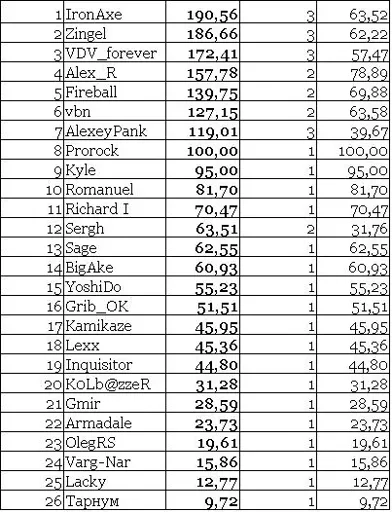
Attachments 1
1 file attached • Total size: 39.8 KB
User Avatar
Auto-translated
Basically, here's what I've done!

I used the following formula for positioning: X(i) = K * X(i-1), where X is the rating, i is the position, and K is the non-linearity coefficient K = 0.98 - 2.8/n, where n is the number of participants. I plan to reduce the constant 3.5 to make the parameter change more gradual.
The formula for the result is: Y = Rb/Rp * 100, where Y is the rating, Rb is the best result, and Rp is the result of the current participant.
Overall rating: P = (X * 3 + Y * 7) / 10
User Avatar
Auto-translated
You know, Kamikaze, it's hard to say how objective your rating is (as with all the others), and I won't even argue that this system is the most complex and confusing (remember how people reacted to even simpler formulas). The main point is that the system is full of coefficients pulled out of thin air, which cannot be understood or explained. 3 to 7, 2.8, 3.5, 0.98 – it's awful. It's just a set of numbers that you use to adjust the behavior of the curve to what you consider optimal. They have no physical meaning. In mathematical terms, when, looking at the results of a tournament, you mentally assign a certain rating to them using your own system of values, it's said that a grid function is defined (its values are known at certain points). Then you solve an approximation problem. So, why bother? With such a large number of arbitrary coefficients, you can achieve almost the same accuracy as when launching a rocket using standard splines or Runge-Kutta coefficients, etc. But there will be little logic in such a rating, and a lot of your personal worldview. Let's wait for the administration's decision: will they use the existing system, announce a competition, or choose their own? But what you are proposing now, in my opinion, is absolutely not viable.
User Avatar
Auto-translated
Yes, I simply adjusted the coefficients to favor the most loyal factions, emphasizing the superiority of the leaders. In my opinion, this is simple and correct. But thank you for your opinion. ;)
User Avatar
Auto-translated
I think you've read the previous discussions, so you know that I support the idea of rewarding first-place finishes. I understand the logic you used, although the implementation could be simpler. But it all comes down to personal opinion. I believe that the importance of a player's placement in a tournament should be high; otherwise, the influence of the map becomes too strong. We don't need to look far for an example; consider the 6th stage of the World Cup. Differentiating participants only by the day they played was definitely foolish because the map was very simple and fast. As a result, we got very close results, and this was not due to the high level of the participants (half of them had played only 1-2 times in their lives), but rather to the conditions on the map. And Topor suggests ignoring placement altogether. Therefore
User Avatar
Auto-translated
I propose two options for calculating the rating, both of which are strict and fair. First, let's look at the general principles of their calculation: R(i) = R(n) + R(l) + R(b), where R(i) is the player's rating, R(n) is the non-linear rating, R(l) is the linear rating, and R(b) is the bonus rating. The non-linear rating is calculated using the formula proposed by IronAxe: R(n) = 100 * n(1) / n(i), where n(1) is the result of the first place, and n(i) is the player's result. The linear rating is calculated using the modified formula proposed by AmberSoler: R(l) = 25 - 25 / (m(l) - 1) * (m(i) - 1), where m(l) is the last place in the tournament, and m(i) is the player's place. The number 25 was chosen after analyzing all the tournaments. In my opinion, the linear component of the rating should not be more than 1/4 of the non-linear component. However, these numbers can be debated. In total, the maximum rating for these two components is 125 points. Now, let's move on to the bonus. For its calculation, I propose two options: 1. R(b) = R(tr) / R(iSr) * R(l) * k, where R(tr) is the actual tournament rating, equal to the average non-linear rating of the tournament, R(iSr) is the average non-linear rating of the player, R(l) is the linear rating, and k = R(tr) / R(tp) is the tournament coefficient, and R(tp) is the expected tournament rating, equal to the average rating of all participants in the tournament. This rating option takes into account the strength of the tournament and the previous results of the players, i.e., a player with a lower average rating receives a higher bonus in the tournament. This allows compensating for the difference between the non-linear rating and the other two. 2. R(b) = k * R(l), where k is the tournament coefficient (see the previous formula), and R(l) is the linear rating. This formula is simpler but does not take into account the player's previous results. In addition, to increase the rating for official tournaments, coefficients for the bonus rating can be introduced, as proposed by VDV_forever for the Grail tournaments: 1.4 for ВК tournaments and 1.6 for ВоВ tournaments. I am attaching tables with calculations for all tournaments for Heroes 1 and 2.
Attachments 1
1 file attached • Total size: 23.7 KB
Мы спасемся? Я не знаю. Верьте...
Геройский Интернационал
Клан Homo homini - основатель клана
Член РКСМ с 07.07.07.
ФЛУДОВСКИЕ ССЫЛКИ!- сообщить о бесполезной теме/сообщении.
User Avatar
Auto-translated
The linear rating is calculated using the modified formula of the respected AmberSoler: R(l)=25-25/(m(l)-1)*(m(i)-1), where m(l) is the last place in the tournament, and m(i) is the player's place. The number 25 was chosen after analyzing all the tournaments. In my opinion, the linear component of the rating should not be more than 1/4 of the nonlinear component. But we can argue about these numbers.
Let's consider an example that I couldn't provide until a week ago, so as not to violate the tournament rules – Stage 6 of the VK.
The proposed map turned out to be very easy due to the abundance of starting and joining forces. On such a map, the place taken is the main factor, since it is impossible to differentiate based on the number of days.
The distribution by days is approximately as follows: 7 days – excellent completion, 8 – good, 9 – also not bad, 10 – let's say, average (and let some participants forgive me). Why 10 – because it is from this result that the lower half of the table begins; completing the game in 10 days is easy and straightforward, for example, with 2 boats and one runner, although, if you're lucky, you can get 9.
Objectively, on a 100-point scale, a completion in 10 days (for your level) deserves about 50 points; those with a higher place get a little more, and those with a lower place get less. But what happens if the days and the place are related in a 4 to 1 ratio? It's quite a mess.

Now, a bonus.
1. R(b)=R(tr)/R(iSr)*R(l)*k, where R(tr)
I've already said that a person shouldn't suffer because they completed the previous tournament well, but you stubbornly disagree. As a result, let's look again at Stage 6 of the VK. Romanuel, vbn, and Fireball showed very similar completions. Only vbn didn't take the +2 magic artifact and didn't focus on one parameter. I chose the artifact, but ignored one parameter, although I knew it was possible. Romanuel did everything perfectly. AlexR's completion is better conceptually, more precise and accurate. But in the rating, he is only in 2nd place!!! And only because Romanuel did not participate in Stage 1??? Although, ideally, Alex should have a good lead. It's some kind of nonsense.
2. R(b)=k*R(l),
Perhaps this is better than the first option, but it's still not quite right. If the ratings reflect the real strength and the maps are not too easy for the participants, then the coefficient k will always be quite close to one (that's how you defined it). That is, this is only formally a bonus, and in reality, the ratio of the linear and nonlinear ratings from 1 to 4 will become 1 to 2. In short, this is clearly not a bonus.

Summary. Looking at your two proposals, the Kamikaze system, and the 6 stages of the VK, an ordinary forum user (assuming he has good attention and logic) should exclaim:
"Long live the oscillator!!!"
In reply to Fireball
User Avatar
Auto-translated
Fireball;105332
I think you've read the previous discussions, so you know that I support the idea of rewarding first-place finishes. I understand the logic you used, although the implementation could be simpler.
But it all comes down to personal opinion. I believe that the role of placement in a tournament should be significant; otherwise, the influence of the map becomes too strong. You don't have to look far for an example; consider the 6th stage of the World Championship. Differentiating participants only by the day they played was definitely a bad idea because the map was very simple and fast. As a result, the results were very close, and this was not due to the high level of the participants (half of them had played only 1-2 times in their lives), but rather to the conditions on the map. And Topor suggests ignoring placement altogether.
Therefore, the rating should be based more on logic and less on coefficients (i.e., personal perception).
At the beginning of my arguments, I explained that I am providing this information so that others can help optimize it. I believe that a 3 to 7 ratio is optimal, but you think otherwise. I'm ready to listen to how you would compare them. :)
And the sixth stage was still a special case.

Added after 22 minutes
AlexeyPank;105375
I propose two options for calculating the rating, both of which are strict and fair.
What is unclear is that the ratings of leaders in different tournaments differ from each other.
User Avatar
Auto-translated
I believe a 3 to 7 ratio is optimal, but you don't think so. I'm open to hearing how you would balance them.
And the sixth stage is still a special case.
Any tournament is a special case, but these special cases create the overall picture.
Logically, the role of days should be greater in tournaments with large gaps in scores, while the role of placement should be greater for closely contested results. How many tournaments with large gaps have there been recently – only one, and how many with close results? Almost all the others, especially the 6th stage of the World Cup and the tournament for trios (where there will almost always be a close competition). It turns out that the role of placement should be key more often, purely based on practice. And therefore, the contribution for placement should be no less than for days, and it also greatly increases competitive interest.
Currently, I believe a 1 to 1 ratio is optimal. Moreover, with the development of the portal (i.e., the accumulation of tournament experience by its participants), the results will only become closer, especially in the leading group. Otherwise, we might have to allocate 70% of the rating to placement.
In reply to Fireball
User Avatar
Auto-translated
Fireball;105438
Any tournament is a specific case, but these specific cases form the overall picture.
Logically, the role of days should be greater in tournaments with large gaps between scores, while the role of placement should be greater for closely contested results. How many tournaments with large gaps have there been recently – only one, and how many with closely contested results? Almost all the others, especially stage 6 of the World Cup and the tournament for trios (where there will almost always be a close contest). It turns out that the role of placement should be key more often, purely based on experience. And therefore, the contribution for placement should be no less than for days, and this also greatly increases competitive interest.
Currently, I believe that a 1:1 ratio is optimal. Moreover, with the development of the portal (i.e., the accumulation of tournament experience by its participants), the results will only become more closely contested, especially in the leading group. Otherwise, we might have to allocate 70% of the rating to placement.
Dear participants, please share your thoughts on this matter. In the meantime, I will present the rating tables with a 3:7 ratio for your consideration.
In reply to Fireball
User Avatar
Auto-translated
Fireball;105401
Let's consider an example that until a week ago I couldn't provide without violating the rules of the tournament, Stage 6 of the VK.
The proposed map turned out to be very easy due to an excess of starting and joining forces. On such a map, the primary factor is the place taken, since it's impossible to differentiate based on days.
The distribution by days is roughly as follows: 7 days - a great Walkthrough, 8 - good, 9 - also decent, 10 - let's say, average (may some participants forgive me). Why 10? Because the bottom half of the table starts exactly from this result; a Walkthrough in 10 days is achieved immediately and without problems, for example, with 2 boats and one runner, although if you're very lucky, you can get 9.
Objectively, on a 100-point scale, a Walkthrough in 10 days (for one's level) deserves about 50 points; those with a higher place get slightly more, those with a lower place get less. But what happens if days and place are correlated 4 to 1? That's a huge blunder.
The actual strength of a player is still reflected by the number of days. Parameters, mercury—these all undoubtedly reflect the player's strength. But! This only reflects their logistics skills and attentiveness. This, of course, matters, but it is not the deciding factor. If a player can complete the map in time, trailing the leader by 1-2 days, then it's not significant if they forgot to pick up a mercury flask in the process. Therefore, the player's strength rating should be determined primarily by the time indicator. The place in the tournament reflects only one aspect of the player's strength, nothing more. For example, in this tournament, I followed a tactic where I could have achieved 8 days. But due to a lack of time, I couldn't time it so that the computers didn't wander off too far. Yet, by the eighth day, I took all the Castles. It turns out that if the determining parameter is the place, I am penalized for a lack of time to play. Isn't that a blunder?
Fireball;105401
Now for the bonus.

I already said that a person should not suffer from the fact that they normally completed the previous tournament, but you stubbornly disagree. In the end, let's look again at Stage 6 of the VK. Romanuel, vbn, and Fireball showed very similar Walkthroughs. Only vbn didn't take the +2 spellcasting artifact and didn't bother polishing one parameter. I picked up the artifact but ignored one parameter, even though I knew it was possible. Romanuel did everything cleanly. AlexR's Walkthrough is conceptually better, more precise and careful. But in the rankings, he is only in 2nd place!!! And only because Romanuel did not participate in Stage 1???!!! Although, ideally, Alex should have a decent lead. This is turning into some kind of nonsense.
As I already mentioned, the system is taken from tennis. A person with a lower average rating, i.e., a potential outsider, receives a larger bonus specifically because they played better than expected. In terms of tournament placement, they trail the leader, who was expected to win. But for surpassing themselves, they receive a higher rating. Although, you should have noticed one peculiarity. A newcomer to the tournament has strength (in this case) at 2/5 of the maximum (100 points), i.e., 40 points. The esteemed AmberSoler suggested making this indicator 30% overall. If we assume that a newcomer has strength at 50% of the maximum (as I assumed from the start), the indicator changes sharply. See the attached file.
Fireball;105401
Perhaps better than option 1, but still not quite right. If the ratings reflect actual strength to any extent and the maps are not too simple for the participants, then the k coefficient will always be quite close to one (since that's how you defined it). That is, it's only a bonus formally, while in reality, the ratio of linear and non-linear ratings will change from 1 to 4 to 1 to 2. In short, this is obviously not a bonus at all.
This option is specifically for those who are dissatisfied with the "punishment" for previous performances. Essentially, it was created specifically to give bonuses for the strength of the tournament (if players perform worse than they could, they receive a smaller bonus).
Fireball;105401

Summary. Looking at your 2 proposals, the Kamikaze system, and the 6 stages of the VK, the average forum user (provided their attentiveness and logic are fine) should exclaim:
"Long live the oscillator!!!"
The oscillator does not reflect:
1 - The strength of the tournament.
2 - The strength of the players based on the results of their previous games.
Attachments 1
1 file attached • Total size: 12.0 KB
Мы спасемся? Я не знаю. Верьте...
Геройский Интернационал
Клан Homo homini - основатель клана
Член РКСМ с 07.07.07.
ФЛУДОВСКИЕ ССЫЛКИ!- сообщить о бесполезной теме/сообщении.
User Avatar
Auto-translated
The real strength of a player is still reflected in the number of days. Parameters, mercury – all of this certainly reflects the player's strength. But! This only reflects their skills in logistics and attention to detail. This is, of course, important, but not decisive.
Logistics and attention to detail are absolutely crucial in a tournament, very often accounting for about 90 percent. The rest is luck and a couple of tricks in battles. How many difficult battles did you have in stage 6? I had 0.
If a player can complete a map within 1-2 days of the leader, it's not significant that they forgot to pick up a mercury vial. Therefore, the player's strength rating should be determined primarily by the time taken.
On different maps, the same difference in skill will result in a different difference in days and their ratio. AlexR's walkthrough is 2-3 times better than a 10-day one, but the ratio in days is only 0.7. Here, 2-3 days is quite a lot.
For example, in this tournament, I was using a tactic that could have given me 8 days. But due to lack of time, I couldn't adjust it so that the computers wouldn't get too far ahead. After all, on the eighth day, I took all the castles. It turns out that if the determining parameter is the place, then I get a penalty for not having enough time to play. Is this a flaw?
No, it's not a flaw, although it's frustrating, and I understand you. I had less time in the evening for stage 5. And I already wrote about how many days were added to my score simply because I didn't have enough time to generate the hero. But these were my problems, and the result is the result. And stage 6, by the way, didn't require much time. I played for no more than 5-6 hours.
As I said, the system is taken from tennis. A person with a lower average rating, i.e., a potential underdog, receives a greater bonus precisely for playing better than expected. In terms of their place in the tournament, they are behind the leader, who was supposed to win. But for exceeding their own expectations, they receive a higher rating.
Have you wondered what percentage of the total points in a tournament this bonus in tennis actually represents? It's a small thing.
See the attached file.
I looked at it.
In the rating for stage 1, the winner is in 2nd place, and in stage 6, AlexR is only slightly ahead of Romanuel, although his walkthrough should be much better. But Romanuel is far ahead of me and vbn, even though our walkthroughs are almost the same. And only because he didn't play in stage 1. It's all the same.
This option is specifically for those who are not happy with the "penalty" for previous performances. In essence, it is created specifically to give bonuses for the strength of the tournament (if players play worse than they could, they will receive a smaller bonus).
Look carefully at the value of this coefficient in different tournaments and you will see that it is almost a constant and is approximately equal to 1 (and the further, the closer it will be), and therefore this is not a bonus, but a change in the ratio of points for the place and days.
The oscillator does not reflect:
1 - The strength of the tournament.
If it's for the Warlords of Ka'Rooj, then all stages should be equal and without bonuses. And if it's for the overall rating, then you can add a multiplier to the oscillator, as I suggested. In this case, there will be no penalty for previous participation, and the ratings for tournaments will differ by a factor, and not a bonus for the winners of about 30 and that's it.
2 - The strength of the players based on their previous games.
It should only affect the strength of the tournament. See again the multiplier and coefficient that I suggested.
User Avatar
Auto-translated
I think you are sacrificing the global perspective of Tournaments for the sake of each individual one. Rating is global. Even if the leader gets fewer points in a specific Tournament than another player, they will still be significantly ahead in the overall rating. If we remove the bonus for new players, the leaders will quickly pull ahead so much that it will make no sense for anyone else to play. If we are interested in a specific Tournament, then there are simply indicators of the placement. The rating for a single Tournament is meaningless. The player's strength in a Tournament is still determined by their result. But on a global scale, introducing a rating means that leaders need to constantly win to maintain their top positions. This stimulates their activity. For newcomers, there is an incentive in the form of a bonus that allows them to gradually reduce the gap with the leaders.
If the rating does not take into account past performances, we will not see the overall picture. A single Tournament season will be broken down into a bunch of separate games that are not connected to each other. In this case, the rating will be useless to anyone. It is enough to simply look at the tables for each Tournament, and we will see who played and how. But the rating connects the Tournaments into one.
Even with the bonus, all stages of the World Cup are equal. It is simply necessary to take into account the strength of the Tournament. If its coefficient is 0.5, this means that the strongest players did not play in it, and they did not show their best result. What is the point in giving them the same rating as those who fought for every step on the map? But the basic rating of 125 points is the same for all stages.
Мы спасемся? Я не знаю. Верьте...
Геройский Интернационал
Клан Homo homini - основатель клана
Член РКСМ с 07.07.07.
ФЛУДОВСКИЕ ССЫЛКИ!- сообщить о бесполезной теме/сообщении.
User Avatar
Auto-translated
I think you are sacrificing the global perspective of Tournaments for each individual one. Rating is global. Even if the leader gets fewer points in a specific Tournament than another player, they will still be significantly ahead in the overall ranking. If you remove the bonus for new players, the leaders will quickly pull ahead so much that it will make no sense for anyone else to play. If we are interested in a specific Tournament, then there are simply indicators of the placement. The rating for a single Tournament is meaningless. The player's strength in a Tournament is still determined by their result. But on a global level, introducing a rating means that leaders need to constantly win to maintain their top positions. This stimulates their activity. For newcomers, there is an incentive in the form of a bonus, which allows them to gradually reduce the gap with the leaders.
All of this looks good and smooth on paper, but in reality, a new strong player will receive the bonus once, but it won't compensate for missing the previous Tournament. Look at your own overall ranking table (the old one, where the bonus was initially taken into account). In it, Topor has pulled away from everyone to an incredible extent, although his average rating across Tournaments is far from the highest (and he will also receive a larger bonus than a player who plays less often but better; have you thought about this???) because he plays in almost every Tournament. The bonus won't prevent him from pulling ahead; it will only help. If you want to "restrain" the leaders, then the final effective rating should take into account its average value. Or you can limit the number of Tournaments per year, for example, to 12. If you play more, you choose the best results. But is it necessary?
If the rating does not take into account past performances, then we will not see the perspective. A single Tournament season will break down into a bunch of separate games that are not connected to each other. In this case, the rating will be useless to anyone. It is enough to simply look at the tables for each Tournament, and we will see who and how played. And the rating connects the Tournaments into one.
No, everything will be simpler and clearer. The additivity of results is always clear.
Even with the bonus, all stages of the World Cup are equal. It is simply necessary to take into account the strength of the Tournament. If its coefficient is 0.5, this means that not the strongest players played in it and did not show the best result. What is the point of giving them the same rating as those who fought for every step on the map? But the basic rating of 125 points is the same for all stages.
In a multi-stage Tournament, a player should not suffer for the fact that his favorite version on the portal is not played, and the winner should always have the same rating.

Moreover, the bonuses you propose reflect not so much the strength of the Tournament as how the player performed relative to himself. Don't you understand this? And is it worth giving bonuses for this at all? IMHO, this is unnecessary.
User Avatar
Auto-translated
to Fireball and AlexeyPank
Regarding the bonus, I want to note that its introduction is generally a positive factor, but its size should be adequate (otherwise, the linear component is almost twice as small as the bonus). Also, the principle of aging could be used.
And regarding the ratio of positional and result-based components, I agree with Alexey: the result (the criterion by which the winner is determined) should play the dominant role.

Added 3 minutes later
Fireball;105504
In a multi-stage tournament, a player should not be penalized for the fact that their favorite version is not played on the portal, and the winner should always have the same rating.

Moreover, the bonuses you propose reflect not so much the strength of the tournament, but rather how the player performed relative to themselves. Don't you understand this?
I absolutely agree with the respected Fireball. The bonus should be of a different nature – progress (or regress) relative to opponents, in any case.
Fireball;105504
And is it even worth giving bonuses for this?
In my opinion, it's unnecessary.
In my opinion, bonuses are needed.

Statistics

Welcome our newest member: Emil
