

 Kamikaze

Auto-translated
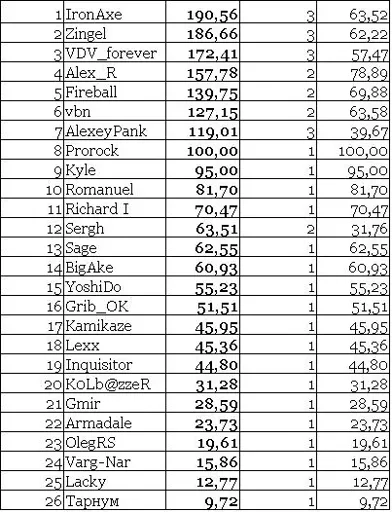
And the overall rating for Odenerochka:

New here? I'm Roha — want a quick tour?
Nice! Want a quick tour of this page too?
Show the author's original text and human translations first. Machine translation is used only when nothing else exists.
New here? I'm Roha — want a quick tour?
The linear rating is calculated using the modified formula of the respected AmberSoler: R(l)=25-25/(m(l)-1)*(m(i)-1), where m(l) is the last place in the tournament, and m(i) is the player's place. The number 25 was chosen after analyzing all the tournaments. In my opinion, the linear component of the rating should not be more than 1/4 of the nonlinear component. But we can argue about these numbers.
1. R(b)=R(tr)/R(iSr)*R(l)*k, where R(tr)
2. R(b)=k*R(l),
I think you've read the previous discussions, so you know that I support the idea of rewarding first-place finishes. I understand the logic you used, although the implementation could be simpler.
But it all comes down to personal opinion. I believe that the role of placement in a tournament should be significant; otherwise, the influence of the map becomes too strong. You don't have to look far for an example; consider the 6th stage of the World Championship. Differentiating participants only by the day they played was definitely a bad idea because the map was very simple and fast. As a result, the results were very close, and this was not due to the high level of the participants (half of them had played only 1-2 times in their lives), but rather to the conditions on the map. And Topor suggests ignoring placement altogether.
Therefore, the rating should be based more on logic and less on coefficients (i.e., personal perception).
I propose two options for calculating the rating, both of which are strict and fair.
I believe a 3 to 7 ratio is optimal, but you don't think so. I'm open to hearing how you would balance them.
And the sixth stage is still a special case.
Any tournament is a specific case, but these specific cases form the overall picture.
Logically, the role of days should be greater in tournaments with large gaps between scores, while the role of placement should be greater for closely contested results. How many tournaments with large gaps have there been recently – only one, and how many with closely contested results? Almost all the others, especially stage 6 of the World Cup and the tournament for trios (where there will almost always be a close contest). It turns out that the role of placement should be key more often, purely based on experience. And therefore, the contribution for placement should be no less than for days, and this also greatly increases competitive interest.
Currently, I believe that a 1:1 ratio is optimal. Moreover, with the development of the portal (i.e., the accumulation of tournament experience by its participants), the results will only become more closely contested, especially in the leading group. Otherwise, we might have to allocate 70% of the rating to placement.
Let's consider an example that until a week ago I couldn't provide without violating the rules of the tournament, Stage 6 of the VK.
The proposed map turned out to be very easy due to an excess of starting and joining forces. On such a map, the primary factor is the place taken, since it's impossible to differentiate based on days.
The distribution by days is roughly as follows: 7 days - a great Walkthrough, 8 - good, 9 - also decent, 10 - let's say, average (may some participants forgive me). Why 10? Because the bottom half of the table starts exactly from this result; a Walkthrough in 10 days is achieved immediately and without problems, for example, with 2 boats and one runner, although if you're very lucky, you can get 9.
Objectively, on a 100-point scale, a Walkthrough in 10 days (for one's level) deserves about 50 points; those with a higher place get slightly more, those with a lower place get less. But what happens if days and place are correlated 4 to 1? That's a huge blunder.
Now for the bonus.
I already said that a person should not suffer from the fact that they normally completed the previous tournament, but you stubbornly disagree. In the end, let's look again at Stage 6 of the VK. Romanuel, vbn, and Fireball showed very similar Walkthroughs. Only vbn didn't take the +2 spellcasting artifact and didn't bother polishing one parameter. I picked up the artifact but ignored one parameter, even though I knew it was possible. Romanuel did everything cleanly. AlexR's Walkthrough is conceptually better, more precise and careful. But in the rankings, he is only in 2nd place!!! And only because Romanuel did not participate in Stage 1???!!! Although, ideally, Alex should have a decent lead. This is turning into some kind of nonsense.
Perhaps better than option 1, but still not quite right. If the ratings reflect actual strength to any extent and the maps are not too simple for the participants, then the k coefficient will always be quite close to one (since that's how you defined it). That is, it's only a bonus formally, while in reality, the ratio of linear and non-linear ratings will change from 1 to 4 to 1 to 2. In short, this is obviously not a bonus at all.
Summary. Looking at your 2 proposals, the Kamikaze system, and the 6 stages of the VK, the average forum user (provided their attentiveness and logic are fine) should exclaim:
"Long live the oscillator!!!"
The real strength of a player is still reflected in the number of days. Parameters, mercury – all of this certainly reflects the player's strength. But! This only reflects their skills in logistics and attention to detail. This is, of course, important, but not decisive.
If a player can complete a map within 1-2 days of the leader, it's not significant that they forgot to pick up a mercury vial. Therefore, the player's strength rating should be determined primarily by the time taken.
For example, in this tournament, I was using a tactic that could have given me 8 days. But due to lack of time, I couldn't adjust it so that the computers wouldn't get too far ahead. After all, on the eighth day, I took all the castles. It turns out that if the determining parameter is the place, then I get a penalty for not having enough time to play. Is this a flaw?
As I said, the system is taken from tennis. A person with a lower average rating, i.e., a potential underdog, receives a greater bonus precisely for playing better than expected. In terms of their place in the tournament, they are behind the leader, who was supposed to win. But for exceeding their own expectations, they receive a higher rating.
See the attached file.
This option is specifically for those who are not happy with the "penalty" for previous performances. In essence, it is created specifically to give bonuses for the strength of the tournament (if players play worse than they could, they will receive a smaller bonus).
The oscillator does not reflect:
1 - The strength of the tournament.
2 - The strength of the players based on their previous games.
I think you are sacrificing the global perspective of Tournaments for each individual one. Rating is global. Even if the leader gets fewer points in a specific Tournament than another player, they will still be significantly ahead in the overall ranking. If you remove the bonus for new players, the leaders will quickly pull ahead so much that it will make no sense for anyone else to play. If we are interested in a specific Tournament, then there are simply indicators of the placement. The rating for a single Tournament is meaningless. The player's strength in a Tournament is still determined by their result. But on a global level, introducing a rating means that leaders need to constantly win to maintain their top positions. This stimulates their activity. For newcomers, there is an incentive in the form of a bonus, which allows them to gradually reduce the gap with the leaders.
If the rating does not take into account past performances, then we will not see the perspective. A single Tournament season will break down into a bunch of separate games that are not connected to each other. In this case, the rating will be useless to anyone. It is enough to simply look at the tables for each Tournament, and we will see who and how played. And the rating connects the Tournaments into one.
Even with the bonus, all stages of the World Cup are equal. It is simply necessary to take into account the strength of the Tournament. If its coefficient is 0.5, this means that not the strongest players played in it and did not show the best result. What is the point of giving them the same rating as those who fought for every step on the map? But the basic rating of 125 points is the same for all stages.
In a multi-stage tournament, a player should not be penalized for the fact that their favorite version is not played on the portal, and the winner should always have the same rating.
Moreover, the bonuses you propose reflect not so much the strength of the tournament, but rather how the player performed relative to themselves. Don't you understand this?
And is it even worth giving bonuses for this?
In my opinion, it's unnecessary.