Connection ErrorBad RequestThis page went staleSession ExpiredSign in requiredForbiddenNot FoundToo Many RequestsServer ErrorBad GatewayService UnavailableGateway TimeoutHTTP Version Not Supported
Session Expired
Your session has expired. Please log in to continue.
Sign in required
You need an account to do that. Sign in or create one — it only takes a minute.
This page went stale
Your security token was rejected, usually because the page sat open too long or you signed in elsewhere. Nothing was saved. Reload the page and try again.
Request Failed
We encountered an issue while processing your request.
Please check your internet connection and try again.
Смысла нет, но вы держитесь там. Удачи, здоровья, хорошего настроения! И пока в кармане пачка милкиуэйев - значит все не так уж плохо на сегодняшний день
The Banner Saga So-so... + Short (if you only consider the first part) + Art style +- Story and presentation. +- Almost no randomness, just pattern recognition of AI, and even that is rare +- Rather strange tactics overall. It feels somewhat oversimplified, not very balanced, but you can still think about it +- Encounters and choices. Half of them don't affect anything, but some are decent, allowing you to take a break from management and combat. There will be one STORY TWIST, but when it happened, I couldn't even remember which character was involved and why their lines didn't quite match the in-game choices... In the end, I just sat there with a blank expression. - Monotonous battles. Some can be skipped, but then you'll regret it in the finale (as I did) - Identical mobs with an ugly golem design. Rare moments of fighting humans are like a breath of fresh air. But overall, there are still only two types of battles, not counting the single boss - Inconvenient checkpoints - Uneven difficulty. Some battles can be lost, and it seems like only the story will slightly change or you'll lose some resources... But if you do that, the hard difficulty finale is simply impossible. I replayed it about thirty times, but since there is no randomness, I couldn't manage it. Plus, you need to manage resources about an hour before the finale, and if you don't do it based on some incredible intuition, you're out of luck. It's good for a relaxed evening with beer or something stronger, but it didn't motivate me to play the second part. With such a flawed combat system, they should have focused more on the story, or they should have done something about the boring mobs and monotonous setups, which become nauseating by the middle, if not earlier. 4.5/10
E si sui vius, er mi grans benananza, e si ieu muoir, er mi grans deliuriers
I congratulate all those who care; it hasn't even been 20 years since we got a second *cool* little game about Warhammer 40k after the Dawn War of 2004. I'll say right away that this computer role-playing game is fucking long; I don't even want to say how many hours are on my save, even accounting for alt-tabs. Possibly the longest of all RPGs I've ever played; I truly wasn't speedrunning, but going for maximum content, and yet my playthrough clearly wasn't 100%, given its peculiarities, so it's possible it would have dragged on a bit more compared to what I have if I had squeezed out every last drop for the absolute maximum.
So, I think I'll list my impressions as they occurred. I knew nothing about the concept of "rogue trading" in 40k, nor the developers, nor the game itself, which I downloaded and launched randomly with zero information; it turned out to be a little RPG about how we, a giga-aristocrat with incredible powers and wealth, conquer an entire sector in 40k through our will. I generated myself a pretty sleazy-skuf character with the background of a commander, nobleman, and Hero of the Imperium, who puts everyone around him in their place with every phrase, even starting with a "fake it till you make it" mindset, and after 30 minutes of gameplay, I felt that something elusive was preventing me from dropping this trash—as usually happens when launching dubious modern non-Japanese projects, especially those based on 40k, which these days are parasitized by everyone who bought the rights from GW for a small fee. I really planned to do exactly that and move on to another game penned by Japanese masters, but somethiiing still wouldn't let me rest here. Pretty soon I realized it was the dialogues in magnificently written Russian—they tried just a tiny bit to load me down with dull lore, but I simply ignored it, delivering maximum giga-chad elephantine phrases, and this stage was mined in a matter of tens of minutes, and this event even rewarded me with absolutely unexpected recognition within the game setting for this choice. And everyone I had these great-and-mighty dialogues with communicated—imagine that—not in the modern-habitual-soy-NPC way, in typical RPG game design style with some questions-answers, tangible alignment-routes of dialogue and so on, but in a way that made me think—hmmm... well, okay, for now the dialogues and characters are written slightly more interestingly, and most importantly organically-lifelike, than usual.
Next, I discovered that I was actually made an arbiter of fates in the 40k setting, at whose snap of fingers thousands, tens, and millions of thousands of respected and pious citizens of the Imperium do everything I say, and I repay them by using all my unquestionable authority and self-confidence to resolve any crisis exactly as a rogue trader of 40k should—an anointed one of the God-Emperor, and without exaggeration, the best person in the entire galaxy. Alright, alright—I thought—this is a cheap way to buy my favor; you've got the wrong guy, I'm not some piece of shit eater, and if I smell something unpleasant, I'll drop it that same hour. But what do you think? The plot and game design didn't even think about gradually lowering my rank as a player toward "shit-eating," but on the contrary—they piled on more and more material that helped me realize—this time you've actually sat down not for some random piece of shit indie RPG, but exactly for what you signed up for (without even realizing it)—an anointed one of Humanity in the forty-first millennium.
------
The great stuff. Continuing the previous tale—I really liked the subservience of 90% of the NPCs encountered in the game. Yes, I mercilessly and sometimes cruelly punished heretics, boors, and unreliable elements with maximum bias; however, being in my position, I couldn't help but treat the common servants of the Imperium, who clearly realize the difference between their position and mine and spare no effort for the prosperity of the Imperium, with the maximum possible respect and solidarity. If you are a cog in the state machine, even fully realizing that the Imperium will lose nothing with your loss, but you continue to perform your role for the benefit of my dynasty and the Imperium as a whole, you will be highly valued by me and rewarded if the current situation allows. But if you are a little bitch who puts your own emotions and needs above what is destined for you, then you are not needed in this paradigm.
I also liked the combat. It's not particularly complex, characters don't have that many stats, progression doesn't differ super-cardinally from class to class, but the devs (I don't know if it's this game or the rogue trader sub-setting itself) made it so that even with a relatively meager set of mechanics, classes and their combat are cardinally different from each other, sometimes squeezing out the maximum available possibilities of game-mechanics to introduce variety—but not for the sake of variety as such, but variety that makes sense within the given mechanics. It might be hard to explain in words, but it will be easily felt when trying to play.
I liked the warp jumps through this segment of 40,000-space, though there is a negative point associated with this. In general, "warp" in all its manifestations—both explicitly as space travel between systems or demon spawns, and implicitly, including quests, exploration of chaos-afflicted locations, atmosphere, and other things—is shown quite excellently, as some unconquerable and unknowable element even to the player, which puts them before unpredictable variables that can manifest at any moment of your Gameplay, regardless of how correctly you complete quests/level up/gear up/manage the navigator/buff yourself before battle. For example, warp-things can randomly spawn in combat when one of your psykers casts any spell. Or in any newly encountered location, you might discover the influence of the "Ruinous Powers" and instantly realize that you now have to mentally prepare for any kind of shit, because it will definitely happen. And so on and so forth. But in the case of this little game, you have to move through the warp quite a lot, and when for the 50th time you hit a fight spawn with demons and cultists on a typical deck, it's... not great. Well, fortunately, on the player's side, this can be mitigated by assigning a squad of imaginary NPCs to the fight at the cost of losing one type of cargo.
To that, I'll add the following minus-plus: the reputation situation is not obvious. Here you can sell unused goods and gear from some of the Factions (by moving them into "cargo"), and I didn't really sell them throughout the game, waiting for some separate moment where it might be useful. Don't do as I did—sell any "cargo"-trash immediately to your favorite faction as soon as they appear, and if they don't appear, add loot from mobs there. You lose nothing from this, only gain. You'll thank me in the end.
There is also a specific problem with pacing. At one point %%we are deprived of some of our regalia, and have to endure without them (approximately 95%, because for the remaining 5% we remain ourselves)%%, but... then we overcome it. Admittedly, this isn't the longest moment, but just considering the paradigm in which I PERSONALLY played, it deprived me for some time of one of the game's central pillars.
There are many other things I noted during the game, but perhaps now I'll only write down one major one. The English voice acting is super-excellent; all characters seem to be felt by their voice actors down to the smallest fiber. For example, a Battle Sister speaks with fanatical excitement and breathlessness, as if the Emperor himself appeared in her bedroom at the most critical moment of her life; an Inquisitor—dryly, coldly, and clearly, without frills; your Right Hand advisor—corresponding to his background + with complete reverence and businesslike manner, so that it's impossible not to respect this impeccable best-boy-grandpa; the alt-girl from the DLC—with a sense of inexhaustible faith in the Emperor, but at the same time existential longing and acceptance of the heaviest fate befitting both her and humanity as a whole. And so on and so forth. Other than companions, I can't even recall anyone else being voiced, but those who were—it was magnificence within the setting and their character. I couldn't have imagined that something like this would be possible in a "Western" game in 2023-24, but look at that.
Well, I'll add that technically I hit a noticeable number of bugs and the camera is shit. But whatever.
On the other hand, thematically—the theme of some of my favorite xenos is super-developed, about whom there isn't much content in the game industry or the setting in general, so in the end it's a good thing.
And overall, in terms of a modern computer RPG—the game is simply top. If you are not an Imperium hater and don't mind CRPGs, you'll love it. To be honest, compared to Divinity: Original Sin 2, which I praised last time as a "good Western CRPG," in terms of computer-RPG progression-exploration-overpowering—the game is clearly worse, not even the same opera. That is, you won't have situations where you, as a disembodied being limited by your game avatar, walk through the world, level up the most obscure techniques, and eventually farm chests in unreachable places or defeat bosses with one pinky using a super-broken build.
But unlike team Larian, here you have a good, non-joke setting, and you'll really enjoy it in terms of plot, setting, roleplaying, and everything related to that; you'll dive into it headfirst even with total ignorance (and it won't even be hard for you if you don't know 40k at all).
Anyway, I'll end on this—if you have a couple hundred free hours in your stash, then perhaps this will be the best or one of the best CRPGs of your life. I'm not joking—specifically in yours, whoever is reading this now.
Chrono Ark A friend had been recommending it for a while, and I was also considering trying it myself after looking at the screenshots and listening to his stories, but like with a million other games, I just never got around to it... Then my friend got fed up and decided to gift it to me on Steam – so I had to play it.
- It's not demanding; you can play at your own pace, at any convenient time, in any intervals – whether it's ten minutes or even ten hours. - The game has many characters with unique skills and features; each one plays differently; there's a huge number of diverse items, events, and everything else, allowing you to try out all sorts of combinations; and the balance is excellent: you have to think, but you don't have to stress or min-max. - The previous two points might make you think that this is just a fun time-killer, but that's not the case – the story is also very engaging: it develops gradually, with cool twists and depth.
Maybe I'll eventually complete all the achievements and finish reading the archive – for the reasons mentioned above, it's not a chore at all.
When this game came out, everyone unanimously started shouting that the small indie studio Larian, consisting of two and a half bear-dachshunds, had set an absolutely new, incredible standard of quality in the RPG genre. Unfortunately or fortunately, by this time I had long had my own internal "standard," which I wrote about here. Willy-nilly, I compared this new game to it. In a nutshell: I didn't experience the same euphoria, though there was no great disappointment either. By and large, BG3 is simply a good and high-quality game, but, apparently due to the obscurity of alternatives, a vastly overrated one. And here's why.
The hallmark of any such game is its companions. While I wrote many good things about the companions in WOTR, here the very first encounter with Larian cameos causes aversion and makes you give them the brush-off (going solo was a pretty sound decision on my part). Moreover, the aversion only grows the more these companions are forced upon you — and the forced nature, the Mary Sue-ishness, the attempt to divert attention away from the player character is felt in every breath. All the game's covers, posters, and banners feature the faces of companions in close-up, and only them (on the canonical WOTR covers, by the way, they tried to depict the commander — apparently technology too advanced for Larian). Their introduction is as spectacular as possible — but the developers, in most cases, didn't consider the player's motivation to take them into the party. Why should I recruit an unbalanced toad that attacks everyone? A suspicious priestess with a suspicious artifact who instantly tries to impose her opinion on you, even though you just saved her five minutes ago? A guy who suspiciously resembles a vampire and tries to slit your throat with a knife? Well, it's just assumed that since you're given this opportunity to travel with someone in a party, you'll apparently take everyone, because the devs worked so hard, wrote such cool stories for them...
Even when some companion is directly tied to story progress, they can't use their mouth to say it properly, instead trying to maintain a fake air of mystery. Shadowheart slobbered all over trying to prove she's absolutely necessary, that you must take her because "without my artifact you'll die there." When asked if she could just give the artifact without herself, she said no, she and the artifact are a package deal. In the end, the artifact just magically appeared in my character's camp under the pillow at one point in the story — see, to get into our camp at any cost, these people will stoop to any lie and baseness.
If you were unlucky enough to invite someone, thinking it would be short-term, then I'll have to disappoint that person: there's no "let's go our separate ways" option here. Any self-respecting game has one. After WOTR, I certainly expected it. But not here. The only option in that case is to manually walk up and kill them, roleplaying in your head (or not) that you parted ways; however, even this won't exclude the character from the final credits, and their corpse will lie in the middle of your camp for the entire game. In short, our companions are so good that even death won't part you.
An extra laugh: the game has a ton of scrolls of resurrection, and ideally it would be convenient to use them on those characters you actually need, say, for a quest. But — no. Dead means dead. A companion can be resurrected at any moment, and in fact even if the corpse is kilometers away from you, even vertically, and obviously inaccessible.
Overall, the game is praised for its freedom of action, but everywhere I go, I keep running into limitations and scripts. This isn't a flaw in itself, but it's a matter of how this entertainment is positioned. Why did they set the level cap at 12? The scale of events doesn't match it, and even if it did, they should have made it larger — that's all, because a computer adventure can easily be adapted for maximum progression. Shoving in various ways often decides the outcome of battles: but you choose the direction slightly poorly, and you're not shoving anywhere; many chasms are completely inaccessible to push into (it depends on whether the devs bothered to add a couple of strokes of a special mask to indicate a bottom, or forgot; and you can't push on slopes either 🤪). Sometimes you can jump and simplify moving to another level of the map, but in the temple of Shar in the first act, you can't jump, just because. Yes, you can cast Feather Fall and jump right to the gates, but the script will kill you 🤪.
I used to think WOTR had a lot of bugs or things perceived as such, like charge, which refuses to work at the slightest step or pebble in the way, and yes, it broke entire classes like the cavalier. The difference is that a bug in WOTR either had almost no effect, just slightly miscalculating a formula, or yes, it had an effect, but working 80% of the time, you could just use another mechanic to win your battles and forget about it. Don't like how charge works? Don't take a cavalier, take any other warrior, and you'll be happy. In BG3, it's a shame to give up shoves, because a significant portion of the time they work — but when they don't, which is also frequent, you experience an outrage I never even dreamed of in my anger.
Sometimes bugs or unfinished features appear in things I wouldn't even have thought of. The "Weapon Masterpiece" quest simply wouldn't complete for me because the interface for creating the special weapon didn't work. Sussur flowers are supposed to block all magic, so in the third act I was glad to find a use for them by tossing one at a djinn before it started its tricks... But the djinn didn't care, and the script played out normally.
Multi-level locations (houses with several floors) are a nightmare. The reason is the camera, which works extremely poorly and never wants to show you the level you need. Sometimes I had to climb ladders instead of flying, simply because to fly you need to click on the floor you want to move to, and you physically can't do it.
In short, what I want to say is this: BG3 is considered a game about variety and unconventional thinking — in reality, I felt the whole game that it's more about finding Easter eggs. The player is supposed to guess the "unconventional" things that the developers specifically built in for them — and, apparently, feel like a genius, but in reality, all this "unconventional" stuff is on the surface, while real flexibility is unavailable to you because it wasn't scripted.
The thing that disappointed me the most, it seems, was the ending. First, the final battle is nothing special.SpoilerJust a few illithids that aren't particularly buffed, and then some more spawn from the nautiloid. There was also a dragon, but a weak one. Honestly, from a huge, super-genius brain, you expect it to be able to annihilate entire cities with its psionic magic, without even resorting to the help of illithids on nautiloids, but instead the brain itself was a dud, doing absolutely nothing for most of the fight. Only towards the end do we get to enter a space with it, but even there its abilities are pathetic compared to previous bosses we encountered. Second, the epilogues are even more pointless. SpoilerThe good ending offers no scope in any of the options — you just become an adventurer or something like that. The bad ending is just some kind of power fantasy — lol, you and the brain just went and took over the whole world together. Given the fight I described in the previous spoiler, this really sounds extremely fantastical, not to mention that this ending just drops on you out of nowhere, like a piano from a bush; you literally had no villainous development in that direction, even if you played as a villain, because, in Larian's understanding, a villain is a maniac with a knife and nothing else.
Also, of course, the D&D 5e system itself seemed highly questionable to me for such a game. First, character growth in it is barely noticeable compared to Pathfinder; somewhere around level five, neither my battle strategy, nor damage, nor other important things fundamentally changed until the very end. Considering they're trying to sell us on the idea that we're deciding the fate of the world... Well, sure. Second, the variety is worse, since in WOTR there was a class for practically anything, for roleplaying any role; you can't do that here (or you install mods, but even with them it's worse).
What are the game's positives? Undoubtedly, the graphics. Out of curiosity, I went back a while ago to take a look at WOTR; yes, looking at it has objectively become harder, especially considering that a large part of that game was spent in an acid-dark palette. But even here it's 50/50, and you know why? Because the character... BG3 has a terrible character creator, just terrible — especially for a game that tries to make cool action cutscenes with close-ups. Even Morrowind with mods was better. I had the complete feeling that, for the sake of hype, Larian focused on entirely the wrong thing: instead of making normal faces, or even better, a face editor, at least like in Skyrim, they spent everything on advertising their genitalia; I'm speechless.
Body options? Choose between a tiny waif or a huge gorilla; no other options were provided. Sorry, but there's no logic — height sliders were invented about twenty years ago; was it really that hard?
And the emotions... I don't know who told them that emotions should be animated so disgustingly; it brings to mind memes from Andromeda. Even if you find a normal face among mods, it will still twist into some monster throughout the entire game.
Compared to this, let me remind you how it was in WOTR: maximally neutral models that can easily be made roughly suitable for a character, plus a portrait. Any portrait you want — download one, draw one yourself. Take a selfie in the mirror and put yourself in. Maximum flexibility. Surprisingly, it's flexible customization that people want from an RPG.
Alright, I've drifted back to flaws again... Merits, let's return to them. So...
"Us" is a cool animal companion. Scratch is overrated.
Sometimes you can have fun in the game, especially with explosions, or with Otto's Irresistible Dance.
Best moment in my playthrough
There are plenty of quests, of course, some interesting, some quests or items amusing. The logic, of course, is often a bit...
To summarize, running around as a bum in the outskirts of Baldur's Gate wasn't as interesting as being the pompous Commander of the Crusade; the latter's roleplaying felt much more alive, since it's cooler to make real historical choices instead of choices like "should I throw these lame goblins into the chasm or settle things peacefully." But as a checkbox, to get acquainted with the genre, partly for those very secrets, partly for the story and lore, I did it. That's how it is.
P.S. I forgot to mention that cleaning the same map with a fine-toothed comb for dozens of hours was also a questionable design decision after Pathfinder games, which invented switching modes from tactical to strategic. But I think I wrote about that already somewhere, and it should be intuitively clear that even if the mode itself is weaker, the fact of switching attention allows you to rest, and is therefore obviously beneficial. A mistake not to include it.
A game from my childhood. Well, one of them. It was mainly based on the Dracula movie with Keanu Reeves. Of course, I didn't know that as a child. In general, it's a decent horror game with zombies, ghosts, wolves, and spiders. It's quite hardcore; at the beginning, you have to choose whether you want more lives or more health. You also have to complete small quests. It's a shame that everything is in English; it's hard to understand what's written. But the music is pretty good. And, as is typical in such games, there are many secrets and hidden passages in various castles.
Смысла нет, но вы держитесь там. Удачи, здоровья, хорошего настроения! И пока в кармане пачка милкиуэйев - значит все не так уж плохо на сегодняшний день
I haven't read a visual novel in a long time; the last time was back in college, when I was about 21, and now I'm 32. I stopped reading them because they caused me intense emotional turmoil that lingered for weeks, disrupted my normal life, and generally made me even more melancholic than usual. At some point during that 11-year period, I decided that VNs were just tearjerkers without substance and that it wasn't worth spending time on them. But despite this, I still decided to read this particular work.
The first chapter was quite difficult. The main character was incredibly annoying with his absurd phrases, which made me feel ashamed and irritated. His activities weren't very interesting either – just a typical Japanese freshman who browses 2channel, hangs out with a friend in a summer maid cafe, and, as a bonus, constantly spouts irritating nonsense. It wouldn't be an exaggeration to say that I read the first chapter with difficulty. The only exception was the lecture – it was quite interesting to read. I've always liked the theme of time travel, but specifically in terms of the theoretical model of various timelines, paradoxes, and so on. The practical side – how it would actually work – wasn't interesting to me because it seemed too complex and far removed from reality. Here, everything was explained in simple terms – of course, not super-simple, since it deals with complex subjects – but it was quite understandable for the average person. But the ending of the first chapter intrigued me, and after that, I read with interest. I'll say right away that this will be a general trend – each chapter skillfully escalates the tension and captivates more than the previous one. The only thing that is still difficult to accept is the behavior of the main character, but even he evolves at some point and will sometimes even pleasantly surprise.
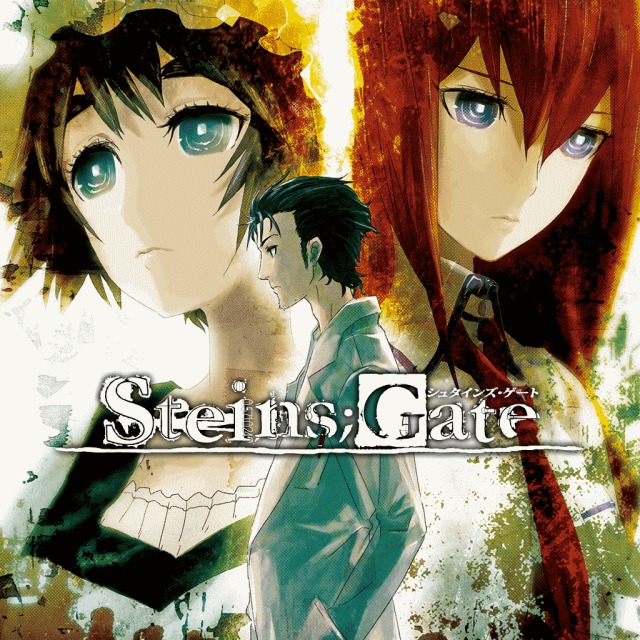
I liked how the gameplay was implemented – in the form of interactions with a phone, where we respond to emails and phone calls. I liked this because in a typical VN, you feel like you're on rails, where you're only allowed to choose a direction at certain points. Here, you feel like you're actually "playing" – you can interact with your phone if you want, or you can ignore it. Of course, this is just a way to disguise the choices, but it's still cool. At first, the unusual art style surprised me, but after getting used to it, I realized that it's actually quite pleasant. The music fits the moments well and harmoniously complements them. Both of the main heroines (who you see in the picture above, if it hasn't broken) are simply wonderful. And yes, I remembered why I stopped playing VNs – just like when I was 20, I was overwhelmed by very difficult emotional experiences at the end. So difficult that, to be honest, I couldn't work properly today and almost completely lost my appetite.
At first, I thought about giving the heroines a rating without spoilers, but I decided – what's the point? The rating will still only be meaningful to someone who has read it. Therefore, spoilers follow.SPOILERS To be honest, initially, when I was reading the first half of the VN, I thought about giving the heroines harsh ratings, accompanying some of them with demeaning words. But when I finished the chapter with Luka, I realized that there was no point in this cynicism. So, I'll just write my opinion about each one. I'll start, however, with the best girl: AssistantZombieChristina Kirisu – she is the best in everything, she is smart, beautiful (because she looks like the best girl from Reim Empire Persona 3), she shitposts on @channel and knows about anime, which means she's one of us (the pun was unintentional). Tsundere without excessive exaggeration, exactly to the perfect degree that she should be, puts Okabe in his place when he is most irritating and supports him when he needs it most. No matter what angle you look at her from, she is simply the most wonderful. Mayuri – a magical cloud of kindness and happiness, a perfectly worthy rival for the title of the best girl in the title. Moreover – throughout the novel, I changed my opinion about the best girl several times in this order: Christina – Mayuri – no one (both are too good) – Christina. So, the battle was lost with more than honor. When I was reading the novel, a memory from another worldline was unlocked – how someone was hating her for the fact that Christina should die because of her. But only when I read the true route, I remembered that someone replied to that guy – that both of them survive in the true route. But since I only remembered this after seeing the standard ending of Christina – I felt very sad and excited. And yes, Mayuri is so wonderful that even if Christina really died because of her – I wouldn't hate her.
As wonderful as the main heroines turned out to be, the secondary heroines are just as far behind them. As I said, I haven't read many VNs, but I don't think the gap between the main and secondary heroines has ever been so large. So, just a few words about each one, in random order: Faris – I liked her the most at the beginning because she also puts down the MC, but she does it by increasing the level of absurdity. She has very cute sprites with emotions. Suzuha – just cute, without frills, but in the end, she probably has the most attractive appearance of all. Luka – I felt sorry for the guy until the true ending, after that – I believe that everything will be fine with him.
What else can I add? If we leave aside the beautiful euphemisms – I cried like a beaten whore, starting from the ending of Mayuri, where she says goodbye to Chris-chan, and especially in the ending of Christina – almost throughout it, with a particular intensification when she runs into the laboratory to say goodbye. And when, in the true ending, her memories from another timeline returned – I probably cried from happiness for the first time in my life. A special thank you to the authors for this happy ending.
Where do we go? Where do we end up when we save the world?
I watched the adaptation because the plot seemed interesting; I like time-travel stuff, but I can’t stand the “walking simulator” genre; I get bored “playing” them. I had the same impressions; it’s a bit slow at first, but it quickly picks up and becomes engaging, and from the middle onwards, it’s all action. I don’t know which ending is considered canon, but it seems to be the true one. And yes, the main character didn’t annoy me; I found him hilarious, such a pompous idiot 🤣 And I agree that both girls are likeable. Although I can’t say that any of the characters really captivated me. They’re okay, cool in the moment, but now I only remember the main character because he’s so meme-worthy.
Grand Theft Auto IV I didn't play it when it was released, I just messed around with it on other people's computers. Now I decided to fully appreciate it, especially since I've already completed the other parts (except for the first ones). It's funny that I finished the 5th part in a month, while this one took me half a year and took more time in hours. I don't know how that happened, maybe the game itself is longer. I won't write much, I'll just briefly describe my impressions and some moments. The main campaign is already a bit forgotten, but the beginning was pleasant, and I immediately liked the darker atmosphere compared to other parts (in this regard, it's more similar to the 3rd). In general, the cityscape somehow creates a better atmosphere in these games, especially the poor neighborhoods, industrial areas, etc. There was not enough of this in the 5th, as well as in Vice City. In particular, I would like to highlight some missions where you had to enter the entrances of apartment buildings, climb the stairs, enter dirty apartments to some dealers, and take them out. It immediately gave the feeling that you were a character from some American gangster movie, or Danilo Bagrov, who came to the USA. It was atmospheric. The roads on the first island (and the small one) are the same, with lots of turns, hills, and streets, but because of this, you can't really speed up and it's not very fun to drive on them. The second one is better in terms of driving, and the third one is so-so again. And I don't remember the other parts very well, but in this one, it seems like there are a lot of character deaths during the plot, especially at the beginning. It's not that it's bad, it's just that this feature stood out. Otherwise, everything was quite familiar, and there were no particular difficulties, except that I didn't immediately learn how to get into a taxi and didn't understand how to find out the exact address when on a date. I also didn't like the fact that "friends" often call you and invite you somewhere, and if you refuse, your friendship decreases. Only after a while did I learn how to refuse them without losing friendship points, which are needed for bonuses. Although playing billiards or air hockey with them is quite good, I played about 20 games of the first one. I can also add random encounters/acquaintances, the ability to choose in some missions, police missions, and the internet, where you can read interesting news, including about your affairs. The missions were generally easy, I didn't have to replay much, except for the last one, considering the script that only works at 30fps, and because of this, I had to lower it technically. The Lost and Damned A terrible add-on with unpleasant characters. All the pleasant and funny ones remained in the other two stories. When I launched it, everything looked even more dull for some reason, and it seemed like the game was running worse, like some kind of demo. But maybe it was just a coincidence, and the difference is only in the design of the radar and other details. I can only add that the story is intertwined with the main campaign and the second add-on, and otherwise, there is nothing interesting, except that you can ride a motorcycle as much as you want, if you haven't done so before. But considering that we spend most of the time on the third island, it's not that great. The road rash-style races and gang upgrades didn't impress me much. And here they showed a completely naked man (but there are still no women). I accidentally found out that a character from the add-on appears in the 5th part.
The Ballad of Gay Tony The opposite of the first add-on. A pleasant protagonist, more vivid characters, and fewer annoying ones, and the plot is even more intertwined with the main campaign and answers questions that may have remained. But most of all, I liked the concept of the story itself, namely that we are co-owners of nightclubs, hang out among famous (and not so famous) people, make useful acquaintances with influential people, try to resolve the problems that have arisen, while also dealing with work matters, and so on. This is not just another story about a con man who came from somewhere or a homeless person who wants to get rich. And almost the entire plot takes place on the second island, and that's cool. The only downside is that they overdid it with the helicopter missions, considering how boring they are and how much time they take. But at least the dealings with "drug friends" are not as stressful as the biker showdowns, because your partners are immortal and you don't have to worry about their lives.
At the beginning, I didn't like much of the radio, except for a couple of well-known songs on some radio stations, but they rarely played, so I often listened to Journey, where there was also a well-known track by a Frenchman (I don't know where I know it from). There was also a melody on this radio that strongly reminded me of the music from Heroes 3 (if you're interested, it's Philip Glass - Pruit Igoe). After a while, I got used to the available genres (I couldn't just turn off the radio, although there seems to be a button for that) and about 1/3 of the stations played periodically, most often the music that I was used to, but when I was completing the last DLC, I almost always drove to electronic music. It was very much in line with the club affairs, + it created the right mood and atmosphere, and besides, there are no stressful tracks there, and some are even pleasant.
I won't give a rating, but I think this part is one of the best.
They evoked the strongest emotional turmoil in me, which lingered for weeks, disrupted my normal life, and generally made me even more melancholic than usual.
MiSide I thought it was just a hyped-up fun little game, but it turned out to be a genuine modern masterpiece. - SCARY. I got goosebumps on a regular basis — the atmosphere is conveyed so vividly: the setting, the imagery, the story, and the sound/camera work are all top-notch. - You're constantly doing something new; the game never stops surprising you, both in terms of gameplay and story. - The puzzles are perfectly balanced — you do have to think sometimes, but you never get stuck without a way to progress. - An adorable heroine — she immediately wins you over and helps you immerse yourself in the story. - A cool contrast between the cozy vibes and the horror. - Based on my experience, it's a unique game unlike anything else. Played with the Japanese voice acting.
It really is cool — for such a simple genre as a walking simulator, they've squeezed out a huge amount of variety in terms of story and ways to deliver it, moments of different atmospheres, and a ton of interesting details for the eagle-eyed. I was expecting something in the vein of an anime dating sim for the youngest, or some lowbrow zoomer horror with notes and jump scares, but instead I got a surprisingly diverse, unusual ADVENTURE, paced so well that no moment gets a chance to drag. And I had a good laugh with the photo mode. Played in Russian with Russian voice acting.
yakuza gaiden Top tier. More intimate and shorter than usual (though still long if you get sucked into the side content), while being darker than the previous entries, feeling more dynamic, with plenty of tasty legacy moments, a lively brawler combat system, finally a cool outfit customization, and overall very, very stylish; the story, despite the segment that seemed sparse on events by that point, is very brisk.
yakuza 8 There's just a ton of side content, almost all of it quite engaging, and it doesn't feel like side quests but like separate spin-offs. You could drown in the legacy content — anyone who skipped all the other entries will probably lose a significant chunk of it in terms of appreciation, though maybe it still works out fine, but for a fan it's a treat you never even dreamed of. The main story felt a bit thinner than in 7, but it's perfectly decent, and maybe it only feels that way due to the sheer scale — it took a considerable amount of time to complete, there are also many mini-stories, quite varied in what they belong to, so the overall picture gets a bit blurred. Overall, I really liked this approach.
Another one of those spontaneous games that unexpectedly took a long time (in terms of hours). Although, it's more about the fact that they removed it from Steam, but I bought it and decided to play through it just in case. Besides, I wanted to have a lighthearted playthrough without stressing over choices or spending 10 minutes reading. I thought I would finish it in about 60-70 hours, considering the gameplay, but it ended up taking longer, plus there’s a small DLC that doesn’t even have a translation. As for the game itself, my first thought was about the camera, which you can’t tilt properly for some reason. It doesn’t seem like an old game, yet this limitation exists. However, you can zoom in and out on the camera, and during these moments, the perspective changes slightly (not much). I don’t know why they couldn’t make this element better. The second detail, and possibly the main downside, is the saving system, specifically the fact that there’s only one save slot! This might be okay for Diablo-like games and others, but it’s very strange for this game. Moreover, manual saves and autosaves use the same slot, while autosave activates at random times (maybe based on a timer), when transitioning between locations, after certain events, and after interacting with a store. Luckily, it doesn’t happen after every dialogue 🙃 If the save glitches, then that’s it, goodbye (this happened to some players). Of course, there isn’t much need to constantly save, plus most dialogues can be replayed, but there may be moments when something happens, then a dialogue appears, followed by a change in the environment and immediate saving, and you might not have had time to do something. I experienced this once: I arrived at a location for a mission where I had been before, but it looked different due to the quest. As a result, I didn’t explore the entire area (which was updated with loot), triggered a boss fight, finished it, and then the location returned to its original state (or I was kicked out of it), and I wasn’t allowed to continue through the new location. I doubt there was anything important or valuable there, but such moments are always unpleasant. There were almost no bugs, though. At most, the game would freeze during loading, but it could easily be closed. Oh, and there was also a bug with a quest. The point is that you need to perform specific actions, after which a script triggers. But it didn’t work for me, even though I used different methods. Then I gave up on it, continued playing, went back to it a couple of times, it still didn’t trigger, and then, I think in chapter 3, it suddenly worked, and I received my reward, which I didn’t really need anymore.
In terms of gameplay, the game focuses more on combat than dialogue. Although there are a few interesting quests, including ones with choices and seemingly intriguing ones (like the one with the amulet). And regarding the plot, I was surprised a couple of times, maybe because I wasn’t expecting much, although other games have had similar twists. Also, the beginning feels too gloomy, in my opinion (not in terms of the plot, but in terms of the number of deaths). Later, it becomes quite a classic adventure. Leveling up is almost like in Tyranny, only with more skills and some overlap between classes (not just in branches, but also in individual skills). The combat is also similar, but better, since characters attack much faster and don’t spend 10 seconds winding up their attacks; they listen better, so it’s easier to control them. There were difficult battles at the beginning, but later I could easily defeat everyone without using potions or bombs, etc. Probably, you should play on hard difficulty. I didn’t like that only the characters who are in the group level up. If you leave someone in camp, then tough luck for them – no experience. It’s not as if you necessarily need to change characters, but I tried to do so based on the quests, even though there shouldn’t be any gameplay problems with completing them. By the way, you can’t complete the game solo. The companions are pretty ordinary, except perhaps the dwarf-warrior (unusual, right?) and the necromancer, who evoked a few emotions. I don’t know why they couldn’t come up with cool characters like in old Baldur’s Gate games. In the DLC, only the initial companions remain (i.e., minus equipment from others), and there are no dialogues. It’s possible that it was simply unfinished, although it is playable.
Despite its linearity, during the playthrough, I found various places/chests that I couldn’t use. As a result, I wrote down these things in a notebook so as not to forget and return to them later. Closer to the end, I revealed all of these secrets (quests), except for one named chest, which remained locked. Probably, it’s locked behind a specific choice in some quest. I thought about checking out one branch later (I even copied the save file), but I just didn’t feel like it. On the one hand, it’s nice when there are such things that you need to return to and possibly solve, but on the other hand, you want to get everything at once.
If we talk about the RPG as a whole, then for me, a plus is always the fact that the events take place in the Forgotten Realms because in this case, there is familiar lore around, and not some new nonsense spanning three pages. Although here, the only familiar place was Luskan (not counting the Underdark), which isn’t fully accessible and may not be something I had seen before (although I think it was in some Neverwinter Nights game), but even this small thing was pleasant. Plus, some other things were mentioned, including my favorite Zhentarim. The journal is also designed quite well (even the gods are briefly described), although I think it’s unfinished because some articles never appeared, such as descriptions of certain creatures, like ogres . After playing more than half of the game, I realized that the music in the game is generally enjoyable. Some tracks remind me of old RPGs, and one even reminded me of the first Fallout games. PS: I wouldn’t recommend anyone play it… but if you do, it’s better to start with a ranger or paladin :) and level up your companion’s perception PSS: Okay, it’s time to play through the best party-based games, not just any random ones...
PSS that's it, time to play the most top-tier party games, not just everything in a row..
lied
Pillars of Eternity
So I finally got to Pillars. I wrote a lot of stuff, but it turned out chaotic, so I decided to rewrite and start from the beginning (I'll note right away that I'll be comparing it to other games). Character creation is generally acceptable, though there's a bit too little content for my taste, but still more than in some other games. I didn't appreciate the renaming of attributes and some classes, and I have questions about the races too. Was a bit disappointed that I couldn't choose a faith, but apparently that option exists for priests (judging by possible dialogue lines). I wanted to complain about the number of portraits (and partly their quality, lol'd at three identical elves in different colors), but given new knowledge, I changed my mind. Besides, I ended up not playing as yet another Arandor and decided to create a character from the expansion for which there was a fitting portrait and class too. So in the end it turned out even better than usual. I should do this more often when possible, because it's more enjoyable to play when you have a coherent and well-thought-out image. And I gathered that the voices in these games (in SCL too) are the same ones used back in the first NWN.
After creation comes the usual intro about a caravan, just like in SCL (if you end up in a fantasy world, never travel with caravans, their mortality rate is higher than that of the local villains' lackeys). Then we arrive at the first village. There you start to realize that the game's beginning is actually quite creepy (with this curse and soulless children (a zoomer reference, btw)) and you even start to get into it. I was pleasantly surprised that the first companions you meet are men, unlike in some games (no finger-pointing). The thing is, they're not very interesting, like all companions in the game. Except maybe Eder seemed like a decent character, perhaps due to his simplicity and lack of excessive tediousness. It's rare for a warrior to be normal rather than a dullard or a villain. Next comes a not-too-interesting run through locations and clearing out a local noble's keep, which tired me out a bit. Also, I was playing a bard and our party wasn't very combat-ready at the start, so I had to use my usual tactic in such games: give everyone ranged weapons and kite (thankfully the game allows this). It wasn't very convenient to fight this way in tight corridors, but the bard can summon creatures without resting cooldown, which eased the task. That's how I got through half the game, if not more. After the keep, I went to our future stronghold and decided to explore it a bit, though I should have just done the quest and left the exploration for later. In the end, I got a bit overwhelmed, but I cleared a few floors. Generally, multi-level dungeons in such games are tiring. If the whole game consisted of them (those exist), it'd be fine, but here the concept is completely different and I'd prefer less of that. I ended up finishing it much later (though still too early, because on one of the last floors I lacked the skill to find/open a hidden door), and the final fight was tough; again, maybe I should have leveled up more.
So, after the cozy keeps and a slight loss of interest in what's happening, we reach the city (btw, the town crier on the street quickly covers the news). There, the spark of interest reignited in me; I even caught some pleasant old-school RPG vibes. Mainly thanks to various taverns, organizations, institutions, rich family estates, and other places to visit. It just lacked named NPCs (don't count the kickstarter backer placeholders), regular houses, and shops x) At least there was a sewer-like area! By the way, at this point, in terms of interesting surroundings, the game already surpasses Tyranny with its two f***ing villages for the whole game and a bunch of identical locations. By this point, we've even killed about 20 different mobs, while there, there are only three types in the entire game. You also learn quite a bit of info about the world, countries, past conflicts, and so on. There's not that much info, of course, and it's almost all in books, but I read them and understood everything. The thing is, it's not as interesting as in Tyranny. In this regard, they're probably the same: not very interesting and small worlds (very little lore depth, like in almost all new "universes," making it boring to learn anything). Honestly, I don't really remember much from Tyranny anyway (maybe a couple of provinces and some details about them), and I'm not even sure I remembered it initially. Were there even books there? Yes, at the start it talks about a war and a genderless invader with their cronies, and you even choose different event outcomes, but do you remember the names you read for the first time? I doubt it. And when you encounter them in dialogues during the actual game, you might not recall them. But oh well, it's hard to top my love for FR anyway, so any lore would have failed my expectations, though they could have come up with something better. I can only note the "soulful" plot branch about animancy, maybe because I like experiments on humans and such. Though overall, the soul theme didn't really impress me. Role-playing in the game isn't as extensive as in Tyranny, and there are far fewer checks. But it's more than in many old RPGs and some others, so it's acceptable; plus, there are text situations (though Tyranny's encounters are definitely better, as are the role-playing opportunities).
The personal keep turned out to be decent and more convenient than in Tyranny. The option might not be very important, but it's pleasant. At first, I thought many different events would occur, but in reality, we were only attacked once, and after that various folks showed up. Most often with escort requests, a couple of times mercenaries came whom you could hire as guards (also a cool option), and occasionally more interesting situations arose. The most useful were the quests, which sometimes gave decent artifacts, and the upgrades providing resources (which I had no problem with) and sleep bonuses. I always increased mechanics at the start. But what I liked most was keeping prisoners in the dungeon; it's a shame you can't do much with them, though in the end, I handed a guy over for experiments x)
As for the visuals, they're quite pleasant. Nothing special on the city streets or in nature, but interiors and dungeons look pretty nice, with many small details drawn in. The situation is the same in Tyranny, just a slightly different style. Characters in Pillars look better, or rather more organic, because in Tyranny they stand out from the environment since their cartoonishness doesn't mesh well with it (and half of the humans are also hunched over like dogs). I'd also like to specifically mention the Vailian Republics' representatives, who stand out not so much by their skin color but by their bright clothes and design, making them look quite cool compared to other characters. Though they could have made the paladin companion from a different nation rather than the usual trend lately. But oh well, what actually bothered me more here was the feathers and all that, as the idea was mediocre and didn't look great either.
So, after the city and quest choice, we're back out in nature, where the only interesting thing is a village. And when I got to the barbarian city, I felt tired again. Showing perseverance, I managed to overcome this feeling of waning interest and finally reached the final location on the map, after which I proceeded to do the DLC (though it turned out some of it was already completed). Because everyone knows that before finishing the main story, you first need to complete the expansions, since you can continue playing after them, but not after the main story. Anyone who didn't know is a noob. In the end, the DLC took longer than I expected, possibly because there were two of them instead of one, though the events take place in one region (why do dwarves always mess around with nonsense in their strongholds? they'd be better off living on the surface and running around in kilts, showing off their yellowed underwear, like their Heroes 3 brethren). But thankfully, it played more briskly, and in snowy settings too; plus, there's no trash like backer NPCs. By the way, I reached max level during the expansions. By that point, the game was practically on easy mode, though there were moments when some mobs quickly shredded HP if you piled on them without using abilities and spells. After finishing the DLC, I returned to the main game and completed it without issue. All in all, I hit waves of frustration about three times (mainly due to locations, maybe, but not only). The toughest fights were with the dragons (the Adra Dragon and the White Dragon from the DLC); they were also the most interesting, as it's a kind of challenge and satisfying to win after several attempts and different tactics.
Now regarding mechanics and other stuff. 1. Items. I liked the soulbound artifacts that level up and give good bonuses. There are almost no downsides to this feature, except that I found some items late and didn't get to level them (though not sure they were better). However, many of the regular artifacts weren't very useful, and there was a noticeable imbalance in some bonuses, or maybe I was just lucky. And I forgot that a bonus to something only counts from one item, not multiple. Though I thought in old RPGs this only applied to defense bonuses. On the other hand, those games had few items with stat bonuses, while here there are tons, especially to strength. But oh well. I didn't like the division of defense into subtypes, as in Tyranny, if I'm not mistaken. I look at new armor, check the overall defense level and bonuses, that's it. Who's going to calculate piercing damage, slashing damage, etc.? Or am I supposed to carry different armor and constantly switch it depending on enemies? That's nonsense, who would bother with that? Elemental defenses are okay, that's an old system and can actually help sometimes (though not in this game). But damage-type defenses should only be for enemies, because it's right that skeletons should be hit with maces and clubs, and trolls finished off with fire and acid. The player shouldn't be burdened with such formulas. I also really dislike the armor's impact on action speed, which was also in Tyranny. In my opinion, this system is garbage. In old RPGs, it was fine. If you're a mage, screw you, no heavy armor; look for robes and don't act tough. Or like in Neverwinter, spend a skill point on armor proficiency, though you'll still get a spellcasting penalty and periodically suck, which is a hint. Besides, in the end, you still dress the mage in light armor and the warrior in heavy (or even everyone in heavy). Except for my bard, I tried everything on him since he was a fighter, a shooter, and a piper. The only good thing was that almost every new piece of armor was better than the previous one, which I can't say about weapons. Yes, sometimes I found cool weapons (usually soulbound), but more often I found artifacts that were worse in damage than what I already had, while having decent abilities. In the end, various clubs and spears were essentially trash, as were most one-handed weapons, except for one axe and a sword given in the second DLC. Otherwise, two-handed swords and one mace ruled (you find two more at the end of the game x)), and ranged weapons were periodically upgraded.
2. Consumables. I played on normal, so I barely used them. I only used traps, as the MC's class allowed for it, and they helped early on. I also used paralysis scrolls against the dragon(s), as it's very effective, especially against one that's nearly immune to everything. I also summoned creatures using various figurines, but again usually against dragons, because I needed to spam meat shields and protect my characters, since I was going for the achievement of not falling unconscious. I used potions only a couple of times, and food too, which you can't even use during combat, which is stupid. In the end, it came in handy once or twice for dialogue checks. Generally, I don't like it when you can't use the inventory during battle, especially some consumables whose effects aren't very long-lasting. But the only thing that annoys me more than this is...
3. Spells. I was glad that here we have familiar spells, and each class has different ones, unlike in Tyranny, but why the hell are half of them only castable in combat? Why can't I buff before battle like a normal person and then attack? Plus, most buffs' duration doesn't even reach 30 seconds. At least some combat spells could be used outside battle, especially area-of-effect ones (though I think not all). This is a classic feature of old games, where you cast a cloud of crap into the fog of war that poisons enemies while you stand aside and wait for them to die (though here they attack you immediately after, and the spells are lousy). This was especially useful against some dragon that would oneshot half my party in a direct confrontation.
Just facts: 1. I collected all the animals and creatures (info not 100%) 2. I missed one quest that becomes unavailable after the second chapter 3. Not all quest decision outcomes were predictable, which is good, and some even had unexpected continuations 4. Almost all companion quests are rubbish 5. There was a funny moment when, near the end of the game, I decided to do bounty contracts on bandits and returned to a location from the middle of the game, meeting guys there whom I had deceived in a quest from that same middle of the game, sending them on a false trail. I thought they just disappeared from that location, but they actually went where I told them and were hanging out there until I met them again x) 6. I also note an encounter in one of the early locations (where I was again looking for bandits) with guys who appear over time after certain in-game events. They're not very important, but still cool due to their unexpectedness, because what are the chances a player will re-explore locations they've already cleared? Such things could be done in other games too, maybe even with more important purposes. 7. Another easily missable moment. Before the finale, I decided to enter the common room (which you visit 1-2 times per game because there's nothing to do there) to check if any new dialogue had appeared for the resting companions (or maybe for another reason), when suddenly the paladin who was with me triggered a line about her quest, which I had already completed long ago. In short, she suggested visiting her friends, whom we had encountered earlier. In the end, a fight broke out there, though this wasn't a quest event anymore, but rather just an encounter, as it wasn't marked anywhere. A rather strange decision, in my opinion, given the "importance/necessity" of the scene and its trigger, which only activates in the common room. And possibly I didn't just enter it, but also pressed the rest button there (and the script fired after that), which basically no one would do, since you can rest outside the building. Such an interesting detail that I accidentally discovered.
As for the overall picture of the game, it's nothing special in general. Though towards the end, I wanted to check out the second part, especially since the story continues there, and the first part only partially brought it to a conclusion. Plus, instead of a personal keep, you'll have a personal ship, which is much cooler. And they say the second part is better, so I'm curious to verify those claims..
PS I finished the game back in January, but given the HW issues..



 Саня Изи

 Граф Орлов


 .
.
