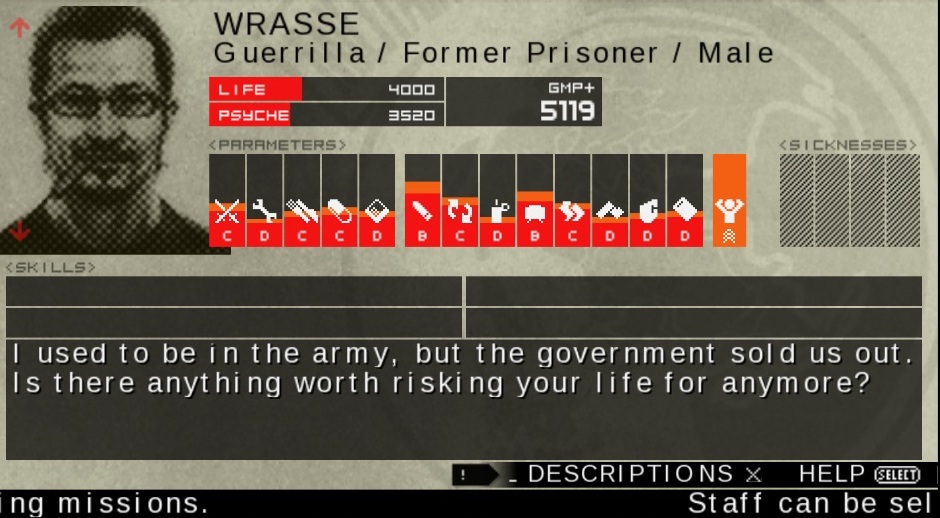
- I liked the text. There are many good descriptions and interesting dialogues. For example:
On the other hand, the walls of text about past events are boring and uninteresting. - The ability to play the game in different ways. That is, not in terms of thief/mage/warrior, but specifically the influence of the chosen skills - there is no class system here. In my first playthrough, I played an assassin in terms of background, and I started developing critical strike after I realized that I could one-shot people outside of combat (as in one of the screenshots above). It was very pleasant to read about such things. Although, at the same time, there were situations when I had no choice but to fight - and this was very stressful (many reloads) because the character was not a fighter.
- The plot is more good than bad. I didn't like what started happening closer to the end, but up to that point, everything was quite decent.
- Neutral soundtrack. It didn't annoy me or make me want to turn it off, but at the same time, I didn't remember it at all.
- There is replayability. You can look at the plot from different angles and, as I wrote above, play in different ways. Although after the first full playthrough, I didn't have much desire to replay it, and after the second, I didn't even start.
- SMALL FONT. I played at a resolution of 1920x1080 and was simply surprised at how the interface space was used: a huge dialogue window, a piece of text, and a lot of free space where you could put a larger text.
- The first impression of the game caused me rejection. I don't know why, maybe because of the terrible graphics for 2015.
- Excessive situationality of the chosen skills, even despite the above-mentioned variability of gameplay. Some skills are rarely useful, and besides, I discovered for myself a kind of necessary meta-game - not to spend skill points until you find yourself in a situation where you don't have enough of a certain skill and, after loading, level it up. It even seems to me that without this method, non-combat characters can simply hit a wall without the ability to continue playing.
- And in general, I got the impression that the game is unfinished (indie problems).
Posts from Recently viewed games
Auto-translated
Initially, I wanted to write a review full of hatred and all sorts of derogatory epithets about this wonderful game, but towards the end, I resigned myself. I resigned myself to the lack of full voice acting (you get used to good things quickly, and I didn't even think to highlight this as a feature of the first Metal Gear), I resigned myself to the lack of full conversations over the Codec, to the pathetic plot, to the locations the size of two houses, to the division into missions (consisting of locations the size of two houses), to the pathetic gameplay, to the lack of cutscenes, which were replaced by some crappy comics - in general, I resigned myself and began to meekly eat crap. Fortunately, the game turned out to be not very long - this is its only positive quality. I was already about to be disappointed in the genius of Kojima, when it turned out that this game was not developed by him. UNSURPRISING, I must say. However, I cannot reconcile myself to the fact that this game received high ratings from critics. Is it just because it was released on the PSP and therefore less is expected of it? I really hope so, because otherwise it turns out that game journalists and even the players themselves have forgotten how to distinguish good games from bad ones. In general, a terrible game, I barely managed to stop myself from dropping it. I was already looking forward to happily playing the fourth installment and received even more bad news:
Metal Gear Solid 4: Guns of the Patriots is a three-dimensional video game in the stealth-action genre, created by the Japanese studio Kojima Productions and published by Konami. According to Hideo Kojima, the main game designer and screenwriter of the game, Metal Gear Solid 4: Guns of the Patriots is the last game about the adventures of the legendary soldier Solid Snake, but nevertheless, it is not the last game in the Metal Gear series. Metal Gear Solid 4: Guns of the Patriots is an exclusive for the Sony PlayStation 3 gaming system.
Where do we end up when we save the world?
Hmm, a spiritual successor to Baldur's Gate and Icewind Dale.
The main thesis regarding this game: Pillars is the same as Baldur's Gate, only worse in every way. While playing this game, I constantly felt like it contained all the negative aspects inherent in classic computer role-playing games and lacked any positive ones.
Classes and Stats
The main reason why I couldn’t start playing this game for a very long time. It’s not good to repeat ready-made concepts, so let’s make everything original. Everything seemed like some kind of fantasy from a random middle school student. I won’t go into details about the classes (ha-ha), but I will say this about the stats – nice idea when they all represent something abstract, based on nothing, and unrelated to anything.
Customization
2015, an RPG. Options: hair color/clothing color. A couple of ugly faces, two dozen completely ridiculous hairstyles.
Background
There are so many things you can choose from, races, peoples, past! You can be a slave, you can be an aristocrat, you can be from one country, or from another. But besides a plus to your status in the game, it doesn’t affect anything else, except maybe a few times in dialogues (although there are always alternative answers).
Style
I liked the pistols and arquebuses. The weapons, in general, also look decent. Armor and spells are just okay.
Setting and Plot
Machines controlling souls, past lives of souls, the ability to read other people's souls – very interesting. The plot of side quests was perceived no better; I only sighed heavily while reading all of this.
Text
It’s a pity that I didn’t immediately understand that characters with yellow nameplates are characters written by writers who, again, allow you to cheat on souls – fan fiction from some random people. When I realized what was going on, I stopped approaching them altogether. And I didn’t even read the tombstones.
Something similar can generally be said about everything else: the player is bombarded with irrelevant and uninteresting information, and considering the overall gloom I felt while playing this game, at some point I got tired of reading even ordinary descriptions in dialogues. Well, basically, I couldn’t care less who decided to twitch their shoulders or looked sideways.
Reputation
Here, you can solve problems in different ways, diplomatically, aggressively, kindly, and in many other ways, and then it will affect how people treat you! Yes, it will, as in the case with the background – a couple of times during the game, and again, with alternative options available. I think that if I had played with high perception, I would have received more unique dialogue options than all of this combined.
Characters
There simply aren't any.
There’s an uncouth inquisitor constantly ranting about arson, and there’s a seemingly pretty dwarven woman who does nothing. As do all the others. The only difference between these bastards and the companions you create is that they occasionally want to tell you something for a few lines, most often after sleeping, and almost always not very interesting. Other NPCs are either fools or empty shells, just like the antagonist.
Enchantments
I used them only a couple of times throughout the game. When I wanted to enchant something, I ran around the shops and found nothing. What else should I do? Run around locations clockwise looking for ingredients? No, thank you.
Money
It’s useless. At some point, I discovered that I had a lot of money from selling loot, but when I went to the merchants, it turned out that there was nothing to spend it on. I bought myself some boots and a hat that I liked (at least, I thought the concept of a warrior in heavy armor, with a two-handed sword in his hands, and wearing such a hat was amusing; one of the few positive moments in this game, and even then – humorous).
Stronghold
Ha-ha-ha, what is this at all? In its current form, it's unnecessary; 90% of the content consists of empty things without any real purpose.
Nice! But I have 40 thousand in my pocket, and as mentioned earlier, there’s still nothing to spend the money on.
And if this fortress were a necessary plot element, but no, even the episode about acquiring it is very contrived.
Grinding
Everything you do in this game (including the "role-playing" element in the form of reputation, backgrounds, etc.) is killing mobs and running around talking to NPCs. I played on normal difficulty; there were some difficulties at the beginning, but later all battles became simple grinding (due to repetitiveness) without any tactics, and what was required from the player was stupid micromanagement. Perhaps on higher difficulty levels it would be more exciting, but I didn’t want to increase the difficulty while playing this.
Mechanics
Downright bad artificial intelligence. Characters simply cannot choose a new target. It seems like hardcore combat, which means the player should control all characters themselves, but this only added more unnecessary micromanagement to various mindless and routine battles.
I don't even want to remember pathfinding. When my characters don't move towards the target UNTIL I MANUALLY CLICK ON A POINT NEXT TO THEM SO THAT THEY STAND CORRECTLY AND DON'T RUN/STAND STILL – 2015 YEAR.
Laziness
The developers couldn’t even bother to properly develop the mechanical part of dialogues in the game. If you tell a girl that you had to kill her family and THEN ask her "where is your family?", it suggests that the main character is not very bright. Or those who made this game.
Cities
Three and a half NPCs, two of whom are writer-created characters. Merchants, as mentioned above, can’t offer anything useful.
But they preserved the old good opportunity to search containers in houses! This is exactly what is most important in classic RPGs.
Stats in Dialogues
Same as with reputation. The exception is perception, which is required in almost every dialogue.
...
And what else? I’m already tired of remembering. I would have given it a slightly better rating if the game were just passable, but considering that it takes up a lot of time, I can’t give it more than that.
3/10
The end of this game.
Sorry for the spoiler)))
The main character asks himself the same question. And finds the answer.
The first impression the game makes is EXTREMELY positive, especially after Portable Ops! The graphics are better here, the locations aren’t just two houses, it’s more interesting to play, there’s full voice acting, the Codec is gone, but they also removed the poor imitation from Portable Ops, elegantly reducing it to a mini-function that doesn’t cause the same confusion as the awful version from Portable Ops. Over time, however, you realize that the locations are still very small here, but at least they tried to make it seem like they aren’t, instead of just shoving the player’s face into the laziness of the level designers. The comic strips are still there, but they’re more pleasing to the eye – I don’t know why, I guess they have a less jerky and clunky style now, even though the artist is the same. You can see that Kojima himself isn’t thrilled with the comics – they constantly use in-game cutscenes, everywhere the game’s weak engine can handle them. The division into missions also remains, although here, in my humble opinion, it’s done more beautifully and better than in Portable Ops – at least here, they don’t force you to visit the same locations a million times. The game continues the previous part not only in these aspects – there’s a slight shift in focus from solo operations to cooperative gameplay and developing your own base. Here, we kidnap enemy soldiers and armored vehicles to create our own private army – MSF, and as a fan of hybrid games that combine both running around locations and some kind of management, I found this quite interesting.
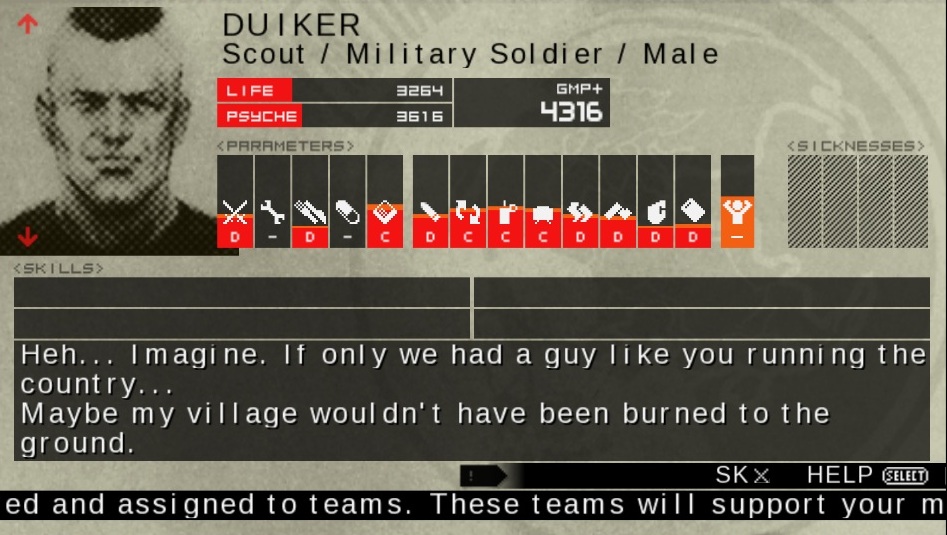
Indeed, why not?
In general, it seems like the game only deserves praise. What’s wrong with it? It’s simple – a bait for hardcore players in the form of 130 additional missions, which, although not mandatory, reveal additional moments in the plot and allow you to develop the MSF base. In fact, the “true” ending and the diary of one character are only unlocked in these additional missions. Of course, someone will argue that this is my personal problem, and in principle, they will be right, but I still don’t like these kinds of tricks.
Overall, I liked the game, but not enthusiastically. A solid plot continues to develop the previous part, which, despite all its shortcomings, managed to convey an important internal change in the character, and essentially leads us to the point indicated in the epigraph. Some moments are simply executed superbly, it’s really touching – you can feel the master’s hand. However, all this is multiplied by a rather primitive and repetitive gameplay and filler content for hardcore players, which is disappointing. I won’t praise Kojima, he praised himself enough in the game, unfortunately, I forgot to take screenshots, but I’m not too lazy to make other screenshots, the purpose of which was to create the right atmosphere so that we would feel the spirit of MSF. I posted the best ones directly in the text, the rest I’ll add in the appendix.
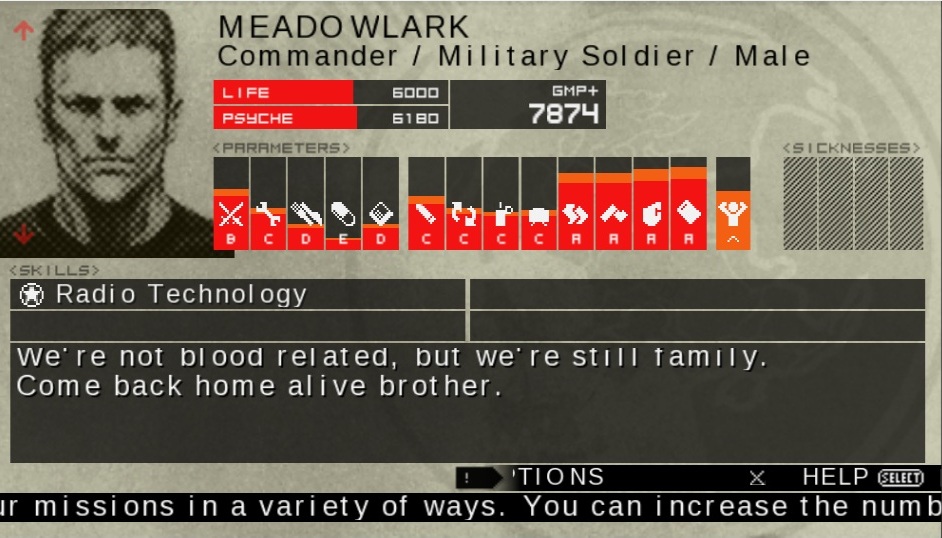
Oh, and here’s a small bonus. I don’t think you’ve ever translated this name this way, have you?
Where do we end up when we save the world?

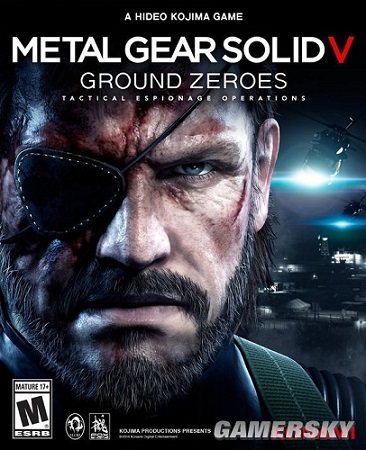
Release year - 2014. We enter the main menu and just exhale - finally! We are in the modern era! Let's say no to ancient fossils with outdated graphics! Yes, how long I've been waiting for this moment. In the menu, there is an option to view the backstory, where Snake is briefly mentioned, then the events of Peace Walker are retold in more detail, and then we are transported to the present. Even simple text blocks are beautifully designed - everywhere there are epigraphs with phrases from the characters, and in the background, there are beautifully processed and significantly improved pictures from the terrible comic. Having enjoyed this beauty, we listen to cassette recordings in the menu, which briefly describe the plot, and there is also an opportunity to listen to the secret diary of one of the heroines from the previous part, which could previously only be obtained by persistent grinding; now we can finally start the game.
And immediately we start watching a video - in principle, this is a common thing for video games. But a video from Kojima, and on such an engine - it's just superb. I must especially note the engine's graphics - it is head and shoulders above some games released in the same year, and in my humble opinion, it surpasses even those games that were released a year later. So, having enjoyed the beautiful and spectacular scene, we move on to the game itself. The scene before it immediately sets the atmosphere - night, heavy rain, gloomy soldiers in poncho-tents - and this atmosphere lasts until the very end of the game. After that, the game itself begins - in the dark, splashing through the mud, trying to avoid the piercing light of huge spotlights or the more modest light of lanterns, we try to save prisoners from the infamous military camp, which housed, among other things, refugees from Cuba. At first, I was surprised by how much they casualized the game, adding some kind of "reflex mode" - a thing that slows down time when an enemy notices you and gives you the opportunity to take him down with an instant headshot. However, soon I remembered that I am no longer playing on an emulator and can no longer save at any convenient moment, but I have to rely on checkpoints - and I began to treat this as a necessity. Although, maybe I'm just clumsy. Another simplification of the game is the ability to mark enemies through binoculars, allowing you to know where they are for the rest of the game once you see an enemy. On the one hand, it seems to oversimplify the game, on the other hand, it turns the binoculars from useless junk into a really useful thing during the game. In addition, there are quite a few "blind" corners in the camp, where you can only see an enemy by bumping into him face to face.
Finally, we left the console corridors and begin to wander through a huge area. Finally, we can no longer, as in Peace Walker, kill all the enemies on the level and run away from it before it becomes a problem. And even more than that - the prisoners can no longer be picked up with an air balloon, which will immediately take them to the base. No, honey, if you want to save a person, be kind enough to carry him on your back, call a helicopter, throw the person there, and pray that the helicopter is not noticed, and if it is noticed, that it is not shot down. In general, the gameplay is just great, and much more complex than Phantom Pain, which was released a year later, in which the reflex mode became twice as long, and the enemies do not see you in the light of day, where the enemies in Ground Zeroes see you at night and in heavy rain. And the plot? After the bland plot of Peace Walker, you are simply amazed by the plot of this game - and no, it is not complex, it is quite simple, but it is emotionally rich, it is filled with darkness, pain, and despair. How did Kojima achieve this, you ask? Very simply, he did not spread the plot in a thin layer of oil over a million hours of gameplay. The whole game takes two to three hours to complete without prior experience and less than an hour if you have already played at least Phantom Pain. Yes, what used to be called a demo version is now called a full-fledged game, and they ask for as much as 600 rubles for it. And to tease the fans, who still have a year to wait for the real game, some collectibles and simple side ops were added - there are four of them, and they take about twenty minutes each, but that's the maximum. This is what kind of contradictory feelings the game evokes - on the one hand, it is wonderful in all aspects, and on the other hand, it is only a demo of a full-fledged game and a scam to get people to give them their money. However, from a commercial point of view, the move is simply brilliant - and not even because this thing is paid, but because its short plot leaves the player in painful anticipation of the next part, seriously, my first thoughts after finishing were - "good thing Phantom Pain has already been released and I can download it right now," I sincerely feel sorry for the people who went through this painful anticipation - and, thereby, played their role in the hype for the upcoming game. In general, I really liked it.
And, of course, I don't want to forget the wonderful song that made me read an article on Wikipedia about Nicola and Bart, and finally find out in honor of whom one of the streets in my city was named.
Where do we end up when we save the world?

В тихой однообразной жизни всегда так бывает: каждый отдельный день бесконечно долог, но месяцы и годы мчатся с непостижимой быстротой.
I wanted to offer you some flowers, but a crown would suit a princess like you much better
Смысл жизни в том, что жизнь на тебе не заканчивается
The final scene of a side quest, which is easy to miss, and which is made from the most boring mechanic in the world and generally takes up only 2% of all the content, is the most powerful scene in the entire game. I don't even know what else to add.
Where do we end up when we save the world?
I had to stop playing it almost a year ago. Didn't feel like going back. I followed the main quest to finish it quickly, and I did. I played as a mage. You hit with lightning in an area, throw chakrams, jump, it's fun.
Небо – угроз не слышит
Небо – ведёт особый счёт
Небо – тебя найдёт
I remember being very eager to play this game even before it was announced. This is easy to explain – I really enjoyed the second part and spent many hours having fun with its gameplay. It’s a pity that the third part of the series didn’t live up to any expectations.
Gameplay
-There is no replayability; I have no desire to play this game again and again – it has nothing to offer me in this regard.
-This game has no stats or skills that the player can upgrade – there are essentially no builds. Levels are gained very quickly, and there is no uniqueness to the items; they are not memorable. There is also no clear distribution of difficulty levels – there are many of them, but there is no point in them other than for cyclical playthroughs. All that remains is to farm for a monotonous paragon level and craft/reroll equipment stats a million times, like in an MMORPG.
-Although I played through the game with three classes, I can say that I don’t want to play it again after a single playthrough.
Story
In such games, the story has very little significance, but in this particular case, I think it is necessary to say the following: this is a case where the lack of any interactions between the player and the bosses (other than battles, of course) is a good thing. If previously they could be perceived as terrifying demons, monsters, etc., now they can only be seen as crazy fools.
The same can be said about many NPCs, in particular Tyrael – he is simply pathetic.
Style
When I learned that an angel would be the antagonist of the new Reaper of Souls expansion, I was very intrigued, as the theme of fallen/dark angels has always been interesting to me. However, as expected from Blizzard Entertainment, they managed to ruin even this idea. In the new act, you could see the same undead in already eye-watering colors, a poor design, hunchbacked angels with flamethrowers in their hands, etc..
Of course, it is quite possible that I am judging unfairly, as I am comparing it to the second part, but that’s how it is. 4/10 – just to have some mindless fun in the evening.
Added 4 minutes ago
I also replayed Enclave (ARPG, 2003), which I played around 2007 or even earlier. 6/10.

An interesting, but tiring and awkward combat system; pleasant level graphics; I liked the presentation of the simple plot (you travel around the map with mini-events) and the length (by the time it gets boring, you're almost at the end). 6.5/10, half a point for not being annoying at all. Fans of strategy games might like it even more. And there's a strange overheating of the video card up to eighty degrees.

Ancient Japanese commando; the atmosphere, level design, graphics, and story are nice; the main problems are minor pathfinding and 3D camera issues. 8/10

Objectively, the game is terrible, and no one should play it. You just walk from point A to point B, constantly shooting at endlessly respawning Genestealers. But I suddenly really enjoyed the atmosphere – the perfect and diverse level design of the abandoned spaceships, a decent number of weapons, and overall, an authentically implemented Terminator-style gameplay with alien innards flying from bolts and alien carapaces crunching underfoot. Subjectively, 6/10.
The characters, plot, and atmosphere are top-notch. I've never experienced a game where I liked and was interested in every single character, including those with minor or insignificant roles in the plot.
If I had to choose my favorite character, it would be Oliver.
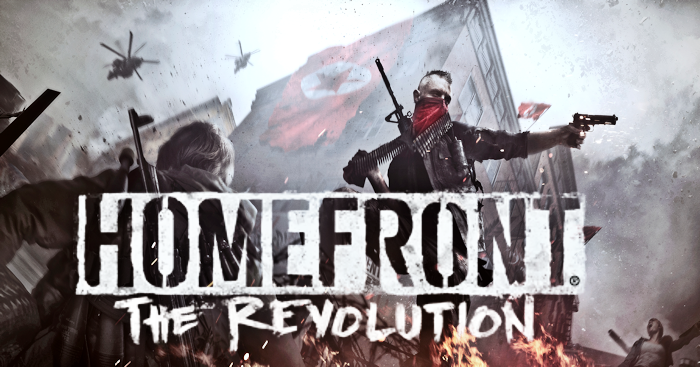
As has been my habit lately, I stumbled upon a random modern shooter in the list of new releases and dove in blindly. It has a 5.5/10 rating online, and honestly, it doesn't deserve much more – it's a monotonous, typical Far Cry-like open-world game with simplistic everything. However, I enjoyed it (I've played all the Far Cry games since the third one with pleasure, including the "humorous expansions." I guess it's my genre), and I happily played it periodically for several weeks. Maybe I just haven't played a good shooter in a while, but the shooting mechanics here are well done – great sound, weapons with attachments, and a satisfying feeling when firing. The design and atmosphere are also appealing – modern urban combat in a war-torn city. The three one-and-a-half-hour DLCs nicely polish the simplistic story, leaving you with the feeling that you've actually accomplished something, rather than just wasting a few dozen hours in a generic FPS sandbox with gameplay that feels five years outdated.
Subjectively – 7/10.
Небо – угроз не слышит
Небо – ведёт особый счёт
Небо – тебя найдёт