


Skip to content

Posts from Quiz Auto-translated

5.0 (1 rating)
In reply to Ple-Sen
User Avatar
#692
Auto-translated
Ple-Sen
Why not? The hour hand has 24 static positions in a day. The minute hand forms a 120-degree angle with it once in the first half of the hour and once in the second half of the hour. That is, twice an hour. 2x24=48.
I cannot answer to avoid giving a hint. It's not 48.
Всё не так плохо как Вы думаете. Всё намного хуже!

User Avatar
#693
Auto-translated
72?

Whatever
In reply to Ple-Sen
User Avatar
#694
Auto-translated
Ple-Sen
These are some very specific watches.
Just regular watches with a dial. :)

Added after 33 seconds
Heroist
72?
No.
Всё не так плохо как Вы думаете. Всё намного хуже!

User Avatar
#695
Auto-translated
How many times a day does the hour hand form a 120-degree angle with the minute hand?
That is, there are 20 minutes on the clock face between them, in one direction or the other. Each hour equals five minutes. The speed of the hour hand is v1 = 5 minutes/hour.
The speed of the minute hand is v2 = 60 minutes/hour.
The hour hand is 120 degrees behind => (v2*t - v1*t) mod 60 = 20 => (55t) mod 60 = 20
Conversely => (v1*t - v2*t) mod 60 = 20 => (55t) mod 60 = 40
t ranges from 0 to 24 hours.
We can see that t must be a multiple of four (or eight in the second case), but not a multiple of three.
t = 4 => 220 mod 60 = 40
t = 8 => 440 mod 60 = 20
t = 16 => 880 mod 60 = 40
t = 20 => 1100 mod 60 = -100 mod 60 = 20
I don't know, something doesn't quite seem right here, but for now, the answer is 4.
 

К А
Стикеры GBF в Telegram
User Avatar
#696
Auto-translated
So, what is the answer? If it's 4, then it's incorrect.
Всё не так плохо как Вы думаете. Всё намного хуже!
User Avatar
#697
Auto-translated
No, that's a very strange answer. I don't understand why I couldn't make the arrows point in the correct directions every hour. In theory, this should be obvious from those calculations, but it isn't...
So, what's the answer? If it's 4 (four), then it's incorrect.
Yes, it's incorrect.
 

К А
Стикеры GBF в Telegram
User Avatar
#698
Auto-translated
Ah, yes, I was wrong. Any tricky non-integer values of t, like 4/11, 8/11, and so on, will work... In short, it's easier to write it like this:
t' mod 12 = 4
t' mod 12 = 8
t' = 11t (from 0 to 264)
t' = 16, 20, 28, 32, 40, 44, 52, 56, 64, 68, 76, 80, 88, 92, 100, 104, 112, 116, 124, 128, 136, 140, 148, 152, 160, 164, 172, 176, 184, 188, 196, 200, 208, 212, 220, 224, 232, 236, 244, 248, 256, 260
That's 42 variations in total. It seems more accurate, and I'm acting like a maniac.
 

К А
Стикеры GBF в Telegram
User Avatar
#699
Auto-translated
22 (or 44, since the hour hand makes two full rotations in a day) – these are my latest guesses.

Whatever
User Avatar
#700
Auto-translated
Ment, 42 - that's incorrect.
Heroist, why 44?
Всё не так плохо как Вы думаете. Всё намного хуже!
User Avatar
#701
Auto-translated
t' = 16, 20, 28, 32, 40, 44, 52, 56, 64, 68, 76, 80, 88, 92, 100, 104, 112, 116, 124, 128, 136, 140, 148, 152, 160, 164, 172, 176, 184, 188, 196, 200, 208, 212, 220, 224, 232, 236, 244, 248, 256, 260
Total: 42 options. It seems correct, and I'm a maniac.
Sorry, t' = 4, 8 also works. Total: 44, Heroesist is right.
 

К А
Стикеры GBF в Telegram
User Avatar
#702
Auto-translated
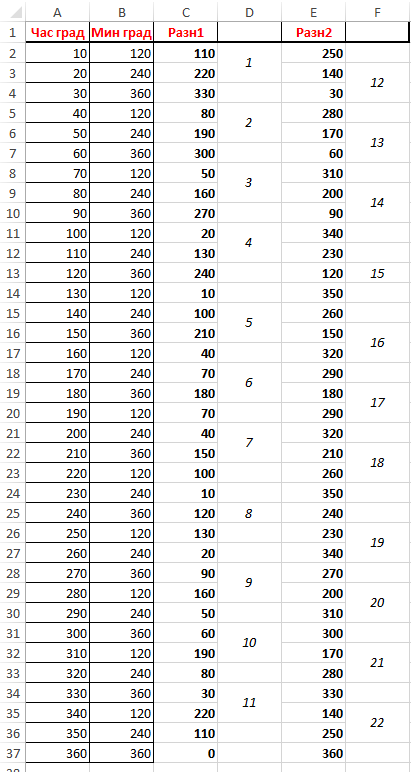
Well, look, in an hour, the minute hand covers 360 degrees, while the hour hand covers 360/12 = 30 degrees. Therefore, the speed of the minute hand is twelve times greater than the hour hand, and for every degree covered by the first, the second will travel twelve times further. Starting from the same reference point (00:00), we get that for the first degree of the hour hand, the minute hand will move 12 degrees ahead, resulting in a difference of 11 degrees. Here, I made a mistake in thinking that it wouldn't be easy to calculate the answer, as the exact number of repetitions per hour is not a whole number, and therefore I was only calculating approximate intervals in degrees, between which the distance between the hands should be 120 degrees. It was also important to consider two factors. First, we need to remember to additionally calculate the reverse angle between the hands, and also the fact that the hour hand makes two full rotations around the dial in a day. Here's a table for clarity.

Whatever
User Avatar
#703
Auto-translated
Yes, 44, but your Ment solution is too complicated for me. I'll try to understand it now, but I figured it out much simpler myself. My solution: The 120° angle will occur when the minute hand is 120° (2π/3 radians) or 240° (4π/3 radians) ahead of the hour hand. The angular velocity of the minute hand is wm = 2π rad/hour. The angular velocity of the hour hand is wh = π/6 rad/hour. First, I calculated how many times the hour hand would be ahead of the minute hand by 2π/3 radians. It will be ahead when the angle between them is 2π/3 + 2πn, where n is the number of revolutions it has already overtaken. But since we already have one instance when 2πn = 0 (n = 0), and we need to find the number of times, I wrote the expression for the angle as 2π/3 + 2π(n120 - 1). The angle that the minute hand travels in time t hours is wm*t. The angle that the hour hand travels in time t hours is wh*t. The angle by which the minute hand will be ahead of the hour hand is: wm*t - wh*t = (wm - wh)*t Thus, we get the following to calculate the number of times the minute hand will overtake the hour hand: 2π/3 + 2π(n120 - 1) = (wm - wh)*t t = 24 hours. 2π/3 + 2π(n120 - 1) = (2π - π/6)*24 n120 = 68/3, which is 22 whole times. Then, I found how many times the minute hand overtakes the hour hand by 240°. Here, the angle is 4π/3 + 2π(n240 - 1). The expression is: 4π/3 + 2π(n240 - 1) = (2π - π/6)*24 n240 = 67/3, which is also 22 whole times. Total: n120 + n240 = 22 + 22 = 44 times. Added 7 minutes later Since Heroist was the first to write the correct answer and has a different explanation, I think it's right to say that he was the first to solve it. Now, it's your turn, Heroist!
Всё не так плохо как Вы думаете. Всё намного хуже!
User Avatar
#704
Auto-translated
Yes, 44, but your Ment solution is too complex for me. I'll try to understand it now, but I figured it out much simpler myself.
It's very simple; I just calculated the exact moments when the situation occurs. Based on the Heroist's solution:
Here, I messed up by not realizing that it wouldn't be easy to calculate the answer because the exact number of repetitions per hour isn't a whole number.
I calculated it.
 

К А
Стикеры GBF в Telegram
User Avatar
#705
Auto-translated
Oh, now I have to come up with something... I'd give this honorable task to Ment, if he doesn't mind, because right now my mind is blank, and I'm not really interested in googling something.

Whatever
User Avatar
#706
Auto-translated
I won't make any wishes right now either, sorry, Heroes fan. (Go ahead, you make a wish. If you don't want to, that's fine, not right now. If you don't feel like it or don't have any ideas, I'll come up with something tomorrow.)
 

К А
Стикеры GBF в Telegram