


 Heroist

Auto-translated
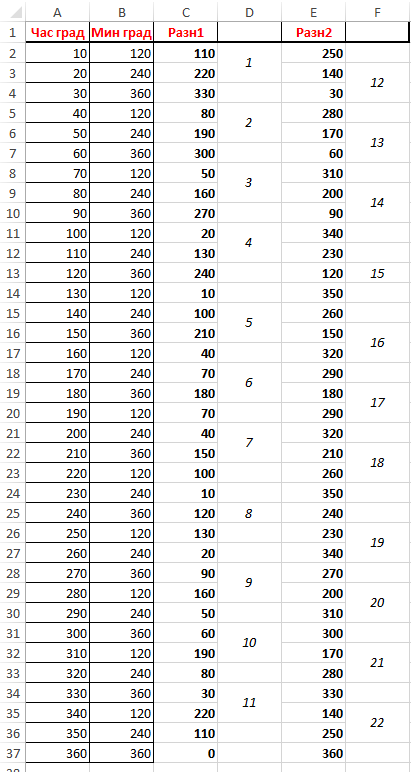
Well, look, in an hour, the minute hand covers 360 degrees, while the hour hand covers 360/12 = 30 degrees. Therefore, the speed of the minute hand is twelve times greater than the hour hand, and for every degree covered by the first, the second will travel twelve times further. Starting from the same reference point (00:00), we get that for the first degree of the hour hand, the minute hand will move 12 degrees ahead, resulting in a difference of 11 degrees. Here, I made a mistake in thinking that it wouldn't be easy to calculate the answer, as the exact number of repetitions per hour is not a whole number, and therefore I was only calculating approximate intervals in degrees, between which the distance between the hands should be 120 degrees. It was also important to consider two factors. First, we need to remember to additionally calculate the reverse angle between the hands, and also the fact that the hour hand makes two full rotations around the dial in a day.
Here's a table for clarity.
Whatever