Connection ErrorBad RequestThis page went staleSession ExpiredSign in requiredForbiddenNot FoundToo Many RequestsServer ErrorBad GatewayService UnavailableGateway TimeoutHTTP Version Not Supported
Session Expired
Your session has expired. Please log in to continue.
Sign in required
You need an account to do that. Sign in or create one — it only takes a minute.
This page went stale
Your security token was rejected, usually because the page sat open too long or you signed in elsewhere. Nothing was saved. Reload the page and try again.
Request Failed
We encountered an issue while processing your request.
Please check your internet connection and try again.
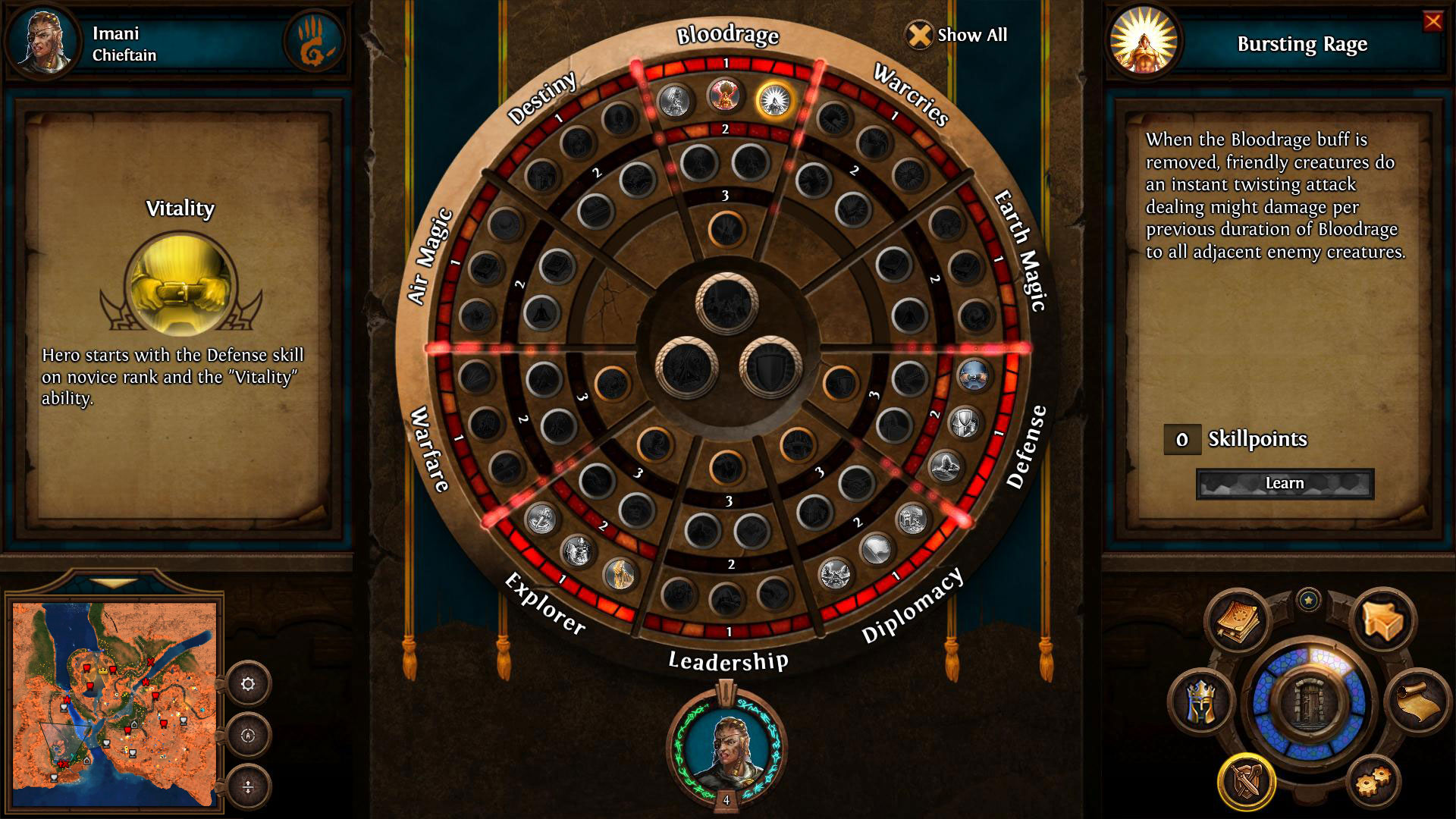
AstralLein, I'm sorry, but in the so-called "skill wheel," I can only mindlessly learn all these sectors at the "Novice" level. :( Can you tell me how to advance to the "Master" level and then to the "Expert" level? Also, some gamers say that there are skills within the skills (sectors of the wheel), but they don't explain where they are. :smile54: Do you know?
Sincerely, Virgin_Sorcerer_Marat
Added after 3 hours and 3 minutes And does a mod for Heroes 7 exist that can eliminate the "lag" in the game when assigning a new turn to heroes, when exiting a city, etc.? Because it really interferes with playing and is a bit annoying, since the game is not only very beautiful, but since the creation of the Shadow Council, it has become my most beloved game in the series, a super-cult game. :cool: I would really like to play Heroes 7 as smoothly as I play the Might&Magic Heroes 3 RoE HD Edition that comes with it!
The skills are arranged in a circle. You click on them to increase their level. The abilities are inside the sectors. If the skill level allows, you click on it to upgrade it.
Most likely, he doesn't understand that you can increase the skill level by clicking on the sectors, for example, from level 1 to level 2 and from level 2 to level 3.
Thank you very much, dear gentlemen! But I didn't wait for those stingy and still unclear phrases about "jamming," as my internet connection failed last night. There are many detailed guides for other Heroes games, but for Heroes 7, there's nothing, and even when you ask for help, you get stingy and unclear responses. It's a pity! :(
Hello! Last time, I didn't receive a satisfactory answer, but I managed to figure it out myself, bit by bit. Now, I want to ask the community again. In my hero's spellbook, not only are the spells of the magic schools that he can learn displayed, up to the second level, but my hero is already successfully using them. :eek: At the same time, spells from the most desired magic school, Light Magic, even at the first level, are not appearing in his spellbook. :( Is this normal behavior for hero magic learning in Heroes 7, or is it a software bug? Perhaps some people don't like that I'm asking these questions, but isn't the forum meant for asking questions?
Hello! Last time, I didn't get a satisfactory answer, but I somehow figured it out on my own. Now I want to ask the community again. In my hero's spellbook, not only are the spells of the magic schools that he is capable of learning displayed, up to the second level, but my hero is already successfully using them. :eek: At the same time, spells of the most desired magic, Light Magic, even of the first level, for some reason do not appear in his spellbook. :( Is this normal behavior for Heroes 7 regarding a hero learning magic, or is it a software bug? Perhaps some people don't like that I'm asking these questions, but isn't the forum designed for asking questions?
Yes, that's how it should be. Just like in Heroes 5, spells are found quite randomly.
Hello! Recently, due to the release of additional official information from Ubisoft, I had to discard almost all the heroes I used to play with in Heroes 7.:mad: I need to introduce additional heroes into the game through modification, either by adding heroes that are not currently in the game or by changing existing heroes.:( The first option: similar to Frozensoull's Shiva mod, I am requesting the creation of a Shiva mod for Heroes 7. Frozensoull and all his acquaintances are not familiar with modding Heroes 7. According to Ubisoft's EULA license, creating paid levels for the game is, for some reason, prohibited, so, no matter how much I would like to do it, I am unfortunately not allowed to offer payment for your intellectual efforts in this area. We can discuss the details if I find a modder willing to help me. The second option: unlock one of the heroes intended only for campaigns and not featured in the game itself (Ranlet would be suitable for me). This also requires modifying the game, for which, unfortunately, I cannot offer any reward again, as Ubisoft explicitly prohibits this in its EULA. The third option: change the biography of an existing hero, i.e., change the text of the Encyclopedia, which is launched in the game program. In Heroes 7, hero biographies are only displayed in the Encyclopedia, not in the game itself. If I remove the epithets "wild" and "bloodthirsty" from Shani, I will be able to play as her. This requires modifying the Encyclopedia. While studying Unreal Editor, I do not yet see the possibility of changing a hero for ALL maps at once, rather than modifying a single map. A mod is needed. I am asking for help because now I have no one to play as in Heroes 7. Previously, there were such heroes: Angel Orna from the Alliance of Light - it turns out she only seeks to cover up the consequences of Uriel's Deception, and is not a repentant sinner.:mad: Irris from the League of Shadows - she appeared in Heroes 6: The Darkening as a cruel executioner, rude and discourteous even to Railag, whereas I saw her as a messiah who would turn the dark elves to worship Elrath, bringing Morality and virtue into their lives.:mad: Dark Storm from the League of Shadows - it turns out she has the specialization "dark prophet" (i.e., the same as Dark Messiah Sareth).:mad: Tieru from the Forest Union - it turns out she is filled with hellish hatred towards demons and hates any of them, pursued and killed dark elves, which is incompatible with the concept of divine love, mercy, compassion, and tolerance, but rather, wild xenophobia.:mad: Lasir from the Forest Union - it turns out she only thinks about having children. I am a Virgin Sorcerer, and iron virginity is infinitely precious to me, and my heroes should also be iron virgins.:mad: Shani from the Unaligned Tribes has the epithets "wild" and "bloodthirsty" in her biography.:mad: After much deliberation, I finally realized that Alessia from the Alliance of Light has the perspective of an ordinary person, and not a spiritual leader of the nation. I used to tolerate this only because she was the second hero after a more important one. Therefore, I cannot take her as my main hero either.:mad: Please help me prepare a suitable hero for the game!!!:smile15: May Elrath help us!
Added after 19 hours 59 minutes I have achieved significant success:cool: in mastering Unreal Editor: I created my own map that works without errors, where my custom hero is available in the hero pool: an Inquisitor from the Alliance of Light with the face of Irris, which impressed me as the face of a heavenly saint. I don't yet know how to set the settings so that my heroine can be chosen at the start of the game; for now, the hero is determined purely randomly. In any case, this is a chance.:) If a modder willing to help me is not found:(, I will create many maps for myself and play only on them with my own heroine - a heavenly saint, a virgin sorceress of Elrath (Virgin Sorceress of Elrath) of the Inquisitor class.
Hello!
Perhaps someone knows in which building on the adventure map you can hire Krakens. On the "Alternative History" map, the yellow player (I'm playing as the orange player) always has two or more Krakens in their army. I've searched for the corresponding dwelling, but I can't find it! Thank you in advance.
Sincerely,
Virgin_Sorcerer_Marat
And yet, I repeat the question: how and where could one obtain a Kraken hero for their army? I really love creatures like the Kraken, and I literally admire the Kraken itself. I really need my hero to have Krakens in their army; I need it desperately!!!
Perhaps, after so much time, there will be those who want to create mods for Heroes 7, primarily focusing on porting Shiva from Heroes 3 into it? :( After all, so much time has passed...
can you tell me if there is a hotseat mode in Heroes 7, where three people and several AI opponents can play in 4 teams against each other, for example?
I selected the "play on one computer" mode, but it immediately starts a battle. And you can only choose one AI opponent. That's no fun.
Hallelujah! I found it! Multiplayer - Adventure - On one computer They really hid it away...
But I would still like to comment on the general playability. My friends and I have played a fair amount of Seven and have come to a disappointing conclusion: the Factions are balanced terribly. Three strong ones stand out: Necropolis, Dungeon, and Stronghold; Tower occupies a middle ground, and the rest are outsiders. Briefly, here are the strengths and weaknesses: 1. Necropolis. This one is obvious—the ability to get huge stacks of skeletons and ghosts, which is what the center perk is designed for, by the way. Builds are primarily focused on attack and initial magic (immediate teleport for two numerous squads, resulting in -2 enemy stacks). The ability to necro-convert creatures obtained through various means, including those accepted via diplomacy, which, by the way, works quite decently in Seven. The units themselves are good, especially spiders and liches. 2. Stronghold. A cheesy ability for 50% magic resistance, which gives them a huge advantage over Tower (regardless of whether Tower plays through Air or Water—it doesn't matter). A racial ability with obvious utility in battle. The building for doubling growth is insane (it's unclear why one would want to crush tons of kentaurs or behemoths with Castle, for example). Wild Orcs with massive damage, and for some reason, they were buffed even further in the patch. But the most important part is, of course, the Behemoths, which wipe out half an army in one jump with 95 damage (I don't know if the -50 defense ability applies here). Moreover, they can jump even when the field size is above average; it's strange that Behemoths didn't have a jump in Three or Four, as it's very logical)) The only partial counter to this is placing additional small squads in front of important stacks using advanced tactics. At levels 20+, Stronghold dismantles almost anyone, except for Necropolis and—if the opponent has high initiative—Dungeon. The latter's troops must act very quickly, but after hundreds of "final" battles between them, one could say it's practically a balance (depending on the battlefield size). 3. Dungeon. With high initiative, they dismantle "good" race troops before various marks, metamagic levels, runes, etc., can accumulate. For Dungeon with its double damage, all these long-term abilities matter little, because assassins, dragons, and constructs on small fields reach/shoot and destroy everything immediately. If luck procs, then you're completely doomed. The presence of an artifact market allows buying items, primarily for initiative and damage. Unreasonably strong Minotaurs—yes, they aren't very fast, but because of the first strike, they don't really need to be. Regarding Tower, it should be noted that if it develops through Air (since building through Light is useless—magic with minuscule damage and equally laughable heal/res, they deal thousands of damage to a stack, while it heals for 200-400 HP)) it can win against Dungeon on large fields, and on small maps, it is quite capable of tearing apart Necropolis via Vortex, but serious problems arise with Stronghold. At the same time, Tower wins relatively easily against Fortress, Castle, and Rampart, because when the opponent has a defensive setup, the metamagic damage becomes colossal. In our experience, the weakest are Castle and Rampart. No matter what builds we tried, people just can't cope with Orcs; the situation is practically a mirror of what happened in Three. Two downgraded units (monks and knights). The latter are a total horror—they have never been this weak, not even in Four. The same Minotaurs have 1.5 times more HP, better skills, and more damage. Cavalry run up to them, get hit by an axe—immediately minus a significant part of the stack—while they themselves deal little damage (attack accumulated due to distance, not damage like the champions of a healthy person). Monks were replaced in Six and it immediately became better. Shots at their level of attack and damage are simply laughable. Of the entire army, only wolves and justiciars are more or less normal. Archangels are also some kind of incoherent—slow, with low damage and fairly low skills. Things aren't any better for Rampart. Let's take two units again—dancers and deer. The former are slow DDs with average stats who get torn apart on the counter-attack, and the latter are completely incomprehensible. Deer HP is average, skills are low, no combat skills. They barely serve as meat, but using expensive penultimate-tier creatures as meat is a questionable idea. Some Orcs or Troglodytes can handle taking hits, but from level 6 units, a clear impact is expected. Again, by the time those marks accumulate on one unit, half your army will be gone. The situation could have been slightly improved by buffing Earth and Light magic, although the general rule that both magical and physical builds of any faction should reasonably withstand similar builds from other factions still applies. For example, whose idea was it to make AoE buffs, which have always been mass-effect? Probably the same person who introduced the zek rule "don't turn your back")) How can an army under a mage's leadership withstand a force oriented toward offense and fast closing with the enemy without strong mass heal, mass slow, or mass stone skin? Granted, magic smooths out the imbalance slightly; in a Fortress-Stronghold match, for example, berserk for Dwarves helps. A little, though. However, Castle-Rampart, Rampart-Fortress, and Castle-Fortress matches can be interesting. That is, there are essentially two tiers of factions: strong and weak. Consequently, the game balance between them requires a fundamental overhaul.
I think you haven't fully grasped the game to make such definitive conclusions. Here's just one example with the deer: it provides a huge advantage in the form of initiative, and that's in addition to its high morale. I think it goes without saying that the first turn largely determines the course of the battle. In my experience, combat skills are inferior to magical skills, as mages can increase their strength many times over.
Hello! In Heroes 7 (licensed version), the game crashes when loading a save file (apparently, near the end of the loading process). I've tried different save files, and they all cause crashes, although everything was fine before. Where should I start looking for the problem? I've verified the integrity of the files and reinstalled the game, but nothing helped.
Czerna, the game wasn't fully polished before release, as Ubisoft (citing a lack of player interest) discontinued development of the project. As a result, the game has many bugs. Your problem is common, and I experienced it as well. Try reinstalling the game and see if that helps.



 AstralLein