Skip to content

Posts from Tales from a parallel world.

5.0 (1 rating)
User Avatar
10 years ago
Auto-translated
Consequently, the left hand is considered unclean and only suitable for this and for handling shoes. Therefore, eating with the left hand causes such shock among the locals.
:(
User Avatar
10 years ago
Auto-translated
Hmm... one thing you definitely shouldn't do in Asia is stress out. It's all good and easy.
If you're going for a couple of weeks, you can just relax – after all, what can you expect from a tourist? They understand this in tourist areas; they're used to it.
But if you're going for a long time, at least left-handed people are warned in advance.)
By the way, I, a strongly right-handed person, used to always give money with my left hand. I had to retrain. So, it might actually be easier for left-handed people.

I became so curious that I even went to a website for Muslims. For them, it's even written in the Quran. In general, I think it's a normal answer: http://islam-today.ru/veroucenie/poklonenie/moj_muzh_levsha_nuzhno_li_emu_pereuchivatsya_na_pravuyu_ruku/
User Avatar
10 years ago
Auto-translated
Was she giving money with her left hand? Well, that makes sense, if the left hand is considered unclean, then it should be used to handle these far-from-sterile bills.
User Avatar
10 years ago
Auto-translated
Fences

Took this photo in Nepal with my phone. However, it's the same in India: broken glass, nails hammered down head-first, sometimes barbed wire...
Everything best is for our smaller brothers)))


Attachments 2
2 files attached • Total size: 65.0 KB
User Avatar
10 years ago
Auto-translated
Excellent fence. :smile20:
User Avatar
10 years ago
Auto-translated
It’s true that even such fences don’t always help. If you forget to close the windows, you might come home and find a mess there and uninvited guests who are behaving rowdily and trying to steal something as a souvenir if they get the chance. Fighting them is pointless – it will only cause more trouble for yourself. You shouldn't look them in the eye; they might think it's a challenge to fight. But you can throw various heavy objects at them that happen to be nearby. Kipling was right – they are a crazy tribe.
Attachments 1
1 file attached • Total size: 50.9 KB
User Avatar
10 years ago
Auto-translated
Sesame
broken glass, nails with heads facing down, sometimes barbed wire...
Not enough voltage. About 1000 volts would do...:D
Sesame
It's pointless to fight them - it will only hurt you.
Can you shoot them?:smile04:
In reply to Злобный Ящур
User Avatar
10 years ago
Auto-translated
Evil Lizard
Not enough voltage. About 1000 volts...:D
Everything is fine with the voltage. At least, this kind of thing really bothers me on the streets. Especially when it also "sings" and sparks :D
Although usually, "sparking" ends with technicians arriving, who turn off the power for a couple of hours and fix something.)


But monkeys don't seem to bother anyone.
They calmly jump along these poles, reaching the desired floor.
Evil Lizard
Can they be shot?:smile04:
No, because ahimsa – non-violence and other religious commandments.
And besides, there isn't much to shoot at. The caste of Kshatriya warriors is usually the army and police; they have nothing better to do than chase all sorts of creatures. And the rest won't take up arms, because that's not the purpose of a Brahmin or Shudra.
Attachments 1
1 file attached • Total size: 23.3 KB
User Avatar
10 years ago
Auto-translated
Puri, Odisha (Orissa), India
Ocean


The ocean beach is the cleanest and most deserted place in Puri. There's no litter here because the ocean is a deity that has repeatedly shown its character and strength by flooding huts on the coast during summer storms and floods, washing away local residents dozens or even hundreds at a time into its fathomless depths.
Locals fear and respect it. Most of them wouldn't think of venturing into its embrace willingly. In fact, only fishermen know how to swim among the locals.
Mostly visitors bathe here. From Bhubaneswar, Kolkata, and even Delhi. Women enter the water fully clothed – no one in their right mind would expose their naked bodies to strangers. Men can afford to undress, although they don't always do so.
The eastern coast, this local resort "for our own," is very different from western Goa, where Russians and other foreigners like to hang out. Here, we, "Russians" (because all Russians here are Russians, Ukrainians, Belarusians, Kazakhs) accept the rules of the game and also bathe in clothes. You go to the shore – the wind and heat dry your clothes in minutes. Although you can walk along the coast outside the city to wild beaches where no one will stare with greedy eyes at blondes in bikinis. Sometimes we do just that. Of course, with companions. Because there have been cases involving women who like to sunbathe alone.
I guess everyone has their own "source of strength" - something that gets you back on your feet in a few days, cures fatigue, dispels thoughts about the futility and insignificance of life. The sea has always been my salvation. Fortunately, it takes only a couple of hours by bus from the city to the coast. A small, shallow Sea of Azov, a village with two streets, off-season – May or September, a deserted beach, storm season... Normal people don't swim at this time. But those who aren't normal gather in groups of 3-4 people and have a great time jumping over waves and diving under them.
In Puri, everything was exactly the same. March, empty beaches, the beginning of the storm season. Although, of course, the ocean is not a small, shallow sea. The waves here are bigger and stronger. In another month or two, swimmers will be replaced by surfers on boards – maybe a couple for the entire coastline )) And until then, you can still dive and jump, dodging unusually high waves, without letting them knock you down, or if they do, hold your breath and control your body so that the "backwash" doesn't drag you into the depths.
The Indians didn't understand this extreme activity but watched with interest and true Indian impudence, sitting on the beach (which was empty!) right opposite our location. Observers :D Or contemplators, I don't know.
After sunset, even the "wild Russians" didn't risk going into the water. At this time, a small market appeared on the shore for strollers - street food, masala tea, ice cream, glowing toys, and kites with lanterns. And stalls – two or three rows, standing right near the surf line. After all, locals know how to contemplate :) We also got used to this pastime: we buy masala tea or "Cola," sit on a bench facing the ocean. And we contemplate... You can watch these raging waves at your feet for hours.
Attachments 2
2 files attached • Total size: 34.3 KB
User Avatar
10 years ago
Auto-translated
The Rainy Season.

In India, the rainy season is in the summer.
It's similar to our autumn – cloudy skies, a wall of water, everything is wet... However, the air temperature approaches 40°C, the water is very warm, and when the rain stops, it feels like being in a sauna.
Sometimes, the rain lasts for several days in a row, and it floods so much that you have to live on the roof. But usually, it's not that bad.
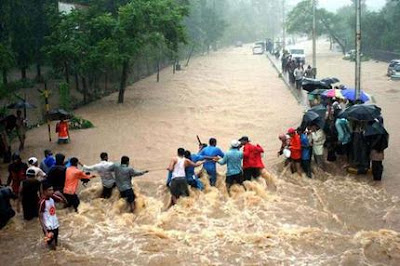

Mumbai (formerly Bombay)

For tourists, summer is considered the "off-season".
Because, in addition to the water, there's an unpleasant thing called mosquitoes, and with them come malaria and dengue fever.
And, of course, there's the controversial issue of washing away the garbage that Indians throw on the streets all year round. Of course, it's good that the streets are clean after the rain, but you can only imagine how much junk that water carries.
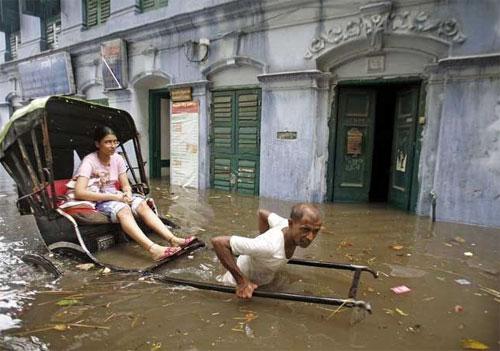

Kolkata (formerly Calcutta)

To avoid catching an infection while "walking" on the street, people apply antiseptic ointments "according to an Ayurvedic recipe" to their feet.
In Nepal, there are two rainy seasons – in summer and in winter. It doesn't flood up to the roofs, but there are unpleasant things like mudslides, where a water and mud flow coming down from the mountains sweeps away houses, people, vehicles... in general, it sweeps away everything in its path.
In Singapore, the rainy season can happen any day after noon (although sometimes it rains in the morning). The drainage system is excellent, and almost all sidewalks are equipped with canopies, so you have to try very hard to get wet. But everywhere there are warnings – during the rain, stay away from bodies of water, because the closer you are to the equator, the higher the chance of being struck by lightning. And Singapore is located almost on the equator, and the thunderstorms here are significant.

Singapore

In Cambodia, the rainy season is also in the summer, until November. You wade through knee-deep water on what was recently a sidewalk, now turned into a river, under the flashes of lightning, and you remember where the nearest lightning rod is and whether there are any at all.

Never mind, in another month, the tourist "high season" will begin, when the sky will be clear, the weather will be almost not hot, and the mood... the mood is never sad here, even in summer.

The photos are taken from the internet because it suddenly turned out that I don't have any suitable illustrations.

User Avatar
10 years ago
Auto-translated
During the rainy season, it is quite possible that when you wake up, you will find a mini-sea on the floor. This is because somewhere the roof is leaking, or conversely, because the apartment is on the ground floor.

But during the dry season, this has its advantages.
In areas similar to our residential districts in India, they make floors out of marble – it’s inexpensive and withstands rain well. Drains for water are made directly into the floor – we had one on the balcony and another in front of the entrance door in the common corridor. Therefore, floors are usually cleaned like this.

Indian-style cleaning
(Puri, Odisha state, India)

1. All items from the floor are moved higher – onto tables and shelves.

2. +
The tap is turned on stronger, and the floor (as well as baseboards and walls, which are usually painted rather than wallpapered) is washed with a stream of water from a hose.

3.

This is a special mop with a hard rubber nozzle so that you don't have to walk through puddles, but instead push the remaining water towards the drain.

4.

And this is a ceiling fan – a useful and ubiquitous thing. If you turn it on and open all the windows, the floor will dry out in about ten minutes.

Indeed, it’s a very fun way to clean. Especially when it’s very hot and you don’t feel like crawling to the beach.
Attachments 4
4 files attached • Total size: 31.0 KB
User Avatar
10 years ago
Auto-translated
yes, that's usually what happens with these little pests :(
you need to keep an eye on your things

User Avatar
10 years ago
Auto-translated
The second monkey is epic.
In reply to Sesame
10 years ago
Auto-translated
Sesame

It seems to me that Asians (except for the Japanese) generally try not to complicate their lives with overly complex and obscure rituals and thoughts.
Here, everything is simple, logical, and follows the path of least resistance.

The culture and way of life of a people are absorbed and adapted from the surrounding actions.
The same street cleaning that you described is a mini-cleaning of the streets during the rainy season.
And so on. The deeper you study, the more interesting patterns you can find.

Consequently, the more complex the living conditions, the more sophisticated methods are used... and over time, the custom remains, but the original reason is lost.
This is how civilizations arise in borderline-difficult living conditions. And in simple conditions, there is no such natural incentive for the development of progress.

Regarding taking bread with your left hand, try proudly and loudly declaring that "you wash your hands!!!":D

An excursion into a parallel world is quite interesting.
User Avatar
10 years ago
Auto-translated
I'm posting a test video.
Here's a bit of the Indian Ocean with its local inhabitants, just to set the mood.
For some reason, YouTube keeps downgrading the quality to the worst possible setting. :(

Statistics

Welcome our newest member: recijeb