Well, here we go again, I'm getting carried away: D
The road network on the map is created according to two principles:
1 - roads tend to connect all cities and villages
2 - the road network grows in the form of a tree
Thirdly, you need to know that templates can be open or closed.
The most striking examples of open templates are Jebus Cross and mini-Nosta.
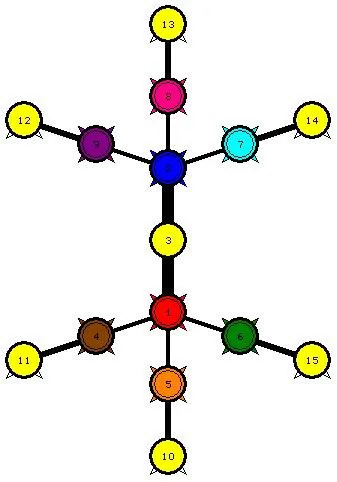
In mini-Nosta, the road network fits perfectly, completely repeating the structure of the template. A disadvantage of such schemes is the certainty of the opponent's position, and rivals have to share the General area (ГО). This eliminates the possibility of rushing the enemy or starting an early attack, which basically impoverishes the game. In addition, the game is mostly played along the roads, and the ability to work off-road is also part of the skill.
But there are templates with a closed structure, for example, CM.
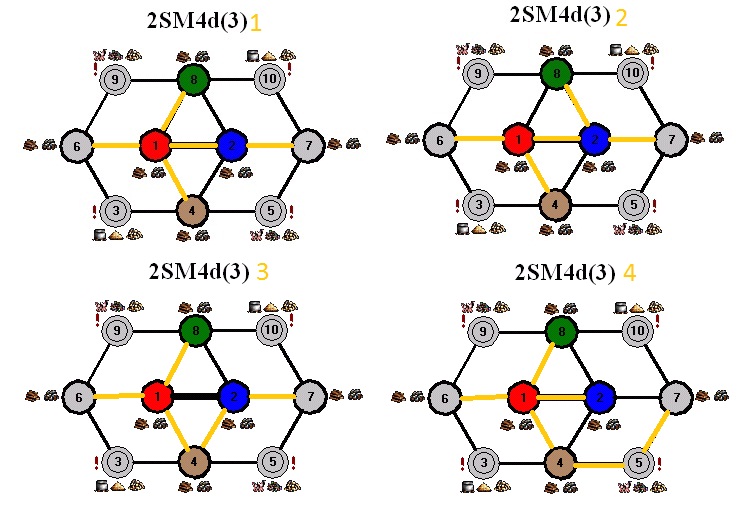
In
version 1, red got 3 secondaries, and blue got one (the opposite situation is also possible: red gets 1 secondary, blue gets 3)
Version 2 is balanced; each player gets 2 secondaries.
In
case 3, the road, fearing the General area (ГО), goes through a secondary and there will inevitably be a quick encounter.
Well, and in
version 4, the road breaks through the treasury and leads to the rival's rear secondary.
These are the main options on CM. As you can see, while maintaining significant diversity, both principles of building the road network are observed.
And now, let's try to determine how the road network is built on the popular 8mm6a. First, let's answer what type this template belongs to, open or closed?..
That's right! Neither. 8mm6a represents a mixed type; it has both looped structures and dead-end branches.
Let's start by looking at the central square, considering that a road must lead out from each of its vertices. Obviously, there are 4 possible variants (crosses indicate transitions across off-road).
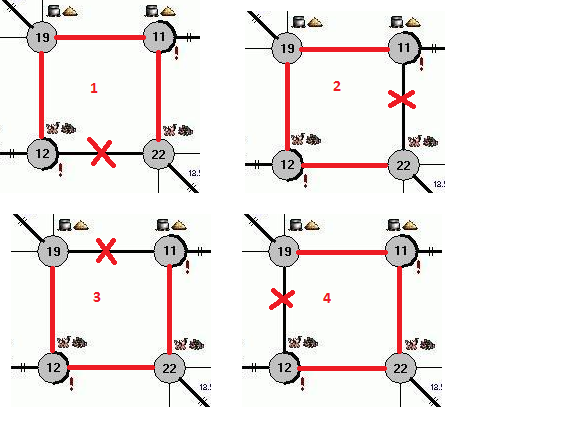
If we look more closely, we will see that there are not 4 variants, but only 2. Variants No. 1 and No. 2 mean that red has 2 roads leading to 2 centers, and blue has only one road leading to one center. Variants No. 3 and No. 4 are the opposite: blue has 2 centers, and red has only one. Here, as in communicating vessels, whatever decreases for one increases for the other. That is, one central village is always
General, and contact with the opponent is most likely there, and the other center can be called
your/opponent's, depending on whether you have a road to it or not.
Now let's see how the road is formed in the red quarter; everything will be identical for the rest of the quarters.
And again, there are 4 possible options, but they are already more interesting than in the center.
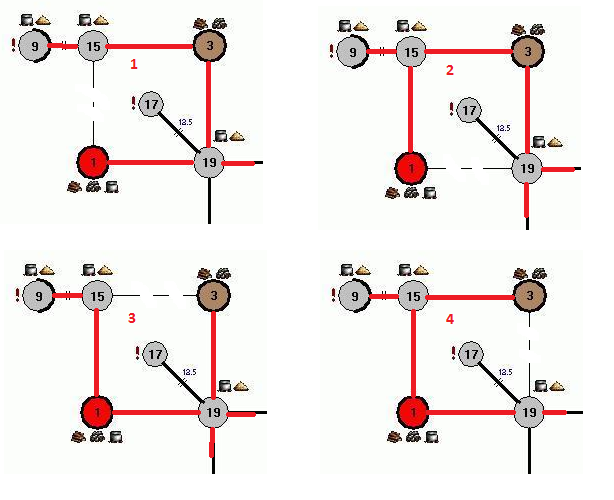
Variant No. 1
Near Center One road from the main leads to zone 19, where there are roads to the center and the brown camp. On the bot respawn, the road splits again, going to the bot itself and the corner treasury.
Variant No. 2
Far Center Here, you are, conversely, far from the central quarter. The only road from the main leads to section #15, then splits into the corner treasury and the brown bot, and only then leads to the center. This scheme is generated much less often than the other three variants, but how do you distinguish it from the near center? How do you determine that you ended up in zone #19 and not in zone #15?
1. The only reliable sign is the presence of guards with 12500 strength in the off-road treasure №17
2. If you got 2 roads leading to the center, then by the abundance of roads, you can determine that you have option 1.
3. Zone #15 is usually (but not necessarily) smaller than zone #19.
Variant No. 3
Scoop (Or any other figure your imagination suggests). Two roads lead from the main; one goes to section #15, further to the corner treasury, and that's all... If you end up here, you need to turn around. There is a guard in the corner with 6000 strength and multiple units; with some experience, you can easily distinguish it from the center guard. In the early game, there is nothing to do here; there are no easy resources for building in the corner, and the probability of blocking the corner village is high (it is still a treasure).
The second road leads from the main to the center and the brown bot.
Variant No. 4
Whale Tail Again, 2 roads from the main; you broke through into zone #19, oriented yourself according to the 12500 guards, everything is great, it's time to kill the brown one. But there is no road to him. You can get to him through zone 15. In general, if you got 2 roads from the main, it is better not to be lazy and break through both sides, just to collect more freebies with pawns.
One-way RoadsA one-way road is not as scary as the place where it appears. On 8mm6a, one-way roads appear rarely but accurately, in the most important direction,
to the center.
The color of the entrance monolith always corresponds to the color of the exit monolith. The scheme of a one-way transition looks like this:
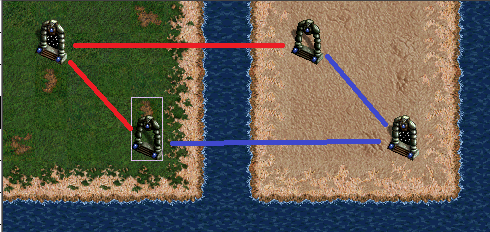
In each zone between which there is a one-way transition, there is always an entrance monolith and an exit monolith, and they are always the same color. Moreover, one-way transitions visually differ from two-way ones, and accidentally diving into them with your entire army is a sign of skill. The problem is that there are no roads between
the entrance and the exit in one zone. By blocking one of the exits with a pawn, you can go where you need to, and also attack the opponent while remaining temporarily inaccessible. If you get a one-way road to the center, you can calmly taunt, summon demons, or even camp. You have time for this; a one-way road is the last thing your opponent will try. Or you can rush forward (after scouting with a pawn) and let the chain of castles be a ticket to nowhere; this may well be enough to win.
8mm6bIf the number of transitions in the template is 28 or less, then one-way roads do not appear guaranteed (unless you abuse multiple transitions). There are no one-way roads on 8mm6b.
The changes in 8mm6b turned out to be not as cosmetic as I would like; the road network is noticeably denser than on 8mm6a. The game is more contact-based; it is played more along the roads than off-road.
In general, templates with a mixed (open-closed) structure can inherit both the advantages and disadvantages of both types.
But the future lies precisely in such templates, diverse in terms of the road network and all sorts of strategies, templates where there is room for rushing, fast attacks, harassment, farming, late-game play, and even camping, but not for boring mirror matches.Uff, I think I'm feeling better now: D



 Lider1