


 Lux in tenebris

Auto-translated
Many people have such video cards. This section is dedicated specifically to them)
P/S-You know my opinion regarding video cards.
But I always respect the opinions of other people.
******************************************************
I decided to start the same old "post-flight analysis"... with the ATI Radeon X1900XTX
When a new top-tier video card is born, any professional journalist wants to write an interesting introduction for the material dedicated to the new product. Analogies for the development of 3D graphics accelerators have been drawn with courier trains, aircraft turbines, and even falling into an abyss, but the pace of development shows no sign of stopping. The arms race, which all reviewers have already written about a dozen times over, continues, and there is no end in sight for the near future. Today's material will be dedicated to a new board that has two goals: "Become the most performant solution on the market for the next six months" and "Win the hearts of all hardcore gamers by showing all doubters exactly who the market leader is." But let's take everything in order.
First, let's travel back to the recent past. In late spring 2005, NVIDIA announced its new G70 chip and its new top-tier product based on it, the GeForce 7800GTX. This accelerator was truly interesting to both specialists and gamers, as 24 pipelines combined with an improved architecture provided a serious performance gain compared to the previous NVIDIA top solution, the GeForce 6800 Ultra. And if you consider that the ability of accelerators to work in SLI mode provided the power of 48 pipelines, it becomes completely clear that NVIDIA had taken a very firm position in the market and did not intend to move from it for the next six months.
But what was happening during this time with NVIDIA's competitor, ATI? They were gradually implementing a plan to regain their leadership position in the market, while simultaneously creating the R520 chip, which became known around the same time as NVIDIA's G70 chip. However, the release of the R520 chip was delayed by about six months, and it was presented to the public much later than its competitor, the G70; plus, the new chip had only 16 pixel pipelines. And what did ATI tell us then? That happiness is not in the number of pipelines, and that our 16 work much more efficiently than NVIDIA's 24, and generally, NVIDIA cards cannot do many things, and their anisotropic filtering is nonexistent. But what matters to the user? The user does not want compromises, and although the new ATI product beat the GeForce 7800GTX in some tests, it still had equal performance. At the same time, it was clear to many that any subsequent product from NVIDIA would resolve this rivalry in its favor—even a simple release of the NVIDIA GeForce 7800 Ultra with increased frequencies compared to the GeForce 7800GTX could easily push the R520-based ATI X1800 XT into the background.
Around the same time, rumors began to circulate about the upcoming release of the R580 chip, which, according to all market logic, was supposed to be simply an overclocked version of the R520 chip, and a product based on it bore the Radeon X1900 index. It was clear even to the uninitiated that the X1800 series would not differ much from the X1900, which confirmed the general theory of an overclocked 1800 XT version. It seems that even the marketers at NVIDIA believed this—and they miscalculated.
As it turns out, all this time ATI engineers were creating a product that followed R520 in architecture. They did it quietly, without hype or fueling rumors. And when it became clear that the release of the R520 would be delayed until the end of autumn (instead of early summer), they faded into its shadow entirely. Then they went and announced a new product for journalists immediately after the New Year holidays. A certain calculation or plan can be traced in all this, and if this plan succeeded, we will not see a counter-move from ATI's competitor, NVIDIA, for quite some time. Think about it yourself: if you see that your competitors only have a chip that works the same as one you already possess, and they have problems with it to boot, then you don't need to worry particularly or rush, but can simply rest peacefully on top of the mountain, feeling like the leader. Especially considering that the next product, which no one has even seen yet, promises to be merely a continuation of what was already created. Therefore, NVIDIA's marketing department did not push its engineers, did not prepare to fend off attacks from the competitor, but calmly observed the development of events and, it seems, overlooked a rather important moment.
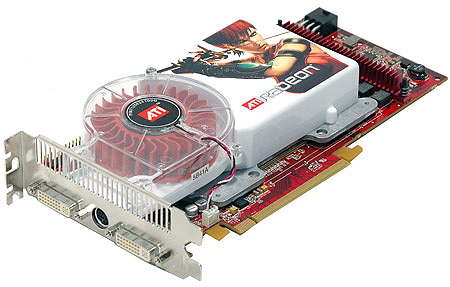
The seemingly unremarkable ATI X1900 based on the R580 chip suddenly turned out to have 48 pixel pipelines inside a single chip plus the ability for boards based on it to work in CrossFire mode, which means the possibility of obtaining 96 pixel pipelines in the system. This is exactly twice as many as NVIDIA's top product, which, by the way, sells for the same money as presumably some Radeon X1900 series models. And if you consider that all of ATI's words regarding the X1800 series also apply to the X1900 series, it becomes clear that the ATI X1900 will have the ability to use branching in shaders without a drop in performance, excellent anisotropic filtering, and many other interesting features that look very attractive compared to the competitors.
Thus, ATI prepared a secret coup, which undoubtedly succeeded. In any case, at the time of writing this material, NVIDIA has not responded to the new ATI product with anything. Therefore, let us welcome the new leader in the world of gaming graphics accelerators—ATI. Let's get to know their brainchild more closely, and we will start with the technical specifications table:
As can be seen from the table, the new X1900 series consists of two video cards, or rather four, but we will talk about the remaining two later; let's just say that the first product not shown in the table is the Radeon X1900XTX CrossFire Edition, and the second is the Radeon X1900 AllInWonder. But let's return to the solutions displayed in the table. Both cards differ only in memory and GPU clock frequencies, while possessing 48 pixel pipelines and 8 vertex ones, 512 MB of memory with a 256-bit bus width and ViVo support. If you compare the new solutions with the previous series, you can notice that both the ATI Radeon X1900XT and the ATI Radeon X1800XT have absolutely identical starting prices; also, these products have an absolutely identical core frequency, and the memory frequency does not differ much. This does not mean that both of these video cards will be present on the market at one price; it's just that the ATI Radeon X1900XT came to replace its predecessor, which, in turn, is now simply obliged to become cheaper and gradually leave the market. The ATI Radeon X1900XTX, conversely, has no analogues among previously released products and therefore has even a new letter index designed to emphasize the special power of this accelerator. Perhaps now competitors, following good tradition, must release a product with an identical letter prefix but meaning the absolute opposite, something like a GeForce 7800 XTX with lowered frequencies... But we've digressed. The ATI Radeon X1900XTX costs $100 more than the same junior model, the ATI Radeon X1900XT, and has an increased GPU frequency of 25 MHz and a memory subsystem frequency increase of 100 MHz.
If you compare new ATI solutions with similar NVIDIA solutions, the win for the former is obvious. Now the NVIDIA GeForce 7800GTX doesn't have "a full" 24 pipelines, but only 24; the amount of local memory on the ATI Radeon X1900 is twice as much as on the NVIDIA GeForce 7800GTX, and functionally the X1900 series has a clear advantage—the ability to use anti-aliasing together with HDR effects alone proves this. We do not believe that the NVIDIA GeForce 7800GTX version with 512MB of memory gained wide distribution, as it often has a heavily inflated price, so we did not include it in the comparison. Now let's look at the internal structure of the R580 chip and try to understand what changed in it.
GPU (process)
R580 (90 nm)
_______
GPU Frequency, MHz
650
_______
Memory Frequency
775 (1550 DDR)
_______
Memory
512 MB GDDR3
Theory
First, let's look at the internal structure of R580's predecessor, the R520 chip

Look at it carefully and try to remember the location of the main modules, as the diagram below is very similar:
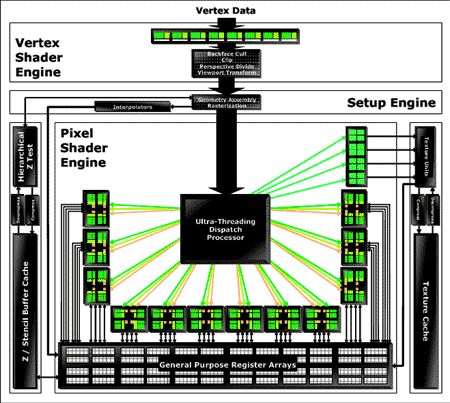
As can be seen, changes affected only the pixel pipeline blocks (they are marked in green). Now there are noticeably more of them, but as before, they are all managed by a multitasking sharing processor. The vertex pipeline blocks remained untouched, as did most other blocks. The general internal structure of the chip remained absolutely identical; changes affected only the internal content of the texture cache and z-buffer. It is also visible that pixel pipelines are divided into blocks of 4, and as before, such a chip structure allows disabling groups of four pipelines if they malfunction due to errors during the creation of a specific crystal. This means that in the near future, a fairly large number of R580-based products with different numbers of pixel pipelines may appear on the market from culled processors. Moreover, given the total number of pixel pipelines, it is absolutely clear that there could be quite a few options for the number of active blocks—for example, 44, 40, 36, 32, 28, 24 and so on. This same point could serve future attempts to unlock potentially working pipelines that were disabled for marketing reasons, as there will clearly be fewer products than options with active blocks. Overall, it can be said that the chip structure is quite successful. However, not everything is so simple. By increasing the mass of pixel pipelines to 48, ATI has most likely completely removed the narrow bottleneck from the pixel pipeline module—now the pixel pipelines will not hold back performance; the question is different—what will hold it back now? First and foremost, this is memory bandwidth, second—a possible lack of vertex pipeline power, as there are only 8 for 48, meaning 6 pixel pipelines per one vertex; on the other hand, vertex pipelines have had little influence on performance recently. And third, and perhaps the most significant limiting factor for graphics accelerator performance, is the central processor. If in a tech demo you can overload a frame with special effects while putting minimal load on the CPU, then in the case of real games things are slightly worse, because there's real physics and AI to calculate. Therefore, to feed such a monster as the Radeon X1900XTX with data, an ultra-powerful processor is needed, not to mention for the Radeon X1900XTX CrossFire. There is an opinion that none of the existing processors, including multi-core ones, will be enough for this type of accelerator. Of course, this is more than compensated for by enabling all possible levels of anti-aliasing with anisotropy, HDR and a resolution near 1600x1200, so the ATI Radeon X1900 series has a future, and it is bright. However, the generation of accelerators after R580 will have problems, because increasing the number of pixel pipelines is a path as finite and dead-end as simply increasing clock frequencies: someday a limit will be reached, and the number of pipelines will no longer reflect performance as radically as it does now.

The cooling systems of the ATI Radeon 1900XTX and ATI Radeon 1800XT do not differ at all, so they clearly don't deserve separate descriptions; however, a brief run-through won't hurt. The design of the cooling system itself raises no serious objections. The GPU core is cooled by a separate copper heatsink, through whose fins the main airflow passes. Memory modules are cooled by an aluminum heatsink via a layer of thermally conductive films. These thermally conductive films have been a subject of long-standing disputes and disagreements, but so far manufacturers haven't come up with anything better, which is a pity. Dividing the cooling system into two heatsinks is a very correct decision, because if it were one heatsink, even copper, the GPU could heat the memory modules through the same heatsink to the point where the memory modules' own heat output would simply be unnoticeable. The second objection to the cooling system is the poorly polished copper base for the GPU.
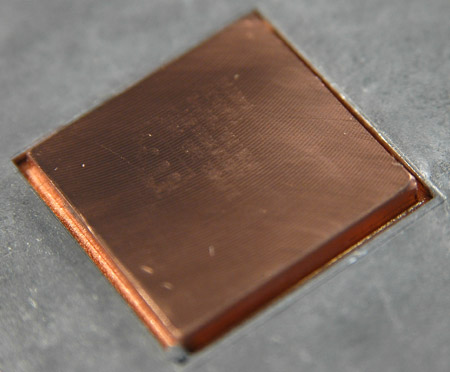
If this element were absolutely smooth, the heat exchange functions of this same heatsink could significantly improve, but alas. And the third objection is noise. Actually, it's not even an objection, but a statement of fact—the most powerful video cards are noisy, and they are very noisy. During a heavy load on the accelerator, air blows out of the vents like from a good hair dryer set to maximum temperature—obviously, not an industrial one.
CrossFire and AllInWonder
Modifications of boards from the X1900 series such as the ATI Radeon X1900XTX CrossFire and ATI Radeon X1900 All In Wonder barely fit into today's description. The first accelerator differs little from its non-pairing sibling, the ATI Radeon 1900XTX, yet it costs almost $100 more. This price is for the ability to pair two ATI Radeon X1900XTXs and obtain an unprecedented power of 96 pixel pipelines. The difference in the ATI Radeon X1900XTX Cross Fire lies in a special connector installed instead of one DVI connector, to which an additional splitter cable connecting the two boards is attached. By the way, the entire ATI Radeon X1900 series, as well as the X1800, has DVI outputs with support for connections required to achieve high resolutions on digital monitors and LCD panels.
As for the ATI Radeon X1900 All In Wonder, its differences from the ATI Radeon X1900XTX or ATI Radeon X1900 XT are quite noticeable. First of all, it has a reduced single-slot heatsink; second, frequencies that are lowered compared to the ATI Radeon X1900 XT; and third, excellent capabilities for processing TV and video signals.
Preliminary Conclusions
One could go on for a very long time talking about the innovations implemented in the ATI Radeon X1900 series, and we will have many more materials for this, but it's time to draw some kind of line. Judging by the description and sober logic, ATI's new product is a success. Like a bolt from the blue, the announcement of the ATI Radeon X1900XTX stunned all reviewers, especially considering that it was not expected since the ATI Radeon X1800 series had been announced not so long ago. Well, we shall see—perhaps NVIDIA will be able to pull a similar rabbit out of its hat, but tricks don't work for everyone and not always.
From the website http://www.ferra.ru
P/S-You know my opinion regarding video cards.
But I always respect the opinions of other people.
******************************************************
I decided to start the same old "post-flight analysis"... with the ATI Radeon X1900XTX
When a new top-tier video card is born, any professional journalist wants to write an interesting introduction for the material dedicated to the new product. Analogies for the development of 3D graphics accelerators have been drawn with courier trains, aircraft turbines, and even falling into an abyss, but the pace of development shows no sign of stopping. The arms race, which all reviewers have already written about a dozen times over, continues, and there is no end in sight for the near future. Today's material will be dedicated to a new board that has two goals: "Become the most performant solution on the market for the next six months" and "Win the hearts of all hardcore gamers by showing all doubters exactly who the market leader is." But let's take everything in order.
First, let's travel back to the recent past. In late spring 2005, NVIDIA announced its new G70 chip and its new top-tier product based on it, the GeForce 7800GTX. This accelerator was truly interesting to both specialists and gamers, as 24 pipelines combined with an improved architecture provided a serious performance gain compared to the previous NVIDIA top solution, the GeForce 6800 Ultra. And if you consider that the ability of accelerators to work in SLI mode provided the power of 48 pipelines, it becomes completely clear that NVIDIA had taken a very firm position in the market and did not intend to move from it for the next six months.
But what was happening during this time with NVIDIA's competitor, ATI? They were gradually implementing a plan to regain their leadership position in the market, while simultaneously creating the R520 chip, which became known around the same time as NVIDIA's G70 chip. However, the release of the R520 chip was delayed by about six months, and it was presented to the public much later than its competitor, the G70; plus, the new chip had only 16 pixel pipelines. And what did ATI tell us then? That happiness is not in the number of pipelines, and that our 16 work much more efficiently than NVIDIA's 24, and generally, NVIDIA cards cannot do many things, and their anisotropic filtering is nonexistent. But what matters to the user? The user does not want compromises, and although the new ATI product beat the GeForce 7800GTX in some tests, it still had equal performance. At the same time, it was clear to many that any subsequent product from NVIDIA would resolve this rivalry in its favor—even a simple release of the NVIDIA GeForce 7800 Ultra with increased frequencies compared to the GeForce 7800GTX could easily push the R520-based ATI X1800 XT into the background.
Around the same time, rumors began to circulate about the upcoming release of the R580 chip, which, according to all market logic, was supposed to be simply an overclocked version of the R520 chip, and a product based on it bore the Radeon X1900 index. It was clear even to the uninitiated that the X1800 series would not differ much from the X1900, which confirmed the general theory of an overclocked 1800 XT version. It seems that even the marketers at NVIDIA believed this—and they miscalculated.
As it turns out, all this time ATI engineers were creating a product that followed R520 in architecture. They did it quietly, without hype or fueling rumors. And when it became clear that the release of the R520 would be delayed until the end of autumn (instead of early summer), they faded into its shadow entirely. Then they went and announced a new product for journalists immediately after the New Year holidays. A certain calculation or plan can be traced in all this, and if this plan succeeded, we will not see a counter-move from ATI's competitor, NVIDIA, for quite some time. Think about it yourself: if you see that your competitors only have a chip that works the same as one you already possess, and they have problems with it to boot, then you don't need to worry particularly or rush, but can simply rest peacefully on top of the mountain, feeling like the leader. Especially considering that the next product, which no one has even seen yet, promises to be merely a continuation of what was already created. Therefore, NVIDIA's marketing department did not push its engineers, did not prepare to fend off attacks from the competitor, but calmly observed the development of events and, it seems, overlooked a rather important moment.
The seemingly unremarkable ATI X1900 based on the R580 chip suddenly turned out to have 48 pixel pipelines inside a single chip plus the ability for boards based on it to work in CrossFire mode, which means the possibility of obtaining 96 pixel pipelines in the system. This is exactly twice as many as NVIDIA's top product, which, by the way, sells for the same money as presumably some Radeon X1900 series models. And if you consider that all of ATI's words regarding the X1800 series also apply to the X1900 series, it becomes clear that the ATI X1900 will have the ability to use branching in shaders without a drop in performance, excellent anisotropic filtering, and many other interesting features that look very attractive compared to the competitors.
Thus, ATI prepared a secret coup, which undoubtedly succeeded. In any case, at the time of writing this material, NVIDIA has not responded to the new ATI product with anything. Therefore, let us welcome the new leader in the world of gaming graphics accelerators—ATI. Let's get to know their brainchild more closely, and we will start with the technical specifications table:
As can be seen from the table, the new X1900 series consists of two video cards, or rather four, but we will talk about the remaining two later; let's just say that the first product not shown in the table is the Radeon X1900XTX CrossFire Edition, and the second is the Radeon X1900 AllInWonder. But let's return to the solutions displayed in the table. Both cards differ only in memory and GPU clock frequencies, while possessing 48 pixel pipelines and 8 vertex ones, 512 MB of memory with a 256-bit bus width and ViVo support. If you compare the new solutions with the previous series, you can notice that both the ATI Radeon X1900XT and the ATI Radeon X1800XT have absolutely identical starting prices; also, these products have an absolutely identical core frequency, and the memory frequency does not differ much. This does not mean that both of these video cards will be present on the market at one price; it's just that the ATI Radeon X1900XT came to replace its predecessor, which, in turn, is now simply obliged to become cheaper and gradually leave the market. The ATI Radeon X1900XTX, conversely, has no analogues among previously released products and therefore has even a new letter index designed to emphasize the special power of this accelerator. Perhaps now competitors, following good tradition, must release a product with an identical letter prefix but meaning the absolute opposite, something like a GeForce 7800 XTX with lowered frequencies... But we've digressed. The ATI Radeon X1900XTX costs $100 more than the same junior model, the ATI Radeon X1900XT, and has an increased GPU frequency of 25 MHz and a memory subsystem frequency increase of 100 MHz.
If you compare new ATI solutions with similar NVIDIA solutions, the win for the former is obvious. Now the NVIDIA GeForce 7800GTX doesn't have "a full" 24 pipelines, but only 24; the amount of local memory on the ATI Radeon X1900 is twice as much as on the NVIDIA GeForce 7800GTX, and functionally the X1900 series has a clear advantage—the ability to use anti-aliasing together with HDR effects alone proves this. We do not believe that the NVIDIA GeForce 7800GTX version with 512MB of memory gained wide distribution, as it often has a heavily inflated price, so we did not include it in the comparison. Now let's look at the internal structure of the R580 chip and try to understand what changed in it.
GPU (process)
R580 (90 nm)
_______
GPU Frequency, MHz
650
_______
Memory Frequency
775 (1550 DDR)
_______
Memory
512 MB GDDR3
Theory
First, let's look at the internal structure of R580's predecessor, the R520 chip
Look at it carefully and try to remember the location of the main modules, as the diagram below is very similar:
As can be seen, changes affected only the pixel pipeline blocks (they are marked in green). Now there are noticeably more of them, but as before, they are all managed by a multitasking sharing processor. The vertex pipeline blocks remained untouched, as did most other blocks. The general internal structure of the chip remained absolutely identical; changes affected only the internal content of the texture cache and z-buffer. It is also visible that pixel pipelines are divided into blocks of 4, and as before, such a chip structure allows disabling groups of four pipelines if they malfunction due to errors during the creation of a specific crystal. This means that in the near future, a fairly large number of R580-based products with different numbers of pixel pipelines may appear on the market from culled processors. Moreover, given the total number of pixel pipelines, it is absolutely clear that there could be quite a few options for the number of active blocks—for example, 44, 40, 36, 32, 28, 24 and so on. This same point could serve future attempts to unlock potentially working pipelines that were disabled for marketing reasons, as there will clearly be fewer products than options with active blocks. Overall, it can be said that the chip structure is quite successful. However, not everything is so simple. By increasing the mass of pixel pipelines to 48, ATI has most likely completely removed the narrow bottleneck from the pixel pipeline module—now the pixel pipelines will not hold back performance; the question is different—what will hold it back now? First and foremost, this is memory bandwidth, second—a possible lack of vertex pipeline power, as there are only 8 for 48, meaning 6 pixel pipelines per one vertex; on the other hand, vertex pipelines have had little influence on performance recently. And third, and perhaps the most significant limiting factor for graphics accelerator performance, is the central processor. If in a tech demo you can overload a frame with special effects while putting minimal load on the CPU, then in the case of real games things are slightly worse, because there's real physics and AI to calculate. Therefore, to feed such a monster as the Radeon X1900XTX with data, an ultra-powerful processor is needed, not to mention for the Radeon X1900XTX CrossFire. There is an opinion that none of the existing processors, including multi-core ones, will be enough for this type of accelerator. Of course, this is more than compensated for by enabling all possible levels of anti-aliasing with anisotropy, HDR and a resolution near 1600x1200, so the ATI Radeon X1900 series has a future, and it is bright. However, the generation of accelerators after R580 will have problems, because increasing the number of pixel pipelines is a path as finite and dead-end as simply increasing clock frequencies: someday a limit will be reached, and the number of pipelines will no longer reflect performance as radically as it does now.
The cooling systems of the ATI Radeon 1900XTX and ATI Radeon 1800XT do not differ at all, so they clearly don't deserve separate descriptions; however, a brief run-through won't hurt. The design of the cooling system itself raises no serious objections. The GPU core is cooled by a separate copper heatsink, through whose fins the main airflow passes. Memory modules are cooled by an aluminum heatsink via a layer of thermally conductive films. These thermally conductive films have been a subject of long-standing disputes and disagreements, but so far manufacturers haven't come up with anything better, which is a pity. Dividing the cooling system into two heatsinks is a very correct decision, because if it were one heatsink, even copper, the GPU could heat the memory modules through the same heatsink to the point where the memory modules' own heat output would simply be unnoticeable. The second objection to the cooling system is the poorly polished copper base for the GPU.
If this element were absolutely smooth, the heat exchange functions of this same heatsink could significantly improve, but alas. And the third objection is noise. Actually, it's not even an objection, but a statement of fact—the most powerful video cards are noisy, and they are very noisy. During a heavy load on the accelerator, air blows out of the vents like from a good hair dryer set to maximum temperature—obviously, not an industrial one.
CrossFire and AllInWonder
Modifications of boards from the X1900 series such as the ATI Radeon X1900XTX CrossFire and ATI Radeon X1900 All In Wonder barely fit into today's description. The first accelerator differs little from its non-pairing sibling, the ATI Radeon 1900XTX, yet it costs almost $100 more. This price is for the ability to pair two ATI Radeon X1900XTXs and obtain an unprecedented power of 96 pixel pipelines. The difference in the ATI Radeon X1900XTX Cross Fire lies in a special connector installed instead of one DVI connector, to which an additional splitter cable connecting the two boards is attached. By the way, the entire ATI Radeon X1900 series, as well as the X1800, has DVI outputs with support for connections required to achieve high resolutions on digital monitors and LCD panels.
As for the ATI Radeon X1900 All In Wonder, its differences from the ATI Radeon X1900XTX or ATI Radeon X1900 XT are quite noticeable. First of all, it has a reduced single-slot heatsink; second, frequencies that are lowered compared to the ATI Radeon X1900 XT; and third, excellent capabilities for processing TV and video signals.
Preliminary Conclusions
One could go on for a very long time talking about the innovations implemented in the ATI Radeon X1900 series, and we will have many more materials for this, but it's time to draw some kind of line. Judging by the description and sober logic, ATI's new product is a success. Like a bolt from the blue, the announcement of the ATI Radeon X1900XTX stunned all reviewers, especially considering that it was not expected since the ATI Radeon X1800 series had been announced not so long ago. Well, we shall see—perhaps NVIDIA will be able to pull a similar rabbit out of its hat, but tricks don't work for everyone and not always.
From the website http://www.ferra.ru
Евангелие от Иоанна, 1.5: Lux in tenebris lucet, et tenebrae eam non comprehenderunt. Свет во тьме светит, и тьма не объяла его.


 And so on = with a screen up to 21.1 inches. Increased memory, HDD, etc.
This doesn't threaten us.
*******************************************
I'll continue:
PCI-E 512Mb ATI Radeon X1900XT, ASUS EAX1900XT CrossFire HDTV, 2DVI
GPU Manufacturer ATI
Graphics processor Radeon X1900 XT
Core frequencies 625 MHz
Memory frequency 725 MHz
Video memory size 512 MB
Video memory type DDR3
Bus PCI E x16
Memory bus width 256 bits
Pixel pipelines 48
RAMDAC 400 MHz
Maximum resolution 2048x1536
Frequency at max. resolution 85 Hz
DirectX 9.0
OpenGL 2.0
Cooling system Active/Passive
Connectors:
DVI 1
HDTV Yes
SLI/CrossFire support Yes
Physical characteristics:
Package size 8.8 x 47.3 x 31.2 cm
Weight (gross) 2.1 kg
Link to the manufacturer's website
And so on = with a screen up to 21.1 inches. Increased memory, HDD, etc.
This doesn't threaten us.
*******************************************
I'll continue:
PCI-E 512Mb ATI Radeon X1900XT, ASUS EAX1900XT CrossFire HDTV, 2DVI
GPU Manufacturer ATI
Graphics processor Radeon X1900 XT
Core frequencies 625 MHz
Memory frequency 725 MHz
Video memory size 512 MB
Video memory type DDR3
Bus PCI E x16
Memory bus width 256 bits
Pixel pipelines 48
RAMDAC 400 MHz
Maximum resolution 2048x1536
Frequency at max. resolution 85 Hz
DirectX 9.0
OpenGL 2.0
Cooling system Active/Passive
Connectors:
DVI 1
HDTV Yes
SLI/CrossFire support Yes
Physical characteristics:
Package size 8.8 x 47.3 x 31.2 cm
Weight (gross) 2.1 kg
Link to the manufacturer's website 


