


Recently viewed games
Auto-translated
 Ment
Ment

Auto-translated
Muv-Luv & Muv-Luv Alternative
I'll allow myself to start the new year in this thread with my post, and at the same time, I'll address a topical issue for Japanese content: the quality of the translation. In general, if you ignore the typical "shitty," "dude," "holy crap," and other things that are difficult to convey in English, I was satisfied with the translation, but there is one remark regarding the presentation: the use of capitalization to emphasize specific words became annoying after a while. I'm talking about this:



 If I had encountered this a couple of times, I wouldn't have paid any attention to it, but this form of text appeared almost every sentence. I'm exaggerating, of course, but if I took a screenshot every time I saw it, I would definitely have accumulated at least a couple of hundred of them. It's not that it's so terrible that it makes you cringe, it's just that it's uncomfortable to read and doesn't serve any literary purpose. For example, if you write "Really bad!!", you are already emphasizing the urgency and importance of the situation, so there is absolutely no need to write it in capital letters; it's not a message in a messenger or even on a forum. Well, as I wrote above, I liked the translation overall because it was a translation, not a localization. I believe that projects with moderate popularity are the golden mean in this regard, because in obscure projects, there will be a machine translation, and in mainstream projects, there will be little left of the original dialogues.
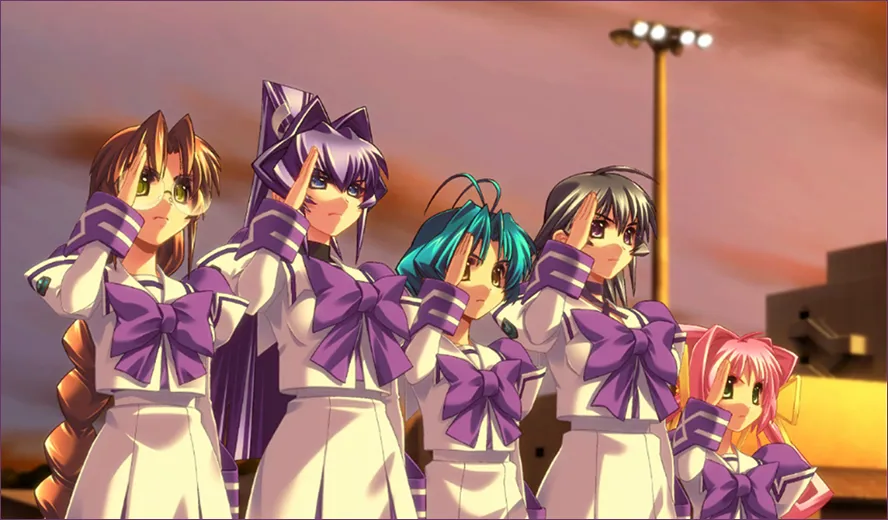 Most of both novels, with a total duration of about a hundred hours, take place mainly in one location, but the world-building is conceived and presented simply brilliantly, and the immersion in this world occurred at an unprecedented level for me. The psychological and emotional state of the main character and his gradual growth as a person are conveyed very accurately, in accordance with his background, new environment, and the situations he faces. I think that anyone who grew up in the modern world in one of its relatively safe regions will be able to empathize with his feelings. Instead of classic cliffhangers that create a feeling of "oh, what will happen next?", it's interesting to be here, discover new elements of the setting, and observe the theater of military operations. Technology, medicine, tactics and strategy, the political situation in the world, the complexity of international relations, the influence of decisions made by superiors on the lives of the characters – all of this is worked out in the smallest details, and the pre-operation briefings deserve special attention. The description of the conditions and goals of military operations by a superior officer takes place in great detail, using the elements described above, as well as with branches in case something goes wrong, which allows you to visualize the development of events long before they begin. The differences in moral and ethical norms, depending on the social, cultural, and situational context, are excellently presented. The nobility of the human soul with all its numerous flaws is beautifully conveyed; the spirit of camaraderie, the place of a person in life, the feeling of patriotism, and the harshness of war. The main characters are enchanting, the secondary characters are inspiring, and even ordinary nameless soldiers evoke sympathy. The soundtrack incredibly accurately emphasizes what is happening, and in combination with all the other elements of the novel, it skillfully plays on the reader's heartstrings.
In general, I was very impressed, especially by some personal things, although it also left a somewhat sad aftertaste.
Most of both novels, with a total duration of about a hundred hours, take place mainly in one location, but the world-building is conceived and presented simply brilliantly, and the immersion in this world occurred at an unprecedented level for me. The psychological and emotional state of the main character and his gradual growth as a person are conveyed very accurately, in accordance with his background, new environment, and the situations he faces. I think that anyone who grew up in the modern world in one of its relatively safe regions will be able to empathize with his feelings. Instead of classic cliffhangers that create a feeling of "oh, what will happen next?", it's interesting to be here, discover new elements of the setting, and observe the theater of military operations. Technology, medicine, tactics and strategy, the political situation in the world, the complexity of international relations, the influence of decisions made by superiors on the lives of the characters – all of this is worked out in the smallest details, and the pre-operation briefings deserve special attention. The description of the conditions and goals of military operations by a superior officer takes place in great detail, using the elements described above, as well as with branches in case something goes wrong, which allows you to visualize the development of events long before they begin. The differences in moral and ethical norms, depending on the social, cultural, and situational context, are excellently presented. The nobility of the human soul with all its numerous flaws is beautifully conveyed; the spirit of camaraderie, the place of a person in life, the feeling of patriotism, and the harshness of war. The main characters are enchanting, the secondary characters are inspiring, and even ordinary nameless soldiers evoke sympathy. The soundtrack incredibly accurately emphasizes what is happening, and in combination with all the other elements of the novel, it skillfully plays on the reader's heartstrings.
In general, I was very impressed, especially by some personal things, although it also left a somewhat sad aftertaste.
Auto-translated
It's been almost three years (just kidding, it has been) since I started playing this game. Yes, I dropped it several times, switching to other games, some of which I also put on pause. Eh, either games are like that these days, or I've just changed... 😔
So, my opinion of the game is mixed, and that's probably normal, considering you could say that about many games. I'd like to write it out more coherently and literarily, but that would require sitting for a long time and squeezing formulations out of myself like the last bits of ointment or ketchup from a packet, so better to go point by point.
1. Character. Maybe this isn't exactly a plus, but as an exception, I did enjoy playing not another village bumpkin, but an educated (I took aristocratic origin) representative of legitimate (?) authority who keeps order and enforces laws, while also carrying out tasks from superiors. And the main thing is that practically no one can talk back to you, and if they dare, you can easily resolve it with a boot or a bottle. I think Nebka and Alex would have liked this aspect, as well as the ability in some cases to kill through choosing the right dialogue line (sometimes even without reason). Character creation here is fairly standard, except that choosing your own banner stands out from the rest and evokes associations with Mount&Blade, but that's where it ends. The presence of portraits was nice, so I didn't have to look at crooked 3D faces like in NWN2. There are few skills/specializations, as there is little of everything else (almost lol). Skill trees are mostly classic and generally fine, although almost all of them are combat-oriented, +there are buffs/debuffs and passive bonuses. +As the game progresses, skills appear that depend on your reputation and the loyalty of your companions, and artifacts also give decent abilities. But those are rather pleasant bonuses. What stands out most here is magic. It has a rather unusual mechanic, though calling it unique wouldn't be fair either. You're given the opportunity to create spells yourself by combining various sigils and enhancing their characteristics, or adding new effects. At first, this is quite entertaining and you add them to every character (yes, anyone can cast, but effectiveness will vary), but closer to the end of the game, you get tired of it. You grow weary of creating these spells, picking the best combinations, comparing them, plus you need to update them if you suddenly found a new sigil and decided to add it to an existing spell, or simply leveled up and can enhance it (also, for some reason, new spells stopped appearing on the bottom pop-up magic panel for me, even though I saved them and deleted old ones in the main window). In the end, I only bothered with this about three times. Still, it's a cool mechanic, as is the spire/edict mechanic that unlocks at the end of the game. I also enjoyed studying and crafting.
-I leveled dual wielding, but by the end of the game I realized that not just any one-handed weapon suits this style lol +I leveled Barik with two-handers, though it would have been better to go down the shield path. +Only at the end did I learn that you can upgrade your gear at the forge. Poor Barik 😅
2. Story. Many people praise it above all else. Yes, the story setup differs from most games, though I don't rule out that some Japanese developers have something similar, or in other genres. Here you don't need to save the world from yet another demons, and that's probably already good, though I don't really stress over stories in general, so neutral. But I did like the ability at the start to choose events that happened immediately before the game itself began (I think I saw something like that in some Japanese game). These choices affect the availability of certain locations, characters, your reputation, and such things, so fans of full content might be disappointed, because you'll definitely miss something lol) Though you'll miss stuff anyway, since there are four endings here, and consequently different paths of plot development and appearance/cutting off of certain options lol)) Sometimes certain dialogue options can cut off access to information, or terminate it entirely, though such outcomes weren't very obvious and I didn't particularly like that. But the variety is often good. Otherwise, there are interesting stories and mini-plots here and there. And most of it seems reasonably well written (some dialogues and such). But apparently nothing grabbed me too hard, since I can't recall anything specific from what was interesting. However, I can write about the amount of text))) At the beginning of the game (after the prologue?), when you arrive at the military camp and meet your first companions and other dudes, naturally the option arises to talk to them. And even though it was quite a while ago, and maybe I wasn't in the mood, those dialogues stuck in my memory well. Not the substance itself, but that I got fed up reading them (some religions forbid skipping dialogues). On one hand, it's kind of good that the characters are properly fleshed out and you can learn a lot about them and the world, but when a ton of text gets dumped on you at the start of the game, it can push you away. Many folks probably just skipped them, or didn't ask absolutely every question, but still, this was the devs' intention since such an option exists, and it's not very good — they could have done better and somehow split up those "sessions," especially since the reading material is mediocre. Yes, there are some games that consist mainly of text, but there it's probably more interesting, +those games themselves set you up for reading lol) Though later there's less text and that's pleasing, or it alternates well with battles and there's no such pile-up of letters.
-At the very end during the trial, I think I caught a glitch, because the skill-based replies weren't highlighted, but through trial and error I managed to achieve the desired result..
3. World. It's boring. Maybe I'm just a fan of the Forgotten Realms, and therefore all other worlds turn out significantly smaller in every sense and don't spark much interest in me, barring rare exceptions. First of all, what stands out here is that THERE ARE FEW RACES AND CLASSES (there are none at all), but that's a matter of taste. Although they didn't even bring in enemy varieties. There are humans, there are deathclaws beastfolk, and there are ghost-elementals. There aren't even stupid wolves lol) To each their own, but for me such fullness matters too. Now let's talk about locations. Most of them are small or medium-sized. Sometimes that's a plus, sometimes a minus. Many are probably similar to each other, only the landscape and terrain type change. Although there are a few cool ones I liked (a couple in the desert and one in the rocks, maybe something else). But the saddest part is that across the entire game there are only two and a half villages, +camps and assorted farms, speaking of settlements. That is, there isn't even a proper city like in old RPGs. And throughout the game you read a lot about various cities and countries, but you can't really picture them, you don't even remember where exactly they are located, and only names remain in your head, let alone visiting them. Maybe it's my personal problem and they just didn't spark any interest in me. Either way, it's too little. This isn't just about scale/terrain, but also lore moments. Take the Archons, for instance. In the game you only encounter five of them, but they do tell you a bit about various others who were or exist somewhere else, but alas, they won't even show them to you (except for someone). In short, I'd have wanted to see more of what the game tells you about. Among the positives, I'd highlight random encounters. Those I definitely liked, because they're not just sudden annoying fights, but various kinds of events that can be entertaining in themselves (funny bits, lore reveals, another chance to use the boot, and even some hanky-panky) and that can also give you buffs/valuables/reputation. Some of them can of course be reduced to combat, but I usually avoided that and resolved them purely through text options.
4. Companions. A fairly typical set of characters personality-wise, in my opinion. Although some were attempted to be distinguished through certain quirks. And while they aren't particularly interesting on their own, the banter overall was decent, plus there wasn't always the possibility to say/do what would please absolutely everyone, and that had its own appeal, +here you essentially can't build a party of goods or a party of evils like in BG. Also, there was no escaping discrimination, since there are only two men and as many as four women. By the way, one of the guys (Lantry) reminded me of Menth almost the whole game. And I think only three companions are well written, while the rest are lesser, as it seemed to me. Plus the former also have personal quests. Although I still liked Sirin the most, but sadly I never managed to get into her panties.
5. Combat. Not a mandatory point, but I still want to voice my thoughts. I love "active pause" in BG, NWN, and other games, maybe sometimes even more than turn-based, but here I didn't like it. Rather, I didn't like the combat itself, because everything happens quickly, clumsily, and unclear under what rules, rounds, and so forth. Yes, you pause, issue commands, and it still turns out badly. In those games you understand who hits when, whether you'll hit the enemy before he hits you, and so on. Here I had problems with that, especially early on when characters are weak and unleveled. In my opinion, there's too big a difference in weapon speed and everything else. By the end I was crushing everyone (even with a janky build), provided I carefully controlled the battle and healed in time. And I haven't even mentioned the fight with the Archon, whom I defeated with Lantry alone 😎
That's the game. At times it was interesting, but given several lengthy breaks, evidently it was also tiring/not engaging enough, so I certainly wouldn't play it again. unless paid lol)
PS not recommended for achievement hunters, since getting everything in one playthrough is impossible
Be strong. Believe
 Граф Орлов
Auto-translated
struggling to come up with the right words, like squeezing the last bit of mayonnaise or ketchup out of a packet
I think Nebka and Alex would have liked this part
PC: cracks his fingers, when the NPC refuses to answer
NPC:
-Ouch, ouch, damn! Do you enjoy tormenting those who are weaker? Did you go to war for that?
Companion 1.
-Well, yes.
Companion 2.
-Not just for that, you dirty southern whore, but it's also enjoyable.
It's not the essence itself, but the fact that I got tired of reading them
It's immediately clear that you didn't go through the "Pillars" training. The "Pillars" of endless text. Compared to them, Tyranny is ultra-concise, and - a brilliant solution - provides links directly in the dialogues to key NPCs and events if you forget something. Given that the world itself is much more interesting and meaningful, it's impossible to lose the thread of the story.
The skill trees are mostly classic and generally normal, although almost all of them are combat-oriented
The non-combat skills are even more fun. When they are leveled up, they are leveled up for the entire party at once, and as a result, the entire party quickly becomes identical in terms of non-combat functionality.
3. The world. It's boring.
I found it to be one of the best in the history of RPGs. The only thing that comes to mind that is equally unusual and interesting is Age of Decadence, and everything else in my memory merges into a uniform mess. This is where I can't find any complaints, and it's presented very well: they concisely outline the general picture - they provide detailed information about the current area of action - if desired, the player can dig up additional information about the "external" world, which organically complements the initial information and through which the perception of events and locations of the current game moment will proceed. And all this is very skillfully stretched out throughout the game - because it often happens that either they throw you into an unknown world, and in the finale they generously shower you with revelations, or vice versa - from the very beginning it is obvious that the killer is the gardener, and the protagonist in the finale will save the world and kill the bad guy.
But the battles are terrible. The game has about five areas. All combat encounters in each of them will be absolutely identical in terms of enemy types and tactics, only at first there will be small groups of mobs, of which there are also about five, with three or four varieties each, and at the end there will be a "boss" - one of the already seen mobs, but on steroids and surrounded by twice the number of lackeys. Fortunately, the locations are at least relatively short, and they change faster than they become boring.
5. Combat.
The system is quite bad, slightly vague characteristics from "Pillars" have been transferred (at least you don't have to max out strength for mages anymore), as well as clumsy controls and the complete inability to sometimes recognize what is happening behind the special effects, but it has still become better, it is much easier to assemble builds, microsecond timings, abuse of rest, mechanics of double health and other wonderful features of the hastily made mechanics have gone into the past. They really messed up with the balance, the first act is difficult, the "boss" required ten reloads on the highest difficulty, and you can go through the rest of the game even without reloads. I even know why - because the auto-leveling system apparently takes into account stats, but not equipment.
I would rate Tyranny at around seven and a half. It's all good, but it's a very short game (I finished it in a week, playing for a few hours in the evening, and I did everything possible (within one playthrough, of course)), in which a lot of time is spent on boring battles. But with RPGs now, everything is so sad that this can claim to be the best in the last decade in the genre
Auto-translated
Pillars of endless text.
Yes, the links in Tyranny are convenient, but only as a reminder or as new information, since it wasn't mentioned before.
It's even more fun with non-combat skills. When they level up, they level up for the entire squad at once, and as a result, the entire party quickly becomes identical in terms of non-combat functionality.
And in fact, only "knowledge" matters, considering the dependence on magic.
I don't have any particular complaints about the presentation of the lore/world, but it doesn't really change the situation and doesn't satisfy my tastes.
Yes, the battles are the same. I actually only liked casting spells, especially towards the end, when mass spells appeared, like ice and so on.
By the way, I don't think I ever took a break during the game (maybe once at the beginning, and even then just out of curiosity) and only slept on the spire, but not very often.
Be strong. Believe
Auto-translated
My first impression was very good. The gameplay, graphics, physics, and features – everything was better compared to the previous installment; in short, the game evolved. During the initial phase of exploring the game, it was enjoyable to simply drive around the nicely designed and detailed city. I particularly appreciated the first-person perspective; this new feature turned out to be very useful and something the series had been lacking for a long time. I drove cars according to my mood, sometimes in one mode, sometimes in another, and I mostly preferred playing in first-person mode, as it was significantly more enjoyable.
However, despite the presence of certain positive aspects, overall, GTA V seemed tedious to me. I have always considered the ability to play in free-roam mode – driving around the city, engaging in shootouts, surviving, etc. – to be the main theme of this series, but I found it interesting to do this in Vice City, in 3, a little bit in San Andreas, a few times in IV, but now, not anymore; this form of entertainment has lost all interest for me. In addition, the plot seemed weaker compared to other games in the series. The characters themselves, although I liked the ability to switch between three, were also less appealing than the previous protagonists. Trevor could have been an interesting character if the developers hadn't taken his personality to the extreme. Franklin was the most normal of the three, but at the same time, he was quite boring. As for Michael... I'll just say that his sarcasm got on my nerves. Annoying guy.
6/10, I'm too old for this series.
And I only finished it last year.
The game isn't stressful, so I finished it in a month, without rushing and completing almost everything it offered. There were a few amusing missions, but I remember the heists the most, especially the second one. I don't know if the mercenaries' skill level affects the outcome in any way, but I took cheap guys twice, and they died during the mission, which I actually liked. If this is a script that doesn't depend on the choice, then it's not as cool, but still okay. I also didn't understand the hype around Trevor, but apparently, it was the schoolkids who elevated him to a cult status. I mostly played as Michael, because he looked better visually (if only his clothes didn't reset), although Franklin was really the most normal, and I enjoyed playing as him to some extent, because I liked his conversations with Lamar and some other moments. At the beginning, I thought there would be more random events, like when I helped some bandits rob a store, but it seems that this was a one-time introduction to the mercenaries, and then there was only helping helpless women who were being robbed by men (although there was another case with a female mercenary). I also liked the business missions, which, however, were also quite ordinary. But I'm always up for shooting and driving, if there's some meaning to it. I no longer have any interest in deliberately causing chaos, as I did in my childhood. Now, this happens rarely and more by chance, when a dozen people rush under the wheels and a chase begins. In addition, the physics have long reached a new level, if you compare it to Vice City and others, which means that it's much more interesting to have fistfights here. Sometimes I deliberately pitted bots against each other, and sometimes I beat them and ran away to some rooftop, after which they climbed up after me, where my foot or fist was waiting for them. I always enjoyed pushing someone off a height, although it didn't always end well for me.
The most free-roam mode is revealed only in online mode and with friends. It's fun even just to drive around and shoot, not to mention other amusements, although all this is only temporary. I remember wanting to go to some RP server, but...
Be strong. Believe

Auto-translated
Michael >>> Franklin >>>>> crap >>>>> pee >>>>>>>>>>>>>>>>>>>>>>> Trevor
By the way, I still haven't finished the game; maybe I'll play it in a couple of years.
Where do we go?
Where do we end up when we save the world?
Where do we end up when we save the world?
Auto-translated
but what I remember most are the robberies, especially the second one
My sword, my trusted ally, unphased by my aspect.

Auto-translated
Soukou Akki Muramasa
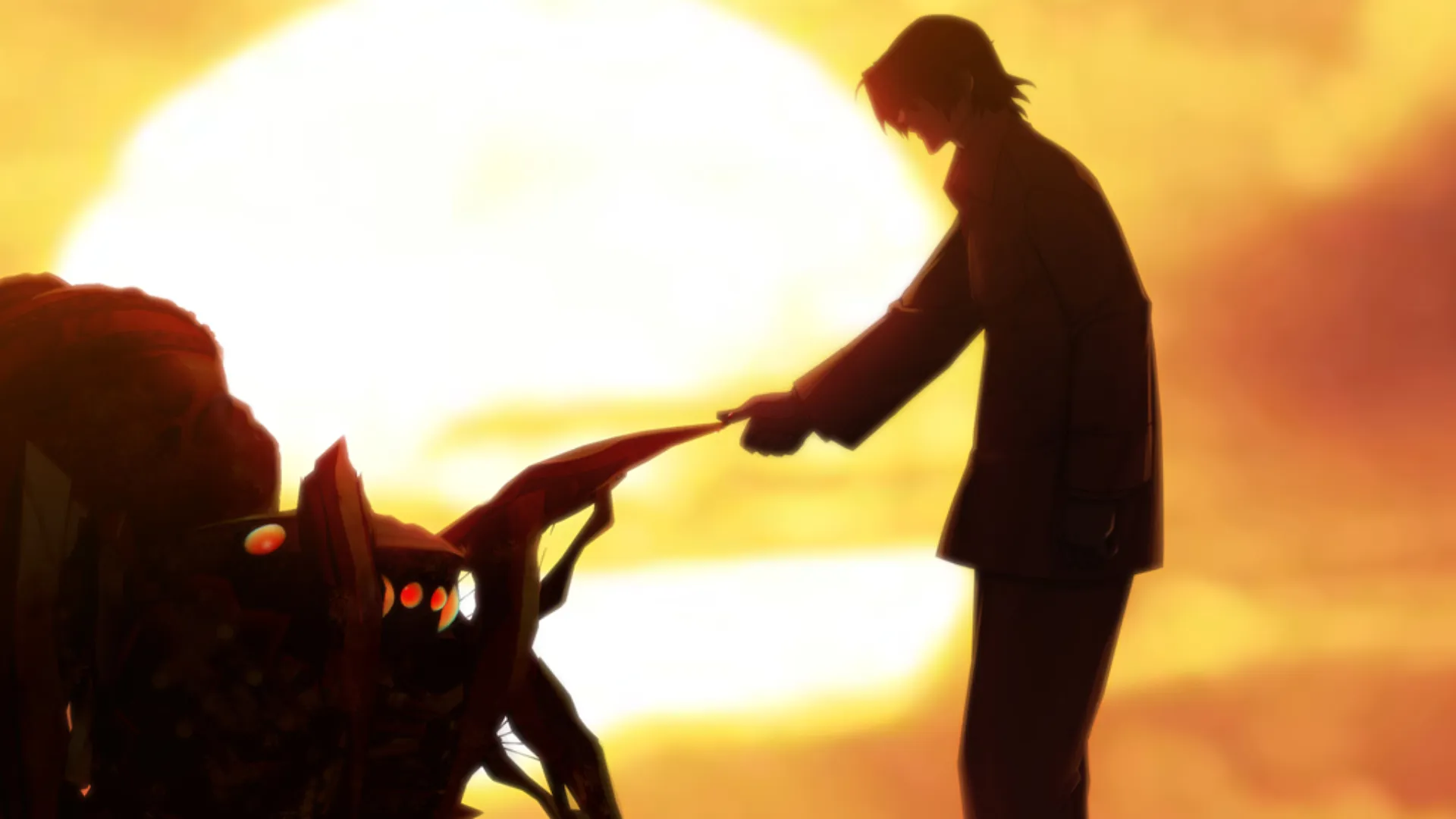
I'd long wanted to play read this visual novel, though purely because I really liked the design of one of the characters — I knew practically nothing about the story. Over time I forgot about it, but this month I quite accidentally discovered that a translation had been put out in the middle of last year, so naturally I dropped everything else, including the ducklings promised to Loken, and ran off with my tongue hanging out to read it. And I can say I didn't regret it! It's even surprising — you sit there mindlessly staring at the screen or grinding XP, and then suddenly you're wolfing down this much quality content on both cheeks — first the stunning Muv-Luv, and then the ultra-stylish Muramasa. You could sink into skepticism and assume it's just the antidepressants working, but better not.
Here we have excellent humor, an engaging plot with all sorts of twists and hints scattered across several routes, a deeply fleshed-out setting with many opposing factions and methods of warfare/combat techniques/equipment, atmospheric music, tons of great art, backgrounds and sprites, worldview clashes between flawed characters, each living according to their own convictions, and the novel lets you understand their point of view. The main theme of this VN, which I won't name to avoid spoilers, is well developed throughout the entire story and resonated with me, as did many other philosophical moments. A thought-provoking work, in short.
^ That topic when players attacked the GM's character.
As for the heroines, it's hard to say since they're all good. I'll only note that the narrow-eyed one has some absolutely unhinged humor. Oh, and yes, the protagonist is excellent, not only due to his role in the story itself, but also because of his personality traits.
I'd long wanted to play read this visual novel, though purely because I really liked the design of one of the characters — I knew practically nothing about the story. Over time I forgot about it, but this month I quite accidentally discovered that a translation had been put out in the middle of last year, so naturally I dropped everything else, including the ducklings promised to Loken, and ran off with my tongue hanging out to read it. And I can say I didn't regret it! It's even surprising — you sit there mindlessly staring at the screen or grinding XP, and then suddenly you're wolfing down this much quality content on both cheeks — first the stunning Muv-Luv, and then the ultra-stylish Muramasa. You could sink into skepticism and assume it's just the antidepressants working, but better not.
Here we have excellent humor, an engaging plot with all sorts of twists and hints scattered across several routes, a deeply fleshed-out setting with many opposing factions and methods of warfare/combat techniques/equipment, atmospheric music, tons of great art, backgrounds and sprites, worldview clashes between flawed characters, each living according to their own convictions, and the novel lets you understand their point of view. The main theme of this VN, which I won't name to avoid spoilers, is well developed throughout the entire story and resonated with me, as did many other philosophical moments. A thought-provoking work, in short.
^ That topic when players attacked the GM's character.
As for the heroines, it's hard to say since they're all good. I'll only note that the narrow-eyed one has some absolutely unhinged humor. Oh, and yes, the protagonist is excellent, not only due to his role in the story itself, but also because of his personality traits.
Auto-translated
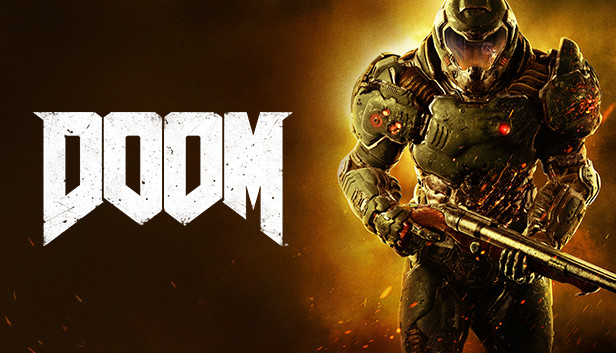
Not bad. I liked the variations of weapons/enemies, all sorts of upgrades, etc., and almost everything found its use (I didn't really use holograms, and I barely used the pestle). The difficulty level on ultra-hard is just how I like it - not too easy to get bored, but not so difficult that I want to quit. And there's a nominal plot, but it doesn't bother you with dialogues, diaries, etc.
Граф Орлов
Auto-translated
Divinity OS EE
I dropped it many times, usually after a failed attempt (I was playing on one save), but even after I stopped failing, I was very reluctant to resume the Walkthrough. In the very end, I dropped it completely due to a bug – apparently some script broke when I killed Icarus. But that's not the main point; the important thing is why I dropped it before that.
The world is just mega-boring. The setting aspect of the game is annoying in every way: the plot, which can be summarized in one sentence, the characters in general, the dialogues in particular, the drawn cutscenes that are out of place, and, excuse my French, the atmosphere – it's just very, very unpleasant to be in. And yet, this is what the RPG genre was created for, not only, but primarily. You can fight and admire the numbers in tactics games, explore locations in action games; there are even games where you have to press buttons while walking, just like in Divinity, only usually they are more intelligent in action games. I'll get back to the buttons later.
The RPG genre also has a component called the role-playing system. Well, it's okay, to be honest. You can even say it's very good, but first you have to endure endless stuns from invisible spots, then there will constantly be a 50% chance of being controlled, defeated, and having to reload, and so on until luck smiles upon you, but then you can easily crush not only mobs but also bosses in the second half of the game. If, of course, you occasionally change your equipment. This is the kind of game that will appeal to those who like to loot, go shopping, and see how stats progress. But even that is not certain, because tactics are the only thing that provides at least some enjoyment in the gameplay.
The rest of the gameplay consists of traps, quests, and puzzles. Traps will ruin the playthrough for those playing on one save a couple of times (one of them is bugged, and the second is so obviously-not-obvious that it's as if Reven himself set it up), and then they will simply be slightly annoying because they require you to spend time healing and reloading. Quests... something on the level of "fetch quest." They are only needed for farming experience. There is zero variability in the Walkthrough – literally zero; it's just "go to point B, then hand in the quest at point A," and neither B nor A can be avoided; the game is more linear than the average platformer. Sometimes there is a parody of a moral choice (read: sometimes you can level up some useless stat by saying something meaningless). There are no consequences for choosing or skipping a quest. There is no motivation other than the infamous experience. There is no need to remember anything, think, or explore further – no. Point A, point B, a couple of traps and a combat encounter along the way, a choice of a couple of phrases at the end.
Puzzles... This is the best part. There are essentially two types: "use a skill" and "find a button." Find a button. In an RPG from a third-person perspective. A gray button on a gray wall. Brilliant. So brilliant that the whole game is filled with these buttons – every time I got stuck on a "puzzle" and couldn't solve it, it turned out that it wasn't because I was stupid and couldn't figure out the developers' idea – it was because I didn't see the button. In addition to pressing buttons, you can also pull levers if you like. And here's an example so you understand the level of the famous puzzles in Divinity.
Introduction: there are three buttons with symbols (priest, fish, warrior), three statues (priest, fish, warrior), and three barrels (oil, poison, water). And a lever to pull. Well, I pull it, of course... Nothing. Okay, let's use our brains. There is poison spilled near the warrior statue. There is a fish near the priest statue. And there is a torch next to the fish. Well, I think, we solved more difficult puzzles in the first grade, but this was the most difficult one in the whole game (and we're near the end), I even had to think and explore the location... We put the barrels on the buttons: the fish button – oil, the warrior button – poison, and the priest button – water. And... Nothing. It turns out that you just need to put the statues on the buttons. Apparently, they decided that the target audience of the game couldn't handle a chain of three links, so they abandoned the barrels...
So, that's it. The world is bad, buttons instead of exploration, a teleport button instead of puzzles, clicking through numbers instead of quests, zero replayability. So, what's the point of all this? Probably just for the combat, but even that gets boring quickly. And a couple of fun moments, like killing an NPC in a quest, then telling another NPC, who was standing near the corpse, and taking all his stuff and increasing my capital fivefold, but if this is almost the only memorable moment besides the combat for a couple of dozen hours, that's kind of sad. It's completely unclear where the game got such high ratings. Although "Pillars of Eternity" also has high ratings.
Let's say 4/10
Added 10 minutes ago
Ah yes, an important question: given all this, is it worth trying to play the second part?
I dropped it many times, usually after a failed attempt (I was playing on one save), but even after I stopped failing, I was very reluctant to resume the Walkthrough. In the very end, I dropped it completely due to a bug – apparently some script broke when I killed Icarus. But that's not the main point; the important thing is why I dropped it before that.
The world is just mega-boring. The setting aspect of the game is annoying in every way: the plot, which can be summarized in one sentence, the characters in general, the dialogues in particular, the drawn cutscenes that are out of place, and, excuse my French, the atmosphere – it's just very, very unpleasant to be in. And yet, this is what the RPG genre was created for, not only, but primarily. You can fight and admire the numbers in tactics games, explore locations in action games; there are even games where you have to press buttons while walking, just like in Divinity, only usually they are more intelligent in action games. I'll get back to the buttons later.
The RPG genre also has a component called the role-playing system. Well, it's okay, to be honest. You can even say it's very good, but first you have to endure endless stuns from invisible spots, then there will constantly be a 50% chance of being controlled, defeated, and having to reload, and so on until luck smiles upon you, but then you can easily crush not only mobs but also bosses in the second half of the game. If, of course, you occasionally change your equipment. This is the kind of game that will appeal to those who like to loot, go shopping, and see how stats progress. But even that is not certain, because tactics are the only thing that provides at least some enjoyment in the gameplay.
The rest of the gameplay consists of traps, quests, and puzzles. Traps will ruin the playthrough for those playing on one save a couple of times (one of them is bugged, and the second is so obviously-not-obvious that it's as if Reven himself set it up), and then they will simply be slightly annoying because they require you to spend time healing and reloading. Quests... something on the level of "fetch quest." They are only needed for farming experience. There is zero variability in the Walkthrough – literally zero; it's just "go to point B, then hand in the quest at point A," and neither B nor A can be avoided; the game is more linear than the average platformer. Sometimes there is a parody of a moral choice (read: sometimes you can level up some useless stat by saying something meaningless). There are no consequences for choosing or skipping a quest. There is no motivation other than the infamous experience. There is no need to remember anything, think, or explore further – no. Point A, point B, a couple of traps and a combat encounter along the way, a choice of a couple of phrases at the end.
Puzzles... This is the best part. There are essentially two types: "use a skill" and "find a button." Find a button. In an RPG from a third-person perspective. A gray button on a gray wall. Brilliant. So brilliant that the whole game is filled with these buttons – every time I got stuck on a "puzzle" and couldn't solve it, it turned out that it wasn't because I was stupid and couldn't figure out the developers' idea – it was because I didn't see the button. In addition to pressing buttons, you can also pull levers if you like. And here's an example so you understand the level of the famous puzzles in Divinity.
Introduction: there are three buttons with symbols (priest, fish, warrior), three statues (priest, fish, warrior), and three barrels (oil, poison, water). And a lever to pull. Well, I pull it, of course... Nothing. Okay, let's use our brains. There is poison spilled near the warrior statue. There is a fish near the priest statue. And there is a torch next to the fish. Well, I think, we solved more difficult puzzles in the first grade, but this was the most difficult one in the whole game (and we're near the end), I even had to think and explore the location... We put the barrels on the buttons: the fish button – oil, the warrior button – poison, and the priest button – water. And... Nothing. It turns out that you just need to put the statues on the buttons. Apparently, they decided that the target audience of the game couldn't handle a chain of three links, so they abandoned the barrels...
So, that's it. The world is bad, buttons instead of exploration, a teleport button instead of puzzles, clicking through numbers instead of quests, zero replayability. So, what's the point of all this? Probably just for the combat, but even that gets boring quickly. And a couple of fun moments, like killing an NPC in a quest, then telling another NPC, who was standing near the corpse, and taking all his stuff and increasing my capital fivefold, but if this is almost the only memorable moment besides the combat for a couple of dozen hours, that's kind of sad. It's completely unclear where the game got such high ratings. Although "Pillars of Eternity" also has high ratings.
Let's say 4/10
Added 10 minutes ago
Ah yes, an important question: given all this, is it worth trying to play the second part?
Auto-translated
After playing and highly appreciating the second part, I considered trying the first one again, but after reading everything you wrote, I remembered how it felt, and I no longer feel like trying it.
You can try it. Its worst part is the second half of the first act, but it's not as bad as the worst moments of the first part; otherwise, the world is reasonably decent, and I don't remember any particularly frustrating moments a year after playing it. But it's important to understand that in my style of playing, I've learned to filter out undesirable elements, such as perfectionism, going around in circles, reading notes, endless dialogues, and excessive looting and inventory management, over the years, so I might not have noticed anything particularly bad. Also, the fact that I hadn't played Western RPGs for several years and had taken a break from them by the time I encountered this one might have helped.
My sword, my trusted ally, unphased by my aspect.
Auto-translated
cyberpunk

The ultimate Witcher 3 with all its elements: bleakness, question marks, pseudo-dialogues, a schizophrenic main quest, a disgusting interface, auto-leveling gear, vomit-inducing role-playing system with nothing of substance – with percentages added to dreary effects instead of interesting progression.
However, there is an undeniable plus compared to the Witcher, which is that, firstly, it's a shooter – shooting is always more enjoyable than waving a drawn toothpick, and secondly, it's in first person.
Overall, I see several major serious problems with it.
The main one is that the world is utterly repulsive. From the point of view of traveling by car, in some areas, you can admit that the city is designed coolly, in the sense that when you look at the intricate patterns of urban dystopia in industrial zones, you feel that it could look like this in real life, and it really does look like it in Moscow, that is, serious attention has been paid to details, plus good graphics enhance this detail. But otherwise, the city is just a city, and it consists of typical houses, fences, garbage cans, vending machines, advertisements, and other repulsive modern junk that evokes nothing but fatigue and disdain.
The NPCs are extremely awful; I probably haven't seen such freaks anywhere else. Imagine all the possible mutants from Oblivion, dressed in completely random clothes, as if a schoolboy had gone wild in an MMORPG – he generated freaks and bought the most eye-watering cosmetics for them. And the saddest thing is that this really feels like a very likely scenario for the near future of human civilization – in this sense, it's immersive, but not in the way I would have liked.
In general, I couldn't spend a single minute trying to walk around the city, look at the NPCs, and the world, but I just rushed along the marker, just to avoid seeing this nightmare.
An additional sub-problem stems from the previous one – because of this, there is no desire to delve into the intricacies of the relationships between the NPC freaks, read useless thousands of notes (I didn't read a single one during the entire game – I tried a couple of times, but I dropped it almost instantly out of boredom, it's completely generic and dull), think about the details of quests or one and a half moral dilemmas, and so on – being in the world won't become more pleasant because of this.
In addition to this, the developers are trying in the most clumsy ways to force unnecessary and awkward lore – for example, you can click on the portrait of a character, which will be indicated on the diary page with the text next to the corresponding quest, and it will give you his picture with a quote – who he is, what he did. Why is this needed – it's unclear, the NPCs are completely awful, you'll look at many of them for only about 15 minutes, and this information doesn't give you anything. Another clumsy method is when you are in a quest dialogue, when taking or completing a quest, after you have just had a serious conversation about a robbery or some other vital things, you can additionally ask one or two questions of the level "well, are you still watching boxing?" and the NPC will answer you "yes, today Ivan Ivanovich is against Peter Petrovich, how he knocked him out with one left hook, uuu" – that is, it should create the impression that you are like acquaintances or friends, and as if you are having an immersive dialogue, during which one line from the quote will be retold to you in this form of a thesis, but again – it's done in a mega-clumsy way, and it's unclear why I should be interested in this.
Another major drawback is that the plot is small, commensurate with the setting. The individual elements and concept of it appeal to me more – if you compare it with the same Blade Runner, then in the Blade Runner films, a completely hackneyed, boring, and banal idea is brought to the forefront, which can be conveyed in any possible setting, and not just in a cyberpunk setting (I haven't read the book, but a friend who read it claims that there the replicant theme was only one of the concepts in the plot, and in the rest there was a lot of everything diverse, unlike the films, where it is presented as the only thing worth paying attention to). What is shown in Cyberpunk – at least fits more or less into what I am personally willing to expect from such a setting, but I don't like the presentation. The excessive amount of cinema – it's not just watching half-hour cutscenes in first person, but "interactive" cutscenes, where you need to slowly follow the NPC down the street during a dialogue, and even press X at some moments to move further in the dialogue – it's incredibly annoying. Absolutely unnecessary, vague Keanu Reeves, on whom 90% of the budget was spent, mumbling something under his breath, with disgusting relationships with his friends, which you have to figure out and watch a movie.
Moreover, individual moments of the main plot or even side quests are very, very good – atmospheric, with interesting events and concepts, sometimes raising interesting questions, generally feeling like 8-8.5/10 and clearly stand out from the overall Far Cry-GTA-like form factor that we have in the end. Here, the thought arises that these may be preserved elements from the original concept of the game – that is, the Cyberpunk 2077 that was promised and announced long before the marketing machinations completely reworked its concept ten times. If the whole game was like these individual moments, it would be excellent, but there are only one or two of these moments.
And, in addition to the problems mentioned above, you can just throw into the heap all that was listed in the very first sentence. Bland progression; trash dialogues; "content" in the form of question marks/collectibles; driving a car is so repulsive that you feel like you're on a flying carpet, regardless of the make of the car.
The interface and ergonomics are non-existent concepts – imagine that you have 10 types of grenades that are thrown by pressing the mouse wheel, plus an implant like knives on the same button, and the only way to switch between them is to go into the inventory and drag another grenade into that slot. Or here's another joke – you shot an enemy at close range, pressed R to reload the weapon, and instead of reloading, your character picked up the weapon of the killed enemy, because R is also to pick up a weapon from a corpse.
In addition, there are completely useless merchants and weapon customization – why bother with this if in 10 minutes a new random bandit on the street will drop a gun that is simply better in all parameters than your customized legendary one?
Otherwise, despite all this, you can run around and shoot if you like shooters – the shooting itself is done pleasantly. I especially liked that many subtle moral questions can be solved with lead, which, of course, may cause some kind of shock in some NPCs, but in general it is very suitable for the game and the setting, in my opinion.
Overall, I would rate it a solid seven or a weak seven and a half.


The ultimate Witcher 3 with all its elements: bleakness, question marks, pseudo-dialogues, a schizophrenic main quest, a disgusting interface, auto-leveling gear, vomit-inducing role-playing system with nothing of substance – with percentages added to dreary effects instead of interesting progression.
However, there is an undeniable plus compared to the Witcher, which is that, firstly, it's a shooter – shooting is always more enjoyable than waving a drawn toothpick, and secondly, it's in first person.
Overall, I see several major serious problems with it.
The main one is that the world is utterly repulsive. From the point of view of traveling by car, in some areas, you can admit that the city is designed coolly, in the sense that when you look at the intricate patterns of urban dystopia in industrial zones, you feel that it could look like this in real life, and it really does look like it in Moscow, that is, serious attention has been paid to details, plus good graphics enhance this detail. But otherwise, the city is just a city, and it consists of typical houses, fences, garbage cans, vending machines, advertisements, and other repulsive modern junk that evokes nothing but fatigue and disdain.
The NPCs are extremely awful; I probably haven't seen such freaks anywhere else. Imagine all the possible mutants from Oblivion, dressed in completely random clothes, as if a schoolboy had gone wild in an MMORPG – he generated freaks and bought the most eye-watering cosmetics for them. And the saddest thing is that this really feels like a very likely scenario for the near future of human civilization – in this sense, it's immersive, but not in the way I would have liked.
In general, I couldn't spend a single minute trying to walk around the city, look at the NPCs, and the world, but I just rushed along the marker, just to avoid seeing this nightmare.
An additional sub-problem stems from the previous one – because of this, there is no desire to delve into the intricacies of the relationships between the NPC freaks, read useless thousands of notes (I didn't read a single one during the entire game – I tried a couple of times, but I dropped it almost instantly out of boredom, it's completely generic and dull), think about the details of quests or one and a half moral dilemmas, and so on – being in the world won't become more pleasant because of this.
In addition to this, the developers are trying in the most clumsy ways to force unnecessary and awkward lore – for example, you can click on the portrait of a character, which will be indicated on the diary page with the text next to the corresponding quest, and it will give you his picture with a quote – who he is, what he did. Why is this needed – it's unclear, the NPCs are completely awful, you'll look at many of them for only about 15 minutes, and this information doesn't give you anything. Another clumsy method is when you are in a quest dialogue, when taking or completing a quest, after you have just had a serious conversation about a robbery or some other vital things, you can additionally ask one or two questions of the level "well, are you still watching boxing?" and the NPC will answer you "yes, today Ivan Ivanovich is against Peter Petrovich, how he knocked him out with one left hook, uuu" – that is, it should create the impression that you are like acquaintances or friends, and as if you are having an immersive dialogue, during which one line from the quote will be retold to you in this form of a thesis, but again – it's done in a mega-clumsy way, and it's unclear why I should be interested in this.
Another major drawback is that the plot is small, commensurate with the setting. The individual elements and concept of it appeal to me more – if you compare it with the same Blade Runner, then in the Blade Runner films, a completely hackneyed, boring, and banal idea is brought to the forefront, which can be conveyed in any possible setting, and not just in a cyberpunk setting (I haven't read the book, but a friend who read it claims that there the replicant theme was only one of the concepts in the plot, and in the rest there was a lot of everything diverse, unlike the films, where it is presented as the only thing worth paying attention to). What is shown in Cyberpunk – at least fits more or less into what I am personally willing to expect from such a setting, but I don't like the presentation. The excessive amount of cinema – it's not just watching half-hour cutscenes in first person, but "interactive" cutscenes, where you need to slowly follow the NPC down the street during a dialogue, and even press X at some moments to move further in the dialogue – it's incredibly annoying. Absolutely unnecessary, vague Keanu Reeves, on whom 90% of the budget was spent, mumbling something under his breath, with disgusting relationships with his friends, which you have to figure out and watch a movie.
Moreover, individual moments of the main plot or even side quests are very, very good – atmospheric, with interesting events and concepts, sometimes raising interesting questions, generally feeling like 8-8.5/10 and clearly stand out from the overall Far Cry-GTA-like form factor that we have in the end. Here, the thought arises that these may be preserved elements from the original concept of the game – that is, the Cyberpunk 2077 that was promised and announced long before the marketing machinations completely reworked its concept ten times. If the whole game was like these individual moments, it would be excellent, but there are only one or two of these moments.
And, in addition to the problems mentioned above, you can just throw into the heap all that was listed in the very first sentence. Bland progression; trash dialogues; "content" in the form of question marks/collectibles; driving a car is so repulsive that you feel like you're on a flying carpet, regardless of the make of the car.
The interface and ergonomics are non-existent concepts – imagine that you have 10 types of grenades that are thrown by pressing the mouse wheel, plus an implant like knives on the same button, and the only way to switch between them is to go into the inventory and drag another grenade into that slot. Or here's another joke – you shot an enemy at close range, pressed R to reload the weapon, and instead of reloading, your character picked up the weapon of the killed enemy, because R is also to pick up a weapon from a corpse.
In addition, there are completely useless merchants and weapon customization – why bother with this if in 10 minutes a new random bandit on the street will drop a gun that is simply better in all parameters than your customized legendary one?
Otherwise, despite all this, you can run around and shoot if you like shooters – the shooting itself is done pleasantly. I especially liked that many subtle moral questions can be solved with lead, which, of course, may cause some kind of shock in some NPCs, but in general it is very suitable for the game and the setting, in my opinion.
Overall, I would rate it a solid seven or a weak seven and a half.
Title
My sword, my trusted ally, unphased by my aspect.
Auto-translated
anal ring

I am insanely tired of playing this. It took even more hours than DS 2, except I didn't fully clear all the "content," and I completely skipped one part of the map — I couldn't figure out how to get there and couldn't be bothered to look it up.
Why did I put "content" in quotes? Because I can't call copy-pasted caves like in *Scrolls* by that name. I didn't think I'd ever see something like that again, but lo and behold — in 2022. And I'm not joking in the slightest. At first, I was suspicious of the open world idea — we all know open worlds are garbage — empty, dead, full of low-effort, tasteless filler. And in the first few hours, I really did feel lost, given that in *Ring*, unlike standard open worlds, there are no quests with markers, no tangible hand-holding, or anything else we're used to. You can go in any of the four directions from the start, but where and why is unclear.
Then I thought — okay, maybe, knowing that Miyazaki has some vision, the open world should serve worldbuilding. Recalling the diversity of patchwork-like locations in the other Souls games — perhaps the scope here would finally show us something resembling a full continent, with its own settlements, landscapes flowing smoothly into one another, and all that. I was wrong. This open world is literally the same patchwork quilt of locations, only first, these patches are much larger in area, and second, they have less variety than before; meanwhile, there's almost no effort put into organic placement or thoughtfulness. Here you have a desert, there a snowy area, here a swamp, there a meadow — the same crap as always, just with a distant view. At the same time, the only real landmark is the Erdtree, visible from any part of the map — while most nearby locations are often hidden by fog. And where they are visible, we see nothing interesting, just some generic cliff-plateau and maybe a couple of spires from a random minor castle.
All these vast expanses are ~87% empty. In the 13%, you might find some pack of standard mobs, a copy-pasted dungeon, and some herbs for crafting growing here and there. Crafting — that's exactly what Dark Souls was missing, I hope you agree. We have an open world, *Witcher*-style Roach, copy-pasted dungeons, so we need crafting too. Makes sense?
Regarding the copy-pasted dungeons — I'll say again, I'm not joking. There are a few types of dungeons: a regular cave, a crystal mine, a crypt with gargoyles, a crypt with skeletons, a crypt with a chariot from DS2; ... ... I actually stopped writing just now, leaned back in my chair, seriously thought for half a minute, and still couldn't remember other types. There were probably one or two more types of cave or crypt, but I really don't remember anymore. So, in all these dungeons, the texture and interior are the same, the same standard halls and corridors, differing only slightly in room layout — as if all these crypts and caves were built by Khrushchev himself. In all these crypts, there are about 5 types of enemies, varying in toughness depending on the dungeon's "difficulty," but these enemy types are completely identical. At the end, you face some miniboss — often just a slightly tougher regular mob, which rewards you with a few drops of souls, a random trash item (not necessarily gear), and a button to "teleport back to the entrance." And these bosses aren't just reused occasionally — there are literally about 5 boss types across dozens of dungeons, reused over and over, over and over, over and over — sometimes a bit beefier, sometimes in pairs. Oh, I remembered. Sometimes on the overworld map, you encounter circles instead of dungeons that instantly teleport you to an arena with a miniboss, so you can kill it without wandering through those Khrushchev-style caves. That's why this type of "content" is the best of its kind.
However, the reuse issue isn't just about the dungeons themselves. The thing is, across the entire game, all over the continent, spanning 150-200 hours of playtime, you can count the enemy types on the fingers of your extremities — maybe on four hands, or even three. In different locations, these 15 enemy types are repeatedly reused with different colored skins. For example — we have infantry from one "lord" (one of several large chunks of the continent) in chainmail of one color, another, a third, a fifth. We also have green poisonous flowers that spit poison, or identical ones in blue that spit magic, or identical ones in red that spit fire — and so on. You know, it's not like the Souls games were ever particularly dazzling in enemy variety before, but this is a new level of laziness for them.
The same can be said about many things. For instance, there are only about 10 types of armor — a couple of rags, a couple of gambesons, a couple of chainmails, a couple of full plates, etc., often hardly differing from each other in appearance, design, stats, or even color. In Souls 1, I remember something similar, but at least there honestly wasn't that much armor overall.
Same for weapons — the standard sword, dagger, katana, club, bow, spear, but each with 20 variations, hardly different from each other. Though that's not a problem — almost all standard weapons are completely useless because there are unique ones. You upgrade standard weapons with standard titanite, and unique ones with unique titanite, while unique weapons simply deal higher damage, and unique titanite isn't rare at all and doesn't gatekeep you from using unique weapons.
For example, I found a curved greatsword in the first hour of the game that scaled C and later B with dexterity and D => C with strength, and it dealt more damage at any point in the game than a strength-scaling A standard weapon fully upgraded, with base dexterity in my build and 40-50 strength. I used it all the way to the end. The only advantage of standard weapons is that you can apply a skill at the blacksmith that you want, but unique weapons generally have better skills too.
Essentially, skills similar to those in Dota are the only thing that adds some variety to weapons in this game, and they also largely define the combat. I beat almost all bosses just by spamming my sword's skill attack between their combos, without worrying about anything else. As a result, the only mob where this strategy failed was the story-driven mad dog near the end — there I had to use regular auto-attacks because my sword was slow, and he sometimes dodged the skill.
Similarly, there are plenty of spells and greases, but since I didn't use them myself, I can only judge what I saw from enemies, and while they have them, there isn't much variety in their attacks.
Btw, all this wonderful inventory filling is a total nightmare. The inventory is incredibly cumbersome and schizophrenic in the best traditions of Western RPGs — lots of item tabs you get confused in even after 100 hours, just clicking tabs at random until you visually spot what you need on the page, and you only need 1% of everything you loot throughout the game. Each of these tabs has multiple screens of cells to scroll up and down — ergonomics are out of the question. At some point, you have no idea what's in your consumables tab — you never use anything throughout the entire game. You almost never consciously check the weapon and armor tabs — what's the point, if you're immediately buried under monstrous, unwieldy menus full of dozens of useless rags and crap weapons? They're not interesting to look at and not productive. All you need is to equip or unequip a longbow from your hand slot. And when you find something new, roughly in the first half of the game, and it disappears before you can see what it was — just forget about it and let it go. You'll never find what you picked up in your schizophrenic hoarder inventory. Most likely, your only way to know is to open a wiki for your location and try to find that drop in its text.
Overall, this approach characterizes the game — you search for one and a half percent of anything quality — rare good weapons/spells/levels in a barn of bland hay.
Returning to the empty dead world — I previously liked Souls games for their level design and exploration. Not in every entry or everywhere, but overall you could expect some level design worth exploring. Here, there are maybe 4 locations, totaling 15-20 hours out of 150-200. And those are the main boss areas (and not even all). Here we have levels that depart from meadows, hills, and standard Khrushchev-style dungeons and are designed at least somewhat — on par with the oldest and roughest parts of Souls. Some even take a while to get through, but overall it's a drop in the ocean. During my playthrough, I almost dropped *Ring* several times — not because some boss or tough location wrecked me, but because I was just monstrously exhausted clearing it with a fork. After a few dozen hours, I even started skipping most of the open world — just galloping on horseback, mostly not killing mobs, not searching every nook for another piece of crap loot, and even then, seeing how much more of this swamp I had to wade through, I had zero motivation to continue.
Barely, gritting my teeth, taking breaks during which I played *Cyberpunk* (which I ended up liking more than I should have in comparison to *Ring*, and I won't say *Ring* was more enjoyable to play) and a couple of other projects, skipping quite a bit, I dragged myself through this slog to the end. Not my greatest achievement in life, I'll be honest.
Overall, in terms of rubles per hour, the raw amount of game content probably represents one of the best deals on the market. Much more profitable — if you're an autist who finds it fun to spend hundreds of hours clearing the same stuff with a fork without any reward factors except appeasing your inner OCD demon. Or if you're a stuffy, enthusiastic Souls fan who will eagerly gobble up everything this company regurgitates into your beak — which correlates with the above.
If you're a sane, healthy person with a good graphics card, you can play it for about 50 hours, enjoy the quite pleasant graphics, speedrun a few main areas, and happily finish the game. Any effort you put in beyond that will most likely be wasted time and energy, with horrifying diminishing returns.
To summarize with a score: at its best moments, I'd give the game a 7.5, no more. At its worst, blandest, most tedious stretches — a 3.5-4. Worst moments make up 87%.
Figure it out for yourselves.
I am insanely tired of playing this. It took even more hours than DS 2, except I didn't fully clear all the "content," and I completely skipped one part of the map — I couldn't figure out how to get there and couldn't be bothered to look it up.
Why did I put "content" in quotes? Because I can't call copy-pasted caves like in *Scrolls* by that name. I didn't think I'd ever see something like that again, but lo and behold — in 2022. And I'm not joking in the slightest. At first, I was suspicious of the open world idea — we all know open worlds are garbage — empty, dead, full of low-effort, tasteless filler. And in the first few hours, I really did feel lost, given that in *Ring*, unlike standard open worlds, there are no quests with markers, no tangible hand-holding, or anything else we're used to. You can go in any of the four directions from the start, but where and why is unclear.
Then I thought — okay, maybe, knowing that Miyazaki has some vision, the open world should serve worldbuilding. Recalling the diversity of patchwork-like locations in the other Souls games — perhaps the scope here would finally show us something resembling a full continent, with its own settlements, landscapes flowing smoothly into one another, and all that. I was wrong. This open world is literally the same patchwork quilt of locations, only first, these patches are much larger in area, and second, they have less variety than before; meanwhile, there's almost no effort put into organic placement or thoughtfulness. Here you have a desert, there a snowy area, here a swamp, there a meadow — the same crap as always, just with a distant view. At the same time, the only real landmark is the Erdtree, visible from any part of the map — while most nearby locations are often hidden by fog. And where they are visible, we see nothing interesting, just some generic cliff-plateau and maybe a couple of spires from a random minor castle.
All these vast expanses are ~87% empty. In the 13%, you might find some pack of standard mobs, a copy-pasted dungeon, and some herbs for crafting growing here and there. Crafting — that's exactly what Dark Souls was missing, I hope you agree. We have an open world, *Witcher*-style Roach, copy-pasted dungeons, so we need crafting too. Makes sense?
Regarding the copy-pasted dungeons — I'll say again, I'm not joking. There are a few types of dungeons: a regular cave, a crystal mine, a crypt with gargoyles, a crypt with skeletons, a crypt with a chariot from DS2; ... ... I actually stopped writing just now, leaned back in my chair, seriously thought for half a minute, and still couldn't remember other types. There were probably one or two more types of cave or crypt, but I really don't remember anymore. So, in all these dungeons, the texture and interior are the same, the same standard halls and corridors, differing only slightly in room layout — as if all these crypts and caves were built by Khrushchev himself. In all these crypts, there are about 5 types of enemies, varying in toughness depending on the dungeon's "difficulty," but these enemy types are completely identical. At the end, you face some miniboss — often just a slightly tougher regular mob, which rewards you with a few drops of souls, a random trash item (not necessarily gear), and a button to "teleport back to the entrance." And these bosses aren't just reused occasionally — there are literally about 5 boss types across dozens of dungeons, reused over and over, over and over, over and over — sometimes a bit beefier, sometimes in pairs. Oh, I remembered. Sometimes on the overworld map, you encounter circles instead of dungeons that instantly teleport you to an arena with a miniboss, so you can kill it without wandering through those Khrushchev-style caves. That's why this type of "content" is the best of its kind.
However, the reuse issue isn't just about the dungeons themselves. The thing is, across the entire game, all over the continent, spanning 150-200 hours of playtime, you can count the enemy types on the fingers of your extremities — maybe on four hands, or even three. In different locations, these 15 enemy types are repeatedly reused with different colored skins. For example — we have infantry from one "lord" (one of several large chunks of the continent) in chainmail of one color, another, a third, a fifth. We also have green poisonous flowers that spit poison, or identical ones in blue that spit magic, or identical ones in red that spit fire — and so on. You know, it's not like the Souls games were ever particularly dazzling in enemy variety before, but this is a new level of laziness for them.
The same can be said about many things. For instance, there are only about 10 types of armor — a couple of rags, a couple of gambesons, a couple of chainmails, a couple of full plates, etc., often hardly differing from each other in appearance, design, stats, or even color. In Souls 1, I remember something similar, but at least there honestly wasn't that much armor overall.
Same for weapons — the standard sword, dagger, katana, club, bow, spear, but each with 20 variations, hardly different from each other. Though that's not a problem — almost all standard weapons are completely useless because there are unique ones. You upgrade standard weapons with standard titanite, and unique ones with unique titanite, while unique weapons simply deal higher damage, and unique titanite isn't rare at all and doesn't gatekeep you from using unique weapons.
For example, I found a curved greatsword in the first hour of the game that scaled C and later B with dexterity and D => C with strength, and it dealt more damage at any point in the game than a strength-scaling A standard weapon fully upgraded, with base dexterity in my build and 40-50 strength. I used it all the way to the end. The only advantage of standard weapons is that you can apply a skill at the blacksmith that you want, but unique weapons generally have better skills too.
Essentially, skills similar to those in Dota are the only thing that adds some variety to weapons in this game, and they also largely define the combat. I beat almost all bosses just by spamming my sword's skill attack between their combos, without worrying about anything else. As a result, the only mob where this strategy failed was the story-driven mad dog near the end — there I had to use regular auto-attacks because my sword was slow, and he sometimes dodged the skill.
Similarly, there are plenty of spells and greases, but since I didn't use them myself, I can only judge what I saw from enemies, and while they have them, there isn't much variety in their attacks.
Btw, all this wonderful inventory filling is a total nightmare. The inventory is incredibly cumbersome and schizophrenic in the best traditions of Western RPGs — lots of item tabs you get confused in even after 100 hours, just clicking tabs at random until you visually spot what you need on the page, and you only need 1% of everything you loot throughout the game. Each of these tabs has multiple screens of cells to scroll up and down — ergonomics are out of the question. At some point, you have no idea what's in your consumables tab — you never use anything throughout the entire game. You almost never consciously check the weapon and armor tabs — what's the point, if you're immediately buried under monstrous, unwieldy menus full of dozens of useless rags and crap weapons? They're not interesting to look at and not productive. All you need is to equip or unequip a longbow from your hand slot. And when you find something new, roughly in the first half of the game, and it disappears before you can see what it was — just forget about it and let it go. You'll never find what you picked up in your schizophrenic hoarder inventory. Most likely, your only way to know is to open a wiki for your location and try to find that drop in its text.
Overall, this approach characterizes the game — you search for one and a half percent of anything quality — rare good weapons/spells/levels in a barn of bland hay.
Returning to the empty dead world — I previously liked Souls games for their level design and exploration. Not in every entry or everywhere, but overall you could expect some level design worth exploring. Here, there are maybe 4 locations, totaling 15-20 hours out of 150-200. And those are the main boss areas (and not even all). Here we have levels that depart from meadows, hills, and standard Khrushchev-style dungeons and are designed at least somewhat — on par with the oldest and roughest parts of Souls. Some even take a while to get through, but overall it's a drop in the ocean. During my playthrough, I almost dropped *Ring* several times — not because some boss or tough location wrecked me, but because I was just monstrously exhausted clearing it with a fork. After a few dozen hours, I even started skipping most of the open world — just galloping on horseback, mostly not killing mobs, not searching every nook for another piece of crap loot, and even then, seeing how much more of this swamp I had to wade through, I had zero motivation to continue.
Barely, gritting my teeth, taking breaks during which I played *Cyberpunk* (which I ended up liking more than I should have in comparison to *Ring*, and I won't say *Ring* was more enjoyable to play) and a couple of other projects, skipping quite a bit, I dragged myself through this slog to the end. Not my greatest achievement in life, I'll be honest.
Overall, in terms of rubles per hour, the raw amount of game content probably represents one of the best deals on the market. Much more profitable — if you're an autist who finds it fun to spend hundreds of hours clearing the same stuff with a fork without any reward factors except appeasing your inner OCD demon. Or if you're a stuffy, enthusiastic Souls fan who will eagerly gobble up everything this company regurgitates into your beak — which correlates with the above.
If you're a sane, healthy person with a good graphics card, you can play it for about 50 hours, enjoy the quite pleasant graphics, speedrun a few main areas, and happily finish the game. Any effort you put in beyond that will most likely be wasted time and energy, with horrifying diminishing returns.
To summarize with a score: at its best moments, I'd give the game a 7.5, no more. At its worst, blandest, most tedious stretches — a 3.5-4. Worst moments make up 87%.
Figure it out for yourselves.
My sword, my trusted ally, unphased by my aspect.
Auto-translated
Fallout 3
Fallout New Vegas
Fallout 4
I really love and adore Bethesda games. There's something indescribably cozy about them; playing them feels like coming home, everything is familiar and comforting. I still occasionally open Oblivion and load up old saves with my ancient Khajiit character. In Skyrim, I practically live; since its release, I can navigate all the cities and major dungeons with my eyes closed. It's just nice to wander aimlessly through this world, complete a small quest, or try out a new mod – anything to relax and unwind.
Last autumn, for various reasons, I finally decided to replay the Fallout games. And...
Yes, the third part is like the Elder Scrolls, but viewed from the side, with all the typical strengths and weaknesses of the series. For me, that's a good thing. I quickly got used to the beautiful new world and fell in love with it. I adore retro-futurism, I like post-apocalypse, and the combination of these two aesthetics is simply amazing. It feels a bit rough around the edges, a little clunky, but honestly, I don't want to criticize Fallout 3. There's not much to praise it for either, except for the awesome radio and the overall aesthetic of the series, but it's fine. I played through it relatively quickly, eager to get to the next part, but I still managed to get immersed and enjoy it, and it's a game I'll want to return to, as the Bethesda vibes are still there.
New Vegas... Well... It's not Bethesda. It's a very good game, with polished gameplay, the ability to truly choose a faction, unlike in the third game, where there's essentially no choice, a successful cast of companions (although I ended up only playing with the adorable Eyebot, ED-E), a more pleasant color palette, and the absolutely amazing Old World Blues DLC, which had me laughing until I cried. But... The closed ending makes me very sad. I made, probably, five hard saves before the battle for Hoover Dam, not counting the autosave, but I'm still sad. And the Mojave itself seemed... Empty, or something. More isolated locations, fewer random caves and settlements. I really enjoyed this part, and I'll probably return to it, but it's not Bethesda, and Obsidian couldn't quite recreate that same cozy and familiar feeling.
I haven't really finished the fourth one yet, but oh my god, I'm so excited, ten out of ten, a hundred out of a hundred. I can only criticize the new dialogues, that "Yes, no, sarcasm" – I really miss the additional dialogue options that were unlocked by leveling up certain stats or choosing certain perks. But the voiced protagonist makes me feel good and happy. The aesthetic and atmosphere of retro-futuristic post-apocalypse are still there, the graphics are bright, fresh, and pleasing to the eye, and the building option is simply amazing. It's not Sims, of course, but it's still pretty good, and I'll definitely have plenty to do and also increase my affinity with the companions. By the way, speaking of companions, this is probably the first Bethesda game where I enjoyed having a companion with me. Gosh, I'm ready to forgive the fourth Fallout for all its flaws just for Nick. I haven't finished the main quest yet, but I'm already lost in post-nuclear Boston and don't want to leave, it's hard to draw comics, all my thoughts and desires are focused on Fallout. I even complained about this in the public group, lol. I want to draw funny things about the companions, their affinity levels, various funny situations with them, I keep replaying different quests, ideas, and I promise myself to make a few sketches for the public group, as a couple of oil paintings are right in front of my eyes and my hands are itching to bring them to life. The last time I felt this way was with Mass Effect in 2010, I think, and Dragon Age in... When did I play it? 2011? 2012? I don't remember. But it's been a long time since I felt this way, and Fallout 4 has breathed new life into me, given me inspiration and enthusiasm. I'm infinitely happy about this wonderful, almost forgotten feeling. And for that alone, I'm ready to give it eleven points out of ten. And another half point for Nick, he's just so great, you little rascal ❤️
Fallout New Vegas
Fallout 4
I really love and adore Bethesda games. There's something indescribably cozy about them; playing them feels like coming home, everything is familiar and comforting. I still occasionally open Oblivion and load up old saves with my ancient Khajiit character. In Skyrim, I practically live; since its release, I can navigate all the cities and major dungeons with my eyes closed. It's just nice to wander aimlessly through this world, complete a small quest, or try out a new mod – anything to relax and unwind.
Last autumn, for various reasons, I finally decided to replay the Fallout games. And...
Yes, the third part is like the Elder Scrolls, but viewed from the side, with all the typical strengths and weaknesses of the series. For me, that's a good thing. I quickly got used to the beautiful new world and fell in love with it. I adore retro-futurism, I like post-apocalypse, and the combination of these two aesthetics is simply amazing. It feels a bit rough around the edges, a little clunky, but honestly, I don't want to criticize Fallout 3. There's not much to praise it for either, except for the awesome radio and the overall aesthetic of the series, but it's fine. I played through it relatively quickly, eager to get to the next part, but I still managed to get immersed and enjoy it, and it's a game I'll want to return to, as the Bethesda vibes are still there.
New Vegas... Well... It's not Bethesda. It's a very good game, with polished gameplay, the ability to truly choose a faction, unlike in the third game, where there's essentially no choice, a successful cast of companions (although I ended up only playing with the adorable Eyebot, ED-E), a more pleasant color palette, and the absolutely amazing Old World Blues DLC, which had me laughing until I cried. But... The closed ending makes me very sad. I made, probably, five hard saves before the battle for Hoover Dam, not counting the autosave, but I'm still sad. And the Mojave itself seemed... Empty, or something. More isolated locations, fewer random caves and settlements. I really enjoyed this part, and I'll probably return to it, but it's not Bethesda, and Obsidian couldn't quite recreate that same cozy and familiar feeling.
I haven't really finished the fourth one yet, but oh my god, I'm so excited, ten out of ten, a hundred out of a hundred. I can only criticize the new dialogues, that "Yes, no, sarcasm" – I really miss the additional dialogue options that were unlocked by leveling up certain stats or choosing certain perks. But the voiced protagonist makes me feel good and happy. The aesthetic and atmosphere of retro-futuristic post-apocalypse are still there, the graphics are bright, fresh, and pleasing to the eye, and the building option is simply amazing. It's not Sims, of course, but it's still pretty good, and I'll definitely have plenty to do and also increase my affinity with the companions. By the way, speaking of companions, this is probably the first Bethesda game where I enjoyed having a companion with me. Gosh, I'm ready to forgive the fourth Fallout for all its flaws just for Nick. I haven't finished the main quest yet, but I'm already lost in post-nuclear Boston and don't want to leave, it's hard to draw comics, all my thoughts and desires are focused on Fallout. I even complained about this in the public group, lol. I want to draw funny things about the companions, their affinity levels, various funny situations with them, I keep replaying different quests, ideas, and I promise myself to make a few sketches for the public group, as a couple of oil paintings are right in front of my eyes and my hands are itching to bring them to life. The last time I felt this way was with Mass Effect in 2010, I think, and Dragon Age in... When did I play it? 2011? 2012? I don't remember. But it's been a long time since I felt this way, and Fallout 4 has breathed new life into me, given me inspiration and enthusiasm. I'm infinitely happy about this wonderful, almost forgotten feeling. And for that alone, I'm ready to give it eleven points out of ten. And another half point for Nick, he's just so great, you little rascal ❤️
А, вот почему.
🏹🎪+⛓️♿=💕
🏹🎪+⛓️♿=💕