


 Ment
Ment


Auto-translated
Religions
There are many religions on Nero, but perhaps it is worth mentioning these in particular:
Monotheism of the Wanderers
The earliest form of monotheism on Nero; the wanderers were its very first sources. They say this was back when the people of the wanderers were not yet roving nomads adopting the culture and language of the peoples whose lands they inhabited. Although a question arises: did such a time even exist, or is it simply some kind of legend? In any case, this religion has practically died out now and is practiced by only a few residents of Nero, all of whom are, of course, wanderers. But before its death, this faith managed to spawn several other monotheistic religions that serve as same-kind successors.
Blessing: increases the blessed person's will and concentration.
Curse: decreases will and concentration.
Monotheism of the Polo
The prevailing religion among the polo in the Kro Empire. It is supported personally by the emperor, who is the head of the church. The Empire builds temples and actively engages in missionary work, including outside the Empire: primarily in its colonies.
Blessing: the blessed character will most likely find money very soon.
Curse: the cursed character will certainly lose something.
Monotheism of the Sylvs
It shares many similar traits with the monotheism of the polo, not only in its laws and religious scriptures, but even in its rites. Almost every sylv is a believer; exceptions are rare. The highest body of church authority is traditionally the council of bishops and heads of orders. Although in recent decades, many events have occurred in Tervert that shake this rule one way or another. And amendments continue to be made to it to this day...
Blessing: once a day allows the character to be resurrected after death with 25% hp.
Curse: the character is struck by a severe illness. Most likely, this will not immediately render them incapacitated, but in the long run, the consequences may be unpleasant.
Monotheism of the Creats
It does not prevail among the creats, but it is encountered quite often. It is interesting for its almost complete lack of rites, a rather loose interpretation of scriptures by individual church members, and a practically total absence of church authority: various clerics consult with each other and influence one another, but overall, each episcopate pursues its own policy, if it pursues any at all. There is simply no unifying body of authority in this church.
Blessing: increases intelligence (does not allow learning an additional skill, but improves work with technologies) and accuracy.
Curse: decreases intelligence with possible loss of skills or abilities.
Therofon
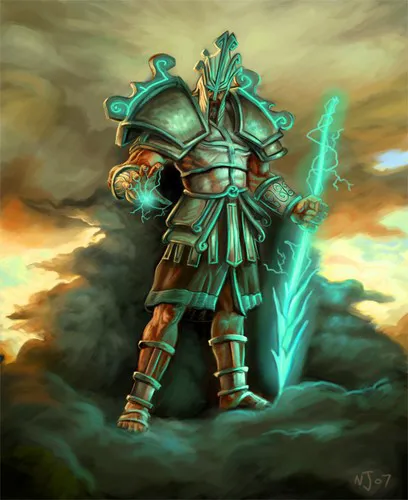
One of the most common deities among the daskaloses, Therofon controls the flows of energy throughout Nero and even beyond. In times past, the daskaloses often witnessed special purple storms—materialized flows of energy that Therofon sent to Nero to terrify those who do not revere him.
Therofon is the supreme deity, and many other daskalose deities worship him, recognizing his power. Though not all.
Blessing: adds additional distortion element damage to the blessed person's attacks.
Curse: the character immediately receives distortion element damage after being cursed.
Nuu
Nuu is the patroness of all the wise and of wisdom; she is highly revered by the daskaloses. According to daskalose beliefs, Therofon himself (a very hot-tempered deity, among other things) wanted to become her husband, but Nuu decided that he was not worthy of her. An enraged Therofon sent Nuu to a dungeon and tortured her with lightning for five hundred years, but Nuu remained steadfast in her choice. Eventually, Therofon could not take it anymore and released her, but he grieved bitterly that his will had proven weaker and that he was therefore unworthy of the title of greatest among the assembly of deities. But Nuu, unexpectedly, comforted him: "Today you have only confirmed your greatness by recognizing the greatness of another. You showed immense will when you realized the hopelessness and meaninglessness of your previous willful decision." After all this, Nuu married Therofon, once again showing her wisdom with this act, which required great endurance and complete same-kind forgiveness—the lack of which could have clouded the mind of anyone in Nuu's place.
Blessing: increases intelligence and grants free knowledge of the "wisdom" ability if it has not yet been learned.
Curse: decreases intelligence with possible loss of skills or abilities.
Dana
Among the daskaloses, Dana is the creator of all magic on Nero, and the great teacher Daskalos himself was one of her first and best students. They say that Dana gave Daskalos and others the opportunity to ask for her help at any moment to change the world for the better. But then, understanding the needs of her students, Dana gave them the ability to change space themselves—that is, what is now called magic. They, in turn, spread this gift throughout Nero.
Most daskaloses believe in Dana, but not all recognize her role as exactly such. However, the aforementioned interpretation is very common.
Blessing: the blessed character begins battle with a full mana pool.
Curse: mana restores significantly slower.
Fartlos
One of the few daskalose deities who is the sworn enemy of Therofon. Fartlos corresponds to stillness and cold: he always tried to stop Therofon's energy flows, to force them to halt. But Therofon is movement, and even Fartlos's stillness only accelerates his energy, allowing it to move faster by removing obstacles in its path. To somehow stop Therofon, Fartlos resorted to trickery: he froze his wife Nuu. Now the intensified flows of Therofon's energy could kill her, and subsequently drive Therofon himself to the grave. However, the assembly of deities freed Nuu and defeated Fartlos. He was exiled far to the North and is rumored to dwell there still. And yet he finds many followers among the daskaloses, who believe that one day Fartlos will return and bring with him the end of the world in eternal peace.
Blessing: the character has a chance to reflect a magical attack back at the enemy.
Curse: magical attacks have a chance to hit the cursed caster.
Ferlita
An ancient deity of fertility and life among the sylvs. Like many sylv deities, she is practically forgotten, and now only a few can say who she is and what she is famous for, let alone be her follower.
Blessing: increases viability.
Curse: decreases viability.
Ore
Ore is in a similar situation to Ferlita; he has been almost forgotten. Ore is the deity of the forest. Moreover, according to ancient sylv legends, he is the forest itself. Not the trees, but the spirit that connects all living beings in the forest, including humanoids, binding them with unbreakable ties.
Blessing: the character gains a special connection with trees and animals. He feels them better; furthermore, he can bind his life to one of them: nothing will harm the character, no matter how much they are attacked, but if you attack the tree/animal—the character may die along with it.
Curse: the character temporarily acquires the soul of a beast while the curse is active.
Mrak
The prevailing deity among the yoru, Mrak is the patron of darkness, of everything hidden and unknown, shrouded in mystery. His followers are hard to detect when they do not wish it, and even harder to defeat.
Blessing: once a day, the character can use dark invisibility. The character is as if covered by darkness and becomes very difficult to notice (completely impossible during nighttime or in a dark room). Effectively, the character casts the corresponding spell of two-element darkness magic, even without having any skill for it.
Curse: a seed of darkness enters the character's soul and they slowly change for the worse: all their good qualities become the basis for bad ones, and bad qualities are further emphasized.
Lis
Among the yoru, Lis is the patron of cunning and the cunning; his followers can find a way out even from the most hopeless situation and come through unscathed. Now, those who serve Lis are fewer and fewer; Mrak is gradually becoming the sole deity of the yoru among the many that existed before. But still, those serving Lis can hardly complain about their fate: complaints are not for them; they prefer planning and action.
Blessing: the character begins to sense a trap or trick in any place where they await him. He himself becomes more cunning.
Curse: the character acquires terrible paranoia, an obsession that prevents him from thinking and adequately assessing the surrounding environment. Effectively, he temporarily goes insane.
Batoru
The deity of war among the yoru; many samurai warriors used to worship him, and even now Batoru has lost little in popularity. Batoru is depicted as a four-armed warrior; he helps any warriors, whether they be swordsmen, archers, or anyone else. Batoru is the art of war itself, and everything about war is known to him, as is the honor of a warrior.
Blessing: increases power and accuracy.
Curse: the character gains a chance to completely fail any attack.
Atheism
The denial of the relevance of any religion and the existence of any supernatural forces. Hardly needs a detailed description.
Blessing: the character gains immunity to curses.
Curse: vitality and concentration are reduced.