


 Ment
Ment
Auto-translated
Actually, yes, I've read about your ideas, [email protected], and secretly felt quite glad that many of them are fully compatible with my own original world, traces of which I left on the forum (though it was in the section dedicated to FRPGs). I didn't dare speak up so as not to intrude unnecessarily on someone else's project, but zahar0z convinced me otherwise; better to just say it.
Here is the main thread.
And overall, the section is dedicated to this little world.
I am ready to propose joint lore development based on all this (not necessarily the lore of this specific world, since much has already been written there, but specifically *based* on it). If you're interested.
Briefly regarding what this nonsense is: well, it's fantasy with elements of Victorianism, and a long time ago I dreamed of porting it to the engine of the fifth game. The time period is the beginning of the 20th century for the more technically advanced Factions, the Renaissance for those more magically inclined, and as for the savages, obviously, everything is savage (although savages such as orcs, goblins, and giants usually don't unite into specific Factions, unless they are individual "civilized" specimens who were raised in more technically advanced countries and adopted their culture).
I also consider an advantage of this world to be the presence of pagans—quite a lot of them—but it's not universal paganism; there are more "normal" religions too. And there are none of those currently fashionable things like a canonized myth of the creation of the world; meaning the system here is much more flexible, everyone believes in their own thing, and the conflict isn't reduced to a couple of dragon-gods having a scrap and everything revolving around that.
I mostly abandoned it because I couldn't resolve (and couldn't even imagine how to solve) problems with the game mechanics, as there are many things I dislike in the combat engine of the fifth game. In particular, these are counterattacks (although this point could be solved somewhat clumsily by giving everyone universal retaliation, though that would break "infinite retaliation," which is also bad; in exceptional cases, heavy-class creatures with retaliation are still desirable), and the inability to limit the range of shooting and magic for creatures, as a result of which the tactical component suffers greatly.
My hopes were partially tied to Heroes VII, thinking that surely *there* all this could be implemented. But time passed, no one plays or mods the seventh game anymore (including me), and it seems the limitations there are roughly the same, so...
However, a maximum goal is one thing, and world-building assets are another. And here, perhaps, I can be useful, as I had even thought through creature lines along with full faction concepts and all that.
Until the thread author arrives, I'll slowly put the details under a spoiler, and then we'll see if any of this is needed. Objectively speaking, most likely not, but a bout of graphomania is a bout of graphomania.
A rough map looks approximately like this:
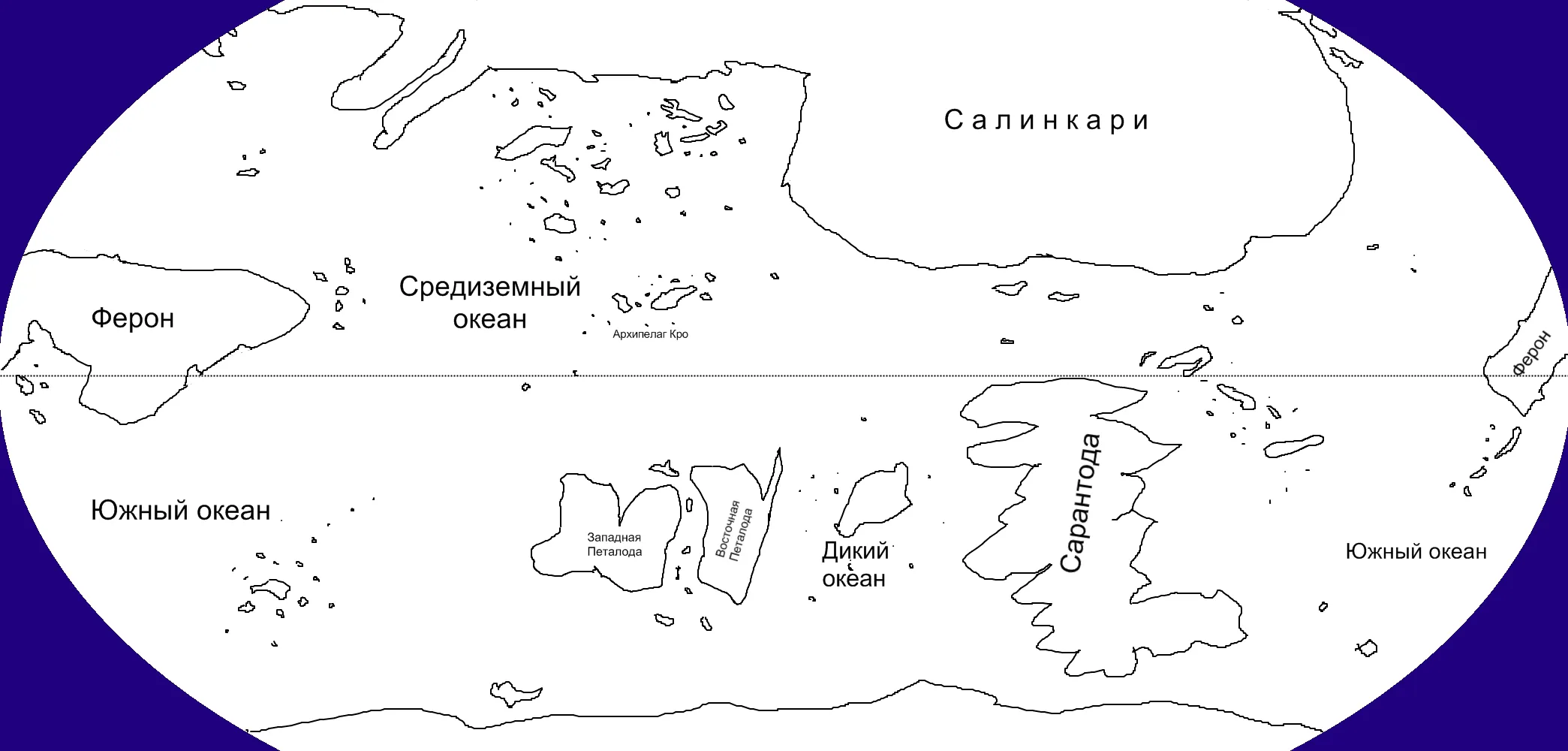
The basis of the conflict for adaptation to Heroes V:
1) Roughly at the start of the narrative, the major powers became aware of the Wild Ocean and the continent of Sarantoda, and the potential it holds. A race begins to see who can develop these new lands the fastest.
2) The continents of Western and Eastern Petaloda have formally already been divided some time ago, however, not everyone is satisfied with the current balance of power there. Accordingly, colonial wars are ready to flare up at any moment. A separate problem is the local population: orcs, goblins, and giants. Orcs and goblins are partially civilized and join the ranks of the invading countries, but not all; there are enough reactionary tribes who do not need progress (which is being very crudely imposed) and are ready to tear apart both the occupiers and each other at every opportunity. Sometimes literally; cannibalism is honored among them. Giants are a separate headache, as their intelligence level is very low even by the standards of their other wild brethren; they are simply incapable of living in society.
3) In the Old World (Pheron and Salinkari), not everything is fine, as old conflicts haven't gone anywhere. For instance, the Forge of Life, a source of immense and mysterious magic in northern Salinkari, is still a tempting prize; it has changed hands many times between various peoples with access to the north, but in the end, it never remained in the hands of anyone specific. Now the lords of the dead are eyeing it—a sect of former wanderer mages who suddenly gained enormous influence and their own recently formed state.
4) Separatist sentiments are strong in some places. For example, the Yoru (local dark elves), although they have their own state, are currently under strong political influence from their Sylv relatives (local high elf knights, partially sylvan, the state of Tervert). This is due to a lost war; relatively recently roles were reversed and it was the Sylvs who were under the tyranny of a rather powerful empire of dark elves, which also united northern human Vikings, river elves, and several other peoples, but in the end Tervert took control of the mountains, and the coastal territories of the former Yoru empire went to local analogues of "Spaniards".
In general, all this is a kind of analogue to the real First World War. Humanoids, on one hand, have become much better at understanding how to kill their own kind, and on the other—how to protect their political ambitions by forming alliances; all this will lead to wars of previously unseen scales.
Regarding the game Factions:
1) Creats
Very heavily inspired by one of the factions in the game Rise of Legends. The Creat Empire is relatively homogeneous—its citizens are mainly the titular nation, and its power is built on colony resources (exploited in an absolutely brazen manner) and the most powerful engineering school in the world.
Creats, like all other humans, do not possess magic, but with the recent explosive growth of mechanical engineering and aeronautics, this no longer seems like a big problem for them.
Essentially, the faction line was planned (heh, if you can call it planning) based on an absolutely absurd number of flying units—these include airships, planes, and helicopters (designed similarly to Da Vinci's helicopters). Ground troops consist of various riflemen and grenadiers. The faction's combat style is extremely mobile but extremely fragile: fly in, bomb, shoot, and gain an advantage from that, but if the enemy isn't defeated quickly, then alas and ah. In a prolonged fight, Creats are mediocre fighters.
2) Dwarves
Representatives of the continent Pheron. Although Pheron is in the south, it represents a unique weather anomaly: there are few hot regions, and the highest mountain areas are very, very harsh. In ancient times, dwarves did not inhabit Pheron; their home continent was Salinkari, specifically the northern lands, so the settler dwarves took it as a good sign that they managed to find a place covered in snow, like their former homeland.
On Pheron, there actually live two slightly different dwarven nationalities (they have the same origin, but the timing of migration to the continent differed, so cultures vary), and halflings have also settled there.
Also, like humans, dwarves are technically advanced, but the historical reasons for this are different. The surface of many mountainous regions of Pheron is poorly suited for life; temperatures there are below zero year-round—few places like that still exist. However, in areas of volcanic activity, it is warm, but developing only the surface in such places is economically insufficiently profitable. Therefore, since ancient times, parallel to surface development, dwarves dug deep and became very proficient at it.
They had magic back then, but its level of development didn't make it an effective tool for construction (since magic in the world of Nero is primarily a science; if you don't study it in the smallest detail, you achieve nothing); it was easier to use crafting and their own hands. Moreover, the settler dwarves, due to their religion at the time, had already mastered working with iron, among the first in the world.
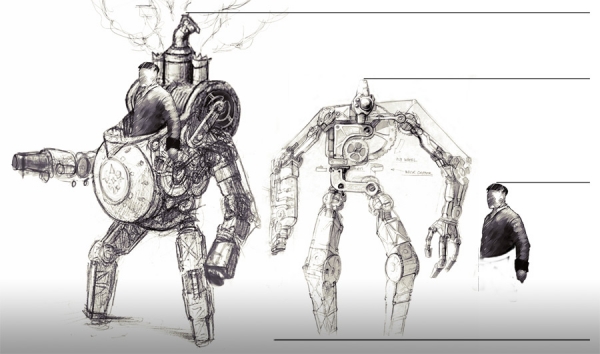
The dwarven combat line, according to my idea, consisted of
- tamed digger worms (a traditional combat unit, not particularly strong by modern standards, but these worms are very easy to breed and can be multiplied by the tens of thousands, as they simply eat dirt)
- shooters (one of whose upgrades are technomages, meaning they use magic to enhance the parameters of their rifles) and mechanized units
- a special line of cannons (practically stationary units, and I hoped that one of the grades would fire at moving targets, but of course, that's impossible to do)
- the coolest thing—self-propelled machines, one version of which becomes a mechanical dragon, a machine that dwarves created with a view toward earth dragons, the most terrifying and powerful inhabitants of Pheron's dungeons.
The characteristic of dwarven lines is their "brute force." They are the least prone to tricks and simply maximize the durability and damage of everything they create. I thought about making one of the upgrades berserkers (not for all creatures, but only those tied to living strength more than technology). It wasn't exactly the same idea as in the fifth game; here I thought that a human player simply wouldn't be able to control them, but because of this, berserkers would have even more serious stats than regular units. They wouldn't attack their own, though; that's also a poor mechanic. They would simply try to attack the nearest enemies and that's it.
Another feature is that they have no flyers, only "diggers"—combat units that essentially teleport by tunneling underground. When mechanically there's not much difference.
3) Dascalos
Local analogues of mages, the Dascalos are Greco-Romans. Historically, "Greeks" lived on the plains and specialized in air magic, while "Romans" lived in volcanic and mountainous terrain, where fire magic was honored. Fire magic in ancient times allowed these mages to rise very, very high through metalworking; they mastered iron roughly at the same time as the dwarves and began actively uniting scattered poleis, forming a state. Subsequently, an ideology of venerating the ancient teacher of mages, Dascalos, was established in this state; the cult of personality of this humanoid became so strong that the entire nation eventually bore his name.
Dascalos are the most academic of all mages; they constantly seek new ways to apply it, specifically creating golems based on a special technique of accumulating magical energy using special crystals.
Generally, the Dascalos are very similar to the mages of Ashan, except that the Indo-Arabic setting in their case is replaced by a Greco-Roman one, which, as is known, is much cooler.
The Dascalos combat line was supposed to represent an alternative of air and fire units, including
- legionnaires and hoplites (legionnaires have the fire element and their gimmick is better equipment and the ability to throw disposable fire spears at the enemy; hoplites are spearmen with a powerful ability to counterattack the enemy before they attack them, combined with a probability of knocking the enemy squad back with a blast of air)
- golems (based on air and fire magic respectively)
- djinn (air and fire-ifrit)
- battle mages themselves
- as well as cannons made via a mechanism similar to the golems. Mages saturate them with energy before the battle, and then in battle, these things fire at the enemy with a power that an ordinary battle mage is incapable of.
4) Sylvans
Elves with a knightly aesthetic, and the right kind—monotheistic faith included, along with many monastic orders. Not like in fantasy where any association of fanatics is called an "order," often not even based on religion—remember the so-called "Order of the Dragon" in Ashan. But not here; these are orders in the full sense of the word; they pray there, and periodically fight, as there is someone to fight.
Sylvans do not possess powerful engineering; they try to compete with the Dascalos in magic but cannot outdo them. And their former traditions no longer work in modern warfare.
But their real gimmick is that they are masters of tactics. Their innate abilities are earth magic and air magic. With earth, they strengthen their own bodies, create obstacles on the battlefield, and fortify their positions. They use air to manipulate enemy squads.
Their long-standing and still strong alliance with Ents deserves special mention—a wooden people, once "cursed" by a pagan goddess, but since then they converted to the true faith along with the Sylvans.
Sylvan units are swordsmen, archers (earth grade is armor-piercing, air is pushing), mounted knights (as well as knights on unicorns and pegasi as upgrades), ents, and traditional monk-druids (Cynics specializing in air magic, and Stoics who can reduce their speed to zero to increase their parameters, thus becoming an analogue of dwarven cannons for a time). All of them use magic in battle whenever possible, but do not forget to cover their bodies in armor, and use weapons based on outdated principles but with the most perfect technology (bows are enhanced by magic, metal for swords is not simple, etc.).
That's probably enough for the Factions for now; I wanted to mention some general things.
Important facts about the lore
All types of elves, dwarves, halflings, and mages (both Dascalos and other types) know how to use magic in this world.
Humans and troglodytes (meaning orcs, goblins, and giants) cannot.
Magic was planned to be elemental, like in "Avatar"—earth, water, fire, air. But not exactly.
Feature 1: in reality, the elements aren't elements at all, but rather a question of the state of matter. Earth is about everything solid/granular, water is about liquids, air is about gases, and fire is plasma and partially the control of high temperatures.
Feature 2: at the intersection of magics, a new magical school is born. Earth+water gives control over crystals, including ice. Water + fire gives electricity. Fire + air — light. Earth + air — darkness. Earth + fire — metal. Water + air — unknown which state of matter this combination is responsible for.
Spellcasters who are skilled in several elements usually begin to develop in these mixed schools of magic and gain very serious advantages over single-element users. Advanced healing techniques also belong to mixed schools (a humanoid organism can only be disinfected or given other basic treatments using water magic; to accelerate tissue regeneration and other serious things, one must master at least earth+water).
Dragons of this world are terrible monsters that remain something in the vein of "better not mess with them" even with modern technology. There is no question of dragons fighting in regular armies, as they are uncontrollable.
Dragons are large, physically strong, and are the most powerful spellcasters. As in Ashan, every dragon is proficient in its own element. Several types:
Mentioned earth dragons, or brown dragons—diggers living underground
Red dragons—specialize in fire
Black dragons—also specialize in fire. The fire of black dragons is so powerful that they use it for flight (as a winged lizard of their size could never stay in the air, fire magic is like an engine for planes for them).
There are sea dragons, similar in shape to earth ones, but swimmers.
Green and azure dragons—masters of air.
Snow dragons—relatively small, but one shouldn't be fooled by their size; they are dual-element, essentially icy.
Troglodytes
These are orcs, giants, and goblins, but all of them here are green and reptilian (as they literally contain reptile genes, most are covered in scales, and their teeth are sharp and predatory).
The difference is that goblins have an R-strategy, while orcs have a K-strategy. Goblins are small and numerous; they regenerate well. Orcs were selected based on physical strength and rage. Giants are the quintessence of such selection; they are several meters tall, and occasionally even larger and more ferocious one-eyed individuals (cyclopes) are born among them. Giants understand nothing but the language of force, whereas among orcs and goblins there are those who have normally integrated into society (the Kro empires, main population are Polo, who are essentially Spanish-humans).
Troglodytes can be found on all continents; however, on Salinkari, most locals died out in their time (killed by more civilized neighbors), leaving only northern giants, whom it was too expensive to touch. Now Salinkari is full of goblins and orcs again, but they are newcomers from other continents, migrants.
Game Mechanics
As I said, I wanted to move away from things like counterattacks at the time, leaving them only to a few squads that specialize in it (and making them infinite by default). That is, only spearmen and other defensive-type units would counterattack. This would destroy "one-unit" tactics and make focusing less interesting (instead of destroying one squad while its retaliation is down, you could "chip away" at several different squads if it allows for a more advantageous positioning of your own troops or for other goals).
I also hoped for a limitation on the range of magic and shooting for units, as in the current form, both greatly limit the tactics for mages and shooters; moving them is disadvantageous in most cases—just exposing yourself for no reason. Also, the fact of taking losses against relatively weak neutrals simply because they move slightly earlier and shoot at you has always irritated me personally. This again creates stupid things, like the active use of invisibles in the army.
Nargott tried to fight this using penalties and limiting unit speeds, but in my opinion, his approach also has problems. Firstly, the neutral problem persists. Secondly, as long as long-distance shooting hasn't disappeared as a class, it will still remain the de facto standard for most battles, as people don't want to bother, and gaining advantages at short distances requires attentiveness. Only in final battles would I personally expect people to actually maneuver shooters (and mages, obviously, won't maneuver even there).
Therefore, it would be good to do as I wrote above, and also give the ability to move and shoot/cast simultaneously, as it was in KB: The Legend. That's just a dream; then units would actually run around. But I fear it's nothing more than a dream.
Overall, that's basically everything.
Here is the main thread.
And overall, the section is dedicated to this little world.
I am ready to propose joint lore development based on all this (not necessarily the lore of this specific world, since much has already been written there, but specifically *based* on it). If you're interested.
Briefly regarding what this nonsense is: well, it's fantasy with elements of Victorianism, and a long time ago I dreamed of porting it to the engine of the fifth game. The time period is the beginning of the 20th century for the more technically advanced Factions, the Renaissance for those more magically inclined, and as for the savages, obviously, everything is savage (although savages such as orcs, goblins, and giants usually don't unite into specific Factions, unless they are individual "civilized" specimens who were raised in more technically advanced countries and adopted their culture).
I also consider an advantage of this world to be the presence of pagans—quite a lot of them—but it's not universal paganism; there are more "normal" religions too. And there are none of those currently fashionable things like a canonized myth of the creation of the world; meaning the system here is much more flexible, everyone believes in their own thing, and the conflict isn't reduced to a couple of dragon-gods having a scrap and everything revolving around that.
I mostly abandoned it because I couldn't resolve (and couldn't even imagine how to solve) problems with the game mechanics, as there are many things I dislike in the combat engine of the fifth game. In particular, these are counterattacks (although this point could be solved somewhat clumsily by giving everyone universal retaliation, though that would break "infinite retaliation," which is also bad; in exceptional cases, heavy-class creatures with retaliation are still desirable), and the inability to limit the range of shooting and magic for creatures, as a result of which the tactical component suffers greatly.
My hopes were partially tied to Heroes VII, thinking that surely *there* all this could be implemented. But time passed, no one plays or mods the seventh game anymore (including me), and it seems the limitations there are roughly the same, so...
However, a maximum goal is one thing, and world-building assets are another. And here, perhaps, I can be useful, as I had even thought through creature lines along with full faction concepts and all that.
Until the thread author arrives, I'll slowly put the details under a spoiler, and then we'll see if any of this is needed. Objectively speaking, most likely not, but a bout of graphomania is a bout of graphomania.
More details on what I once planned
World InformationA rough map looks approximately like this:
The basis of the conflict for adaptation to Heroes V:
1) Roughly at the start of the narrative, the major powers became aware of the Wild Ocean and the continent of Sarantoda, and the potential it holds. A race begins to see who can develop these new lands the fastest.
2) The continents of Western and Eastern Petaloda have formally already been divided some time ago, however, not everyone is satisfied with the current balance of power there. Accordingly, colonial wars are ready to flare up at any moment. A separate problem is the local population: orcs, goblins, and giants. Orcs and goblins are partially civilized and join the ranks of the invading countries, but not all; there are enough reactionary tribes who do not need progress (which is being very crudely imposed) and are ready to tear apart both the occupiers and each other at every opportunity. Sometimes literally; cannibalism is honored among them. Giants are a separate headache, as their intelligence level is very low even by the standards of their other wild brethren; they are simply incapable of living in society.
3) In the Old World (Pheron and Salinkari), not everything is fine, as old conflicts haven't gone anywhere. For instance, the Forge of Life, a source of immense and mysterious magic in northern Salinkari, is still a tempting prize; it has changed hands many times between various peoples with access to the north, but in the end, it never remained in the hands of anyone specific. Now the lords of the dead are eyeing it—a sect of former wanderer mages who suddenly gained enormous influence and their own recently formed state.
4) Separatist sentiments are strong in some places. For example, the Yoru (local dark elves), although they have their own state, are currently under strong political influence from their Sylv relatives (local high elf knights, partially sylvan, the state of Tervert). This is due to a lost war; relatively recently roles were reversed and it was the Sylvs who were under the tyranny of a rather powerful empire of dark elves, which also united northern human Vikings, river elves, and several other peoples, but in the end Tervert took control of the mountains, and the coastal territories of the former Yoru empire went to local analogues of "Spaniards".
In general, all this is a kind of analogue to the real First World War. Humanoids, on one hand, have become much better at understanding how to kill their own kind, and on the other—how to protect their political ambitions by forming alliances; all this will lead to wars of previously unseen scales.
Regarding the game Factions:
1) Creats
Very heavily inspired by one of the factions in the game Rise of Legends. The Creat Empire is relatively homogeneous—its citizens are mainly the titular nation, and its power is built on colony resources (exploited in an absolutely brazen manner) and the most powerful engineering school in the world.
Creats, like all other humans, do not possess magic, but with the recent explosive growth of mechanical engineering and aeronautics, this no longer seems like a big problem for them.
Essentially, the faction line was planned (heh, if you can call it planning) based on an absolutely absurd number of flying units—these include airships, planes, and helicopters (designed similarly to Da Vinci's helicopters). Ground troops consist of various riflemen and grenadiers. The faction's combat style is extremely mobile but extremely fragile: fly in, bomb, shoot, and gain an advantage from that, but if the enemy isn't defeated quickly, then alas and ah. In a prolonged fight, Creats are mediocre fighters.
2) Dwarves
Representatives of the continent Pheron. Although Pheron is in the south, it represents a unique weather anomaly: there are few hot regions, and the highest mountain areas are very, very harsh. In ancient times, dwarves did not inhabit Pheron; their home continent was Salinkari, specifically the northern lands, so the settler dwarves took it as a good sign that they managed to find a place covered in snow, like their former homeland.
On Pheron, there actually live two slightly different dwarven nationalities (they have the same origin, but the timing of migration to the continent differed, so cultures vary), and halflings have also settled there.
Also, like humans, dwarves are technically advanced, but the historical reasons for this are different. The surface of many mountainous regions of Pheron is poorly suited for life; temperatures there are below zero year-round—few places like that still exist. However, in areas of volcanic activity, it is warm, but developing only the surface in such places is economically insufficiently profitable. Therefore, since ancient times, parallel to surface development, dwarves dug deep and became very proficient at it.
They had magic back then, but its level of development didn't make it an effective tool for construction (since magic in the world of Nero is primarily a science; if you don't study it in the smallest detail, you achieve nothing); it was easier to use crafting and their own hands. Moreover, the settler dwarves, due to their religion at the time, had already mastered working with iron, among the first in the world.
The dwarven combat line, according to my idea, consisted of
- tamed digger worms (a traditional combat unit, not particularly strong by modern standards, but these worms are very easy to breed and can be multiplied by the tens of thousands, as they simply eat dirt)
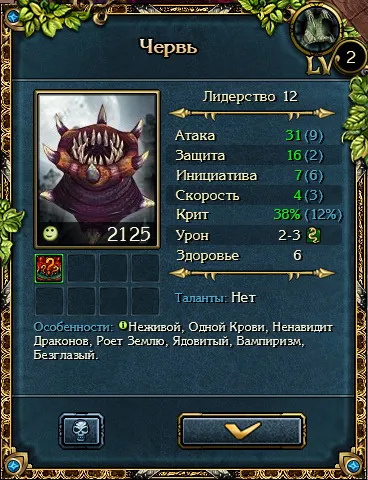
- shooters (one of whose upgrades are technomages, meaning they use magic to enhance the parameters of their rifles) and mechanized units
- a special line of cannons (practically stationary units, and I hoped that one of the grades would fire at moving targets, but of course, that's impossible to do)
- the coolest thing—self-propelled machines, one version of which becomes a mechanical dragon, a machine that dwarves created with a view toward earth dragons, the most terrifying and powerful inhabitants of Pheron's dungeons.

The characteristic of dwarven lines is their "brute force." They are the least prone to tricks and simply maximize the durability and damage of everything they create. I thought about making one of the upgrades berserkers (not for all creatures, but only those tied to living strength more than technology). It wasn't exactly the same idea as in the fifth game; here I thought that a human player simply wouldn't be able to control them, but because of this, berserkers would have even more serious stats than regular units. They wouldn't attack their own, though; that's also a poor mechanic. They would simply try to attack the nearest enemies and that's it.
Another feature is that they have no flyers, only "diggers"—combat units that essentially teleport by tunneling underground. When mechanically there's not much difference.
3) Dascalos
Local analogues of mages, the Dascalos are Greco-Romans. Historically, "Greeks" lived on the plains and specialized in air magic, while "Romans" lived in volcanic and mountainous terrain, where fire magic was honored. Fire magic in ancient times allowed these mages to rise very, very high through metalworking; they mastered iron roughly at the same time as the dwarves and began actively uniting scattered poleis, forming a state. Subsequently, an ideology of venerating the ancient teacher of mages, Dascalos, was established in this state; the cult of personality of this humanoid became so strong that the entire nation eventually bore his name.
Dascalos are the most academic of all mages; they constantly seek new ways to apply it, specifically creating golems based on a special technique of accumulating magical energy using special crystals.
Generally, the Dascalos are very similar to the mages of Ashan, except that the Indo-Arabic setting in their case is replaced by a Greco-Roman one, which, as is known, is much cooler.
The Dascalos combat line was supposed to represent an alternative of air and fire units, including
- legionnaires and hoplites (legionnaires have the fire element and their gimmick is better equipment and the ability to throw disposable fire spears at the enemy; hoplites are spearmen with a powerful ability to counterattack the enemy before they attack them, combined with a probability of knocking the enemy squad back with a blast of air)
- golems (based on air and fire magic respectively)
- djinn (air and fire-ifrit)
- battle mages themselves
- as well as cannons made via a mechanism similar to the golems. Mages saturate them with energy before the battle, and then in battle, these things fire at the enemy with a power that an ordinary battle mage is incapable of.
4) Sylvans
Elves with a knightly aesthetic, and the right kind—monotheistic faith included, along with many monastic orders. Not like in fantasy where any association of fanatics is called an "order," often not even based on religion—remember the so-called "Order of the Dragon" in Ashan. But not here; these are orders in the full sense of the word; they pray there, and periodically fight, as there is someone to fight.
Sylvans do not possess powerful engineering; they try to compete with the Dascalos in magic but cannot outdo them. And their former traditions no longer work in modern warfare.
But their real gimmick is that they are masters of tactics. Their innate abilities are earth magic and air magic. With earth, they strengthen their own bodies, create obstacles on the battlefield, and fortify their positions. They use air to manipulate enemy squads.
Their long-standing and still strong alliance with Ents deserves special mention—a wooden people, once "cursed" by a pagan goddess, but since then they converted to the true faith along with the Sylvans.
Sylvan units are swordsmen, archers (earth grade is armor-piercing, air is pushing), mounted knights (as well as knights on unicorns and pegasi as upgrades), ents, and traditional monk-druids (Cynics specializing in air magic, and Stoics who can reduce their speed to zero to increase their parameters, thus becoming an analogue of dwarven cannons for a time). All of them use magic in battle whenever possible, but do not forget to cover their bodies in armor, and use weapons based on outdated principles but with the most perfect technology (bows are enhanced by magic, metal for swords is not simple, etc.).
That's probably enough for the Factions for now; I wanted to mention some general things.
Important facts about the lore
All types of elves, dwarves, halflings, and mages (both Dascalos and other types) know how to use magic in this world.
Humans and troglodytes (meaning orcs, goblins, and giants) cannot.
Magic was planned to be elemental, like in "Avatar"—earth, water, fire, air. But not exactly.
Feature 1: in reality, the elements aren't elements at all, but rather a question of the state of matter. Earth is about everything solid/granular, water is about liquids, air is about gases, and fire is plasma and partially the control of high temperatures.
Feature 2: at the intersection of magics, a new magical school is born. Earth+water gives control over crystals, including ice. Water + fire gives electricity. Fire + air — light. Earth + air — darkness. Earth + fire — metal. Water + air — unknown which state of matter this combination is responsible for.
Spellcasters who are skilled in several elements usually begin to develop in these mixed schools of magic and gain very serious advantages over single-element users. Advanced healing techniques also belong to mixed schools (a humanoid organism can only be disinfected or given other basic treatments using water magic; to accelerate tissue regeneration and other serious things, one must master at least earth+water).
Dragons of this world are terrible monsters that remain something in the vein of "better not mess with them" even with modern technology. There is no question of dragons fighting in regular armies, as they are uncontrollable.
Dragons are large, physically strong, and are the most powerful spellcasters. As in Ashan, every dragon is proficient in its own element. Several types:
Mentioned earth dragons, or brown dragons—diggers living underground
Red dragons—specialize in fire
Black dragons—also specialize in fire. The fire of black dragons is so powerful that they use it for flight (as a winged lizard of their size could never stay in the air, fire magic is like an engine for planes for them).
There are sea dragons, similar in shape to earth ones, but swimmers.
Green and azure dragons—masters of air.
Snow dragons—relatively small, but one shouldn't be fooled by their size; they are dual-element, essentially icy.
Troglodytes
These are orcs, giants, and goblins, but all of them here are green and reptilian (as they literally contain reptile genes, most are covered in scales, and their teeth are sharp and predatory).
The difference is that goblins have an R-strategy, while orcs have a K-strategy. Goblins are small and numerous; they regenerate well. Orcs were selected based on physical strength and rage. Giants are the quintessence of such selection; they are several meters tall, and occasionally even larger and more ferocious one-eyed individuals (cyclopes) are born among them. Giants understand nothing but the language of force, whereas among orcs and goblins there are those who have normally integrated into society (the Kro empires, main population are Polo, who are essentially Spanish-humans).
Troglodytes can be found on all continents; however, on Salinkari, most locals died out in their time (killed by more civilized neighbors), leaving only northern giants, whom it was too expensive to touch. Now Salinkari is full of goblins and orcs again, but they are newcomers from other continents, migrants.
Game Mechanics
As I said, I wanted to move away from things like counterattacks at the time, leaving them only to a few squads that specialize in it (and making them infinite by default). That is, only spearmen and other defensive-type units would counterattack. This would destroy "one-unit" tactics and make focusing less interesting (instead of destroying one squad while its retaliation is down, you could "chip away" at several different squads if it allows for a more advantageous positioning of your own troops or for other goals).
I also hoped for a limitation on the range of magic and shooting for units, as in the current form, both greatly limit the tactics for mages and shooters; moving them is disadvantageous in most cases—just exposing yourself for no reason. Also, the fact of taking losses against relatively weak neutrals simply because they move slightly earlier and shoot at you has always irritated me personally. This again creates stupid things, like the active use of invisibles in the army.
Nargott tried to fight this using penalties and limiting unit speeds, but in my opinion, his approach also has problems. Firstly, the neutral problem persists. Secondly, as long as long-distance shooting hasn't disappeared as a class, it will still remain the de facto standard for most battles, as people don't want to bother, and gaining advantages at short distances requires attentiveness. Only in final battles would I personally expect people to actually maneuver shooters (and mages, obviously, won't maneuver even there).
Therefore, it would be good to do as I wrote above, and also give the ability to move and shoot/cast simultaneously, as it was in KB: The Legend. That's just a dream; then units would actually run around. But I fear it's nothing more than a dream.
Overall, that's basically everything.