Nebo, please check if everything is okay; let me know... I hope it turned out well.Nicomedus of the House Cadmid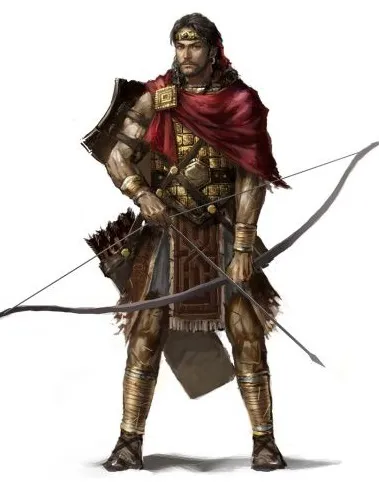 Age:
Age: 24 years.
Origin: Hysteosian, White Dragon clan.
Beliefs: White Dragon.
Nicomedus's great-grandfather, Cadmus, was the son of a slave, but thanks to his martial skills and athletic success, he was recognized as a free citizen and a full Hysteosian. He didn't waste any time; he married a woman as strong and stubborn as himself, made a good name for himself, and became the father of two sons and a daughter. Cadmus settled in the city of Carsia, firmly believing that his descendants would build a strong and respected house there, so that no one would remember his slave origins.
The eldest son, Cephalus, became the head of the house and continued his father's success. He was no less athletic and stubborn, and thus proudly fended off attacks from more pure-blooded brethren and did not shame the family's newly acquired status as Hysteosians. Unfortunately, his brother, Thersites, died at a young age in war, leaving no offspring. But Cephalus lived a long and very successful life. It was under his leadership that the house was accepted into the White Dragon clan. His sister, Tyro, grew up to be a girl strong in spirit and body, possessing a flexible mind and a firm character, which impressed a fairly well-known and glorious warrior, whom she eventually married. Since then, Cephalus and his house received the support of the son-in-law's family.
Cephalus himself also married successfully—to an older and not particularly beautiful heiress of a wealthy family. Thus, the Cadmids added financial prosperity to the virtues of their young but already proud and ambitious house.
Fortunately, the marriage was a genetic success, because Cephalus's children, three sons, grew up as same-sized beauties. All three, though born several years apart, were distinguished in childhood by strength, health, and beauty. Each became famous to some extent in both military and sporting affairs. And although they did not achieve any global breakthrough like their father and grandfather had, they were undoubtedly worthy continuers of the house. Only a slightly darker skin tone and a slightly unusual face shape betrayed them as descendants of a non-true Hysteosian.
Naturally, all three married well and started families. After Cephalus's death, the eldest son—Pallant—became the head of the family.
Unfortunately, shortly after the wedding, Pallant's wife's health began to deteriorate. Many said she had become barren, and this left a mark of gloom on Pallant's character; not only did the worries of the family's global affairs fall upon him, but he had always wanted an heir, a strong and mighty son to continue the direct lineage of the Cadmids. Only stubborn faith and prayers to the Dragon helped his wife conceive. And Nicomedus was born to her.
And so Nicomedus was not like a descendant of Cadmus at all. He was a healthy but large boy, overweight. He showed no particular desire to engage in sports and was somewhat clumsy. Even in childhood, he was more interested in cities, merchant markets and goods, as well as the stories that could be heard in such places. His mother noted that the usually gloomy Nicomedus seemed to awaken when he heard tales of other countries and other cultures, his eyes lighting up with sincere interest. When Pallant took him to the capital at the age of seven to teach him sense and show him the greatness of true Hysteosians, Nicomedus was most impressed by the central library, not the stadiums or palaces. Yes, all Cadmids considered themselves respected and cultured members of society and loved books, but Nicomedus loved them more than anyone else...
However, in other respects, he had a very unhappy childhood. Only his mother loved him sincerely and cared for him, protecting him from his father's wrath. The most problems were caused by his two cousin-twins: Hermogenes and Heliodorus, sons of Cephalus's second child, who constantly teased and mocked him.
But everything changed when Nicomedus was 11 and his cousins were 10. One day on the way home from training, where the Cadmids learned horse riding, they encountered a company of peers and slightly older boys. They began to call names and insult Nicomedus. His heart sank: as if constant mockery from his cousins and pressure from his father weren't enough, now almost stranger boys were attacking... He was prepared for Hermogenes and Heliodorus to join in the teasing, but the opposite happened. When the bullies blurted out something about a "mudblood," the twins' eyes lit up with cold fury. "Who did you call a mudblood, you little brat?"—and after these words, Nicomedus's cousins flew at the boys. He himself was a bit shocked by this and stood there doing nothing for about 5 seconds, but upon receiving a shove from a nearby teenager, he quickly came to his senses and joined the fray. As mentioned, yes, Nicomedus might have been a bit fat and clumsy, but like all Cadmids, he was distinguished by endurance and basic physical robustness. In general, there were three of them and five bullies, plus they were mostly older, but Nicomedus and his cousins prevailed. Yes, with difficulty, yes, receiving a bunch of bruises and scratches, but they won.
This event fundamentally changed the boy's worldview. He grew closer to his cousins and began to be friends with them. It dawned on him that no matter how hard it was sometimes to communicate with family, no matter what pressure was put on him, family remains family, and they will always be on his side. He began to engage more actively in sports, took his father more seriously, and grew less angry and resentful toward him. Moreover, puberty hit soon after, during which Nicomedus shot up significantly, so that after 3 years he looked not like a chubby kid, but like a quite ordinary youth—perhaps not as strong as the others, but in no way lacking.
As for military affairs, Nicomedus was distinguished even in childhood by good attentiveness and caution. He was far from the best swordsman, and it's embarrassing to even mention wielding two-handed weapons... But he was one of the most accurate shooters among his peers. So, when the time came to set out on the first military campaign, Pallant, of course, resisted and grumbled—for he, his father, and grandfather had all been swordsmen—but he listened to his son's request and his wife's persuasion and assigned Nicomedus to a unit of archers.
And it was not in vain. Battles tempered Nicomedus: he became stronger, more enduring, and even more cautious. He learned the value of life; he learned what honor and valor are. At the same time, finding himself far from home, he somehow overcame his complexes on his own. Nicomedus was a good conversationalist—not exactly the soul of the party, but everyone was always glad to see him. He knew how to listen attentively, deliver an appropriate joke, and laugh sincerely at someone else's story. While his cousins continued the traditions of the house and were strong, stubborn, and slightly proud warriors who kept themselves a bit apart from everyone else, Nicomedus became one of the guys for many comrades over the years of campaigning. Of course, there were those who tried to bully him, but by that time Nicomedus already knew that you have to hit someone in the nose immediately and hard. And if anything, his cousins or just buddies had his back.
In general, when Nicomedus turned 22, with the blessing of his father and mother, he went to the capital to serve in the garrison. Pallant, of course, was still against this and grumbled quite a bit because this was new for the Cadmids; but first, his wife's health began to deteriorate even further, and caring for her softened his character, and second, he understood that if his son made a name for himself in the capital, in its army, it would give his house the opportunity to rise from a local level to the next step.
And everything was fine: Nicomedus read books, walked through the city, met people, trained, played sports (not all of them, of course, as he still disliked wrestling and almost all track and field, especially long-distance running and jumping), learned about capital life, and went on campaigns as part of the capital army. People began to notice him: not in the same way as the heirs of famous wealthy houses, who were all such lions and beauties, but many knew that he was a pleasant, reliable person—not proud, but also not bending under others.
Until an incident occurred.
Here it is worth going back in time and talking about Pallant's youngest brother. He had no sons, but a daughter was born—Atropa. She was 3 years younger than Nicomedus, but he was very close to her. In essence, besides his mother, she was the only person who supported him in childhood and filled his life with some kind of joy. When all the younger generation of Cadmids became teenagers, Nicomedus grew even closer to her. Moreover, her father died, and therefore Nicomedus and his cousins took upon themselves the responsibility of protecting Atropa and caring for her.
Leaving for the capital, Nicomedus cried only once—and specifically because he would miss his cousin. To be honest, perhaps there was a hidden love for her in him, which however he successfully suppressed with notions of family honor and house pride, as incest, even non-direct, was condemned throughout Hysteosia.
And so Nicomedus returns to Carsia for the Harvest Festival. As it happens, at the same time, an aristocrat from Madinia comes to visit—a mid-level lord who arrived to recruit mercenaries for a war with his competitor over land.
By that time, the Cadmids were already one of the respected and significant Carsian houses, so Pallant, along with his brother and nephews, was present at the negotiations regarding the gathering of the army. This took place outside the city, in the camp of the Madinian's detachment. That is where Nicomedus arrived.
Atropa was also there. And since she grew up to be a very beautiful girl—beautiful primarily by the standards of the central countries rather than Hysteosia (although she was strong and healthy, like a true daughter of her land)—she attracted much attention from the soldiers from Madinia. Two officers, sons of some barons or other, allowed themselves the adventure of approaching the girl in the middle of the night and trying to persuade her to spend time with them. Naturally, the proud great-granddaughter of Cadmus did not agree and delivered a powerful slap to one of them. Alas, this only angered them—and they decided to take Atropa by force.
Fortunately, Nicomedus could not sleep that night. Too many worries and thoughts tormented his soul. Hearing noise, going outside, and seeing that two foreigners wanted to dishonor his cousin, he flew into a rage, took out his bow, and shot them both dead. Hugging Atropa and calming her, he turned toward a voice coming from the side: "And what do you think you're doing, you beast?" This was, in fact, that very lord. "Perhaps I should show you where your place is, you livestock-fucker," he said with a nasty smile and signaled his personal bodyguards, who stepped out with him. "And as for your sister, I think I'll amuse myself personally: this will be a lesson to you and your entire arrogant, proud gang."
Yes, as you can imagine, the negotiations were not going very successfully. The lord underestimated the stubbornness and pride of the Hysteosians, who did not want to go fight god-knows-where for pennies.
And he also underestimated the speed with which an experienced Hysteosian youth can draw a bow, and the accuracy with which he can shoot.
And perhaps he should have worn a helmet.
I will not burden you with the details of what happened next. There was a lot of noise, some more spilled blood, but in the end, both sides were calmed down. Nicomedus realized that the best way out of the situation was to take the blame himself so as not to dishonor the entire house. He voluntarily confessed and decided to go to trial for the murder of an aristocrat. His father solemnly promised to use all resources to settle the matter, calling upon all relatives and kin. And friends from the capital, including army officers, stated they would help however they could. However, a formal judicial procedure still had to be undergone.
And unfortunately for Nicomedus, the tribunal issued a death sentence.
Of all people, he happened to shoot not just some random lord, but one of the important members of the Order.
And so Nicomedus sits in a cell on the deck of a sky ship, silent and lost in thoughts of home, of kin, and how much he failed to understand about this world.
Characteristics:Constitution - 35.
Intelligence - 20.
Strength - 20.
Dexterity - 25.
Speed - 15.
Will - 10.
Perception - 40.
Skills:One-handed weapon
I Proficiency with one-handed weapons.
II Chance to parry an opponent's strike (dexterity).
III +10 to evasion in close combat.
Ranged weapon (bows | crossbows)
I Proficiency with ranged weapons.
II +10 to evasion in distance combat.
III Chance to paralyze the opponent for one turn, next attack deals double damage (perception + critical hit chance).
IV Additional attack.
V Chance to make 4 shots per turn (perception; -20 to accuracy) | Chance to deal triple damage to the opponent (perception; -20 to accuracy).
VI Critical damage chance is doubled.
Trading:
I Discount of 30% at all trading points (x2).
II Discount of 40% at all trading points.
Sniper:
+50% to perception when using ranged weapons (x3).
Scout:
I The character gains the ability to quickly gather information about the nearby territory.
Inventory:Capital garrison member armor set.
Two-handed bow. Very high quality and expensive: the Cadmids never skimped on ordering proper weapons.
Arrows for it.
Family blade. The sword that Cadmus wielded when he was still a slave. It was reforged and decorated; it is a symbol of the house and is in Nicomedus's possession because he is the heir. Sanctified in the Temple of the Dragon.
A not-very-large amount of gold.
A couple of books about the cultures and geography of Setranomicon.


 Happy Life


 Arandor