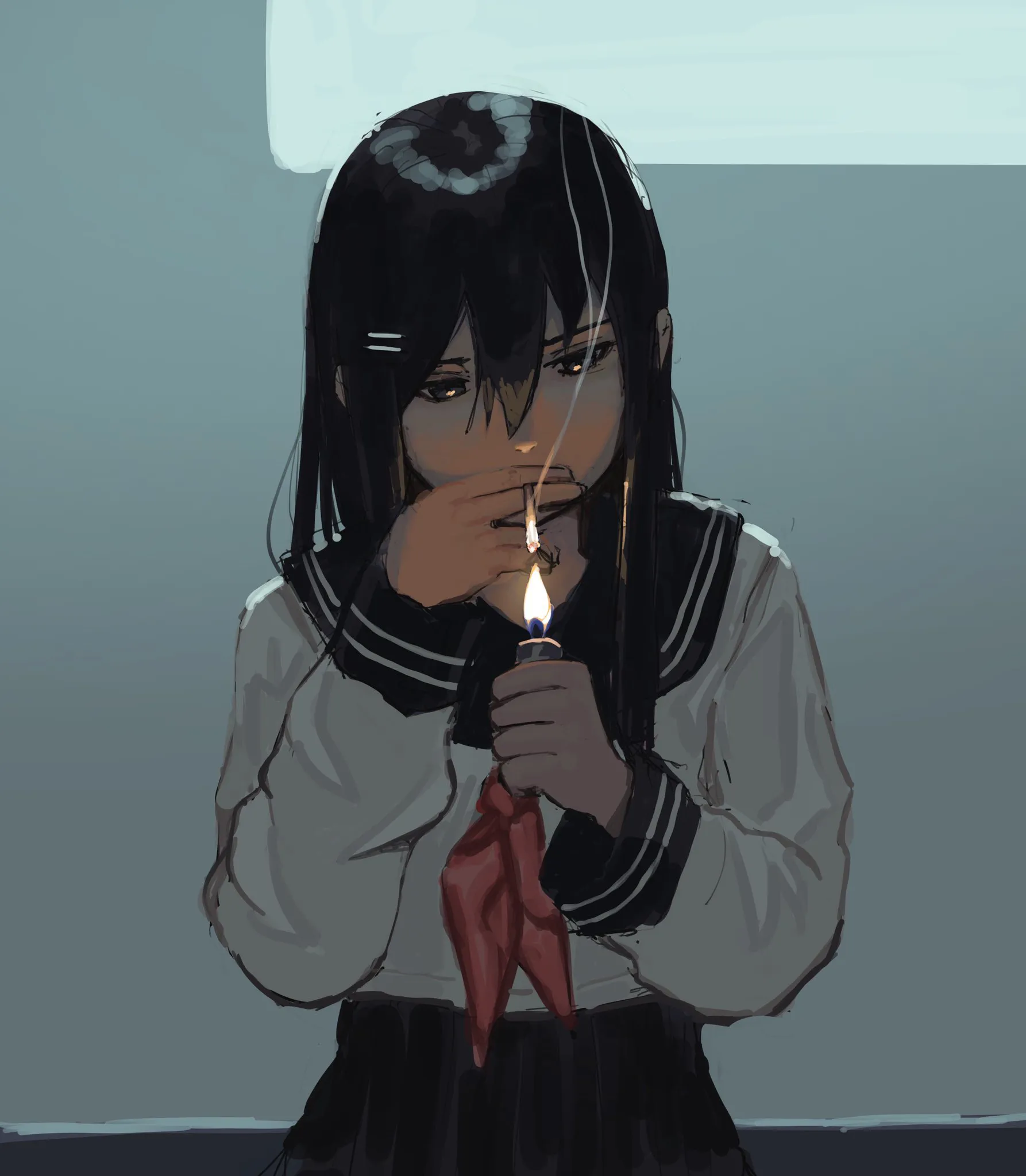
 Sekuhara Futaba
Her parents were not particularly wealthy, the house not especially sturdy, the town not very large, and the surrounding landscapes not particularly scenic. But overall, life was tolerable — her parents worked their jobs, Futa studied at school, and there were no noticeable problems with neighbors or authorities.
Because her parents returned home late and exhausted, Futaba had to learn to cook early on, though it was fairly basic stuff that anyone without deep knowledge eventually starts to whip up on their own over time, just to have something to throw into the stove, regardless of whether they have money for eateries, a good wife, or a skilled housekeeper.
Her parents greatly appreciated this skill. "You'll cook for the little one," they explained. And indeed, shortly after that conversation, her mother quit her job, transitioning fully to housekeeping, and a noticeable belly began to show. Her father had to take on more shifts to somehow feed the family, coming home even later and completely worn out. Still, he didn't complain, because he was a good, loving father who wasn't afraid of hardship—though he did have a drink or two at lunch to relax on his only day off each week.
After her little brother was born, life demanded even more effort from the family. Her father now worked multiple jobs; her mother had a difficult childbirth that badly affected her health, and recovery wasn't helped by the lack of proper sleep due to needing to watch over the newborn. Futa also spent most of her free time in endless household chores and work in the garden, as well as trying to earn a few pennies here and there — wherever shrewd businessmen were willing to pay crumbs for child labor. Because of their collective poverty, she began to eat worse, and her wardrobe, which had rarely been updated and had suffered greatly over the years, started turning into a heap of patched-up rags. All of this combined negatively affected her socialization with peers.
Her father rarely came home — some jobs allowed him to sleep right on site, and even considering the snoring, overlapping sweaty bodies of workers all around, it was still better than waking up every half hour at home to the baby's piercing cries. On the rare days he managed to carve out some rest, he preferred to spend it with colleagues over drinks — he had the right, as he would sternly declare in response to any question about it. Nevertheless, despite all these life challenges, he remained the sole provider, and though they lived in poverty, they somehow survived.
Over the next several years, her mother's health remained somewhat stable but with a tendency toward gradual decline. A considerable portion of money went to medicine, another part to feeding and clothing the new young member of the family. But at least, after leaving infancy, learning to walk and use the potty, he no longer required such constant minute-by-minute attention in everything, so there were some positives.
Mostly, it fell to Futaba to look after him, because her mother spent a lot of time feeling unwell, and her father rarely appeared at home, more often drunk than not. Though he didn't cause trouble, at such times the little boy was kept away from him — just in case, and to spare the child from imprinting the image of his father as a staggering, bleary-eyed drunkard. And on his sober, gloomy evenings, he wouldn't approach them either — the reason wasn't entirely clear; perhaps awkwardness, or irritation from chronic fatigue.
Despite everything, somewhere on the edges of consciousness lingered the feeling that things would soon improve, one way or another.
One fine summer day, Futa and her brother went to the river to swim. On that bright, sunny day, they played a lot, laughed, splashed water at each other, and ran around the meadow. Exhausted, the little boy collapsed onto the grass, relaxed under the caressing sunbeams, ignoring the ants scurrying about, and quickly fell asleep. Futaba lay down beside him and let him rest, counting blades of grass and gazing at the whimsical shapes of clouds. She only came to in the evening — apparently, sleep had overtaken her too, and she had slept in the same spot until sunset, when the ground had cooled. Well, no surprise, considering how much energy their care-filled daily life drained.
However, her little brother was no longer beside her. Terrified, Futaba spent the next several dozen minutes in futile searching and screaming all around the area, until she finally discovered downstream a small body in the same little shirt, caught on a snag jutting from the steep bank, face down, swaying meaninglessly in the water.
Afterward, as a result of endless interrogations by adults and nights of bitter self-reflection, a rough picture of what happened emerged: waking up before his sister, the boy decided to sneak back into the river, but due to inexperience got caught in a strong current that swept him away and threw him under the snag, from which he couldn't free himself and swim out in panic.
Her mother, already weakened by her illness, did not survive this and wasted away very quickly. While they managed to bury the son with their last pennies — little material was needed for the small coffin — her father had to borrow money for the wife's funeral ceremony, and few were willing to help him. Neighbors oohed and aahed, offering empty condolences, and under any pretext crossed to the other side of the street or slammed their doors shut. Partly because he reeked of alcohol, but also because they didn't want to let someone else's grief into their souls. Not that they didn't feel sorry for him, but what could be done — such is fate. Shaking their heads at the receding gloomy silhouette of the ill-fated family's father, they only crossed themselves and thanked the Seven and the Four that all this hadn't happened to them. This thought helped them return to the soothing routine of their own lives and realize that things weren't so bad for themselves. A loaf of bread, some soup, whatever clothes, and a roof over their heads — they had it all, and thank God.
Eventually, someone who specialized in helping people in difficult life situations was found and lent money at a huge interest rate with vague terms, and that matter was settled.
Having fulfilled his human and marital duty to his deceased wife, the father completely fell apart — like a puppet whose strings had been cut. Futaba saw from the sidelines that he tried to pull himself together, but every minute spent in a more or less sober state caused him unbearable pain.
She herself faded and completely lost that drive for life that most children possess. If her brother's death brought her uncontrollable grief, a frenzy of negative emotions, and guilt, then her mother's death was perceived as the inevitable price that followed, part of the same package, predetermined from the very first moment of realizing what had happened.
At school, she completely stopped talking to anyone, as well as making any effort in meaningless studies — she mostly just sat and stared into space while classmates whispered about her. No one ever approached her — many considered her a witch whose aura of curse had destroyed her loved ones and could transfer to another person if they weren't careful enough.
"Family problems are no reason to loaf around," a fat, short-legged woman — the local teacher of the year — would declare, puffing with pride, never missing a chance to pick on Futaba, who completely ignored the need to perform these social rituals and thereby wounded her professional and human pride.
Gradually, day after day meeting no resistance, the teacher escalated to harsher and more mocking monologues, to the excited amusement of the classmates, and closer contact with the victim — she'd bang on the desk, wave notebooks right in front of her face. One day, she decided to forcefully break through Futaba's shell of indifference and, by way of edification during another insulting tirade thoroughly trashing her character, gave her a sweeping slap with a textbook. She achieved her goal to some extent — the physical impact did snap the student out of her melancholic state: slashing the teacher's face with her nails, she pushed her so hard that the woman fell heavily backward onto a row of desks; as later turned out, breaking her hip.
After this incident, Futa was expelled from school, and her father was held accountable — forced to pay a hefty sum for the treatment of the honored teacher. However, there wasn't really any money, so bailiffs seized most of the property in their modest home — including the jewelry her father had once given her mother in their earliest years, and other sentimental items — and confiscated them for sale at a state flea market to collect the fine.
The following several weeks or months, or maybe years — during this period, time lost its flow — stretched out as one endless, suffocating swamp. Futaba wandered the streets mindlessly, turned in bottles, stole things here and there to feed herself, out of habit squeezed the last drops from the neglected garden, but mostly just lived out her days by inertia in oppressive, gloomy apathy. Occasionally, she'd run into local thugs on the street; there was nothing to take from Futa, so the rabble tried to harass her for fun — but facing someone with heavy, traumatic objects at hand who was indifferent to their monkey games, they always slunk away, rubbing their bruised and torn spots.
Her father was drinking continuously, sometimes his buddies came over, hollering nonsense for days and vomiting on the floor, and from time to time creditors visited him and very painfully reminded him that the debt needed repaying. On one such evening, Futa's ears caught a suggestion to "transfer" the daughter to respectable people as payment for the debt — however unappealing she seemed to them, there was nothing else to take from this loser who had lost everything. After barking out this proposal, the moneylender laughed but was reined in by his companion: ease up, you're yelling too loud, someone might hear you.
Hearing this, Futaba was neither horrified nor upset — she had nowhere to run, and she had long ago accepted her life as a hopeless terminal illness that kept throwing new symptoms at her, with no way to relieve them, and no point in resisting.
That same night, lying lifelessly on the floor of her little room in a half-insomniac state, she heard the heavy, unsteady steps of her father trudging down the hall toward her space. Futa gave no sign that she was awake. Her father "quietly" — actually so loudly that even a corpse would have jumped — pushed the door open and stumbled inside. He wasn't just drunk — the reek of booze from him was so strong that if you drew blood from his vein, it would find no alcohol content. Such volumes of alcohol could, if not kill, certainly knock out any healthy person, but her father's trained body could handle it.
Gazing at his daughter's body with a cloudy, unfocused look, he tilted his head back and downed a bottle of rotgut in one gulp, then exhaled noisily, breathing fire, and dropped the bottle on the floor. Taking a couple of steps toward Futaba, he tripped over his own feet and fell right on top of her. Pretending was pointless now, and the daughter, turning her nose away from the horrifying, tear-jerking stench from his mouth, tried to push the booze-soaked body off, but the weight of a grown man was too great.
Her father babbled something incoherent, addressing no one in particular, then grabbed his daughter by the throat with one hand to restrain her.
"Se...e how... bad it i-is... without... m-mom..." he barely managed, his other hand clumsily struggling with the ties on his torn, grimy pants.
Futaba, unable to breathe due to the hand clamped around her neck, tried to pry it open with one hand while frantically groping the floor with the free one, catching splinters and trying to find anything. Her hand found a nail sticking out of a floorboard — she yanked it back and forth mindlessly, but only tore the skin off her fingers.
Her father, unable to handle the ties, lost patience; his movements became more aggressive, his grip on her neck tightened.
Darkness crept into the daughter's eyes, the ringing in her ears completely drowning out all other sounds. In desperation, she beat and thrashed on the floor with her other hand — hit a boot, tried to grab it, but her convulsive finger movement only sent it sliding further across the floor.
"So I'm... supposed to sell... my own daaaughter?! you... baaastards..." — her father shook his fist at the ceiling, then leaned back down and peered with a cloudy gaze into Futaba's purpling face. "Beautiful... like our mom..."
Finally, the dropped bottle that her father had brought into the room rolled under her daughter's hand. Her fingers, numb from strangulation, closed around its neck as best they could, and a desperate swing smashed it against her father's head — one shard grazed Futa's cheekbone, leaving a deep gash; glass fragments miraculously missed her eyes.
Her father grunted in surprise, unsure if he had felt sudden pain or not, wiped his split temple from which blood cheerfully streamed, and tugged at the scab. His daughter, still clutching the bottleneck in her death-grip fingers, stabbed him with the jagged edge in the side, under the ribs. And then again and again.
Whimpering like a boar, her father finally released his grip and rolled aside, clutching at the holes from which shards of glass protruded.
Futaba, seized by a wild cough, struggled to her feet, and as she was — barefoot over the shards, in only a nightshirt, staggering — dashed out into the night street and fell onto all fours in the mud in front of their shack.
From the open house, the screams of her stabbed father echoed down the street; the daughter continued trying to inhale air, interrupted by the reflex to retch, while from the windows of nearby houses, neighbors looked on with disapproving expressions, shaking their heads and whispering among themselves. None of them even thought to come out and see what had happened; no one wanted to get involved. They merely reflexively stepped back behind the curtain when Futaba's gaze swept across their window.
"Here we go again with those alcoholics, what are you gonna do!" flashed through each of their minds. "When will they finally go to sleep?"
Only an hour later, law enforcement appeared at the scene, passing through the area by chance and drawn by the incoherent, drunkenly pained cries of the head of the family. Sealing the house, they escorted away the father, who was kicking and threatening to punish them rear-first, and carried the unconscious daughter into the hands of medical workers.
Upon returning to painful reality, Futaba found herself on a prison cot, roughly treated by medics and locked in a solitary cell, with two burly policemen outside the bars. As soon as she opened her eyes, they began interrogating her in turns, threatening torture, imprisonment, and even execution, banging their batons on the bars and insulting her in every way, but she told them nothing — she had neither the physical nor mental strength for it. This went on for a while until a captain burst into the holding cell — a stern-looking, short, pot-bellied man with a large bald spot and a toothbrush mustache, whom no one in town had ever seen smiling or laughing in their lives. Despite his somewhat ridiculous appearance, he put the foolish subordinates in their place in a few words and dealt them a painful cuff each.
Freeing Futaba from custody, for the duration of her recovery and the investigation, he moved her into a room at the local inn, much to the displeasure of the landlady, who, however, didn't dare argue with a man in uniform and not only provided her with shelter but also free meals, albeit without frills.
This captain turned out to be one of the very few people in the entire town who was aware of this family's troubled history and understood the true story behind what happened. With his pressure, even without any enthusiasm from the indifferent-to-her-own-fate Futa, the true chain of events was reestablished; the father was recognized as a degraded man and scum who, however, according to the law, only earned a relatively short sentence in a labor colony settlement, and the daughter was exonerated and released to go wherever she pleased.
Realizing that she had nowhere to go and nothing left to do in this cursed little town, the captain decided to help within his human means, reached out to some of his contacts, and arranged for her relocation at state expense to the L.S. National Academy and the right to be considered for an entrance exam with subsequent enrollment among the students.
29-02-3981, Taimania, 172 / I / I, room 402
Carried items: medical mask, fingerless leather gloves, pack of cigarettes, sock-hid shank, nail-studded bat.
[spoiler=
Sekuhara F.]
1. a
2. yes
3. disperse
4. no way
5. f
6. k
7. yes
8. the big one eats the little one, any other reasoning is an attempt to gloss over this fact
9. excellent Sakumoriam, I really like everything, great opportunities, kind and responsive people, I sincerely wish everyone could live there
10. enjoy each day, savor youth, master combat with various types of weapons[/spoiler]



 Ment
Ment