Skip to content

Posts from Recently viewed games Auto-translated

No ratings yet — be the first to rate!
User Avatar
#187
Auto-translated
After you conquer everything mentioned above, another island appears – Atlantis, where there are about 5-6 more cities. There will be relatively challenging opponents, but nothing supernatural.
The ending is that an immortal girl with a god complex created this world and considers everyone her toys. The protagonist learns the real historical names not because he has entered a parallel world, but because it is the same world that the creator has been resetting many times, and the protagonist is something like a residual effect that has accumulated and accumulated until it formed a personality, and that is why he vaguely remembers other incarnations of this world. And yes, of course, even Mu is not actually bad, but good, and the only bad character is the creator of the world.
Well, I didn't quite like that, but I did like the moment when we defeat her in the final fight, everyone is happy, they say their stereotypical phrases, and then the screen suddenly goes black with a shutdown sound, and an inscription appears, something like "Forced termination". And then this goddess appears, laughs, explains that she cannot be defeated and that she will now reset the world again. And then, of course, we defeat her with some kind of miracle.
Where do we go?
Where do we end up when we save the world?
In reply to kcfgogbfalgfl
User Avatar
#188
Auto-translated
~kyaaa XD
tl;dr - trash.

===

In detail.

After playing Sekiro, I wondered how Souls games would feel afterward. I decided to launch Code Vein, since I'd had it installed since last year "for the future," and hadn't played past the five-minute, very tedious tutorial.
I had hopes for it as a decent way to spend time, especially in an anime style, but it didn't work out. Let's start with the main point: all its maps are complete garbage. This isn't hyperbole or just using strong language, not rudeness for the sake of rudeness, but harsh reality. Remember someone higher up the thread joked that Souls is like rummaging through guts? Show this person the levels in Vein. It is LITERALLY a thin intestine, curling in own loops, occasionally with small branches, and the ability (necessity) to jump from an upper gut to a lower one. And visually they are indistinguishable from each other, meaning you can't tell by texture or any landmarks—which don't exist—a gut on one part of the map from a gut on another part of that same map. The mini-map doesn't help at all because the loops of the intestine often run over each other, and you can't determine if you've been here or not. Ultimately, you have to run like a rat through a labyrinth that merges into one, pulling levers and looking for shortcuts. I won't say this is necessarily very bad or difficult, rather just tedious and done to stretch the playtime. The exploring, which could have balanced this fuss by rewarding it, gives nothing. All rewards, items, pickups you can find by scouring the map are absolute unusable generic trash. Furthermore, the maps offer nothing interesting aesthetically or in terms of lore. They're just some caves, just some cliffs, just some bridges. There isn't even anything on them. A random texture from a random JRPG used for dozens of random dungeons. And it's like this throughout the game without break—you exit the gut of one biome into a boss room, and from there immediately enter the gut of another.
Monsters in these guts are placed around every corner and on every balcony, specifically so they can "sneakily pop out" and hit you with a chip shot. The first couple of times this might work, but then you already know (and see) the mob behind every corner; after half an hour, you're tired of even rolling your eyes and just lure out the next ambusher with an indifferent face.

The combat, apparently, is balanced for co-op, because if you miss a mob's hit, it can take away more than half your HP in one blow, while one gulp of Estus heals about twenty percent. Therefore, it's better not to get jump-scared from around the corner and generally not to leave yourself open. But this wasn't enough for the devs, so additionally they gave every second mob the ability to stagger your character with any hit; those rotations that many dislike—not just 360, but 720, and in some cases even 1080 degrees—and they love to place them in packs. Meanwhile, you mow these mobs down in packs similarly with one or two hits or one use of some ability (like in Dota), so ultimately it all comes down to autistically baiting them into an ability/hit. Btw, the ability system amused me at first, but soon became extremely tedious. I won't go into details about this, just say that I absolutely disliked this implementation.
Bosses suffer from everything mentioned above, only to the extreme. They kill the player character in a couple of hits, hitboxes pierce several meters away from the model, while you also shred their HP very quickly, and their movesets are practically identical, differing only by special effects.
On the first run, I played and enjoyed it despite the flaws felt from the first minutes. On the second run, I realized the maps and combat in the game aren't great; the enjoyment was cut off. On the third run, I realized I was pushing through tedious, uninteresting levels, spitting at the cheap combat, and it wouldn't get any better; in other words, I was winding up an unpleasant substance. And I dropped it.
The worst soulslike of all those I've played, worse than Immortal Unchained (which is surprising).

***

Then I decided there was nothing to lose and tried *Demon's Souls: Remastered* again. Once I played it as a strength-build tank with a halberd, finished about 75-80% (to be precise: completed the second game fully, the third almost fully up to the credits except for the last boss and the Nameless King—got too lazy to try the latter), then stopped playing. Not because I got stuck somewhere, but just stopped launching it. Thought maybe Souls had just gotten a bit stale and I'd finish them someday, but forgot... And now I understand why that happened.

This time I completed it fully, including DLCs and all optional locations, and it took me a little over thirty hours. Of all these locations, I only liked two—the starting castle and the golden castle with knights; one or two were tolerable, absolutely all others I disliked very much, I spat at them. The dungeon crawler part is too much, you wander too dullly through corridors and small rooms of random gray-black-brown biomes, the developers' attempts to make the player suffer from slow character movements and simple traps/mechanics with pushing into abysses/some trap/being swarmed by a crowd of meat look too forced—for a non-first-timer not just in the series, but in games in general, it causes yawning.
Locations in terms of exploring and rewards are certainly made normally (especially compared to Vein), but being in the locations themselves is simply unpleasant, returning to them is unpleasant, and not because of some oppressive threatening atmosphere, but simply because they are unnecessary, meaningless, and fail to spark interest. I often caught myself thinking that I felt a certain sensation that my character shouldn't be walking here. Not because the locs are dangerous or surreal, but rather surreally poorly put together, as if I'm playing some action-RPG from the early 2000s like Gothic or Morrowind with poorly fitted assets in the editor; the game has aged so much in terms of both graphics and visual/conceptual design. Interiors and exteriors of rooms, dungeons (empty boxes with a table and stool, with low-poly textures stretched on the walls—there were such things even back in the first Thief); some random blurred boulders; hills, pits, bricks placed without clear reason or method. When I opened a DS 3 video after all this, I was amazed at how much of a quality leap had been made in this regard over these years—everything there is so beautifully and pleasantly designed (and yet at the time of playing it seemed to me that everything was quite gray and monotonous; thanks to DS 1 for opening my eyes).

In terms of gameplay, the years also affected the game very negatively. This is perhaps the most casual soulslike of all I've ever played. Remember someone wrote that knights in Souls can be bypassed from the side of the shield? I specifically decided to check this theory to refute it and laugh in that person's face, BUT I COULDN'T. Absolutely all enemies are bypassed from the side, not even by running but by walking, and they can do nothing about it because they are console-like sluggish; they can either spin after you (and even fail to do that), or start very slowly swinging some hit or combo into thin air at a honest 0 degrees. Almost all of them are very easily backstabbed after being bypassed.
Then I sighed and decided to check this theory on bosses, surely they shouldn't be as hollow. Well... Out of three dozen bosses, I could only not bypass two from the side; one is gimmick-based, and bypassing it from the side simply isn't possible because there's a cliff. All others are bypassed by walking from the side like console kids on servers merged with PC players in some online shooter, and while they do their 3.5 hits into thin air, you slice them up completely freely. Even those that come in groups or with minions; even those that are very large—in this case, you can just simply walk right under them head-on. How many times do you think I rolled my character over 30+ hours? No more than a hundred times. Of those, about 60 were at the bottom of Blighttown to move through the sludge faster; another 10 on the Taurus at the start of the game because he couldn't be bypassed from the side due to the narrowness of the fortress wall (this is the second of the mentioned non-bypassable ones), and I didn't want to abuse attacking from the roof, so I fought him face-to-face; another 20 to avoid toxic explosions from cancerous hollows in paintings or a jump into the air and an explosion in all directions from several bosses; another 10 to roll from ledge to ledge while exploring the map.

The game is very easy to abuse. The whole thing can be completed with any 100% shield, although even that isn't required because everyone can be bypassed from the side, and in this case it simply serves as protection against a random slightly wider hitbox once every half hour; on bosses—sometimes required if you're too lazy to dodge, and it doesn't penalize you for using it.
This time I played with a full dex build, and spent 95% of the game in random rags, thinking there would be an agile fast character, but it turned out that speed and rolls aren't needed, and the game pushes you into narrow corridors so actively that you can't capitalize on this. In the last one-and-a-half locations for a test (and out of boredom from needing to bypass mobs/lure them for 10 seconds in those locations where archers shoot at you from above and mobs swarm), I dressed in Havel for the first time, which I had used to complete all other parts and didn't want or plan to wear in this walk-through; I discovered that I lost only one tier of encumbrance, and then I even stopped bypassing from the side—it turned out that in heavy armor, unlike rags, you can just tank everything flying at you face-on even without a shield, and there are no restrictions even on a full glass build. I minced several bosses head-on, without moving from the spot, with one hand on the gamepad.

In short, Code Vein, despite its budget-cloniness, much more limited gear system, and clumsy combat, is an order of magnitude harder than the first Souls. But its level design is also much worse.

I can't say in the end that DS 1 brought me no pleasure at all during this playthrough, but I certainly didn't expect to get exactly this experience, and a couple of times I wanted to drop it due to lack of interest. Nevertheless, I'm rather glad that I closed the gestalt on it and could put a mental checkmark.
And my personal subjective opinion, not claiming to be an established fact: for me, this is the worst part of Souls, without any doubt. It is outdated, clumsy, raw, and it's clearly visible—both externally and internally. I wouldn't rate it above a seven, and even for a seven, I'd think ten times. And this isn't even the fault of Sekiro, which represents a qualitatively higher level—the game itself objectively just doesn't hold up anymore.
My sword, my trusted ally, unphased by my aspect.
User Avatar
#189
Auto-translated
I also tried playing it, but I didn't continue past the first combat location; it didn't grab my attention. I expected good combat, lore, and a more appealing appearance, but I didn't see anything remarkable. It's good that there was a demo, otherwise I would have bought it.
 

К А
Стикеры GBF в Telegram
User Avatar
#190
Auto-translated
On the third day, following the advice of trusted comrades, I acquired a new mega-game – Disco Elysium. Immediately, overwhelmed with eagerness, I clicked on the icon with my eager fingers and launched the mega-game. The amount of dialogue is truly impressive. The writers of this game deserve great respect. Even my brain, which is accustomed to lengthy Planchet dialogues, refused to process it all at first. With the combined efforts of Google Translate, we overcame the problem. The feeling is AMAZING. It's not comparable to Pillars of Eternity in any way. Moreover, the variability pleasantly stimulates the imagination. I played it all day.
This is a great game, and I recommend it to everyone.
As always, this is an advertisement.
Where do we go?
Where do we end up when we save the world?
User Avatar
#191
Auto-translated
I also wanted to play, but I can’t handle that level of English.
I played like that all day.
Hmm, okay, I’ll believe it...
Небо – мольбы не ждёт
Небо – угроз не слышит
Небо – ведёт особый счёт
Небо – тебя найдёт

По вопросам модерации: [email protected]
User Avatar
#192
Auto-translated
Yeah, they’re planning to release a Russian version for it, so maybe in a year you’ll be able to check it out.

Be strong. Believe
User Avatar
#193
Auto-translated
That’s what I’m waiting for.
Небо – мольбы не ждёт
Небо – угроз не слышит
Небо – ведёт особый счёт
Небо – тебя найдёт

По вопросам модерации: [email protected]
User Avatar
#194
Auto-translated

Learning Japanese Geography Through Samurai and Feudalism 2

I started playing this a long time ago, dropped it, but now I decided to try it again, and for real this time. Out of the clans, I was immediately interested in the Otomo from the expansion.

[spoiler="Short version of the report for Arandors"][/spoiler]

And why not, since it's a unique religious mechanic! Not to mention that in Rome I was used to solving all problems with cavalry, and my first playthrough of this game was also an attempt as Takeda -- but here you're supposedly meant to use firearms, which is unusual!
Looking ahead, it was absolutely the right decision in every way.

The first thing I saw was that, according to the game, it was near my capital that the Portuguese were shipwrecked some years ago and established a settlement. And now this settlement is my unique building and, in theory, will allow me to relatively quickly get strong units with firearms, the Portuguese terços (arquebusiers?). At the same time, weaker versions of shooters, namely ashigaru with guns, are available to me from the very start, although they cost more than other ashigaru and have a smaller unit size. In addition, I happened to have an elite kobaya with teppo at sea, instead of bows like everyone else, woohoo! Though I can't build new ones like that right away.

From a religious perspective, Christian churches rule because they provide a better boost to science than Buddhist temples. Building the first chapel immediately gave a good boost to the experience of hired gunners. That's where the good stuff ended. First of all, I might be a bit of a noob, but I initially found it pretty difficult to fight two houses at once (the war starts from the get-go). The AI builds its army pretty quickly and moves it towards you, so you need to fight on two fronts. But at the same time, when you capture an enemy province, you get another problem -- it's impossible to hold it without a serious garrison. Yep, hello, religious discord. At the start of the game, you don't have money for development, the army, AND hiring a bunch of missionaries (I had one), so you end up completely constrained. My attempts to strengthen my position by making alliances resulted in my allies fighting each other and then demanding to know why I wasn't helping any of them. And, I should say, because of the constant religious penalty to diplomacy, making friends in this game was difficult.

Nevertheless, in battle, the guns ruled. As in the picture, my ashigaru quite successfully shot down, maybe not samurai, but all other ashigaru -- halving the infantry ranks -- and also always won shootouts against archers with certainty. But with cavalry, it quickly became clear that I wouldn't really be able to fight with it -- because spears are everywhere. The cheapest ashigaru are yari ashigaru. The most accessible samurai are yari samurai. As a result, for every attempt you make to flank or get behind the enemy, there's bound to be some nasty spearman standing nearby who will thin out your horsemen. And overall, cavalry was only strong on the charge; any prolonged melee, even against archers, ended poorly.

By the way, I said guns ruled in battle -- and that's true. But not entirely. Storming cities with firearms was quite... sketchy. Guns are ideal for defending these same cities, when you stand on the wall and shoot everyone with impunity, but in an assault, the situation is reversed -- you can't shoot over the walls (except at those standing right next to them), and sending ashigaru to climb those walls is suicide. In short, no matter how you look at it, it's a purely defensive faction. Well, all my wars were "defensive" anyway -- they were declared on me, not the other way around...
When I captured my enemy's provinces across the strait, when I captured one province of the Shoni (I left the second one as a vassal -- remember about garrisons, and here money just flows in from trade and tribute), when I defeated the Ito and eventually captured my entire home island of Kyushu... The Mori attacked me, and I realized that what came before was just the prologue, and the real heat was starting now. Of course, in terms of the number of provinces (which was comparable to mine) and armies, the Mori were already a formidable opponent, but the main action was on the water. And then I suddenly realized how strange naval battles are in this game.

They are downright buggy. When you attack an enemy fleet twice your size, their ships just sit in a line and don't move until you approach. You approach them from the side -- the nearest ships start a shootout with you, the rest don't react at all. Moreover, you could easily see that AI ships have preferred targets. That is, if you attack a certain kobaya with two kobayas, you see that their ship only shoots at one of yours. You pull the targeted ship away to the side -- the enemy ship stops shooting, and doesn't care that there's another target right next to it. Exploiting all this, I doubled and then tripled my fleet without any problems (almost, if it weren't for those fire arrows, ugh!), by alternately attacking groups of ships I could handle and capturing them through boarding. The bonus was that Mori ships are better than standard ones -- at least in terms of crew size.
However, the funniest bug was when, after my victory in a naval battle, my house's heir-general sailed away from me on an enemy ship.

On land, everything was generally normal. Just before the war, I received Portuguese terços

as a reward for a mission and transferred them to a city bordering the Mori along with some other relatively free troops. Guess who almost single-handedly shot up and then cold-bloodedly finished off an entire army of samurai in melee combat? I didn't even have a general there; I couldn't take any from the Ito provinces, which were itching to rebel.

In the northwest, I go on the offensive with a small detachment of ashigaru, capture an empty province with a gold mine, and lease the land to the Portuguese (I was sure the Mori would immediately take this province back from me, but here's an easy 4500k money). Happily spend the dosh on building a foreign trade ship in the capital (it's like a normal trade ship, but with cannons and a crew of three hundred, haha, although it costs a fortune). As a result, no one ever tried to take that gold province from me. Okay...

Still, the real problem was with finances. At the start of the game, I didn't understand what was what and didn't capture a single trade post. As a result, they were all taken, which was sad... I still tried to get by by signing trade agreements with absolutely everyone who agreed -- but the Mori kept pirating my trade routes with small flotillas for a long time, adding a considerable fly in the ointment to this strategy. After roughly halving the Mori's provinces, I made peace with them, demanding seasonal tribute, and prepared to rest a bit. The next season, the Mori declared war on me again. I made a "Well, fine, if I must!" face and captured another province from them, making peace again. This time, I demanded all the money at once, not in installments.

This moment became critical for me. Yes, for once, thanks to trade agreements, my diplomacy was finally going well. Yes, I even got a good "friend," namely the Chosokabe clan, who converted to Christianity and became as smooth as silk. Furthermore, constant wars and pirates forced almost everyone (except Chosokabe and Date in the north) to vacate their trade posts, which I immediately filled with a full set of trade ships. I even, albeit with difficulty, captured the European Black Ship through an event! Oh, how panicked I was at first, because this thing only needed one, sometimes two, volleys across the entire map to rout any of my little ships. The strategy that saved me was a shootout with my trade ship, which, though clearly weaker in terms of firepower, turned out to be morally and physically tough enough to distract the enemy. And I spammed the enemy with fire arrows and boarding attacks, and its morale couldn't take it.

And all this was fine, I had about 15 provinces, but the Shogunate was already about to declare war on me. One more province -- and that's it. And if the Shogunate declares war on you, then everyone who isn't your ally declares war too.

At first, I didn't like this approach; I perceived it as dumbly skipping turns while all the interesting stuff happens around me. But in the end, I used this time productively, boosting the economy and saving up money for metuske actions (an agent who keeps order and can bribe), and I didn't regret it. I bought a bunch of agents -- ninjas, and, most importantly, priests. By now, I knew how to handle them -- the most powerful tool is inciting rebellions. Cheap and effective.

By the end of the standoff, I had a powerful alliance consisting of me, my vassal Shoni, Chosokabe, Date, and Yamana. And although everyone except Chosokabe turned out to be absolutely useless, and even a bit harmful, in military terms, the massive trade with them helped me not really feel the exterminatus that the Shogunate declared on me. It was captured in the shortest possible time, after I captured the Mori province adjacent to it and bribed part of the Shogun's troops, and in my favorite way -- I attacked the remaining army in an open field, and the garrison from the city came to that army's aid. Well, almost all of them were wiped out there; I take no prisoners -- although I still took the capital itself through auto-resolve.

Unfortunately or fortunately, even the most correct and perfect assault on a serious fortress is a considerable test of skill, adaptability, micromanagement, and many other things. I was hoping I could buy European cannons and blow everyone away, but -- no such luck. Cannons don't hit living targets very well; in terms of castle structures, you can at most destroy one gate and one tower (and so what? Any infantry does the same without any problems using Molotov cocktails). However, if we digress a bit, cannons are good in an open field -- not so much for their greater killing power (which is true), but because they force the AI to do absurd things; it immediately aggroes and goes on the attack.

Anyway, I became Shogun, everything was fine, then I conquered the Ikko-Ikki (another powerful religious power, though!). Having a good army, plenty of provinces for unit bonuses, and a decent amount of money, I no longer hesitated to build churches, which, together with metuske, helped me get by without particularly large garrisons and advance further. The Ikko-Ikki were a tough nut to crack, and they loved cavalry, but I was doing pretty well too; the carbine cavalry were especially helpful, incomparable to the enemy's light cavalry.

Meanwhile, the diplomacy penalty from realm divide kept growing... And after I officially got crowned and received the elite Shogun ship... And after reaching 25 provinces (short campaign)... And it was already over -100...

I wanted to quickly finish off the Ikko-Ikki and Takeda for fun and have peace and friendship, but no, first Yamana declared war on me, then Date... Both right after I gave them monetary gifts to appease them, hmm. And Shoni rebelled against their liege, but I was ready -- immediately suppressed them.

In short, I spammed everyone with agents, conquering them bit by bit, but it's already less interesting, and everything is clear in principle. Chosokabe won't fight me for a few seasons yet, but it's possible that at the end of the game, their algorithm will force them to rebel too. If the beginning was sweaty, the middle made you think, stop, and smell the cherry blossoms, then towards the end everything became far too algorithmic and mechanical with this endless realm divide penalty. But, I've already formally won, so maybe it wasn't intended for anyone to keep playing and evaluating beyond that )) Although it is logical, you need to make sure the political system you created is stable, lest it collapses like the Macedonian Empire.

Overall, I found it very interesting; I probably spent way more time on it than I should have, but all that planning completely captivated me. As I said, I really liked absolutely all the features of the clan; I could very clearly feel where you have advantages and where you have difficulties that you pay for with those advantages. A good faction, a good game.
Attachments 1
1 file attached • Total size: 19.8 KB
 

К А
Стикеры GBF в Telegram
User Avatar
#195
Auto-translated
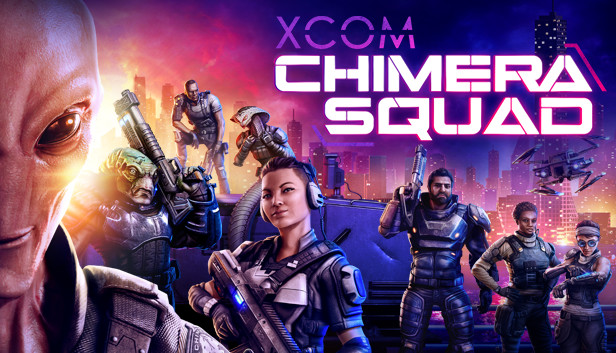
xcom chimera


Well, I ended up playing it out of boredom. I was a bit biased at first, because five years ago I was already tired of the Firaxis combat system, and then the left-wing agenda also leaked out and smeared itself all over. And to show they weren't joking, the devs hit you with one agenda-driven punch after another in the first half hour - relentlessly and unstoppably, in every dialogue, design, and story beat. Over time, its concentration settles down a bit (or maybe the body just gets used to it?), and it transitions into a slightly more neutral plane. You know how games are made today - the first few hours are polished so you don't refund on Steam right away, and so the gaming press can launch it once and give a good review, and after that they can relax and, to some extent, let things slide.
But what never stops for a single second is the tasteless, toothless, degenerate little jokes in every single dialogue, every other line, regardless of the character. Half the squad are jokesters already, and even the "serious" characters don't lag behind. The jokes are maximally retarded, on the level of the most soy sections of Reddit, and what's characteristic is that they're all delivered in a particular tone - this drawn-out, uncertain, dumb-mocking thing that ends on a questioning note, as if the character hasn't decided whether to respond post-ironically or seriously; didn't quite understand what was being talked about, and blurted out something that's simultaneously obvious information and yet sounds like a student answering a teacher in class with something completely random, hoping to at least get close to the subject area and not get a failing grade. It's not very easy to describe this in vocabulary, but we've all heard this tone a hundred times in a lot of movies and TV series, especially new ones, and it probably has some name. At first, these dialogues are physically painful, then you start to get used to it, but then random dialogues from the "jokesters" pop up that break all the charts of cringe, and you're back to facepalming. After a while, I came to the conclusion that, in theory, you could turn a blind eye to all this, just repeating a mantra to yourself that they're all cops here, and it's sort of within the genre...

The gameplay, unfortunately(?), has degraded a lot. Speaking from an absolute point of view, they took and polished the best from the previous two xcoms and abolished the worst. But unfortunately, in my value system, the "best" of the new xcoms is cancer. By which I mean: cLaSsEs and AbIlItIeS, the general soulless feel of the game, the limited tactical and strategic map.
Classes and abilities are a tumor caused by bedsores from the wheelchair that the game mechanics essentially are. You have two actions, your turn ends after shooting, and half the abilities are just different ways to abuse this system. That is, instead of initially giving a person bionic legs to replace the missing ones, the devs strap a nitrous canister to your wheelchair so that once a day you can drive 50 meters a bit faster. This is super cringe. The other half of the abilities are abilities like in Dota. Boop, threw a grenade, swoosh, went for a skillshot, pew, stunned an enemy - and go on cooldown. This is just tasteless. Accordingly, if before there were several classes, now every little idiot has their own set of abilities, which can certainly delight zoomers, but clearly doesn't steer the tactical aspect in the right direction.
From this also stems the soulless feeling - all battles, both in those two xcoms and to a much greater extent here, boil down to pressing abilities, stuns, grenades, covering something with an overwatch, leaving a couple of heal packs for the enemy, this stun, mom look how I micromanaged. At the same time, you don't get the feeling, like in some RPGs with turn-based combat, that you've done something, won, cleared out, and so on, because like in the previous two xcoms - every turn they shit new enemies on your face, pouring out of every crack (because it's so realistic when extremist groups have hundreds and hundreds of terrorists they can throw at four cops for dozens of missions in a row like cockroaches, while they STEAL CONTRABAND/PLANT BOMBS and carry out other very interestingly "story-justified" "police operations"), and you have to run around with your ass on fire completing objectives and managing abilities. All of this turned the supposed tactical game before and turns it to an even greater degree now into mechanical grinding.
Similarly with the base between missions mode - no randomness, inconsistency, or anything extra anymore. A few resources, a few standard mission types to choose from each time, necessarily giving one resource or another so you can farm what you need, strictly on a schedule - today a mission, tomorrow a day off, the day after tomorrow a mission, then another day off. Nice routine, nice grind, mmm replayability. Research, by the way, has also been removed.
And remember in the previous two xcoms there was "activating enemy pods," or whatever the tryhards called it? When you fly into a mission and from the fog of war, pre-coded groups of 3-5 enemies aggro strictly one by one, while the other aliens stand frozen in the fog of war in other parts of the map, then you clear the aggroed ones and move on to the next, and so on you reveal and take out one pod after another from the fog of war (mmm tactics)? Whoever liked that might be happy - now the unnecessary fluff of moving your soldiers around the map has been completely cut out. Any mission starts immediately with your guys busting into a room and activating a pod, and after they take it out, the game reloads you and automatically throws you into the next room to the next pod, and so on. Now that's what I call next-gen, nothing extra, no unnecessary elements. A convenient elevator from the street straight to the apartment has now been attached to your nitrous wheelchair. And that's right, it was inconvenient to drive in otherwise. And the foot-people - they're not human.

The story and its presentation are crap. There's an introductory tutorial mission that supposedly gives you a hook, and that's it. All the rest of the time you're endlessly grinding standard missions with hundreds of extremists. Only three types of extremists, differing in unit skins and a couple of abilities like in Dota for those same units, and you have to do standard missions one after another against each of them. After the tutorial, there's no story. I finished two factions, didn't start the third, got bored and dropped it.

A score of 70% on Steam is quite fair, and it's not about the ideologically downvoting mommy's alt-righters, who are still a minority compared to the total number of reviewers. I'd personally rate it a bit lower - around 65. By the way, the animations of units, menus, and everything in general are pretty buggy.


**************************************

gear tactics


A very interesting and undoubtedly important fact is that Gear Tactics, also a tactical game, was released at the same time as Chimera Squad, which couldn't help but cause discourse in the United Nations about comparing these two pieces of work. I didn't want to touch Gears, because I thought it was garbage, and I never had any desire to touch the franchise, but after finishing the previous entry in the post, I decided I had nothing left to lose. And it turned out much better than expected.

Let's start with the bad - the combat is similar to the two-action xcom, except the soldiers have three actions instead of two)))
Immediately counter with the good - the turn doesn't end after a shot. That is, you can shoot three times; you can move, shoot, move; you can shoot-move-move; you can..., you can... IS THIS NEXT-GEN?????????? Or did the nineties return?
This might not seem like anything special in words until you play and feel it. Who would have thought that slightly more freedom of action, coupled with the absence of the most idiotic, arbitrary restrictions, would radically change the impression of the game and give it ten orders of magnitude more depth than the two-action xcom crap designed for tablets? And at that moment you realize that the form of Gears is dangerously close to the true, almost the first proper rethinking of old tactical systems since the nineties. Almost the same freedom, only the outdated action points have been transferred into a less precise, more rough, but modern and digestible format. You can move relatively freely across the field to where you need; combine your guys; deliver as many attacks as you want, at the moment you need, not when the master allows. And there are plenty of ways to get more full actions on that turn - which additionally expands possibilities quite nicely. On top of all this, the ability to better position yourself or shoot several times - it negates the typical xcom baguette when your dummy misses with a 60-90% chance to hit, and it ruins the entire turn, because now when you miss you can always shoot again, and you can factor additional action points into your plan just for this case. After the bland zoomer xcom, this was an incredible gulp of tactical freshness.
Overwatch also shoots as many times as you had action points, interrupts enemies, stopping their action, and you can set its coverage zone according to the weapon. This way you can actually hold certain positions against a large number of enemies (and there are actually more of them involved, and in such a tactical system this works perfectly).

The second discovery was the FREE MAP. The map of any mission is quite large (huge compared to xcom) and it's entirely accessible for movement. Enemies, of course, aren't free from that same xcom pod nature in the sense that they spawn in groups that can be scattered across different parts of the map, but again - they still have some understanding of its globality. That is, unless it's a mission where you have several objectives in different parts, each guarded by a pod that doesn't react until you're within screen distance of them, otherwise they generally chase you around the entire map. But this is more due to the specific nature of the enemies, which by nature are mostly spawning rather than placed in advance. But again, they don't spawn like in xcoms - an endless avalanche of extremists from all walls, windows, and doors of one communist block room where you're sitting like an idiot whom the devs won't give a single second of peace from pressing abilities so he doesn't get bored and lose interest, but more in a strategic manner, at a significant distance from your soldiers, on various terrains, so that you still feel it as a city battle where you can redeploy and take a position, prepare the ground, or even just avoid a skirmish with specific enemies, in short - react on a higher level than managing the cooldown of a stun and grenade at a distance of five meters.

Speaking of stuns and grenades - it wasn't possible to completely get rid of AbIlItIeS, BUT, again. Given that we have a next-gen renaissance of the nineties here, and you can run and shoot as much as you want, the first half of xcom abilities, the kind that under the guise of content only gave you perversions and abuses of the retarded two-action system (the nitrous canister on the wheelchair) - is not represented at all. This goes without saying in the local system, and it made me very happy. How easy it turned out to be to please a person - just don't cringe up your product.
And the abilities here are 80% passive, which in the context of 2020 means - increasing the potential of the soldier in a non-obvious way. That is, you can't just throw a skillshot like in Dota (or xcom), stun someone, do something else, and on the management of these zoomer mechanic cooldowns beat the entire game, but you still primarily need to position, move, shoot, make decisions. That is, do what soldiers IN A TACTICAL GAME are supposed to do.
Speaking of active abilities, I won't say they particularly strongly affect the gameplay. Some are better, some are less, but overall I never got the feeling like in xcoms that everything is built on them. Missions can be completed without them at all, and it wouldn't be some kind of perversion or artificial difficulty, but they are simply designed exactly to play the role of a support and flavor tool, and not so that you try to abuse them every minute like in xcom, where the entire game is tailored for that. Actually, the same goes for passives - most of them give you some percentages or situational opportunities, but the whole gameplay isn't built on them. And this is an excellent approach. Xcom should take an example, but it was blown off into the opposite steppe. Abilities, by the way, are numerous, and they are divided into four different branches for each class, which differ greatly in their focuses and allow for quite different builds.
In short, here the wheelchair was given to the poor, while the person himself was actually given bionic legs, which may not have the same sensitivity as real ones, but work tirelessly and in different modes.
Yes, the soldiers themselves, just like in xcoms, are divided into classes, and due to this, in addition to abilities, they have some specific type of weapon hard-coded, which in xcoms always seemed like a pretty soulless thing to me. And yet, even here they managed to diversify this point. For each gun, there are 3-4 types of attachments with various bonuses or additional small passives, and you can customize quite nicely for a specific build or some tasks.

There is almost no non-combat management - only equipment and hiring/firing soldiers. Compared to tactical games of the nineties, or even the two new xcoms, this is sparse, but compared to the soulless-grind implementation of the base in Chimera Squad - it's fine.
The story and presentation are sort of a typical bro-movie, like in an AAA shooter, only without special action scenes, and with what usually goes between them - little conversations advancing the plot. And again, after Chimera, where there is no story or presentation at all, only cringe events and joke tossing - this was fine.

If we talk about problems, I'd call the main one a partial focus on secondary missions. That is, there's no base management, but not every mission is a story mission, and from time to time you have to go through some side junk, and there are only a few types of these side missions, and they differ from each other quite a lot, but not enough from themselves. As a result, in contrast, you feel that you've already done this exact same thing, and you don't understand why it needs to be repeated, given that you have no base development, and all you get from them is new attachments, which can be randomized for you and turn out not particularly good or even unnecessary. But sometimes these side missions have modifiers that can diversify them a bit.
The attachments and gear themselves could also use some work. There aren't that many types, not every one is useful, and the system for using them is far from ideal.
Well, and everyone has GrEnAdEs by default, albeit with a long CoOlDoWn, and although they have secondary uses, they seemed a bit stronger to me than they should be. For example, they help get out of some more difficult situations, and it looks impressive and balanced, but in other parts they can reduce some interesting tactical situation to zero, simply by smearing it. But I won't say that, say, reducing grenade damage or limiting their number could solve this problem. In general, it would be good to balance this, but how - I don't know.

In the end - surprisingly liked it, especially in contrast to Chimera. A very correct direction for a tactical game for the first time in a decade, I'll be extremely happy if they continue this format, working on the flaws, smoothing the rough edges, fixing the inconsistencies, and if possible, adding an interesting non-combat layer.
For those who find the extract of the tactical gameplay itself insufficient and need an extensive mise-en-scene with richer decorations - it's better to pass by the current version for now.

ps separately keked at the character banter in battle - pure unintentional gachiHYPER

My sword, my trusted ally, unphased by my aspect.
User Avatar
#196
Auto-translated
tl;dr - garbage.
Attachments 1
1 file attached • Total size: 65.1 KB
User Avatar
#198
Auto-translated


I decided to replay Dark Souls II for comparison, since I last played it over six years ago. As a reminder, I played all three first games as a pure melee character with a shield; I recently replayed Dark Souls I as a dex/rag build, swapping to Havel's set near the end, and now I decided to try Dark Souls II for the first time as a caster.

I was choosing between Faith and Sorcery, decided to go Faith, and started as a Cleric with a mace and Heal. It's also important to note that in my first and only playthrough of Dark Souls II (and coincidentally my first Souls experience ever), I accidentally joined the Company of Champions covenant within the first half hour, which significantly buffs enemies, and only found out about it near the end. So I decided to do the same thing this time, now being sufficiently experienced in Souls-likes and Soulslikes.

I must say that right after the casual Dark Souls I, playing in this mode turned out to be unexpectedly difficult. The starting mace has very good base damage, but the range is terrible, the swing arc is poor, and the character swings it quite slowly and runs out of stamina after a couple of swings. On the Company of Champions covenant, it took 2-3 hits to kill even the starting mob, and I couldn't always land them because either they didn't stagger from the first hit and started hacking me apart between my swings, or they recovered from stagger after my first hit and gutted me in return, or there were just multiple enemies at once, in which case I lacked the stamina/they attacked at too inconsistent intervals/I couldn't lure them out one by one. Despite the Cleric's starting robe having good defense, on the Company of Champions covenant I still got killed in a couple of hits, after which the Hollowing system from Dark Souls II kicked in, which, as a reminder, reduces your maximum HP, and pretty soon I had so little left that I died literally in one missed hit. A 100% physical block shield, like the one lying around at the start in casual Dark Souls I, wasn't lying at my feet here, and CIRCUMVENTING ENEMIES FROM THE SIDE no longer works here either, because either the enemies swing too wide, or they can properly complete their thrust (not 360 degrees, but 90+). Rolls on the Company of Champions covenant with starting stamina and i-frames, the mace, and improved enemy tracking and enemy density, were also not viable. In short, to my surprise (and pleasure), I had to sweat quite a bit. In casual Dark Souls I, you could start with ten Estus, and a few hours in, with twenty, plus it healed instantly, and Humanity as an item healed your entire HP bar instantly. In Dark Souls II, you start with one Estus Flask, it heals over time, and Humanity just patches up your broken Hollowed rear end. However, I didn't have problems with a lack of healing, because I got one-shot anyway.))

Many people criticize Dark Souls II for "bad graphics," but they should try playing as I did — Dark Souls I first, then Dark Souls II. I remembered it as relatively pleasant, and that was confirmed here. I criticized the first game for empty boxes with dead textures, sometimes hidden by some fog effects, and here I was actually glad to see a quality leap not only in graphics, but also in the visual design of the locations themselves — it's much more enjoyable to traverse them, they have many more pleasant details, in short, it's perfectly clear that the second part is the SECOND part. Additionally, some of the locations are surprisingly beautiful, both themselves and in combination with the backdrops. Majula, all the castles, Dragon Aerie, Heide's Tower of Flame, the forests (I don't mean the Fog Forest or the Undead Crypt, but the regular ones), almost all the locations from the DLCs. As a reminder, in Dark Souls I, the only truly pleasant locations for me were Undead Burg and Anor Londo. Unlike Dark Souls I, in Dark Souls II, I actually ENJOYED being on most of the maps.

One cannot help but compare the level design either. I criticized the first game for having too many dungeons and gameplay focused on cheap tricks like fights on a narrow ledge over a pit, some 10 IQ traps, or the other extreme — running through huge, wide, dead, empty areas like Darkroot Garden, Ash Lake, Lost Izalith. I went into Dark Souls II's locations with caution and was prepared for my memory to play tricks on me, and for my memories to turn out to be false. But no. The level design in Dark Souls II is ten orders of magnitude better than the first game. Open spaces lead into halls, which transition into corridors, leading to rooftops and courtyards, smoothly flowing into new corridors, branching off into small rooms. Almost nowhere do the developers overdo it with design elements; almost all locations are designed to entertain you with DIFFERENT situations and challenges while still looking believable; almost all locations are genuinely interesting to explore and master from a gameplay perspective. The situations you are forced into are sometimes difficult, but not bullshit; rather, they are like solving a puzzle. Of course, there are some rather poorly designed encounters there too, rivaling the best moments of Dark Souls I, or a couple of types of annoying enemies, but they are quite rare.
Let me be blunt — on the Company of Champions covenant, with my build as a glass cannon caster in rags with base HP and stamina, even with a 100% physical Drangleic Shield, I died many times, and often quite unpleasantly; however, almost always I felt it was my fault, not a feature of that specific encounter's design. More precisely, they were indeed designed that way sometimes, but almost never did this design cause frustration aimed at myself, because there was no feeling that it was designed specifically to be insurmountably nasty.
Overall, in this playthrough, my favorite maps were: Iron Keep (top-1) and the preceding mines with the Poison Palace, the Wharf, the Bastille, Shulva, the Sanctum City, and Brume Tower — both from the DLCs — these are simply the most interestingly and beautifully made locations. Shrine of Amana is very beautiful, but in this playthrough I wanted to drop an atomic bomb on it; Frigid Outskirts from the Ivory King DLC is objectively garbage. Everything else is more or less solid.
By the way, some people worship the interconnectivity of locations in Dark Souls I. Like, you can go from one Undead Burg to Blighttown, and the Parish, and the Garden, and somewhere else, what a well-thought-out world, unlike Dark Souls II, where the world map is just a regular tree with several branches. I checked and analyzed this aspect very thoroughly when I played Dark Souls I and Dark Souls II recently, and I came to the conclusion that the world in Dark Souls II feels much more cohesive. The difference in biomes in Dark Souls I is too jarring, and this interconnectivity has almost no gameplay purpose and is only there to keep the player from getting too sad until they find the Lordvessel, which allows teleporting between bonfires. In Dark Souls II, there are simply many more locations, and most of them transition into each other very organically, and their existence carries the right meaning in terms of world design as a whole.
I'll also add that the melancholic atmosphere of Dark Souls II >>>>> the drug trip of Dark Souls I.

Even though I started as a Cleric, it turned out that they were heavily nerfed since vanilla. I thought I'd be throwing lightning like Perun, but I found out you get 3-4 casts per slot, which are weaker than one mace swing. So I decided to go all-in on my first caster experience in Souls and ended up leveling into a Hexer through both Faith and Intelligence. So I started off running around with the mace, then leveled up Intelligence and Attunement and ran around shooting Soul Arrows, and then finally Dark Orbs out-damaged Soul Arrows, and I switched completely to them. Here I saw that since vanilla, the developers had also heavily nerfed the other spells, and despite the abundance of spells, almost none of them are playable. So I ran through the whole game with Dark Orbs. I definitely didn't like this in the caster paradigm, but on the other hand... What are Souls games but two buttons when you play as a melee character? Should casting really be that different?

As a result, I ran through the whole game in this look (angle chosen to capture all details). The helm from the Fog Forest for Intelligence and +souls, the robe from the Creighton the Wanderer in the Undead Purgatory for +souls, the Jester's Gloves from Iron Keep for +souls, and legs with maximum defense for under 60% equip load for a mid-roll. I also had the Silver Serpent Ring for +souls, so with ascetics I was getting more than double the usual souls from enemies. As soon as I unlocked Iron Keep, I could enter from the first bonfire, clear the inner courtyard, and level up 2-3 times at once. The result was quite awesome — both visually and thematically — a villainous dark mage, reaping the harvest and greedily absorbing souls, feeding him to incredible power. The shield, by the way, I almost never used, even though I always carried it. Most often I sniped regular enemies from a distance, and bosses, unlike the casual first Souls game, are not abusable with a shield with such ease here. Many of them have elemental damage on their attacks, or they would drain my build's entire stamina in one hit, and flanking them from the side rarely works in this game. And when I got to the DLCs, there was no point in blocking at all anymore, and I just rolled around like a typical Souls-player noob.

And this is how I specifically geared up for some fire-based bosses from the vanilla game. The Creighton's Mask and Manacles (of the Sinner), the Hexer's Boots and robe for fire resistance. I couldn't wield a 100% physical and fire block shield, so I two-handed it to block some fire if needed, and switched back to one-hand to fire a Dark Orb. And so on every time.
Overall, the equipment is made much more interesting and better than in the first game. I couldn't just put on Havel's set anymore, because in the next-gen version of Dark Souls II it had a Strength requirement, as did some other armors. And in general, their variety, visual aesthetics, and diversity of bonuses — all of this was a pleasant surprise after Dark Souls I, which was full of (and even that not fully) random, uninteresting rags.
Towards the very end, when I maxed out Faith and Attunement, acquired an excellent chime and plenty of attunement slots, I finally started throwing Lightning Spears, and they dealt slightly more damage than Dark Orb. However, against all bosses, for some reason, they still worked worse...
I also ran around for a while after the mace, in the first half of the game, with the Craftsman's Hammer, enchanted with lightning. At the very end, in the first DLC, I decided to pick up and upgrade the not-infamous Rapier, and in the third DLC, I took the Ice Rapier, because going through the DLCs with only Dark Orbs or the Craftsman's Hammer was way too sweaty. I also tried Pyromancy, upgraded both Pyromancy Flames to max, but with my build, it seemed useless to me; Dark Orbs had more utility, quantity, and damage output than any fire.

Regarding bosses, I will say this — the early ones seemed quite weak to me, very entry-level, but then they started to pack a punch. And unlike 90% of Dark Souls I bosses, where interesting fights are replaced by gimmick upon gimmick (let's ignore for a second that almost all bosses there are beaten by circling to the side or abusing a 100% physical shield like a chump), here I expected the worst but was pleasantly surprised that the bosses have more varied movesets, use them more actively, and you absolutely cannot face-tank them like I did in Dark Souls I. Of course, some of them are gimmicky too and quite crappy in that regard, but there are far fewer of them. And in the DLCs, almost all the bosses are excellent (only the paths from the bonfire to some of them are not excellent); the vanilla ones are certainly rather weak in comparison.


= YES, DON'T BE SURPRISED =
Company of Champions covenant, +Dark Orb glass cannon with base HP and stamina. 97% of deaths — on maps against regular encounters... 50% — first half of the game with mace and full hollowing, another 40% — the DLCs... I left the covenant only for about an hour to join the Pilgrims of Dark covenant to farm the rewards from there, after which I rejoined.
Meanwhile, in casual Dark Souls I, I died maybe 30-50 times at most, yawning and playing one-handed.


It took me 130 hours, as can be seen in the screenshot. That's 100 more than it took for Dark Souls I with its DLC and full exploration of all maps with all secrets. I have to thank the Company of Champions covenant, the glass cannon build, and furthermore — a much more content-rich world. I always ranked Dark Souls II first among other Souls games in my mind, and I really wanted to test if it would still feel that way now in comparison. Yes, it does. And this is not a false memory or nostalgia for my first Souls games; I was very biased but genuinely observed, with the naked eye, a quality increase of ten orders of magnitude. Completely surprising.
Elden Ring is still better, that's an obvious next-gen leap, but it's not as much of a no-brainer as comparing Elden Ring to Dark Souls I or Dark Souls III. Dark Souls II turned out to have such a pleasant world and interesting level design.
My sword, my trusted ally, unphased by my aspect.
User Avatar
#199
Auto-translated
3

Breezed through it again as a dex-dualist with the default starting sabres; spent a bit more time than on the first one—around 40+ hours.
At first, the sabres seemed pretty OP, but after a while, they practically stopped staggering mobs, except for the most pathetic ones, though they still dealt good damage. And although out of habit I still kept a 100% Drangleic shield on me for those rare cases when you encounter some crazed enemies who swing a knife ten times but get stunned for five seconds when hitting a shield—making them easier and faster to block than to roll around—otherwise, it just hung on my back. Thankfully, as Alex mentioned in his old post, we're "Bloodborne" now, and the combat is punchier and more roll-oriented. With this same dual dex build, I tried a couple of katanas and some rapier-needle thing from the first DLC, but the katanas were only slightly stronger while the attack speed suffered noticeably, and the rapier-thing has a too confusing and awkward moveset when attacking with two hands.
As for armor, I picked up some Viking gear in the undead settlement and finished the game with it under 69(smirk)% load; it practically plays no role in this part.

Generally speaking, I liked it—in the context of replaying the entire series at once. That is, looking at it that way, there's an incredible amount of quality-of-life improvements in the design of everything. Locations—practically all are fine, without the stressful gimmicks of the first or second; enemies—practically all are reasonable. But... the enemies feel monotonous compared to the previous parts, and the level design in terms of interest loses heavily to the second. The maps themselves are very beautiful and visually detailed, even if they seem greyish against the backdrop of previous parts, but they don't really have any interesting shortcuts or "puzzles" (Souls-like style, giving them a pass). There are practically no stupid gimmicks like pitch darkness, traps from all sides, heaps of chasms, monsters jumpscaring from around corners, or various narrow bridges, but there are practically no interesting ones either—like the multi-level pirate grotto with torches from the second. You just run through the maps and run—well okay, I don't really care, although a couple of spots were decent—for example, the ballista on the underground lake (though the location itself is crap).
I didn't like the thematic reuse of locations from previous parts. I mean, I understand of course that it's for lore and direction—whether it's a multiverse with parallel worlds or a continent with countries and times overlapping in some places—but seeing a blend of Izalith with the underground lake, and a crypt on top of that—the most tedious locations of DS 1 for me—wasn't great at all.
While it's not the main thing for me, I didn't particularly like the NPCs. Completely random guys who ask point-blank—"take me as your teacher-merchant at the base," you say "yes," and they... become your teacher-merchant at the base! It's convenient, of course... and can be considered a quality-of-life improvement... but it's just too soulless. And after that, they say one line of dialogue; in reality, it's as if they weren't even there.

The bosses looked very beautiful in these graphics, no doubt, but after the second one with a Glass Cannon build in the Covenant of Champions (where I had to throw about 70 dark orbs during a single ten-minute DLC boss fight, doing several dodges or running 200 meters between EVERY shot), and generally after several Souls games before this, they were nothing. The same old movesets, nothing new, only now they're easier to dodge since combat is more dynamic, and there's no need to block with a shield or flank, and the sabres shred so fast that before you can blink, you've already won. Plus, you can tank in the face with Estus, which is plentiful here, and the HP bar is huge even without upgrading (it even hardcaps at 50 instead of 40, heh yeah). In general, in terms of mob and boss difficulty, the third is closer to the casual first one, but I wouldn't say it's completely for kids. Overall, it's a golden mean between 1 and 2, leaning more toward the simplicity of the first. Even the ranged mobs here don't lead their shots like in the second; they've degraded back to console players, where you step a millimeter to the side and they fire a bolt into thin air. The only thing that pleasantly surprised me—the dogs in this part are the craziest.
In short, by all possible evaluation parameters except graphics—a solid mid-tier )). Which, of course, doesn't say much in its favor as a hyped title, but perhaps it can provide an averaged and modernized experience of the trilogy.

In my head before replaying, I always put the third in the shit-tier because it didn't really leave an impression, but in essence, it's a polished first one, more focused on dynamics and, shall we say, accessible for everyone. Since DS 1 unexpectedly disappointed me with its excessive obsolescence, my subjective tier list looks like this: divine axe >>>>>>>>>>>>>>> ds 2 >>>> ds 3 >>>>>>> ds 1 >>>>>>>>>>>>>>>>>>>>>>>>>>>>>>>>>>>>>>>>>>>>>>>>>>>>>>>>>>>>>>>>>>>>>>>>>>>>>>>>>>>>>>>>>>>>>>>>>>>>> code vein

Thank you for your attention.


***
Forgot to mention—the most interesting boss of the trilogy I'd call Elana from the first DLC of the second. I liked that the fight includes both running across the arena, but in moderation, not as tedious as most dragons in all parts, and rolling; dodging both attacks and spells and summons, and the fight itself includes some random element, which doesn't reduce it 100% to memorizing a pattern and which side to circle the boss.
My sword, my trusted ally, unphased by my aspect.
User Avatar
#200
Auto-translated
Persona 4 Golden


I think the title says it all. After Catherine, I had a strong prejudice against Atlus, but, as is usually the case, I gave it a fair chance. Turns out, I was wrong.
Throughout the game, you have to walk around in 2.5 dead locations, where you can enter a rarely updated store or do something to get a bonus to a skill that gives you a stat boost (which isn't needed for anything significant). Sometimes you can bond with one of the ten NPCs – if you're lucky and have enough relationship points with them, there will be some kind of everyday scene.

You can also go to a procedurally generated (and therefore very bad) dungeon. The combat, and the entire system in general, is one of the worst I've seen in a JRPG. It's a primitive turn-based grind from the 80s about "attack-use skill-guard" (but guarding is almost unnecessary), only here it's one of those systems – spiced up with an awkward, uninteresting, and schizoid system of fusing skills and classes into others. You level up one Persona, and then ten more appear; you level up another, and after half an hour of leveling, you see that the other Persona has acquired a skill that you already had on the first one. You exit the dungeon, go fuse Personas together, the new Personas have the same skills, or even worse, and they also need to be leveled up from scratch. All the skills are completely uninteresting garbage, like "hit with fire-lightning-ice," "buff agility." The Personas don't differ from each other almost at all, except for a minimal difference in skills. All the skills and Personas have schizoid names that you have to dig through; all this fusing and other grinding doesn't give you any real sense of advantage; it just exists to stretch your playtime with menu-diving.
Anyone who has played even one JRPG with a similar system will get tired of this kind of thing the first time, to the point where they never want to do it again. There's also no point or desire to go to the dungeon (which the developers very often and insistently suggest, even without a specific goal, just to grind and level up) – it's procedurally generated, and it consists of one and a half corridors with generic drops as rewards.

There are side quests, and they're complete garbage. Bring a randomly dropped item from a mob in the dungeon to a random nobody for no reason.
The story is a typical anime about high school students fighting after school with some incomprehensible nonsense for no reason; it's presented well, but that's not Atlus's merit; it's simply presented as a typical anime slice-of-life about going to school – it's hard to mess that up.
There are funny scenes, and there are funny bonding events. That's the only good thing. The rest is a terrible combat system, a terrible RPG system, a terrible art style, decent music that's sometimes spoiled by terrible vocals, a terrible dead "world" consisting of two and a half locations, each of which has two and a half nobodies who repeat the same phrase for weeks, and which I stopped going to after school at one point because there was no point – it's dead and almost never updated, and when it is updated, there's no soul or interesting side content.

In conclusion. When I think about going to a dungeon, the first question is, why? It's garbage, the combat is garbage. When I think about walking around the city again, why? It's garbage, the NPCs are garbage, the quests are garbage. I thought about trying to speedrun just the scenes with the characters because there's no other game here, but the thought of launching it and going back to the 2.5 dead locations or, God forbid, the garbage dungeon immediately made me not want to launch it.

Overhyped garbage from bad developers and a deserved flop.
My sword, my trusted ally, unphased by my aspect.
User Avatar
#201
Auto-translated
Pathologic.
Originally, this was intended to be a game about three characters, but only one survived until release. We pray that episodes featuring the others will be released.
The main character is the son of a local doctor (to put it very simply). He returned to his hometown after receiving an education at a medical school somewhere outside the city. The return went wrong from the start—his father died, and soon the city was gripped by an epidemic of a dangerous disease with unusual properties. Under these conditions, our hero must survive and try to save the city.

What does survival entail? The player has parameters for fatigue, hunger, thirst, immunity, and infection. Accordingly, the character needs to sleep, eat, drink, and avoid getting infected. Sleep takes up time and increases hunger; food must be found or bought somewhere. Simultaneously, one must find a way to stop the disease. The infection parameter is zero by default and does not appear on the screen—until it becomes non-zero.
What does saving the city entail? Well, basically, everything is as usual—you need to complete quests. Markers are in place with rare exceptions, and there is a "journal" as well. Speaking of the "journal"—it is something absolutely incredible. Pathologic has a so-called "Thought Map" instead of traditional journals, and it is stunningly convenient. The closest analogy I can find is a board with a bunch of papers, like in movies, connected by string links. But it is drawn very conveniently, not clunky—we easily see which things are linked to each other and which are not; we see which branch is completed or has hit a dead end, and which still has options for development—in short, it's worth playing just to see this, no joke.
Accordingly, the Gameplay can be summarized quite simply—we move through the city, collect various information, complete the main quest, and possibly side quests, while also ensuring our own survival.

What is so good about this game? For starters, the correction of mistakes from the previous part (Pathologic: Dragon Utopia). Initially, I even wanted to do a step-by-step comparison of both games, but it turned out to be too cumbersome. But essentially, absolutely all the mistakes of the first part—and this is not a figure of speech, I mean all—were corrected. A YouTube comment expressed this perfectly:
Pathologic 2 is like a video game adaptation of Pathologic

You couldn't put it more ideally. The first part was a book with an atavism in the form of Gameplay, whereas Pathologic can be played as a full-fledged game. However, forget about the first part; let me tell you why you should play the second one:
The main tags here would be plot, dialogues, and atmosphere.
1) Plot. The city we arrived in is not so simple. Essentially, it consists of two halves. The first—ordinary townspeople, so ordinary that I don't even know what to say about them. They go to work, have children, all that sort of thing. The second half—the steppe-dwellers or the Way. The thing is, the city was built in the middle of the Steppe, where there is nothing but, well, steppe. The steppe-dwellers lived here for thousands of years and for thousands of years they lived the same way. The city was built—but where to get food, where to get anything at all to be economically useful? The steppe-dwellers raise bulls—from them they make meat for food and hides for sale. But this is all surrounded by a bunch of rituals and customs, and the steppe-dwellers have no intention of changing it, while the townspeople can do nothing about it—because they have no leverage. Thus, two societies exist in parallel—one close to what was in the 20th century, and others living in a primitive tribal system. The main character is himself half steppe-dweller, and his father was not only a doctor but also largely a spiritual leader. Therefore, he will need not only to find a way to defeat the disease but also to understand the Way, to make it respect him—especially since the search for a cure and the understanding of the Way will be linked. At the same time, our cultural code is felt—the steppe-dwellers may not look like us, but at the same time, something vaguely familiar is felt in them. The English Wikipedia says they were based on Buryats. I don't know how true that is, but overall the city—both its parts—feels different than in foreign games. There is something special in them, familiar to a Russian person.

2) Dialogues. During the game, I suddenly thought, "man, how cool it is to be able to play in the original, and not in English, but in my native Russian." And then I thought—"what advantages does this give me compared to if I were English-speaking?". And I began to read the dialogues more carefully. And what I saw, I cannot unsee now. All characters speak very well, realistically. Simpletons on the streets talk like simpletons, men from the factory talk like men from the factory, their wives similarly. But it's not just about realism—I noticed the named NPCs and was admired by how skillfully a speech style was chosen for each. I swear, if you were given a chance to talk with each of them for a bit, then write a few sentences on behalf of each (not necessarily about the game plot), and then show these sentences to you—you would easily guess which NPC said what exactly. Because one speaks politely and intelligently, the second strongly and confidently, the third with kindness, the fourth with detachment—each of them feels unique. Of course, some will say that I've inflated this plus out of nowhere, but I am sure that now that this thought is in your mind, you will be able to see it too.

3) Atmosphere. This point is assigned to a bunch of games, but people often struggle to explain exactly what it consists of. But as it seems to me, I can do this because the game's authors set themselves the conscious goal of creating a suitable atmosphere in the game. Pathologic is a game about catastrophe. We are looking for a cure for the disease, but the hero also tries to survive. This is not an RPG where the only danger is the possibility or impossibility of winning another battle. We are specifically trying to survive—scraping together enough for food, avoiding infection, not getting a shiv in the ribs in an alleyway, finding a couple of hours for sleep. At the same time, there are many quests and side quests in the game—and it's unlikely you'll be able to complete them all, except perhaps on the first day. Because you have no time for quests when you are dying of hunger—instead, you break into an infected house in search of valuable loot that can be sold to buy food, while praying to all powers that you can still avoid infection. And the game should feel exactly like that. At the same time, named NPCs will get sick and possibly die. Will you find the time to give them preventive medicines? Will you find the medicines themselves? And if several fall ill, who will you prioritize? And have you forgotten about yourself?
Upon the game's release, many complained that it was too difficult. The developers listened to the requests and added the ability to change the difficulty. However, in the settings, they also wrote this:
Pathologic is a game about catastrophe. Difficulty is one of the ways to tell about it. By disabling the canonical difficulty, you can calibrate the balance for yourself, but we do not recommend doing this during the first walkthrough. By design, the Gameplay of "Pathologic" should be barely bearable.

And this is a very correct statement. I played the game twice—on "normal" difficulty (the easiest) and on "canonical". On normal, I just played—reloading, of course, if I felt I had made an absolutely critical mistake, sometimes even reloading frequently, but without fanaticism. Initially, I wanted to save everyone, then—most of them. Toward the end, I gave up and tried to save only those I considered most important. And I received the experience that, as it seems to me, the authors intended—the experience of feeling one's own helplessness, the fact that even saving someone is already a victory. Even if you didn't save everyone.

On "canonical", I played in a style more typical for me—I had already figured out all the game mechanics and knew how best to use them, imagined the scheme of profitable and unprofitable quests, and so on. I reloaded and polished my perfectionism, intending to save everyone at any cost. And I managed to do it. But I received much less pleasure from the process. I won't lie that I received none at all, far from it—for me personally, the dialogues and plot still carried it, and there were some moments (and especially one) that I missed during the first walkthrough. But essentially, the "Atmosphere" point in the list of pluses was lost for me. Therefore, my advice is—if you play, you can set any difficulty, as long as it is actually difficult specifically for you, and your inner perfectionist-polisher needs to be suppressed for a while.

I don't usually give numerical ratings to games, but it was rated quite highly abroad too, so let it be 8/10. However, then I remember that this is a Russian game, which feels special specifically in the Russian language, not like a game from any other country might feel—because it skillfully uses linguistic and cultural means—and therefore I give it my subjective Russian 10/10.
The last paragraph looks as if written by someone who only imagines they've seen foreign things, so just in case, I'll remind you that for about 8 years now, I play English-language games only in the original. And by the way, I've seen a couple of excerpts from the English translation of Pathologic and I swear—that linguistic quirk, the liveliness of the language, its unnaturalness and sincerity are lost there. So there you have it.
Where do we go?
Where do we end up when we save the world?