Nargott

Auto-translated
About the Project
This is a global modification dedicated to establishing a new balance and unlocking the tactical potential inherent in Heroes 5.
The mod is divided into 3 parts:
1) Duels (Wargame Tactics - WGT) - a complete rework of creatures, spells, and heroes (duel mode)
2) Arena (Wargame Arena - WGA) - a rework of hero skills, artifacts, and town layouts (special map mode for final battles)
3) Standard (Wargame Standard - WGS) - development of new map templates and changes to global mechanics
Currently, active development is focused on the duels part (Wargame Tactics); several versions have already been released, with each subsequent one featuring fundamental improvements based on previous experience.
Files for download:
Heroes 5+ executable, place in the bin folder (launch the game through this)
Wargame Tactics 2.0 mod, place in the data folder
Tactical Interface 1.0 tactical interface for HD monitors with a long ATB bar (20 elements) and other goodies
General Concept
Key Aspects:
- balance
- variety
- tactics
- dynamics
Combat Part:
- updated units (3 equivalent upgrades each + a special combat role system)
- updated abilities (strengthening old ones + adding new ones)
- updated magic (strengthening + special mana balance)
- updated combat mechanics (10% parameters, 50% defense, 50% luck, 5 mana per unit of knowledge, balanced hero attack)
- addition of heavy-class units (positional gameplay)
- reduced speeds (indirect increase in field size)
- low troop numbers (in duels, 1 stack = 1 dragon)
RPG Part:
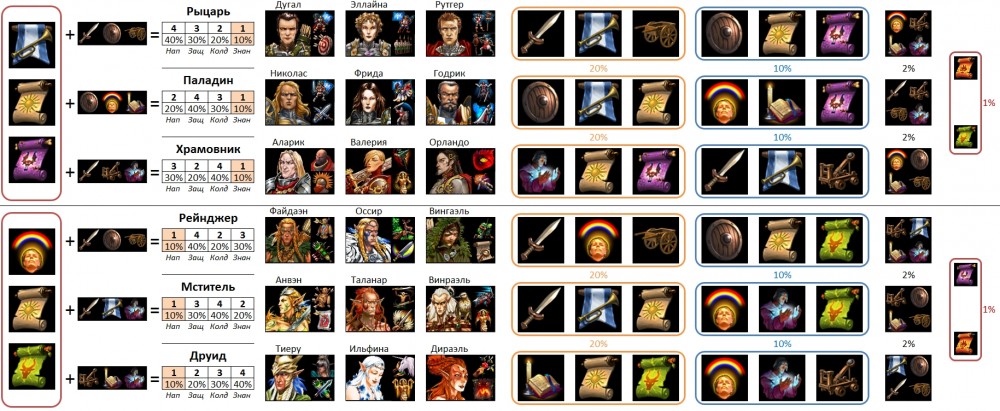
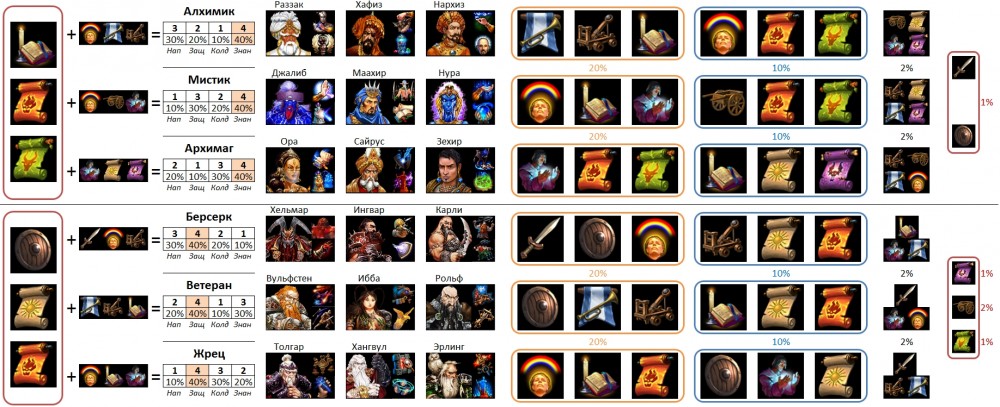
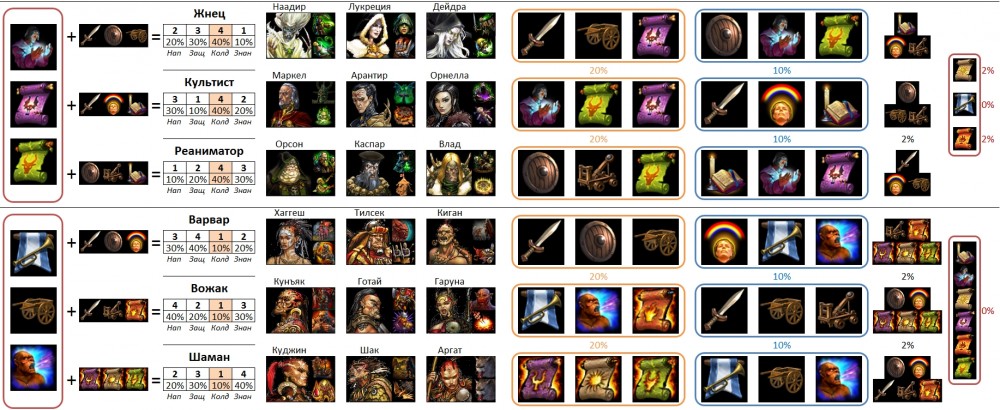
- developed hero class system (24 classes: 3 classes per faction, 3 heroes per class)
- developed level 1 heroes with distinct class differences (total of 10 parameter units instead of 5)
- unified leveling scheme (the difference between classes lies in available skills and parameter distribution)
- simple and flexible leveling scheme without links between skills (all links remain only between abilities within a skill)
- super-ability requires only the mastery pendant and a leveled racial skill, and is not tied to rigid progression of other skills or hero level
- high uniqueness of classes and heroes (even within one class)
- rework of skills and abilities, removal of redundant ones
- developed racial skills (all unique racial perks are placed here, meaning there is a choice)
Strategic Part (planned changes):
- cancellation of chains (when meeting outside a town for an exchange, both heroes' turns are equalized to the minimum)
- high hero mobility (movement distance +60%)
- limit on the number of battles per army per day, as in Disciples 2 (after a battle, the hero loses 50% of their turn during auto-battle and the entire turn during manual battle)
- unique town layouts, as in Heroes 3 (connections + construction dynamics)
- alternatives instead of unit upgrades, as in Heroes 4 (when building an upgraded dwelling, units can be freely re-equipped into any of the 3 versions)
- emphasized (accelerated) growth (upgrading production buildings increases their growth)
- powerful artifacts at an affordable price
- freedom of movement on the map: absence of neutrals guarding passages between zones (or weak passage guards)
- restriction on "hit-and-runs": when fleeing/surrendering, a hero becomes available for hire only after 3 days (not immediately)
Tactical Gameplay:
If we imagine Heroes 5 battles as positioning in the tactical phase followed by an exchange of blows in the combat phase (which is how most battles are conducted), WGE battles are characterized by constant repositioning throughout the entire fight, creating and reflecting threats, while exchanging blows is merely the realization of these. In other words, combat here is chess written in the language of Heroes. In essence, the battles are most similar to modern Kings Bounty, while having many differences in detail.
General Gameplay:
- high dynamics: adapted for open maps (with a sufficient level of "freebies") with an approximate game duration of 2-3 weeks and turn time up to 5 minutes
- fast clearing: automatic clearing of light guards is incentivized (manual battle takes the hero's entire turn), which significantly speeds up the routine process
- mobility: increased hero movement distance accelerates the game, strengthens the role of "scouts," and emphasizes inter-zonal play instead of lingering in one zone
- free expansion: active opening of zones (weak passage guards), early capture and development of several towns, mixing of troops
- variable development: due to short game durations, selective town development is supported instead of total construction (as in Heroes 4)
- troop distribution: the limit on the number of battles and cancellation of chains incentivize using multiple armies for scouting, clearing, and attacking
Combat Mechanics
Key Changes:
- rescaling speeds of non-flying units to 75% (small units have speeds 3-5, large 4-6); equivalent to a linear field expansion of +33%
- 10% damage bonuses and penalties for the difference between attack and defense (instead of 5%): significant increase in the role of hero physical parameters (as in Heroes 2)
- rescaling unit attack and defense from 1-40 to 1-20 (similar to Heroes 2)
- strengthening magic and reducing the mana limit to 5 per unit of knowledge: significant increase in the role of hero magical parameters (including mana scarcity)
- implementation and proliferation of heavy-class units (damage to them is reduced to 50% if the attacker moved 1 or more cells)
- strengthening defense, which gives a +50% bonus to protection (instead of 30%), reducing physical damage by an average of 40% (from 100% to 60%)
- reduction of ranged units' ammo (on average to 75%): making ammo, straight-line shooting, shot conservation, archer movement, and carts relevant
- more powerful creature abilities (e.g., cavalry bonus +50% for each cell moved): significant emphasis on ability-based play
- developed tactical randomness (wide ranges, low unit numbers, and high discreteness of creatures)
- limited uncontrolled randomness (successful attacks give a +50% damage bonus instead of 100%)
Magic Mechanics
Key Changes:
- flexible prices: adapted for any mana pool (there are free and cheap spells, as well as expensive and super-powerful ones)
- strengthened buffs and debuffs: generally by adding an effect dependency on Spellpower (while duration is tied to the skill)
- slowed mass versions of spells: they always require 100% of the hero's turn (instead of 50%)
- limited mass versions of level 2-3 spells: they are all 4x4 area effects (unlike level 1 spells)
- increased cost for mass versions of level 2-3 spells: 4 times more expensive than target versions (except Exorcism)
- hybrid spells: 25% of spells in the Mages' Guild are not learned but granted for leveling up pairs of developed magic schools (2 spells per pair)
This is a global modification dedicated to establishing a new balance and unlocking the tactical potential inherent in Heroes 5.
The mod is divided into 3 parts:
1) Duels (Wargame Tactics - WGT) - a complete rework of creatures, spells, and heroes (duel mode)
2) Arena (Wargame Arena - WGA) - a rework of hero skills, artifacts, and town layouts (special map mode for final battles)
3) Standard (Wargame Standard - WGS) - development of new map templates and changes to global mechanics
Currently, active development is focused on the duels part (Wargame Tactics); several versions have already been released, with each subsequent one featuring fundamental improvements based on previous experience.
Files for download:
Heroes 5+ executable, place in the bin folder (launch the game through this)
Wargame Tactics 2.0 mod, place in the data folder
Tactical Interface 1.0 tactical interface for HD monitors with a long ATB bar (20 elements) and other goodies
General Concept
Key Aspects:
- balance
- variety
- tactics
- dynamics
Combat Part:
- updated units (3 equivalent upgrades each + a special combat role system)
- updated abilities (strengthening old ones + adding new ones)
- updated magic (strengthening + special mana balance)
- updated combat mechanics (10% parameters, 50% defense, 50% luck, 5 mana per unit of knowledge, balanced hero attack)
- addition of heavy-class units (positional gameplay)
- reduced speeds (indirect increase in field size)
- low troop numbers (in duels, 1 stack = 1 dragon)
RPG Part:
- developed hero class system (24 classes: 3 classes per faction, 3 heroes per class)
- developed level 1 heroes with distinct class differences (total of 10 parameter units instead of 5)
- unified leveling scheme (the difference between classes lies in available skills and parameter distribution)
- simple and flexible leveling scheme without links between skills (all links remain only between abilities within a skill)
- super-ability requires only the mastery pendant and a leveled racial skill, and is not tied to rigid progression of other skills or hero level
- high uniqueness of classes and heroes (even within one class)
- rework of skills and abilities, removal of redundant ones
- developed racial skills (all unique racial perks are placed here, meaning there is a choice)
Strategic Part (planned changes):
- cancellation of chains (when meeting outside a town for an exchange, both heroes' turns are equalized to the minimum)
- high hero mobility (movement distance +60%)
- limit on the number of battles per army per day, as in Disciples 2 (after a battle, the hero loses 50% of their turn during auto-battle and the entire turn during manual battle)
- unique town layouts, as in Heroes 3 (connections + construction dynamics)
- alternatives instead of unit upgrades, as in Heroes 4 (when building an upgraded dwelling, units can be freely re-equipped into any of the 3 versions)
- emphasized (accelerated) growth (upgrading production buildings increases their growth)
- powerful artifacts at an affordable price
- freedom of movement on the map: absence of neutrals guarding passages between zones (or weak passage guards)
- restriction on "hit-and-runs": when fleeing/surrendering, a hero becomes available for hire only after 3 days (not immediately)
Tactical Gameplay:
If we imagine Heroes 5 battles as positioning in the tactical phase followed by an exchange of blows in the combat phase (which is how most battles are conducted), WGE battles are characterized by constant repositioning throughout the entire fight, creating and reflecting threats, while exchanging blows is merely the realization of these. In other words, combat here is chess written in the language of Heroes. In essence, the battles are most similar to modern Kings Bounty, while having many differences in detail.
General Gameplay:
- high dynamics: adapted for open maps (with a sufficient level of "freebies") with an approximate game duration of 2-3 weeks and turn time up to 5 minutes
- fast clearing: automatic clearing of light guards is incentivized (manual battle takes the hero's entire turn), which significantly speeds up the routine process
- mobility: increased hero movement distance accelerates the game, strengthens the role of "scouts," and emphasizes inter-zonal play instead of lingering in one zone
- free expansion: active opening of zones (weak passage guards), early capture and development of several towns, mixing of troops
- variable development: due to short game durations, selective town development is supported instead of total construction (as in Heroes 4)
- troop distribution: the limit on the number of battles and cancellation of chains incentivize using multiple armies for scouting, clearing, and attacking
Combat Mechanics
Key Changes:
- rescaling speeds of non-flying units to 75% (small units have speeds 3-5, large 4-6); equivalent to a linear field expansion of +33%
- 10% damage bonuses and penalties for the difference between attack and defense (instead of 5%): significant increase in the role of hero physical parameters (as in Heroes 2)
- rescaling unit attack and defense from 1-40 to 1-20 (similar to Heroes 2)
- strengthening magic and reducing the mana limit to 5 per unit of knowledge: significant increase in the role of hero magical parameters (including mana scarcity)
- implementation and proliferation of heavy-class units (damage to them is reduced to 50% if the attacker moved 1 or more cells)
- strengthening defense, which gives a +50% bonus to protection (instead of 30%), reducing physical damage by an average of 40% (from 100% to 60%)
- reduction of ranged units' ammo (on average to 75%): making ammo, straight-line shooting, shot conservation, archer movement, and carts relevant
- more powerful creature abilities (e.g., cavalry bonus +50% for each cell moved): significant emphasis on ability-based play
- developed tactical randomness (wide ranges, low unit numbers, and high discreteness of creatures)
- limited uncontrolled randomness (successful attacks give a +50% damage bonus instead of 100%)
Magic Mechanics
Key Changes:
- flexible prices: adapted for any mana pool (there are free and cheap spells, as well as expensive and super-powerful ones)
- strengthened buffs and debuffs: generally by adding an effect dependency on Spellpower (while duration is tied to the skill)
- slowed mass versions of spells: they always require 100% of the hero's turn (instead of 50%)
- limited mass versions of level 2-3 spells: they are all 4x4 area effects (unlike level 1 spells)
- increased cost for mass versions of level 2-3 spells: 4 times more expensive than target versions (except Exorcism)
- hybrid spells: 25% of spells in the Mages' Guild are not learned but granted for leveling up pairs of developed magic schools (2 spells per pair)


 .
.