
Skip to content

Posts from Yuu's Logbook

No ratings yet — be the first to rate!
User Avatar
#1
Auto-translated
Civ III Conquest I: Mesopotamia
Civilization: Sumerians
Leader: Gilgamesh

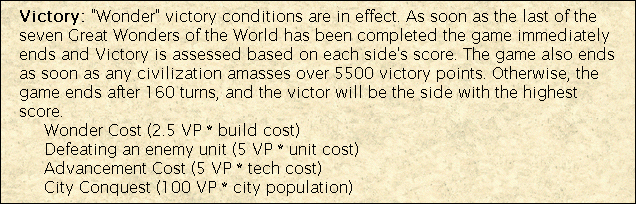
Victory conditions:
Other civilizations: Egypt, Mycenae, Babylon, Media, Phoenicia, Hittites.
Brief overview: In the early game, I encountered the Babylonians and exchanged starting technologies with them. Shortly after, I attacked them, not least because of the unique unit's abilities. The Enkidu Warrior replaces the starting warrior and is equally good in attack and defense. Of course, it would become outdated later on, so I wanted to take advantage of this as soon as possible, plus I don't like having powerful neighbors.
I captured Babylon (the capital) without any problems; the civilization entered a Golden Age, and I signed a peace treaty:
From my side: nothing
From the Babylonian side: technology (1)
After that, I met the Medes and almost immediately attacked them, taking advantage of the moment (after the battles with the Babylonians, the army remained more than capable). I captured and burned cities, and subsequently signed another peace treaty:
From my side: nothing
From the Median side: technology (2), a city, contact with the Hittites.
I met the Egyptians and exchanged irrigation secrets for sailing (naval).
Again, I attacked Babylon. Why? Military advisor, please explain:

Again, I burned and captured, and again agreed to peace in exchange for their technologies (2), a city, and some gold (19).
A few turns later, the Hittites demanded secret stonemasonry techniques from me, but I refused. As a result, they declared war on me, while I built the Temple of Artemis in my capital. I decided to deal with the Hittites by establishing embassies in the capitals of all other states and convincing everyone who was less developed than me to fight on my side (using those same technologies and money). The only one I couldn't convince was Egypt; they were probably already stronger than me at that point. While enemy troops were occupied by allied soldiers, I attacked poorly defended towns and destroyed them. At the same time, Egypt demanded tribute from me, and I paid it. The amount was very symbolic, and I didn't want to get involved with them at that moment.
Towards the end, they still attacked me, which led to a major conflict between the two strongest states in Mesopotamia, but by that time the game had already ended based on points.
Result:
Enjoyment: ★★★★
Difficulty: ★★★★★
Summary: time spent, culture (the huge difference is due to building the Temple of Artemis, which spawned free cultural buildings in each city), top 5 cities and demographics, power, score

P.S. I play on Monarch – as in many other games, I prefer a middle ground. Playing on too easy difficulties becomes excessively boring due to the complete lack of challenge, and sweating on extremely high difficulties isn't appealing if increasing the difficulty level only involves giving the AI some advantages (free units, resources, etc.).
Also, I never load saves except to resume the game (this applies to almost all games where there is a possibility of negative consequences from actions).
Стартовый пост - Квенты - Разное
Резара - Аксель - Орвальд - ЭмилияСтэфания - Амвросий - ЛестерАльсираАлария
User Avatar
#2
Auto-translated
Civ III Conquest II: Rise of Rome
Civilization: Rome
Leader: Caesar

Victory conditions:

Other civilizations:
Persia, Carthage, Macedonia (playable)
Celts, Egypt, Goths, Scythians (unplayable)
Starting Conditions

I am red, gray is Carthage (we are in a locked war with them, i.e., there is no way to make peace; the same applies to Macedon and Persia), green is Macedonia, purple is Persia.
As you can see on the map, I have significantly fewer cities than the other three major powers, which is a serious disadvantage because in Civilization (at least in the third installment) this is essential for development and maintaining military power.
On the other hand, as I later realized, the Romans had enough other advantages to compensate for this shortcoming: firstly, mobile and easily built settlers, secondly, they have the best units in this scenario (legionaries are excellent both defensively and offensively, plus they can build roads, which is also very important).
First Turns
- Attacked the Celts, Egyptians declared war on me.
- Persians demanded Mathematics, I refused, they declared war on me (I shouldn't have skipped classes; otherwise, they wouldn't have asked me to copy my homework).
- The Golden Age began, I befriended the Macedonians, Carthaginians and Egypt declared war on them.
- Managed to build several Great Wonders at once.
- Captured Sicily.
- Taught mathematics to the Macedonians in exchange for literature and astronomy.
- Made peace with the Celts in exchange for two of their cities, bought off the Scythians with gold. I didn't want to split my army into several fronts.
- Lost two armies due to clumsiness, which slowed down my advance through enemy territories.
- Then chaos ensued, a circular war; during this time, the Persians dominated the east (as it turned out later, this was a fatal turning point for me).
Naval Battles and Unit Transportation
Only one naval unit was available for construction, which severely limited the possibilities of naval battles and made them extremely boring. And since my main opponent - Carthage - was located across the sea, I had to deal with this against my will.
Late Game
Got very tired – too much micromanagement.
Carthaginians
I spent most of the time fighting alongside these guys. Sometimes I captured their cities, sometimes they took them back, but in the end, I still managed to put them in their place (by the end of the game, they had only two cities left; unfortunately, I didn't have time to destroy them; maybe bonus points would have been awarded).
Persians
At some point, I was able to start advancing south and west, which allowed me to begin rapid growth. At the same time, I noticed the colossal successes of the Persians in the east, but since they were so far away, I could not interfere with them in any way.
Result:
Enjoyment: ★★★★★
Difficulty: ★★★★★
Summary

When a timer appeared warning about the last twenty turns, I realized that I would no longer be able to overtake the Persians. If the game continued for some more time, I would probably have won by population and territory, but it turned out like this. On the other hand, in such a situation, there would have been a possible war with the Persians, which I really did not want - at this stage, it would require too much micromanagement.

Victory conditions, culture, top 5 cities and demographics, power, points
Attachments 1
1 file attached • Total size: 23.6 KB
Стартовый пост - Квенты - Разное
Резара - Аксель - Орвальд - ЭмилияСтэфания - Амвросий - ЛестерАльсираАлария
In reply to kcfgogbfalgfl
User Avatar
#3
Auto-translated
Civ III Conquest III: Fall of Rome
Civilization: Celts
Leader: Brenn

Victory conditions:

Details: Victory is achieved by accumulating points, primarily through conquests and destroying units. Both parts of the Roman Empire start with approximately 10 thousand points, and in general, it is much easier for them to gain more, so the scenario includes a condition: any civilization automatically loses if it loses 8 cities. That is, to win, you need to destroy both the Eastern Romans and the Western ones.
I managed to drive out the enemy first from Roman Britain, comfortably settled there, and created a powerful military machine for producing marauders and chieftains - powerful attacking units. Thanks to this, I destroyed the Western Roman Empire and took second place in terms of points after the Byzantine Empire. Soon, I prepared a massive army that I immediately sent towards them, and I almost wiped them off the face of the ancient world, but...

Without interacting with me in any way, the Byzantines managed to score enough points to win. In other words, the same thing happened as with the characters in the previous game – the opponent was too far away from me (you can look at the map to see where Byzantium and the British Isles were located to understand the situation). If the game had continued for at least ~ten more turns, I would have 100% won because I didn't have much left to do to destroy them, but alas.
In general, I enjoyed such dynamic gameplay (victory conditions encouraging quick and decisive actions, the absence of hundreds of cities).
Result:
Enjoyment: ★★★★★
Difficulty: ★★★★★
Summary
Time spent, points, power, culture, top 5 cities and demographics
Стартовый пост - Квенты - Разное
Резара - Аксель - Орвальд - ЭмилияСтэфания - Амвросий - ЛестерАльсираАлария
User Avatar
#4
Auto-translated
Civ III Conquest IV: Middle Ages in Europe
Civilization: Byzantine Empire
Leader: Theodora

Victory conditions:

I liked this moment with the sacred relics, and it is implemented quite balanced: Byzantium, for example, is located close to Jerusalem, but the relics are only available to countries of Western Europe.
I also note that I liked the unique technology branches for different civilizations.
Chronology of significant events:
- In this scenario, there were also kings (three of them), whose death led to the elimination of the civilization. However, I never considered this game mechanic to be particularly important, so I simply moved them all to the capital (you shouldn't put all your eggs in one basket). In Multiplayer, such a mechanic might look more interesting.
- I started founding new cities like crazy, quickly covered the territory of modern Turkey, and at the same time prepared an army to attack the Bulgarians.
- After the war began, I threw all offensive units into one city (Pliska) due to unfavorable random events.
- I replenished some of the lost units during defensive operations and again lost in the same way. I made peace (they somehow agreed to give me one of their cities).
- Again, I rebuilt my army and attacked the same guys, and again I lost. When I lose five strong units on one weak unit, that's not normal.
- Since my war machine was much stronger (and all thanks to rapid expansion in the east), I still defeated them, but increased my territories by only two cities. The Bulgarians really didn't want to lose.
- After some time, another war broke out with them (I demanded that they withdraw their troops from my territories or declare war on me; they chose the latter).
- While I was fighting them again, the Abbasid Caliphate also declared war on me. Fortunately, I had placed a huge army on the border with them (for the future capture of Jerusalem and for protection against such a powerful neighbor).
- Finally, I absorbed the entire territory of my long-time enemies, and at the same time cleared the path to Jerusalem. There I met Arab assassins (their models are invisible to the enemy, so it was very funny to watch my units fight "nothing"), who killed many of my units because they were very powerful in attack.
- Jerusalem turned out to be very well defended, as expected, but I managed to capture it.
- They drove me out of Jerusalem and Antioch, so I had to retreat. Not least of the blame lies with the assassin who single-handedly slaughtered four or five of my units.
- I pitted half the world against the Abbasids just to sign a peace treaty with them after a couple of turns - this became my biggest mistake in this scenario, because in this way I literally isolated myself from the rest of the world (no one else wanted to make any agreements with me except the Germans, who needed access through my territory).
- From that moment on, the Germans waged war against the Abbasids almost until the end of the scenario; I should not have made peace with them, but instead, we should have joined forces to bring down the enemy – this would have preserved my image on the political arena and prevented the Abbasids from scoring a huge number of victory points.
- Instead, like an idiot, I started a war with Burgundy, wanting to get their sacred relic for subsequent delivery to Jerusalem.
- Well, it was a small country and judging by the graphs, not very strong, I sent there an army (one and a half such packs + stable reinforcements) of colossal size, being sure that I could easily defeat them, but I was wrong. I managed to capture and hold Venice only for a few days; the Burgundians defeated my troops, and I failed to regain the initiative. And yet, I could already be defeating the Arabs in the east...
- In the end, I realized that it was hopeless and bought them off with gold. That is, they really defended their country from the Byzantine horde.
- I modernized my army, sent huge legions (even larger than those that were before) to the east, began conquering one city of the Abbasids after another, simply taking over by quantity rather than tactics. Thanks to the actions of the Germans, they were already weakened enough so that I could calmly crush them with my might. I intended to completely destroy them because, according to the score, they were the only ones ahead of me.
Result:
Enjoyment: ★★★★★
Difficulty: ★★★★★
Summary: time spent, score, power, top 5 cities and demographics
Map at the start

Map at the end
Attachments 1
1 file attached • Total size: 172 B
Стартовый пост - Квенты - Разное
Резара - Аксель - Орвальд - ЭмилияСтэфания - Амвросий - ЛестерАльсираАлария
User Avatar
#5
Auto-translated
Civ III Conquest V: Mesoamerica
Civilization: Maya
Leader: K’ak’-Uti’-Witz’-K’awiil

Victory conditions:

I initially planned for a cultural victory, but I didn't manage to achieve it within the time limit and won by points. This surprised me somewhat (or rather, events unfolded contrary to my expectations); while Culture reached the required 7000, the capital did not reach 2000 in time, despite the fact that I built as many as four great wonders there (I managed to build them earlier than my rivals due to technological advantages).
Brief overview: As can be seen from the time spent, this scenario was completed quite quickly, largely because I hardly fought at all. There were only two conflicts; the first one I started myself by attacking the Olmecs' single city. I planned to use the territories they claimed myself, so I couldn't allow them to expand. The second occurred closer to the end of the game when militarized Incas attacked me. I could not compete with them in this area, but I still managed to stop their invasion (although I lost one city at first).
Overall, I enjoyed this scenario; it was pleasant and relaxing, and also atmospheric, plus I was very pleased with the opportunity to avoid a military approach to victory.

Result:
Enjoyment: ★★★★★
Difficulty: ★★★★
Summary: power, top 5 cities and demographics
Стартовый пост - Квенты - Разное
Резара - Аксель - Орвальд - ЭмилияСтэфания - Амвросий - ЛестерАльсираАлария
User Avatar
#6
Auto-translated
Civ III Conquest VI: Age of Discovery
Civilization: Spain
Leader: Isabella

Victory conditions:

Initially, I was intrigued by these victory conditions and the overall concept of the scenario; however, I soon became disappointed: no interesting events occurred, and delivering cargo turned out to be a very routine task. Otherwise, nothing happened except for my attempt to conquer Portugal (which failed).
Result:
Enjoyment: ★★★★★
Difficulty: ★★★★★
Summary: time spent, power, points.
Based on the last screenshot, we can draw the following conclusions:
- No one but Portugal competed for victory (as far as I understand, they either didn't try or couldn't transport enough goods, or they were unlucky with their colonies, or their ships were sunk).
- I started dealing with transportation quite late, which, however, did not prevent me from winning.
- Portugal itself has been involved in this process almost since the beginning of the scenario and threatened my victory until the very end (I won by a hair).
Attachments 1
1 file attached • Total size: 172 B
Стартовый пост - Квенты - Разное
Резара - Аксель - Орвальд - ЭмилияСтэфания - Амвросий - ЛестерАльсираАлария
User Avatar
#7
Auto-translated
Civ III Conquest VII: Sengoku - Sword of the Shogun
Clan: Oda
Leader: Oda Nobunaga

Victory conditions:

Right from the start, I noticed the rather pleasant musical accompaniment and was pleased with the completely reworked technologies, units, etc.
I'm too lazy to describe the details of the Walkthrough; instead of a thousand words, it's easier to show it like this:
- Domination from the very beginning.
- The most powerful clan.

- The largest clan.


Result:
Enjoyment: ★★★★★
Difficulty: ★★★★★
Attachments 1
1 file attached • Total size: 172 B
Стартовый пост - Квенты - Разное
Резара - Аксель - Орвальд - ЭмилияСтэфания - Амвросий - ЛестерАльсираАлария
User Avatar
#8
Auto-translated
Civ III Conquest VIII: Napoleonic Europe
Civilization: France
Leader: Napoleon

Victory conditions:

Brief report:


->
It was somehow unremarkable. Almost all the necessary technologies for waging war are available from the start, cities are built up; the only thing I could do was fight, which is what I did, but even then, I didn't encounter any challenges.
Result:
Enjoyment: ★★★★★
Difficulty: ★★★★★
Attachments 1
1 file attached • Total size: 172 B
Стартовый пост - Квенты - Разное
Резара - Аксель - Орвальд - ЭмилияСтэфания - Амвросий - ЛестерАльсираАлария
User Avatar
#9
Auto-translated
Chronicles of the Petenye Dynasty, Part I: King Janos 'the Spider' of Bulgaria


Year 867
Janos is a great chieftain of Wallachia, a vassal of the Orthodox Bulgarian King Boris of the Balgarsko dynasty. Being a pagan (Tengri), he was held in contempt by both the king himself and his other vassals (as well as his own). By age 22, he possessed the following characteristics and traits:

Elusive Shadow
The Elusive Shadow has mastered the art of intrigue and should make a perfect Spymaster - as well as an ideal mentor for prospective schemers
Quick
This character is brighter than most
Lustful
Lust, or 'Luxuria', the first deadly sin, enflames this character. These carnal desires are not appreciated by the Church, and might also cause problems out of the marital bed...
Wroth
The fifth deadly sin is Wrath, 'Ira', and this character certainly has a hot temper.
Deceitful
This character has a manipulative and dishonest nature - an excellent trait for spymasters... as long as they remain loyal.
Craven
This character is a craven and a coward.
Ambitious
Ambitious characters work harder, making them better at everything. However, their drive to reach the top means they tend to make poor vassals...
Arbitrary
This character could not care less about justice - a character flaw that is not appreciated by vassals and courtiers.
Cruel
This character is an evil sadist, taking pleasure in the suffering of others.
Wounded
This character has been seriously injured, but the damage should heal, given time.

Year 867
January
Appointed as commander; took part in the struggle against the Hungarians (solely as a commander, he did not send his own soldiers to be slaughtered, hoping to use them later to achieve his goals).
February 27. Began close observation of the king, intending to dig up some dirt on him.
April 13. Lost the 'Deceitful' trait.
July 29. Reacquired the 'Deceitful' trait (apparently struggled with his own conscience for several months).
December 13. Accused the bishop of practicing Orthodoxy.
Year 868
February 9. Decided to throw him into a Dungeon for this, however, the bishop raised troops (strange that the Christian king himself turned a blind eye to this).
April 14. Defeated his army and took him into custody.
August 9. Spread rumors that the king is a devil worshipper.
August 10. Received the nickname "the Spider".
November
November 22. Offered the king's guard to kill his monarch in exchange for a generous reward.
November 29. He failed the mission and under torture gave up the name of his employer; now Boris knew of Janos's intentions.
Year 869
February 14. Civil war in the south of the country.
June 6. Once again attempted to take the king's life.
June 13. Another failure.
November 28. Yet another assassination attempt.
December 1. And another failure (the guard was assassinated instead of the king).
December 4. Birth of daughter Anastasia.
Year 870
February
February 6. Another assassination attempt.
February 13. Another failure.
March 2. The king died "under mysterious circumstances" — and it wasn't even by Janos's order.
The heir immediately decided to seize Crimea; at the same moment, a second war against the king's authority broke out in the west of the country. The rebel asked for help, but Janos refused, seeing no opportunity to use this situation to his own advantage.
Year 871
Replaced all his vassals, established a law allowing the seizure of lands, began shaking them down for money, expelled all Christians and took one county for himself.
Year 872
February 14. Crimea is captured.
March 15, the king demanded that part of the lands be transferred to him.
April 11. One of the Bulgarian landowners also received a similar demand and refused; decided to join forces with him in a war against the tyrant (ha).
Year 873
June. During the war, he became preoccupied with writing poetry.
October 12. Lost a major battle because the fool (the rebellion leader) decided to fight under unfavorable conditions.
December 14. The idiot repeated the mistake - this time deciding to cross a river before the battle. Wow.
December 19. Maimed a prisoner (apparently out of rage).
Year 874
February. The Bulgarian faced a couple more rebellions, but that didn't help.
August 15. Signed a peace treaty. Suddenly, Janos did not end up in prison.
September 13. Another attempt to liquidate the monarch and another failure; he again demanded part of the lands. This time he had an even larger army (including mercenaries), so Janos decided to agree.
November 4. Hired professionals who kidnapped King Vladimir and delivered him to Janos's Dungeon.
November 9. Usurped the throne of Bulgaria. From rags to riches! Or rather, from dukes to kings.
Seized all his numerous lands from him.
November 16. Married a Germanic priestess.
December 1. Distributed Christian lands to pagans.
December 20. Granted independence to some southern oddball who had previously fought the former king. The southern borderlands on the frontier with Byzantium did not interest Janos much, unlike order in the country.
Year 875
January 18. Sent a Christian missionary to prison.
February 16. Imprisoned an Orthodox duke and began seizing his lands. Gave Moldova to a pagan.
April 15. Appointed him as a council member, gave him Moldova, and he created a faction to strengthen the council's position against Janos? What a scoundrel.
May 9. Janos found dirt on this Aaron and through blackmail forced him to stop acting against him.
June 14. Peasants organized a rebellion.
July 11. Rebellion suppressed.
Year 876
May 20. Spear throwing competition. Naturally, Janos beat everyone.
July 6. Birth of son Mircea.
September 29. Birth of son Iorghu.
Year 877
February 25. Lost his ambition, apparently having achieved everything.
March 9. Another missionary is sent to the Dungeon.
May 27. Birth of son Bogdan.
July 6. Fleeced the clergy.
August 3. People began complaining about the peacefulness. Started a war with his own vassals wanting to seize lands from Christians.
November 6. The council issues an ultimatum and then declares war.
Year 878
August 1. Birth of son Sas.
Year 879
March 9. Birth of daughter Voica.
April 28. Birth of son Claudiu.
May 29 birth of daughter Ruxandra.
October 21. Distributed the lands seized from Christians to his sons.
November 4. Defeated all the traitors from the council. Transferred the seized lands to the youngest son.
Year 880
August 28. The former king inherited some borderlands outside my country - executed him so that they would pass to my vassal, opening the possibility of seizing them later.
November 3. Birth of son Cornelia.
882
July 21. Lost the fire of youth.
Year 883
January 6. Suppressed a Christian rebellion, redistributed lands among his sons again.
Year 884
April 10. Attacked some nobodies.
November 1. Suspected his wife of infidelity.
November 26. Won the war and acquired new lands.
December 13. It turned out that the wife was cheating with a Germanic king, for which she received the nickname 'Unfaithful'.
Year 885
January 1. Divorced.
January 6. Married some Estonian woman.
Declared war on Raška (no, not the one you might think of, but this one).
June 9. It turned out that the concubine was planning to kill Janos, for which he threw her into the Dungeon.
December 22. Gave Anastasia in marriage to the Khan of the Hungarians.
Year 886
February 24. Defeated Raška, forced them to pay tribute.
September 19. Another betrayal and another divorce.
October 24. Married a Scandinavian woman.
Year 887
March 14. Organized an expedition, bought the best ships.
April 10. Beat a dog with a stick; one of the sons did the same to Janos himself, for which he swung at him too; at that moment the dog bit him and the son grew to hate him.
May 11. Start of the expedition to the British Isles.
May 14. Stress accumulated.
June 1. The expedition ended in success: lots of money and trade routes.
June 12. One of the sons (Sav) adopted Russian culture.
August 21. Died of stress at age 42.
The weakest of all the sons (Mircea) became the ruler; lands were distributed among all the sons. The regent hates the young king, the council hates him, the vassals hate him. Everyone hated Janos too, but he was smart and cunning.
Characteristics in the final years of life

Evaluation and legacy: being a pagan ruler of an insignificant part of the lands of a Christian state, he managed to climb to the very top, consolidate power, establish peace and order in the country, and expel Christians from it.
He was the father of six sons and three daughters.
Стартовый пост - Квенты - Разное
Резара - Аксель - Орвальд - ЭмилияСтэфания - Амвросий - ЛестерАльсираАлария
User Avatar
#10
Auto-translated
The Chronicles of the Petenye Dynasty, Part II: King Mircea 'the Accursed' of Wallachia


887
Mircea was an unremarkable boy who could only hide in the shadows of his promising siblings. Despite this, he remained Janos's firstborn son and therefore inherited the throne after the death of the previous king. He received education from the Khagan of the Magyars, the husband of his sister Anastasia.
889
Followers of the Orthodox faith in the country organized a rebellion. At the same time, brother Bogdan and sister Voica were converted to Orthodoxy by their mentors.
891
Even as a minor, he had great ambitions.
892
January 2nd. Agreed to allow a Catholic missionary into the country.
July 6th. Reached adulthood (5, 6, 6, 6, 6, lower level of education).
July 22nd. Married and also bought a Greek concubine from an Orthodox count (the clergy would have found out about it).
893
July 13th. Peasants tried to kill him but avoided injury or death.
November 19th. Byzantium declares war.
894
He gathered patience and lost the war; he had to give up part of the southern lands.
895
Decided to take some land from his Christian brother, which provoked a civil war throughout the country.
896
January 7th. Son Bajan was born.
June 15th. A new rebellion started by the council.
898
March 29th. Defeated all rebels.
December 16th. Won a small war, slightly expanded the territory.
Tried to win over his sister but was rejected.
899
Created the Kingdom of Wallachia, leaving Bulgaria in second place.
900
January 6th. Adopted Catholicism.
April 7th. Deprived the council of any powers in the kingdom.
April 29th. Organized a tournament; first place went to Aaron II (son of that ungrateful traitor).
902
May 9th. Elisabeta was born.
907
Pagan uprising and swift victory over them.
Befriended his younger brother (the best of Janos's sons, most suitable for the role of ruler); they drank together, monitored the work of peasants, etc., and after a few days he died when they became close friends.
912
Bajan reached adulthood and was almost immediately killed by his father in a duel.
914
November 9th. War with Poland.
915
The beginning of a new civil war.
916
November 10th. Was crippled during battle.
917
End of the civil war.
918
Victory over the Poles in May and onset of obsession in August.
922
In March, it turned out that the promising heir organized a conspiracy to kill his father. Mircea experienced severe stress.
923
Like his father before him, Mircea organized an expedition to the British Isles; however, this time it ended with a quarrel between the king and the local jarl, who called Mircea a useless cripple.
924
Organized a mercenary detachment, appointing one of his sons as their leader.
925
Lost all his courage.
December 6th. Died at the age of 49.

Assessment and legacy: given that the lost territory of Bulgaria in the war with Byzantium was compensated for by other conquered lands, it can be said that Mircea's reign was accompanied by stability and peace. There were five children: a daughter and four sons. The first was killed in a duel, the second inherited Wallachia, the third Timish, and the fourth Bulgaria. Notably, he married his sons to his nieces.
Attachments 1
1 file attached • Total size: 172 B
Стартовый пост - Квенты - Разное
Резара - Аксель - Орвальд - ЭмилияСтэфания - Амвросий - ЛестерАльсираАлария