

 нямка
нямка

Auto-translated
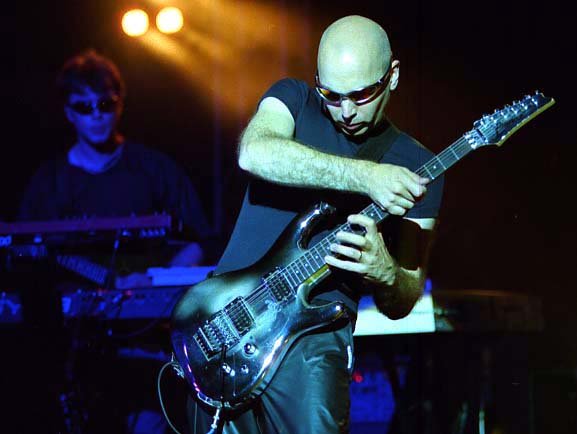
Place of Birth: Westbury, New York, USA
Zodiac Sign: Cancer
Instruments/Skills: guitar, banjo, harmonica, vocals, songwriting
Musical Genres:
Instrumental Rock
Rock and Roll
Hard Rock
Jazz Fusion
Collaborated with musicians: Steve Vai, David St. Hubbins, Nigel Tufnell, Derek Smalls, Stu Hamm, Greg Bissonette, Kirk Hammett, Mick Jagger
His musical influences: Eddie Van Halen, Jimi Hendrix, Jeff Beck
Students: Steve Vai, Kirk Hammett, Larry Lalonde, David Bryson, Charlie Hunter and many others.
Joe was born on July 15, 1956, in Westbury, New York, and grew up in the small town of Carle Place; he had 4 other children in his family. He began his introduction to music at age nine with drums, immediately taking lessons. At first, he had a rather peculiar kit consisting of a coffee can and a rubber pad. His father came up with a way to stimulate his son's learning: when Joe completed another assignment and showed that he was a responsible, growing musician, he received something else, such as a hi-hat. Thus, after about two years of study, by which time Joe could already read music and improvise, he finally got a small Ludwig kit. Soon Satriani realized that he was not as good as those he listened to; he felt as if he lacked something in his physical development for playing the drums and decided to take a break from music.
At the same time, Joe began to become fond of Hendrix and Cream, as well as Led Zeppelin. He decided firmly that if he took up music again, it would definitely be the guitar, and soon after Hendrix's death, he finally made his choice in favor of the guitar and began to practice diligently on a Hagstrom III given to him.
At Carle Place High School, where Joe studied, in addition to general classes, one had to participate in either the choir or the orchestra. There he was taught basic music theory as well as sight-singing. During this time, Joe also began studying from books and harmonic schemes that he borrowed from his friends.
Having quickly mastered the guitar, while continuing his studies, he began giving lessons himself. Steve Vai was one of his first students. However, this teaching was nothing more than a side income for maestro Satriani.
Joe continued moving in the same direction; in 11th and 12th grade, he began studying music theory. This was already advanced music theory, where he was taught how symphonies, cantatas, and string quartets are written. At that time, while studying in New York, exams were taken at the state board of regents level. Thus, they were taught very seriously and tested at the state level. His teacher Bill Wescott was a true music enthusiast.
Parallel to his studies, Joe performed at school dances and in parks for money, and by age 16 he was already playing in clubs. “When I was in 11th grade, my parents usually let me go away on weekends and play concerts in the Hamptons, a resort area of Long Island. It was like returning from another world. On Sunday evening you'd come home after living the life of a professional musician, and you had to do homework and go to school. It was simply a collision of two worlds,” Joe recalls.
Bill Wescott taught so comprehensively that when Joe left school, he felt no need to attend college. By this time, he already had extensive experience in professional work within the musical sphere. Joe's father's older brother had been a musician his whole life. Therefore, he softened the family's reaction to Joe's statement: “I'm going to finish school and become a professional musician.” Consequently, Joe met no opposition.
After school, Satriani moved to San Francisco, where he continued to refine his playing technique, working as a session musician and teacher. For about ten years, while working part-time in a music store, he constantly worked with beginning guitarists. Personalities such as Kirk Hammett (Kirk Hammett - Metallica), Larry LaLonde (Larry LaLonde - Primus), David Bryson (David Bryson - Counting Crows), and jazz-fusion master Charlie Hunter passed through his hands. In addition to teaching, Joe performed constantly with various bands, not staying in any of them for long. The longest-lasting group was The Squares, which featured drummer Jeff Campitelli, with whom Joe would later spend several decades.
In the early 80s, Satriani began thinking about a solo career. In 1984, he independently recorded and then released (at his own expense) on an independent label his debut album "Joe Satriani," however, the album did not attract public attention. The situation changed in 1986 when one of Satriani's best students, Steve Vai, came into the media spotlight thanks to successful work with David Lee Roth's band. In interviews for leading American publications, Vai repeatedly mentioned his wonderful teacher and good friend Joe Satriani. This unplanned promo campaign coincided successfully with the release of his solo debut album "Not Of This Earth," as a result of which public interest in Joe began to gradually increase, but the best was yet to come.
In 1987, after the release of the second disc "Surfing With The Alien," Satriani woke up famous; his photos graced all the guitar magazines. Mick Jagger himself invited him on a tour of Australia and Japan. Joe recalls this period as follows: “The offer to join Jagger's band came at just the right time. At that time, my second album 'Surfing With The Alien' had only just come out. Even people who really liked my discs still didn't know what I looked like. As soon as I joined Jagger's group, I started getting interviews from 'Rolling Stone,' 'CNN,' 'Wall Street Journal,' 'NY Times,' and fame came to me very quickly. And the chance to perform with a showman like Mick Jagger happens once in a lifetime.”
A year later, the album "Dreaming #11" (1988) was released, combining studio compositions and live tracks. And another year later, Satriani's third album "Flying In A Blue Dream" (1989) was released, on which Joe debuted as a vocalist. His career received a new boost after the song "One Big Rush" was used as a soundtrack for Cameron Crowe's film "Say Anything."
Around this same time, Joe began collaborating with Ibanez, resulting in the development of a signature guitar - the Ibanez JS Signature. Due to the work on the guitar, Satriani's next album "The Extremist" did not see the light of day until 1992; however, despite the long break, the album showed excellent results in the American charts.
In 1993, the double CD "Time Machine" was released. The first disc contains studio recordings and "bonus tracks from foreign albums," plus tracks from the first album "Joe Satriani" and three new recordings. The second disc includes 14 live recordings.
In 1994, Satriani received an offer to take the place of the departing Ritchie Blackmore in Deep Purple. After some hesitation, Joe agreed. The task was not easy as he had to learn a large amount of material in a short time, but Joe handled this task brilliantly; he even received an offer from Deep Purple to stay in the band as a permanent guitarist, but Joe (unsurprisingly) declined. “The feelings were mixed. Effectively, I replaced Blackmore himself. Then I thought: 'Wait a minute! Ritchie Blackmore is irreplaceable!' I saw the faces of listeners who looked at the stage with awe, but realized that I was not one of Deep Purple. There were several songs in the repertoire that no one could play better than Blackmore. Later they let me listen to 'live' recordings, and I realized that some of 'Blackmore's' parts changed radically from concert to concert. He was constantly searching for how to improve the song. And so, already being a member of the group, I took over this baton. The 'fine-tuning' mainly concerned new material we toured with. They liked my playing; I liked playing with them. The team is simply fantastic!” Joe recalls.
In 1995, Joe set about implementing a promising guitar project called G3 - it was intended that three bright and original guitarists would participate in it. Joe Satriani says: “At one point I complained to my manager that I felt isolated from the rest of the world, alone in the studio, alone at concerts... My tours and the tours of other guitarists, like Steve, never intersect. We are deprived of the opportunity to communicate and exchange information. Guitarists, as you know, love to hang out with each other, chew the fat and all that. So the idea was born... A guitar festival or something. True, there was one restriction - no more than three performers could participate in the 'festival.' Firstly, many concert halls have a regulation of no more than three hours, and secondly, three hours of 'live' music is, let's agree, still quite heavy for the listener. Out of all these ideas, 'G3' emerged. If memory serves, the name was thought up by my manager Mick. At first, the project was not in high demand. Managers and promoters were frightened by the mere idea of a guitar competition. Nevertheless, I managed to convince everyone of the expediency of 'G3,' and the reaction from fans did not take long.”
Soon the G3 festival grew from a one-time event into an annual show marathon with the mandatory participation of Joe Satriani and Steve Vai, joined each time by a new guitarist: Robert Fripp, Eric Johnson, Yngwie Malmsteen, and John Petrucci from Dream Theater, as well as other guitarists.
In 1998, another studio album by Joe Satriani, "Crystal Planet" (US Top 50), was released, after which G3 tours of the United States continued.
In 2000, Joe decided on bold experiments with electronic effects in the album "Engines of Creation." This album, like almost all its predecessors, contended for a Grammy in the best "rock instrumental performance" category for the song "Starry Night," but as before, Joe did not receive the award. In total, throughout his career, Satriani has been a Grammy nominee 13 times.
In 2001, the live album "Live in San Francisco" was released, featuring a recording of Joe Satriani's concert in San Francisco in December 2000. A year later, Joe released a new studio album "Strange Beautiful Music."
In addition to his own work, Satriani participated in albums by various performers, including: Stuart Hamm's "Radio Free Albemuth," Alice Cooper's "Hey Stoopid," and Pat Martino's "All Sides Now."
In 2004, a new studio disc "Is There Love in Space?" was released. In two compositions, Satriani performed the vocal parts himself, something he hadn't done for 15 years. Working with Joe on this album were: longtime drummer Jeff Campitelli, bassist Matt Bissonette, and keyboardist/guitarist Eric Caudieux.
In 2005, the DVD "G3 - Live In Tokyo" was released. A G3 performance in Japan, in which John Petrucсi performed along with Joe Satriani and Steve Vai.
Official website - http://www.satriani.com/2004/
Russian fan site - http://www.joe-satriani.ru/
Ведутся профилактические работы...