Turan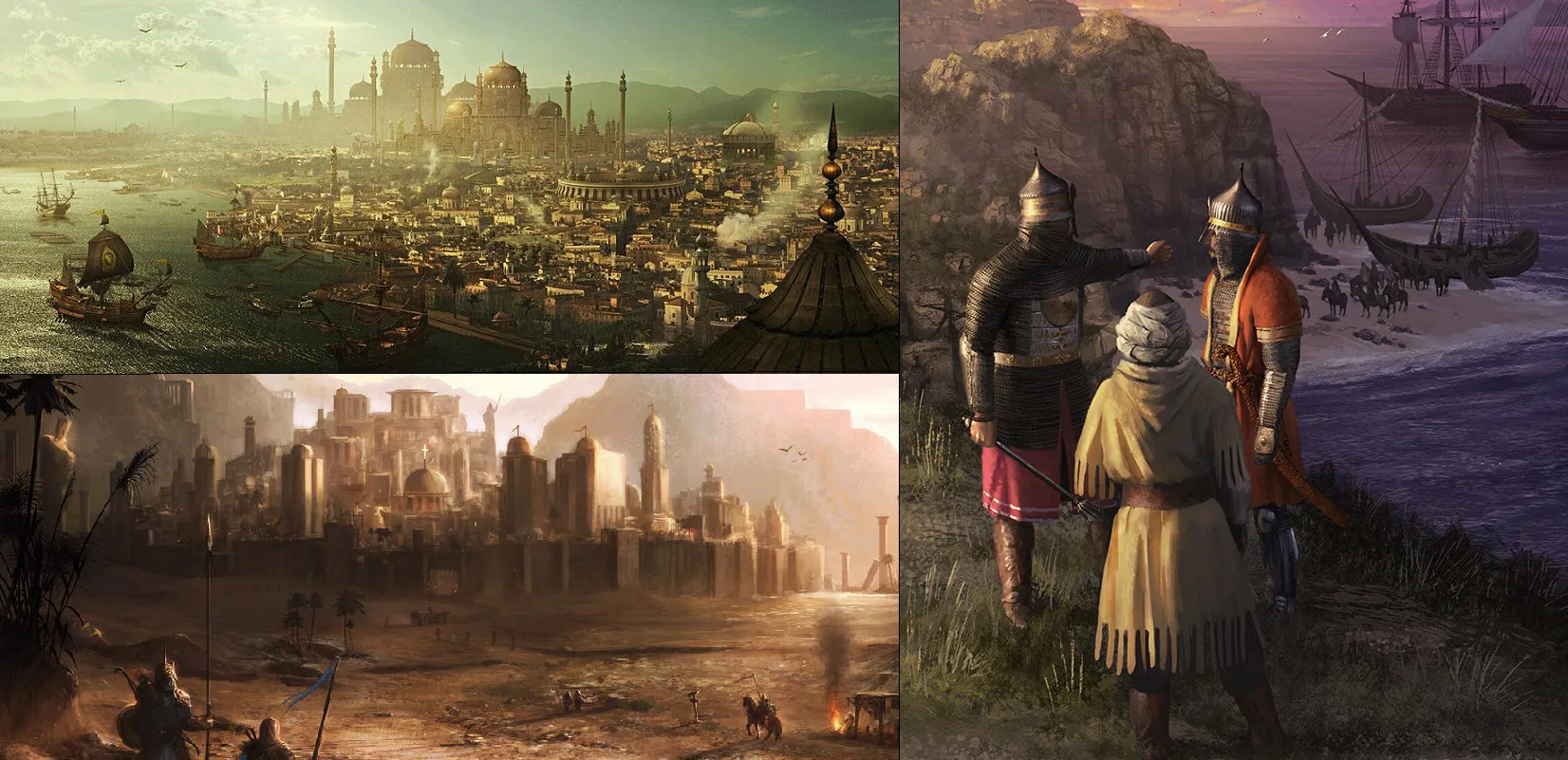
The great empire of the South, the most vast and wealthy state known, the land of glory of the celestial deities, Turan has a long and glorious history.
Turan reckons its chronology from the birth year of Shahanshah Arash I, the founder of the dynasty. The chronicles remember, albeit fragmentarily, other ancient kings of the Turanian people — those who, according to legend, taught their people to work steel and break horses, those who led the people from the foot of the Dragon Ridge into the fertile valleys by the Charag River — but it is thanks to Arash I that Turan became what it is today. According to legend, the king's very birth was marked by a solar eclipse, and he was born only physically of humans, while his spirit was conceived in union with the Sun god and the Moon goddess. Modern historians usually conclude that there was no eclipse on the day the calendar began, so either the calendar is wrong or the chronicles lied, but Arash I is still revered today as the Heir of the Sun. The chronicles say that he possessed great powers: he could revive the fallen and summon heavenly fire, and these facts are no longer disputed by anyone.
Six centuries ago, in the time of Arash I, the Turanian kingdom waged a prolonged feud with its sworn enemy, the kingdom of Yamhad. The chronicle describes the Yamhadites as "a greedy people from a stony land, a people of stone hearts, under whose yoke the West groans, and only the heaven-blessed people of Turan remained unyielding before them," and tells how Shah Arash, having sworn to avenge his father's death at the hands of the Yamhadites, defeated his enemies and took the capital of their kingdom, where he sacrificed all survivors — men, women, children, and the elderly alike — to the gods, saying, "From bad blood, a worthy man cannot be born, just as a rose cannot be grown from a weed." To those peoples who had previously been slaves of the Yamhadites, the Shah was generous, allowing them to keep their customs and their leaders, merely imposing tribute upon them and accepting oaths of loyalty from their kings. Thus, the Shah of Turan became Shahanshah, king of kings. Arash I ruled for fifty years and two more, suffered no defeats, and built a great temple to the Sun god, whose power granted his people victory. He remained in the people's memory as an example of a ruler who mastered the three essences of a righteous king: a victorious general in war, a devout priest in faith, and a wise ruler in peace.
For three hundred years, Turan knew no lasting peace; the rich lands of Turan invariably aroused the envy of its neighbors. The Shahanshahs, subjugating obedient peoples and annihilating enemies, conquered vast territories; their lands in the north stretched along the great Dragon Ridge from the wild lands of the West to the shores of the eastern seas. They created a reasonable system of governance, replacing local kings with their own appointees and relatives, allowing each satrap to rule his own lands, maintaining his own armies and establishing his own order, as long as the Shahanshah approved of his actions; they fortified the borders with fortresses and garrisons, and spread the faith in the celestial deities throughout the empire, resorting to violence only against the most terrible heretics and warlocks. Seeing the splendor of the temples and the reasonableness of the teachings, people willingly converted to the faith. Despite all this, a native Turanian always had priority in everything: all significant civilian positions were held by Turanians, only Turanians served in the guard units that formed the superior part of the army, and finally, there were no Turanians left engaged in crafts or agriculture at all.
The three virtues of a Turanian: courage — the essence of fearlessness; reason — the essence of the ability to distinguish good from evil; strength — the essence of the ability to act and prevail. Therefore, such people are more capable than others and worthy of noble deeds, of which there are two: to rule the state and to guard it. Traditional Turanian upbringing of youths always includes religion, literacy, aesthetics, and physical improvement. The first gives a person fearlessness and understanding of goodness; the second two teach one to live worthily in peace; the third teaches one to live in war and to prevail.
About two centuries ago, Shahanshah Jahanzib V began a war against the alliance of the Golden Cities on the southern coast. Each city at that time was simultaneously a state; the cities feuded among themselves but united against the threat from the North. Their rulers were not experienced in war, but they were rich, and a multitude of mercenaries flocked under their banners, from Dindar sea raiders to desert warriors from Anatan. The war lasted about fifty years in total; Turan was several times on the verge of defeat, and many times satraps and generals tried to persuade the Shahanshah to make peace, but Jahanzib V was adamant. Until then, Turan had lost only one war, not counting a series of inglorious campaigns against the desert sorcerers as a war; the Shahanshah wished to gain glory and conquer these richest cities, which held treasures comparable to those of his entire empire, but beyond the question of glory, the Shahanshah understood that Turan must expand. The state needed new lands, new slaves, and new territories to maintain the strength and order of the empire. Turan did not retreat; one by one, the free cities fell under the pressure of both force and diplomacy — the Shahanshah had to make concessions, preserving the temples of the old gods, sparing lives, property, and even some posts for the city nobility. Later, the coastal cities could never be fully brought to heel — Turan could not afford to suppress such a large rebellion.
Wicked tongues have long said that Turan has swallowed more than it can digest. A hundred years ago, the ruling people only laughed at such words; now, many Turanians themselves are more convinced of this than the empire's enemies. Mighty rivals are rising from the west and east. The Shahanshah can no longer control the bloated, swollen empire, and the satraps remember that they are part of the empire only when the capital demands new tribute from the province. Most soldiers do not know what battle is; most nobles know no other business but entertainment; and from the north, a threat greater than the power of weapons has already appeared. Turan is fragmented, and fragmented people will eagerly grasp at salvation in a single faith. Different peoples, different rulers, different laws — and all that holds the conquered lands together is the power of the rulers and the dominance of their faith. When power withers and faith weakens, the end of the great empire of the South will come.
But outwardly, all is calm. Every person has his place; any talent is in demand; and although commoners are burdened with heavy taxes, they receive order and security in return. The troops still serve, trade bustles, slaves work, and any foreigner marvels at how well everything is arranged in Turan, how rich the country is, how numerous the warriors and wise the rulers, forgetting that the people who created these orders are long dead, and the current people barely manage to maintain the achievements of their ancestors.
Sharabar
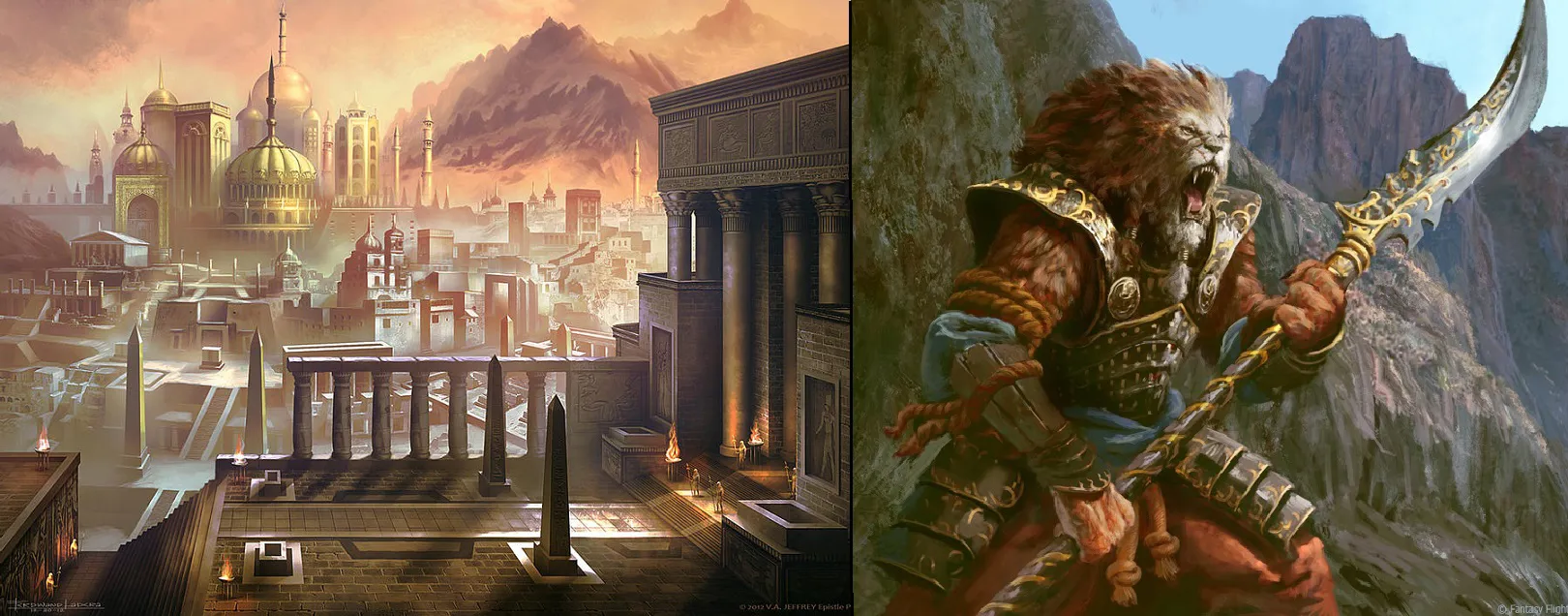
The people of the lion-men, who four hundred years ago emerged from the southern desert and swept like a fierce storm through the then Kharran Sultanate. Now the Sharabarians own the entire southeast up to the borders of Anatan. According to the legends of the Sharabarians, they trace their lineage to two ancient desert tribes, whose men once completely exterminated each other in a great battle, and the ancient desert god, who could take the form of both a lion and a man, lay with the remaining women.
The ideals of the lion-men are war, domination, and prosperity; they believe in the chosenness of their people and their superiority over the human race. Sharabarians are incredibly strong and warlike, but not too persistent and steadfast — if the enemy does not flee immediately, they themselves will flee; and in matters of peace, they are equally lacking in perseverance.
All people in Sharabar are slaves, except for guests of the country, who sometimes pass into that category, and the victors of arena fights, who emerge from slavery. Sharabar's warrior culture forbids denying anyone the right to fight.
Thanks to slaves from the former Kharran Sultanate, who preserved the memory of their people's achievements, Sharabar is a much more cultured country than one might expect from bipedal lions, who, according to rumors, sometimes eat human flesh; and the ports of Sharabar are desirable for merchants. The Sharabarians themselves almost never go to sea — one of the many weaknesses of such physically strong beings, in addition to their inability to write conventionally and problems with animal husbandry.
Lashia
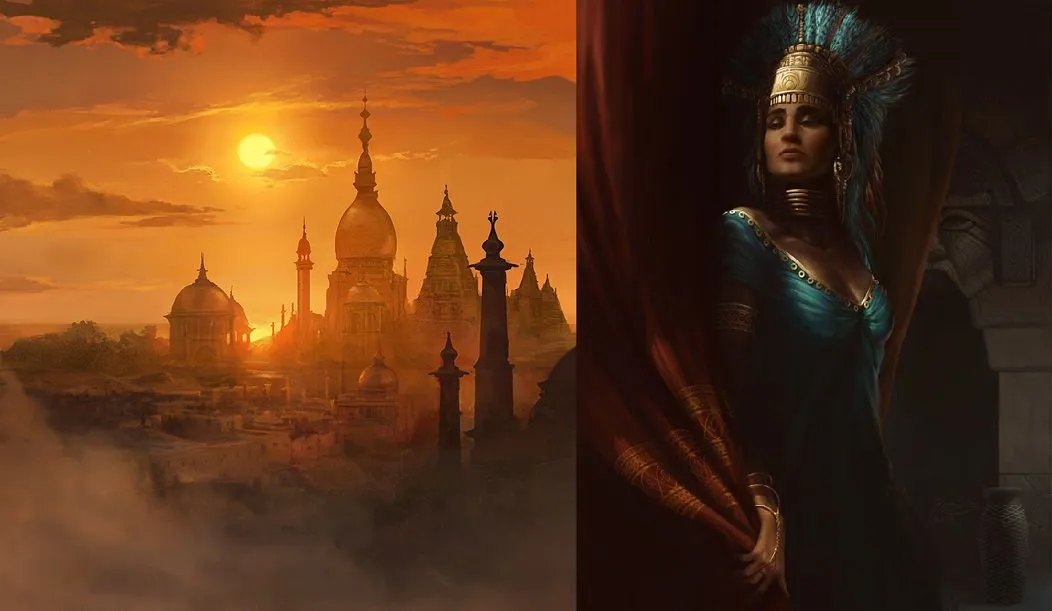
A small but prosperous kingdom southeast of Turan. The lands of Lashia are fertile, rich in valuable minerals, and serve as a transit hub for caravans traveling from Sharabar, Kharran, and Anatan to Turan.
The population of Lashia is peaceful, especially compared to its warlike neighbors. Lashians, both among themselves and in high politics, greatly prefer to settle matters with words and gold rather than by force of arms. Commerce is considered an honorable pursuit, and skilled artisans are valued.
This, however, was not always the case. At the time of the beginning of Turan's conquests, the Lashian people were exhausted by internecine wars. Ruler succeeded ruler like month follows month; the throne of the wealthy kingdom attracted many nobles, and the strife continued until there was no male left in the dynasty at all. The last descendant, a six-month-old infant, was strangled by a rival of the then-regent. When a queen ascended the throne, her first decree was the execution of all her relatives down to the last generation.
Since then, the Lashian throne has passed through the female line, and the custom is also unusual: the king rules for exactly one day — the day of the wedding — is honored with great respect, and on the morning after the wedding night, he is put to death, just as any male child is also killed. If a girl is born, the queen may not marry again. One can feel however one likes about such a system, as well as about the prospect of becoming king for exactly a day, but the country has known no wars of succession since then.
Anatan
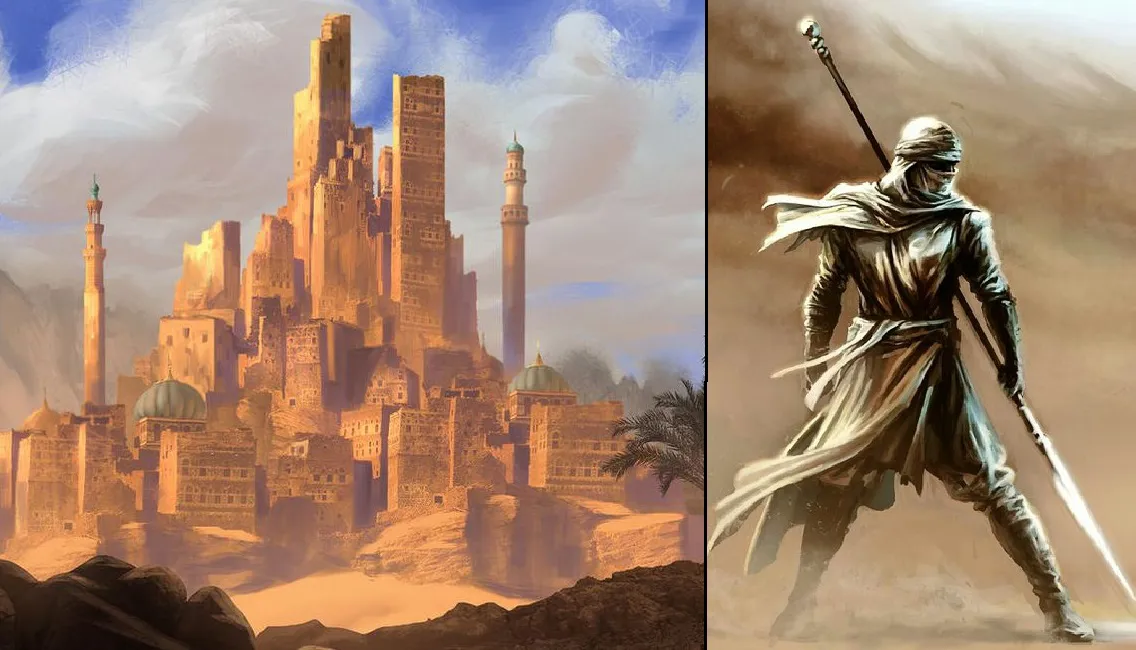
Every Anatanese is, above all, a warrior. Learning the martial craft from their fathers and brothers from earliest childhood, most young men go into their first battle at fifteen or sixteen years old. Later, an Anatanese may settle down, take up a craft or trade, but one who has never been in battle cannot be considered a man among them, has no right to marry, and cannot own land or livestock.
There is no king in Anatan; their leaders — priests and generals — gather together to make important decisions. The majority of the population leads a semi-nomadic lifestyle, equally engaged in agriculture and livestock breeding, and takes up arms when the leaders call. In their few cities live artisans who know no money and exchange their goods with passing caravans. Their craft is subordinated to practical needs; among them, one will not find a jeweler or a glassblower.
Today, Anatan is the shield of the human states of the South, while in the past, it was their scourge, threatening the borders of Lashia and Turan. It was the warriors of Anatan who stopped the expansion of Sharabar to the north, just as they had stopped Kharran many centuries ago, and just as a century ago they, together with the Lashians, defeated the armies of Turan.
Anatanese are not vindictive, and generally not too attached to anything: land, family, or property. Life is seen as a path with many hardships that must simply be overcome with honor, and then one moves on. Many become mercenaries, but their willfulness and peculiar ideas about honor and hierarchy make them problematic, though extraordinarily effective, warriors.
Kharran
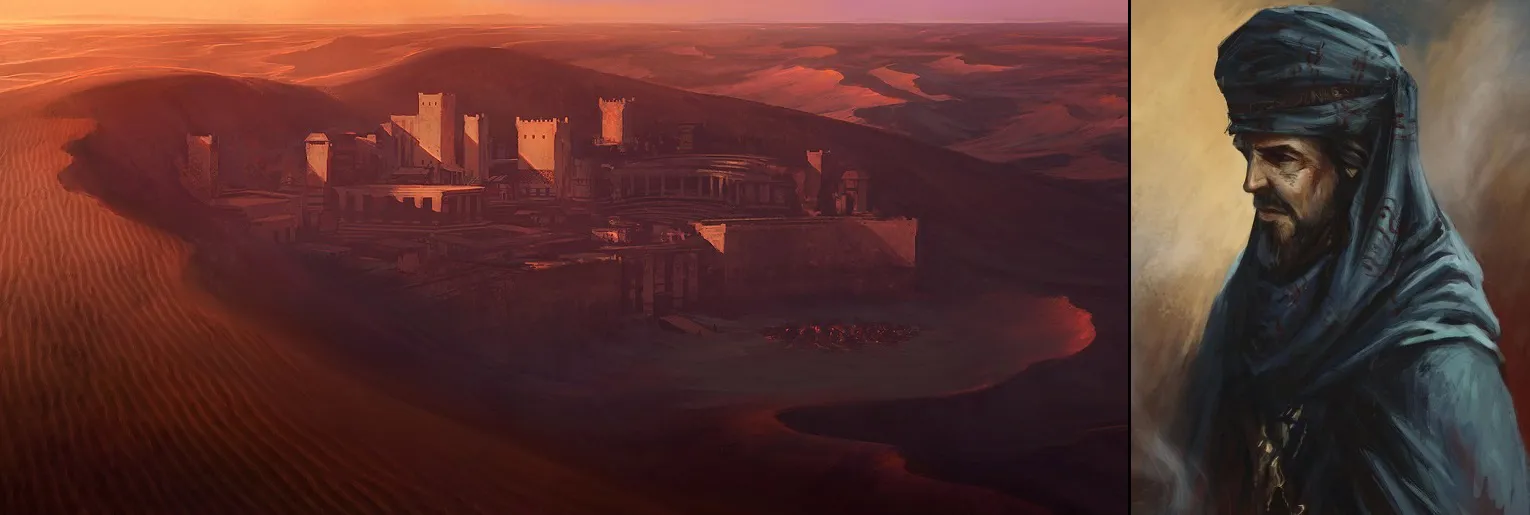
The Kharran Sultanate was once a great empire of the South. Several centuries ago, a horde of warlike tribes from the Red Deserts of the east fell upon the fertile lands on the shores of the southern seas and conquered them. The triumph of the Kharranites was brief but brilliant. They mastered many sciences, especially arithmetic and geometry; they alone were able to compile an accurate calendar, and their achievements in architecture can still be seen firsthand in the Golden Cities of Turan.
The Kharranites worshipped the celestial gods and believed that they showed them the way through heavenly signs. They believed this when the stars guided them through the Red Desert, and continued to believe, watching the sky from the high towers of their cities. In their homeland, the desert, lies hidden the sanctuary of the Oracle, where priests attempt to decipher the stellar signs.
The Kharranites lost the war against the lion-men; by that time they had lost their former martial skills and were forced to retreat back into the deserts. The priests said it was ordained. The generals said it was the price of softness and the forgotten roots of a warrior people.
When the Sultan died, his surviving sons divided the power among themselves, vowing to do everything to restore former glory. The tribes again scattered across the desert, and the present-day Kharranites are warriors and nomads, living by raids on Sharabar and Lashia. They appear, like a sandstorm, from nowhere and return to nowhere, to their cities hidden by the sands. Kharranites are excellent horsemen; their techniques of mobile warfare are akin to those of Anatan.
Sometimes caravans from the west enter the desert. Kharranites barter their loot for cloth, wood, and steel. Kharranites have preserved their skills as craftsmen, and their products are valued in the west.
To the east of the Red Desert lie the lands of demons, from which no man has ever returned.
Rontrad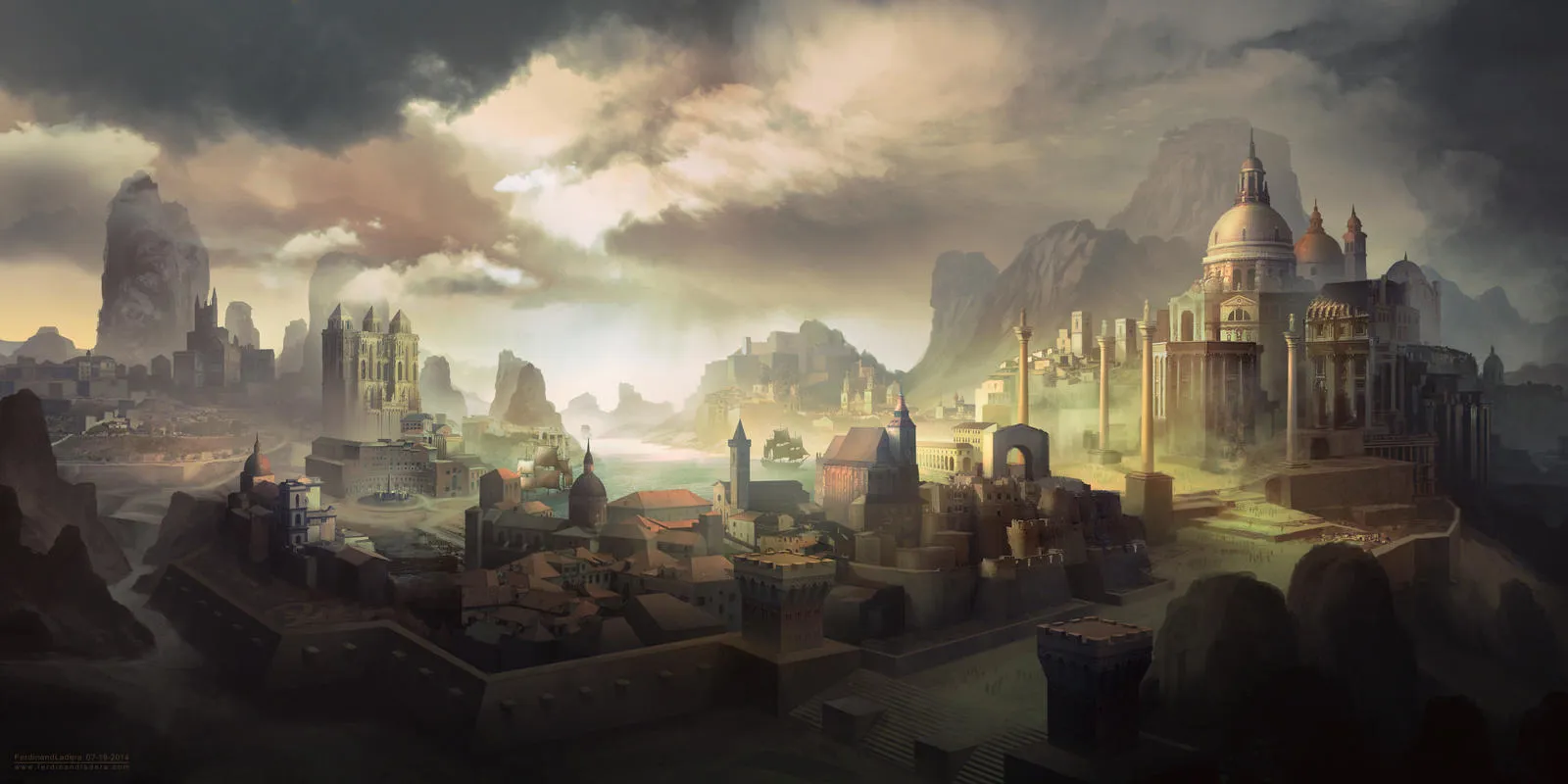
About half a millennium ago, the great Luson Empire existed in the southwest. Once, the Lusonites, a wealthy people from the seashores, conquered their weaker neighbors. Some of them they left in the position of vassals; the rest were less fortunate — anyone not of Lusonite origin was considered a slave and usually led a most miserable existence, although some were luckier — in exchange for labor in the fields and mines, they became domestic slaves or were absorbed into the armies.
Finally, the Lusonites became entrenched in their superiority. The people grew soft; the obedience of slaves began to be taken as an immutable given, which, combined with the greedy, cruel nature of most masters, led to a great uprising: cooks poisoned their owners, oarsmen drowned captains, soldiers overthrew commanders and opened army depots to anyone ready to rise against the tyrants. Finally, the vassals seceded. But it was the former slave-soldiers who led the rebellion, and from among them came a new leader — Oriss, a slave from Turan. Though not a Turanian by blood, Oriss, in his free youth, had absorbed the ideals of faith in the celestial gods; his personal conviction and charisma made his comrades equally firm in the new faith; and above all of the Four in those days, when rivers flowed with blood and the centuries-old empire was turning to ruins, Shakorot was honored. His cult, the cult of the Lords of the East, became the cult of slaves in Luson when they demonstrated in whose hands true power lay, what exactly makes a master a master, and what the Lusonites themselves had long lost.
When the uprising ended, Oriss founded a new kingdom on the ruins, naming it Rontrad. What happened to Luson defined its two principles: power is strength, and those who lose their power face a sad fate. The goals of the new state were simple: to deprive all others of power and to establish its own rule forever.
According to Oriss's laws, the entire people of his kingdom were now divided into warriors and slaves. The former concerned themselves only with war; from the most respected among them were chosen priests, military and civil officials, and anyone who, in the general opinion, did not suit his rank could be stripped of it. The latter labored, could not enter a temple, could not own weapons, and were subjected to the harshest punishment at the slightest disobedience. Thus, Rontrad created a mighty army, which included all the rebels, while the surviving Lusonites were turned into slaves. In subsequent years, Rontrad conquered all the other fragments of Luson and its former vassals, enslaved many peoples, but the power of the warriors remains strong to this day — the most perfect army in the world, where what is valued is not reckless bravery, personal glory, or expensive weapons, but discipline, steadfastness, and the duty of each to all, is not only strong in conquest but also always ready to suppress any rebellion.
Megiddo
The only state in the southeast that withstood both Turan and Rontrad, but not thanks to wealth or the valor of its warriors. Turan, having crushed Megiddo's eastern neighbors, no longer had enough strength to advance further, and the then-ruler, known for his cautious and unassuming nature, negotiated with the Shahanshah to grant Megiddo the status of a protectorate. When Rontrad rose in the west, it did not risk incurring Turan's wrath.
Now Megiddo's position is not so secure. The protector of the kingdom is weakening; the aggressive western neighbor is at the peak of its power; and nomads threaten from the north. Today's Megiddoan looks at life quite fatalistically — whatever will be will be, I can't change anything anyway.
The lands of Megiddo are infertile, but the state does not languish in poverty — its ports are full of merchants, and one can find goods from all the states of the South, from Ormond to Sharabar.Karassites
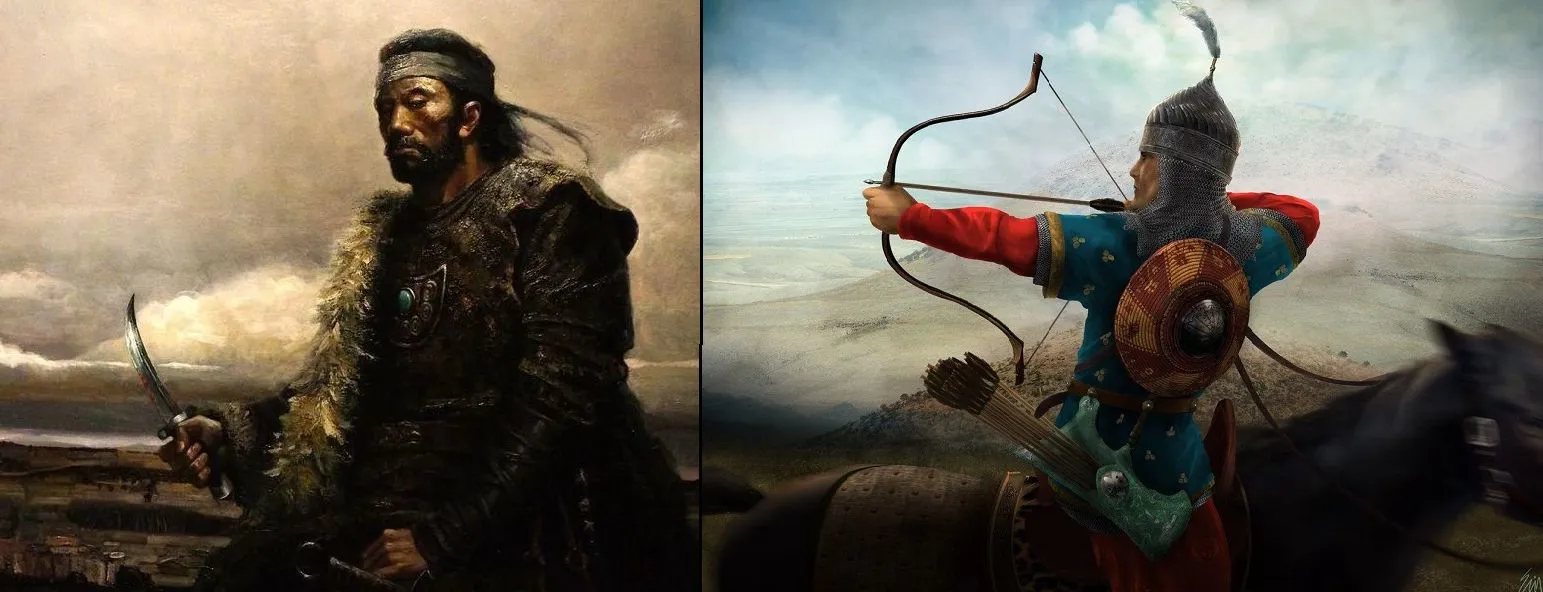
A nomadic people, herders, hunters, and agile warriors inhabiting the vast steppes between Turan and the barbarian lands; the Karassites themselves exist on the edge of civilization and barbarism. There is no harmony between the tribes — some tribes, for Turan's money, defend the empire from the predatory raids of their own fellow tribesmen from other tribes.
The Karassites are proud of their freedom and warlike nature, although in reality, they are very dependent on settled peoples and serve as pawns in the political games of Turan, Rontrad, and Megiddo. Many enter the service of the shahs and form units of the regular army; others abandon their clans and, from herders who are sometimes not averse to banditry, become professional bandits, or conversely, caravan guards.
The Dindar
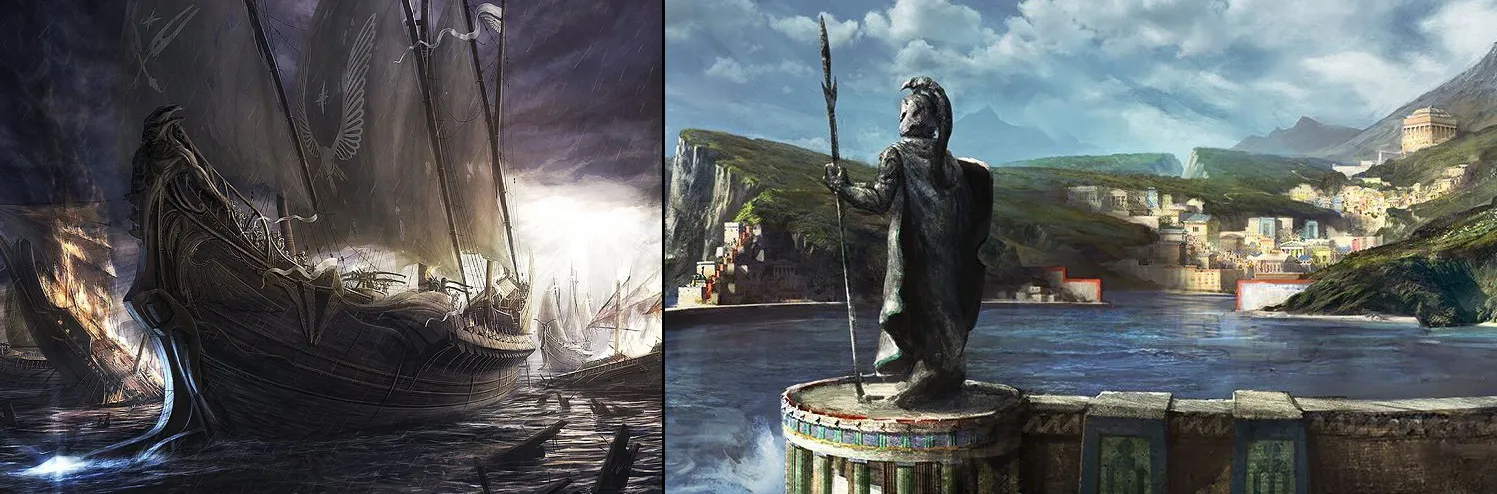
An archipelago south of the mainland is inhabited by the Dindar — a confederation of tribes, known on the continent as traders and pirates, but in reality, easily transitioning from one activity to another and willingly combining them even in a single voyage. They rob each other, repeatedly breaking previous agreements and then concluding them again, as well as Turanian, Egerian, and Lashian ships. Before Turan's rule in the Golden Cities of the southern coast, the Dindar did not disdain raiding the coast itself, and even sailed up the rivers into the interior of the mainland on their light, shallow-draft vessels.
On the islands themselves, most live in fortress-cities, usually located on the coast. Sometimes cities wage wars against each other on land, but they are short-lived and not too bloody — usually the matter is limited to one battle and the devastation of surrounding villages. Among themselves, they have no kings, only a city aristocracy of slave owners, authoritative military leaders, and the wealthiest merchants, who form a kind of city council and rule jointly. Anyone engaged in farming is considered a slave among them and belongs to one of the aristocrats, but can buy themselves out. Free citizens are usually occupied with crafts and are free to join a ship's crew, hiring on for a single voyage or a whole year. The islanders have an enterprising nature and are prone to rebellion — more than once, captains who wished to deceive their crew and shortchange the sailors ended up as shark bait.
Ormond
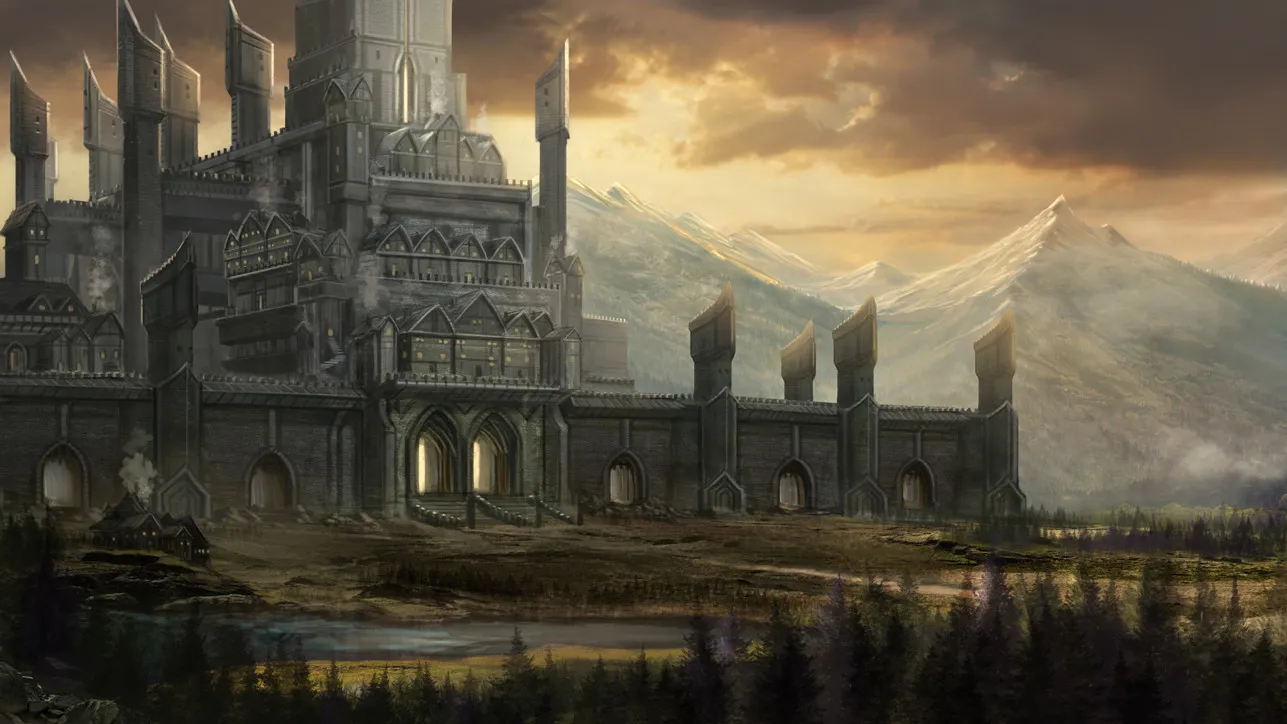
Four hundred years ago, strange people arrived on numerous ships at a peninsula separated from the barbarian lands by a narrow isthmus — the westernmost point of the continent. Coming out to meet the newcomers, the barbarian chieftains saw that they were almost no different from them, except they were very pale and some had eyes of a strange color. They were outnumbered by the barbarians, and most of them had no weapons, and the chieftains did not ponder long over what to do with these people. But as soon as the first barbarian raised his spear, one of the newcomers muttered something in a language the barbarians did not understand, and a bolt of lightning incinerated the warrior. Another newcomer waved his hand, and a huge wave knocked over the host of natives. A third snapped his fingers, and the earth split open and swallowed the chieftains. Thus did the barbarians understand on whose side the power lay, and what fate awaited those who did not submit to the newcomers.
The conquest of the peninsula took only a few months. An impregnable wall was erected on the narrow isthmus against the savages, and, having neutralized all external threats, the Orms, as the people of the newcomers called themselves, became mired for three centuries in an internecine war for the redistribution of their new possessions.
The entire population of present-day, unified Ormond is divided into two parts: Orms and Barbarians. The former are the rulers, administrators, mages, scholars, and the backbone of the kingdom's military strength. The latter are slaves, whose functions depend on the will of their masters. Today a barbarian bends his back in the field; tomorrow he goes as cannon fodder to war with the western neighbor. Although Ormond is formally a kingdom, represented by the head of a family from one of the ancient dynasties, the king's power is greatly limited by a council of nobles.
Some Orms, particularly talented and low-born ones, seek a better lot in the East. In Turan, they founded an academy of magic, and although they violate the first of their laws, which forbids them from passing on their knowledge of magic to other peoples, Turan protects its allies from Ormond's vengeance.
Bardilar
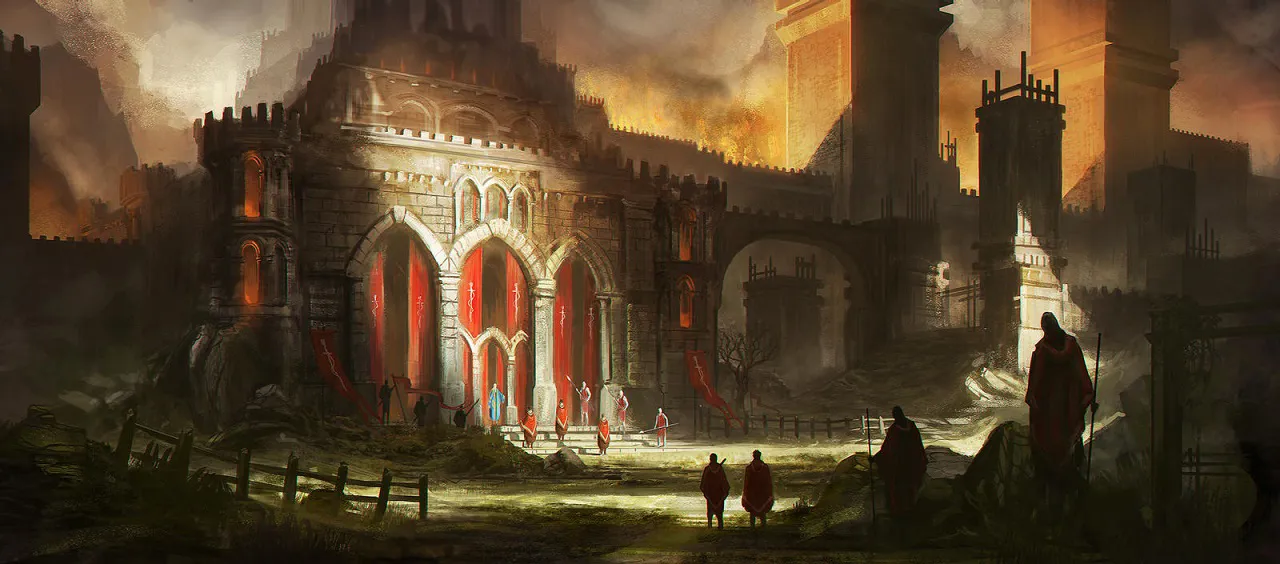
The teaching of the elements, as taught in the Academy, states: there are three elements: air, water, and earth, just as matter can be gas, liquid, or solid, and just as all that exists consists of solid matter in which water is present to some degree and cavities are filled with air. By understanding and using these parts of existence, man subjects the elements to his will. Any attempt to question the triad of elements will meet with unanimous condemnation from the Orms, and the freethinker will be excommunicated from the study of magic.
The dogmas are so strict, and the punishments so severe, because the teaching of the three elements is a lie. The Orms lied to the barbarians and continue to lie to their students in Turan, fearing that knowledge of the fourth, forbidden element of fire will inevitably lead to attempts to use it. They themselves confirmed their fears.
Bardil, the future founder of the school of fire, thirsted for power. When the Orms were mired in war, he was an obscure minor aristocrat with no chance of competing with the ancient dynasties, but his determination was great, and he found a path to power through the forbidden art. Having mastered it himself, he also taught his people the magic of fire, but few of the Orms dared to overcome their fear of the forbidden. Then Bardil broke another law of his people and began teaching the barbarians. In the west of the peninsula, he founded a kingdom where a man's worth was not determined by whether he was an Orm or a barbarian, but by how useful and loyal he was to his ruler. When Ormond finally united, the heretics of Bardilar had already built a kingdom not inferior in power to its rival. The war between them continues to this day.
Since then, fire magic has been officially banned in Ormond, and its study is prohibited. Those who practice it are killed on the spot. Practitioners flee east, to both the Northern and Southern kingdoms, where they pass on their teachings. Alas, most of them lack access to the true art of the fire element, which King Bardil wields. Their magic comes not from the power of the mind, but from faith in the primordial fire, as in a god. This fanaticism they instill in their students as well.The Asayama Shogunate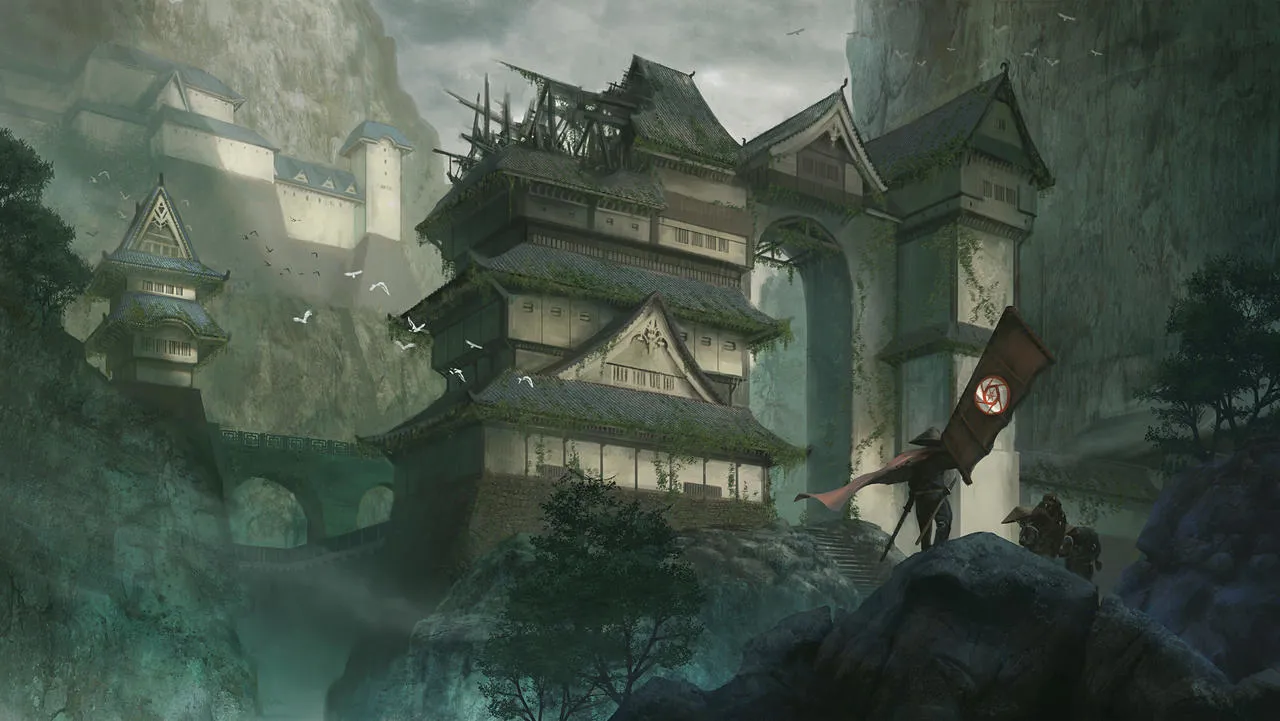
The history of the Asayama Shogunate began with a tribal alliance formed in the south of the island of Yashima, the largest island of the western archipelago, hundreds of kilometers away from the continent. Among the fourteen tribes, there were four powerful military clans — Murata, Araki, Saeki, and Okura — and those from these clans were revered in the alliance of southern tribes as warriors, while all others were considered peasants and subordinate to the former. The southern tribal alliance declared war on the northern tribes, and over the course of two centuries, united them, establishing the Murata Shogunate on the island.
Continuous warfare over two centuries created a unique system. One born a peasant remains a peasant forever and must blindly obey the warriors, for such is the order. One born a warrior must be loyal to the noble clan, for such is the order. Every member of the clan must obey the head, for such is the order. All obey the first clan, the clan of the Shogun, the supreme military commander. Such is the order, and without order, the northerners cannot be defeated. Order must be in etiquette, in the army, in military training.
But then the external enemy disappeared, and during the war, some clans weakened while others rose, and by old habit, the samurai again took up arms. Although the Shogun's right to outlaw any person — a right the shoguns willingly used to restrain a rebellious or overly powerful military clan — held the daimyo in check, war was their only craft, and it was impossible to completely restrain them from warring against each other. Some clans moved from Yashima to the smaller islands of the archipelago, where the Shogun had no power; between the rest, bloody wars flare up from time to time.
Over three centuries passed; the country experienced a series of peasant revolts; through court intrigues, the Murata dynasty fell and was replaced by the Araki shoguns, only to fall to the spears and swords of the rebellious Asayama clan. Again, the peasants toil in the rice fields; again, the samurai practice martial arts and dream of a new war and redistribution of lands; again, intrigues are woven at court. On the isolated islands in the middle of the ocean, nothing has changed for hundreds of years.
The Islands
When in the Shogunate, long periods of calm are only occasionally replaced by brief, albeit extraordinarily bloody, wars, and every daimyo looks over his shoulder at the Shogun whenever he decides to stir up trouble against a neighbor, the daimyo of the small islands spend their time in continuous warfare, often thinking not about what profit they might gain from it, but about how to glorify themselves and their clan. Peacetime is considered undesirable, a time of weakening of the samurai spirit and the triumph of the peasants; a time when true honor and strength are replaced by court etiquette and the false sublimity of rituals and exercises. The island daimyo are proud of their independence and consider happiness not in the size of their fiefs or the fullness of their granaries, but in the opportunity to always act worthily of a warrior and a noble man. The samurai of the islands are usually laconic, stern, and calmly regard breaches of etiquette and other conventions.
The fate of the peasants on the islands is both simpler and more complex at the same time. Constant war ruins them; agriculture on the small islands is harder than on Yashima, but they are not forbidden to keep weapons, the appetites of the lords are more modest, and the sea serves them as a support alongside the land. A peasant has little to lose — most of the harvest has already been taken by his lord — and when a conscripted peasant of the Shogunate dreams only of returning to his plot, the peasant of the islands, in his contempt for danger, sometimes equals a samurai — why be afraid if it cannot get any worse? Sometimes, a distinguished peasant is indeed promoted to samurai — on the land of Yashima, this has not happened once in many centuries.
Origin Bonuses:
Ardor: +4 to Will, +4 to Endurance. All rolls against negative effects are doubled.
Order of Paladins: free Paladin specialization
Divef: all melee attack rolls +25% (final multiplier), free Riding skill, free Knight skill
Order of the Guiding Star: +4 to Will, +2 to Strength, free Knight skill and "Fortitude" ability
Order of the Dragon: restriction -- Black Dragon. +6 to Strength and Agility
Fenderin: damage spread is halved (lower bound is higher), good quality starting equipment. +1 to Strength, +1 to Endurance, +2 to Agility, +2 to Intelligence, access to Champion skill
Rocheri: in the first round of combat, the character gains an additional turn in initiative order; critical and stealth attacks deal 50% more damage (final multiplier)
Yaragat: +2 to Strength, +2 to Endurance. +10 Health per point of Strength, free Knight skill
Eger: Strength requirements for weapons and armor are abolished; weapon tree abilities cost 1 SP less.
Bradan Or: +25 to Stealth and Perception checks. +4 to Agility, +4 to Perception, +10% SCU, free Scout or Archery specialization
Arkhaimar: +2 to Strength, +2 to Will. All incoming damage (final) is reduced by (Will*2)%, limit 50%. Final damage from water and cold is halved, free Warrior of the North skill.
Tritalar: +4 to Strength, +4 to Endurance, +8 to Agility, +8 to Perception, +8 to Will, +8 to Intelligence, -5 SP, inability to use steel weapons and armor, incoming damage from steel is doubled. Access to Greatsword skill.
Turan: +1 SP, +5 SP
Aristocrat: character can read and write, starting capital is increased by 25 times. -5 SP. Access to "Rasmfazar" skill. Slave (10 HP, 12 SP, 1 SS) at start.
Guardsman: free skill and first rank of One-Handed Weapon, Archery, or Riding (choose one), +20% final damage when taking a specialization in any weapon. Access to "Rasmfazar" skill
Academy of Mages: access to Water, Earth, and Air magic. +0.5 to MS per point of Intelligence.
Sharabar: +8 to Strength, +8 to Endurance, chance (Strength) to paralyze the enemy for 1 turn with each attack. -2 to Will, -2 to Intelligence, inability to use ranged weapons, no religion bonuses. Free Desert Lion specialization
Lashia: Evasion, accuracy, and damage parameters are increased by 50% if the character or group is not the aggressor
Kharran: free skill and first rank of Riding, +2 to all characteristics, access to Desert Warrior specialization
Anatan: +3 to Endurance, +3 to Agility, +3 to Speed, free Desert Warrior specialization
Rontrad: +25 melee accuracy, +2 to Strength, +2 to Endurance, +2 to Agility, free Legionary specialization
Megiddo: the character survives one fatal wound per game. Works against instant death effects, but not against "Cleave," "Decapitation," etc.
The Dindar: +4 to Agility, +2 to Perception, item sale price +50% (final multiplier), +5 SP
Karassites: free skill and first rank of Riding, ability to use bows while mounted, +15% to ranged attack evasion
Bardilar: access to all elemental magic. +35% to magical strength.
Ormond : access to Water, Earth, and Air magic. -2 to Strength and Endurance, +5 to Will and Intelligence.
Yashima, Shogunate: +2 to accuracy and evasion, +1 to initiative per point of Will, free Samurai skill
The Islands: +35% to damage, accuracy, and evasion if the character or group is the aggressor, free Samurai skill



 Граф Орлов