


 Граф Орлов

Auto-translated
I'll finish writing how Quintus Grelli's life further developed and how murderously his son Decimus partied on his student days on Thursday-Friday, because otherwise the 24-hour shift will kill me
"Aaaah!" — howled the elderly Aesbulus Grelli and jumped up in bed, clutching the sides with his bony, strong fingers. His sunken eyes on his withered face made him look like a corpse, and in the dim candlelight he was terrifying.
It was hard to believe that this small, wiry old man was capable of such long and powerful howls. Truly, his last strength had left him with that cry, and he fell back onto the pillow again, trembling and whimpering from the pain that tormented him. His three sons — Hilas, Nicanor, and Antisius — stood shifting their feet by the sick man's bed.
"Oh, my sons… I'm dying."
"Hold on, father. The doctor will be here soon," Hilas said uncertainly.
"Doctor, kha… Call a priest, a priest, you fool!" the old man howled again. The brothers exchanged glances.
"He's delirious."
"Mercy, father! Where would a priest come from, in Axoth?"
"Get one! Call the sons-in-law…"
The doctor arrived half an hour later, accompanied by Nanna, Aesbulus's daughter, and her husband Belmont. The doctor was a reliable man. Besides his knowledge of medicine, this somewhat fat, unprepossessing man had only one virtue, but one that old Grelli valued highly. He didn't ask unnecessary questions. Always imperturbable, he helped anyone willing to pay, and to the questions that law enforcers sometimes liked to ask him, he would smile and modestly say, "Doctor-patient confidentiality."
With his usual calm, he strode into Aesbulus's room, chased out the brothers, and got to work. Half an hour later he came out and reported:
"I did what I could. Drained the pus, sewed up the stomach. Lord Grelli doesn't have long left. His entire intestines are corroded."
As if in proof, he presented a bucket in which sloshed about two liters of bloody pus mixed with what had once been Aesbulus Grelli's innards. Nanna, covering her mouth, rushed outside, and the doctor continued:
"The master wished to remain conscious. I gave him a triple dose of painkiller. He is asking for you. That'll be five hundred sen."
Hastily thrusting the money at the doctor, the four men rushed into the room. The old man was sitting, leaning against the wall, looking at them calmly and authoritatively. The agony he had been in for the past days had subsided, and he was once again the same powerful head of the Axoth branch of the Giriza, Aesbulus Grelli, as his sons and subordinates knew him. A man who had tripled the wealth left by his father, stolen more than a hundred laborers could earn in a lifetime, raised three sons and two daughters, Aesbulus loved life so much that he did not fear death.
"Now, Hilas, you will be the head," he took a gold ring from his hand and passed it to his eldest son. "My great-grandfather already led the Giriza! Never once did he soil his hands with work, taking everything for himself from those unworthy of wealth, just like my grandfather, my father, and I myself. Do not disgrace your ancestors, Hilas! The Grellis are strong in their mind, their pride, and their strong family—that is where our strength lies! The people here are rotten, corrupted in soul and body, they know no kinship and honor no fathers—that is why they are weak. Hold firmly to each other—then you will overcome everything. Do not give in to debauchery, keep measure in all things—in women, wine, and greed. You younger ones, listen to your elder. You, Belmont, look after my Nanna. With such sons, I can die in peace. I only regret I won't see my grandchildren… Remember my words, my sons…"
Old Grelli gave them his parting advice for a long time. He passed away in the morning, in his sleep, peacefully. The funeral was modest, among family and friends.
Four years had passed since the death of Aesbulus Grelli, and Hilas and Nicanor were already standing by another grave. A couple of meters beneath their boots, the boldest of the worm kind were already gnawing at their younger brother's coffin. They had retrieved his body from a filthy, disgusting tavern, where, amidst the squeals of local whores and the loud cursing of the owner, Antisius Grelli had ended his life in a drunken brawl. The cold wind tossed fallen leaves from side to side and made the men in their light cloaks shiver, but both were glad that the storm's fury masked their awkward silence.
"Well… We didn't keep an eye on him," Nicanor finally said.
"Father would be furious."
"At us or at him?"
Silence again. Shivering, Hilas said, addressing no one in particular:
"He set me up. They'll think badly of me."
"Thinking badly of the dead…"
"And did the dead man ever think of us once? He was in debt for twenty thousand. We'll have to gut the communal fund because of this scoundrel. And Belmont, that wolf in sheep's clothing, dreams night and day of supplanting me. The speeches he makes when he thinks I can't hear!"
"Maybe we should… you know? He is a relative, sure… But not really kin."
"Don't even think it!" – Hilas grabbed his brother by the shoulder, his gaze turning steely. – "How many have you already destroyed, Nicanor?"
"It's easier to steal from the dead," his brother grinned.
"Remember what father said? Unbridled murder will lead to no good. I know you have side jobs too. Quit that business, brother. I'm not afraid to get my hands bloody either, but you're going too far. Even our own people are looking at you askance."
"I won't break from their looks, I reckon."
Nicanor turned away from his brother and fixed his gaze on the city. Thousands of people were bustling there, each occupied with something they considered extraordinarily important. They were disgusting, and yet—useful. The heavy spirit of money thoroughly permeated this anthill. Take as much as you want! Take money, take women, take someone else's freedom, take someone else's life—everything, everything for you! Life is as simple as it is vile. If they all had a single throat, he would slit it. Nicanor respected his brother, respected his family, and respected the ideas that Aesbulus had hammered into him with fist and word. He had married early; his bride, like Hilas's, was chosen by his father. An exemplary family man, a loyal subordinate, he was not as outright dissolute as Antisius, but vicious greed had already put forth its first, still imperceptible, shoots in him. Perhaps, in these vague, heavy thoughts, born of Hilas's words, a conscience could have awakened in him, but he didn't know such a word.
"If anything happens to me, take care of my wife and children." Having said this, Hilas walked away.
"Now there's a true Grelli."
Nicanor suddenly felt warmth towards his brother. His own wife was also due to give birth soon. He looked again at the fresh grave of Antisius Grelli, topped with a simple stone headstone, completely faded in comparison to the bronze slab marking the resting place of his glorious father nearby.
"Everyone is rewarded according to their deeds. Someday our children will bury Hilas and me, and—what words will they speak over our graves?.."
The birth of a long-awaited heir brought no peace to the house of Nicanor Grelli; on the contrary, the head of the family became more irritable and impulsive with each passing day, and at times seemed not even to account for his own actions. Family life weighed on him. He was irritated by the constant crying of the child, who, in his words, "howled as if being gutted alive"—oh, the Grellis knew well how a man whose intestines have spilled out screams, and he definitely did not want to wake up to such sounds every night. He was irritated by his wife; the once attractive, buxom woman had imperceptibly turned into an eternally dissatisfied, whiny, and utterly unattractive crone. She blamed him for his bad temper and heavy hand making her that way, and he got even angrier at her words, striking her not with his palm anymore, but with a whip that by then was considered shameful to use even on slaves. After beating his wife yet again, heated and angry, he would head to a brothel. He strictly avoided drunkenness, mindful of Antisius's death and afraid of losing his strength and agility, so important in his line of work. Instead, he discovered a passion for a narcotic powder. Sometimes he would use it even before going on a job, and when his brother caught him, he swore it was "only for sharpening my eyesight." Hilas beat him then, ordered him tied up, and kept him in the den under guard for a week. It was humiliating, and although Nicanor acknowledged his brother was right, he continued using the drug.
Falling lower every day, he came to a predictable end—he got caught. It was a contract from a wealthy merchant on his brother, who shared the family business with him. It seemed simple—Nicanor arrived at the merchant's house with a flagon of good wine, introduced himself to the slave butler as his master's business partner, and when the merchant, sleepy and disheveled despite the late hour, came out to him in the living room, he beat the frail little merchant to death with the heavy bottle. About three years ago, he would probably have come up with something more refined than smashing the victim's skull with the thick bottom of a bottle, but now he didn't want to complicate things. The sound of cracking bone on the first blow, the vulgar squelch of brains on the second—it almost excited him, but many times over, Nicanor would hear those sounds in his nightmares.
He left the house through the window—and ended up in the unfriendly embrace of the city guard. His client, grinning with small, sugar-rotted teeth from behind the shoulders of the law enforcers, feigned extreme agitation and pointed pathetically towards his brother's house, exclaiming about his worries for his fate.
Hilas did everything to get his brother out. A witness and the judge were bribed; in court, it was argued that the merchant himself attacked the guest, offended by a sharp word; some unknown whore was found who stubbornly insisted that the deceased had a terribly violent temper and raised his hands at the slightest provocation; the prosecutor, trembling with fear upon realizing who he had gotten involved with, failed to appear in the courtroom, locking himself in his mansion with a dozen guards. The result — exceeding the limits of self-defense and four years in prison.
The enormous costs of the legal campaign destroyed Hilas Grelli's reputation, and the loss of his most reliable and at the same time most fearsome companion made him very vulnerable. Not even two years had passed since the ill-fated trial when he was found dead in his bed. His wife and children had vanished without a trace. Belmont was almost unanimously elected the new leader.
Nicanor emerged from captivity healthier, looking younger. Thick black beard, broad shoulders, his former strength and smoothness in his movements, the sparkle back in his eyes—yes, his friends had ensured his imprisonment was as comfortable as possible. Finding no one at his home, he carelessly thought his family had gone on business or moved, and went to his accomplices.
They welcomed him warmly, even gladly, but answered his questions listlessly and reluctantly, with painful awkwardness. Upon hearing about his brother, his brother-in-law, and that his wife, after the death of Hilas who had kept watch over her, had sold their children and become the kept woman of an old trader, Nicanor withdrew from everyone and was silent for a long time. Holding his head in his hands and staring at the floor, he replayed in his mind all the events that had led him to this point. You can't bring back the dead. But the living—they are in his power.
He left, and no one heard from him for two weeks. In the third week, members of the Giriza read the news about the murder of an elderly merchant and his concubine in Lovirg. Both found with their throats cut, all valuables stolen. The murderer was being sought throughout the city. They exchanged knowing glances.
A week later, he appeared on the doorstep of his sister's house. Nanna's joyful cry and outstretched arms for an embrace were met with a knife thrust to the stomach.
"How could you share a bed with the one who killed your brother, sister?" he asked quietly, but received only an incoherent groan in response. After finishing off the woman, Nicanor stayed to wait for the master of the house.
Belmont was an experienced thief, and his sense of danger was as unerring as his instinct for weakness. The silence immediately alerted him, and he reached for the hilt of his sword, but Nicanor was faster. Rushing at his opponent from behind, he threw him to the floor, twisting his arms, not letting him draw the blade. Grelli was larger, faster, and more experienced than Belmont, and the silent struggle did not last long. Soon he was sitting astride his enemy, pouring narcotic powder onto his face. The powder poured in an endless stream; the pouch contained a dose enough for several dozen people. Involuntarily swallowing and inhaling the drug, Belmont choked. Foam came from his mouth, his throat burned from the caustic substance, he helplessly flailed his unresponsive arms trying to reach his opponent. Consciousness quickly left him, but the agony did not end as quickly as he might have wished.
Nicanor gathered the excess powder and threw the pouch onto the table. Placing a knife in the dead man's hand, he let out a loud, heavy sigh. These murders did not evoke in him the joyful excitement, the feeling of total impunity he had enjoyed in his youth, but neither did he feel a hint of sadness or guilt.
"I guess that's what a good assassin should be like. You do what you have to do, and nothing more. Took me long enough to figure that out."
The next day, it was decided to give leadership to Bran, the husband of Adelicia, Aesbulus Grelli's youngest daughter. Bran is a very unremarkable man. This skinny man always behaves modestly, with a perpetually polite half-smile on his face, but his intelligent, clear eyes betray a cunning nature. He is rich—richer than everyone else in this cell—but lives in a poorly furnished one-story house. Bran loves money itself, not what can be bought with it, and that is why it comes to him.
What inclined the others towards this man—his wealth, his sober mind, the still-living respect for Aesbulus's family among them, alive despite Antisius's stupid death, Hilas's insane expenditures and his own willfulness and aggression—Nicanor did not know and did not want to know. His escapade from the previous day was met with understanding, many even with respect, but now he couldn't even dream of being first. It would be a long time before they stopped looking at him warily; it would be a long time before the name Grelli would evoke respect rather than fear.
Soon Nicanor remarried; his bride was Miranda, daughter of Jhalgar. An old acquaintance of the Grelli family, Jhalgar had joined the organization in the same year Aesbulus Grelli had taken leadership and, being a talented man, rose quickly. Addressing Nicanor only as "Lord Grelli," he approached him with his idea just a day after Belmont's murder:
"You see, the thing is, Lord Grelli… I have a daughter, nineteen years old already, and still unwed. So, Lord Grelli, I just can't seem to find her a husband. And you, so conveniently, are without a wife… oh, I mean, inconveniently. Well, you understand what I'm getting at, right?"
Familial pride suggested that, as the last bearer of the family name, Grelli needed an heir, and in this city of sluts, arranging a suitable marriage was not easy. He didn't particularly like his potential father-in-law: although he was wealthy and not stupid, Nicanor had always considered him unreliable and insignificant, but still, he was one of their own, and such an opportunity might not present itself again. Pondering this, Grelli said:
"I suppose you won't skimp on your daughter's dowry."
"Oh, of course, Lord Grelli! Come to dinner today, I'll introduce her to you…"
Nicanor found Miranda to be a thrifty, well-bred, and even quite pretty girl, and so within a month the marriage was arranged. The newlyweds rented a substantial house, and Nicanor instructed his wife as follows:
"I hear you're educated; that's good, but you won't work. No woman in my family has ever worked. I don't keep slaves because I can't stand strangers in my house. The household is your responsibility."
"Very well."
"Sometimes I'll have to leave unexpectedly and for long periods. Where and why is none of your business."
"Understood."
"I will not tolerate disobedience. Did your father tell you how my previous wife ended up?"
"No."
"Perhaps it's better you don't know. A woman's happiness is in ignorance," Nicanor softened slightly. "Alright, relax. There's one more main duty…"
He slapped her on the backside and led her to the bedroom.
After a year of marriage, Nicanor realized he could tell his wife absolutely everything—she was as silent as the grave. She herself almost never spoke to him, and it was hard to tell what thoughts were hiding in her. Every time Nicanor looked into his wife's dark eyes, he wondered: what does she feel for him? Fear? Respect? Indifference? She was impenetrable. Sometimes this woman scared him. Occasionally, she would wake up at night and pace the house with a candle in her hand, and during the day she would sit motionless in an armchair for hours, staring out the window, which could only show the unchanging courtyard with a blank red brick wall and a single lonely ash tree growing in the middle. The only thing Miranda asked of him, and the only thing she seemed to care about, was books. At her request, Nicanor brought a small library into the house.
"She reads and reads… Does she have her own thoughts, or only those from books?" he would sometimes think condescendingly, but in truth he was glad to have such a cultured, educated wife.
Two years after the wedding, Miranda bore him a son. The boy was named Quintus.
By the age of six, the boy's father's features were already unmistakably apparent. Thick black hair, low-set eyebrows, a broad jaw—he seemed a miniature copy of his father.
"Yes, the Grelli blood is strong," Nicanor thought with satisfaction, but something about his son troubled him. Calm, quiet, too quiet for his age, the boy seemed to have absorbed the silence of the gloomy halls of this house, where his silent mother and stern father lived apart. He learned to read early from his mother and spent much time among the books, picking up one then another, as if searching for something, though he himself didn't know what. He felt he was a burden to his mother, and spent most of the day wandering from room to room. He didn't like going out into the yard: the neighbor children were bigger and older than him, and Quintus was often beaten by them or fell victim to some prank.
"I need to take the boy in hand. His mother won't teach him anything good."
From that moment, the father began seriously preparing Quintus for his inevitable future. Noticing that his son didn't socialize with other children, Nicanor began taking him along to the Giriza. The boy sat next to him, listened to the criminals' conversations, and understood: they were afraid of his father. They behaved obsequiously with Quintus himself, calling him young Mr. Grelli to his face, and whispering behind his back: will he take after his father? his grandfather? will he blab anything? has old man Grelli lost his mind? Returning home, his father would ask him: what did he hear? What did he think of this or that person? Father would chuckle at Quintus's answers, then become serious and patiently explain how wicked and deceitful people were, that these were far from the worst of them, what money was, how it was obtained, and how one could get it for oneself. Earlier, Nicanor often told his son stories about clever and lucky heroes who tricked and robbed "bad" people; as Quintus grew older, these fairy tales turned into stories about the actual deeds of Hilas, Aesbulus, and other long-gone Grellis. Quintus gained an understanding of death early: his father took him on walks to the graves of relatives.
"Father, will I also die? Will you also die? And mother?.."
"Yes, everyone dies. Such is life, that everything passes. You know… what matters is how you die. How you live. Look," Nicanor led his son to the grave of Aesbulus Grelli. "Here lies your grandfather. He did not fear death because he lived a glorious life. You, my son, live by honor, by pride. The Grellis are renowned for their pride."
Quintus did not fully understand his father's words, but he was beginning to grasp that he and his father were better, higher than other people. Nicanor, day after day, continued to instill in his son the ideas his own father had bequeathed to him. When Quintus was twelve, he directly explained to him what his trade was and said that he would teach him everything too. Quintus was delighted. Finally, he would learn how to earn money! He would show all those fat, stupid rich people. Finally, he would be perceived as an equal, no, he would be feared, like his father.
His son's enthusiasm pleased Nicanor, even though he had to repeat again and again how important a cold and sound mind was in such matters. At least his fears that his son would grow up slow and indifferent were not confirmed. Sometimes the teenager was overly silent, sometimes he liked to immerse himself in reading, but Nicanor chalked this up to a lack of communication with peers.
Over these years, Miranda had two more children, both dying in infancy. Her last childbirth undermined her fragile health, and she died when Quintus was thirteen. This did not shake him too much; for the last seven years he had been raised solely by his father, and perceived his mother as a dark, distant figure from a distant past. Her death passed as unnoticed as her life, only new wrinkles appeared on Nicanor's forehead when, for the first time in many years, he lay down in an empty bed.
Quintus went on his first real job before he had even turned sixteen. His father pointed out his target: a wealthy house on the outskirts.
"Listen carefully. The master won't be home. The servants sleep in the annex. The guard is old and lazy, easy to fool. Two floors, the study and bedroom are on the second. The attic is not locked. Don't let me down."
"I'll do it, father."
"Be careful."
Slapping his son on the shoulder, the elder Grelli disappeared into the night. Quintus nervously licked his lips. Everything was simple in words, but imagining himself breaking into someone else's house, rummaging there like a fussy badger digging the earth for worms, and stuffing his pockets, the teenager hesitated. There was something unreal about it. And what a night! Stifling, moonless, it had laid an unbreakable seal of silence over the outskirts of Axoth. Having frightened the timid townsfolk, it favored Quintus. His father had told him that weak souls fear the night because they fear silence. During the day they bustle under the rays of the sun, recklessly generous, dissolving in the bustle of life, but when left in silence and darkness, they involuntarily look inside, see their own rotten essence and are frightened by it. And, aware of their weakness, they fear what might come from the darkness. Sometimes—not without reason.
Getting upstairs wasn't hard. Picking the locks was a bit harder. Calming his breathing and trembling hands was not easy at all, but he managed. Quintus was ready to leave, but his father's voice, coming from the first floor, changed his plans.
"Quintus, come down."
His breath caught with excitement, but putting on a show of resolve, he descended into the hall. The light was on; his father stood in the center of the spacious room, holding a knife to the throat of the old watchman. The old man was wheezing, his eyes rolling wildly, and he was pitiful compared to his formidable father. The armor and sword looked absurd alongside his freckles, bald head, and wispy beard.
"Kill him, Quintus," his father pushed the old man towards the teenager. Disapproving of the idea, apparently, the old man snarled like a beast and rushed at the elder Grelli with his sword. His broad, predictable swings had no chance of hitting Nicanor. Parrying the first two blows, Grelli struck the old man in the jaw with his fist, knocking him flat on his back. Three yellow teeth fell onto the expensive carpet, staining it with blood.
"You can't handle me, old man. Why would a house mutt snarl at an old wolf when even a wolf cub is too much for its teeth? Its teeth, heh."
Still snarling, the old man got up and lunged at Quintus. The raised sword, bulging, faded eyes, bloody spittle spraying from his mouth—from Nicanor's point of view he was ridiculous, but Quintus didn't find it funny. He closed his eyes, frightened, but his trained body made up for the momentary weakness of his mind. Ducking, he stepped towards the old man, thrusting his right hand with a dagger upward, and when he opened his eyes, he saw his enemy lying motionless with a hole in his throat. A bright scarlet liquid pulsed from it in a small fountain, and Quintus liked it.
"Well done," his father approached him. "Many would condemn me for this idea, but I decided you needed to feel it. The first time—it's the hardest. It gets easier from here. The first time is always hard. It's even unclear which is harder to kill, an attacker or a defenseless person. Some still carry such nonsense in their heads… that they don't have the right to take a life. Your mother read all sorts of things, in those books they described it this way and that. But I say—man is a wolf to man, and let them all be no worse than us in their main human essence, but each of them is ready to cut his neighbor's throat, only their nerve fails them. Such a person passes off his faintheartedness as kindness. And those who write books dream of a world of obedient cattle instead of people, while they themselves will fleece and beat those cattle. So they preach—don't you dare kill, don't you dare steal, while they themselves are the most despicable thieves… Alright, time to go. I think today you've earned a little celebration. I'll show you a rather decent place."
The decent place was a brothel, and it was indeed the best brothel in this city of brothels. The madam came out to greet them with an obsequious bow.
"An honor to receive you, Lord Grelli, a rare guest, but always welcome! Such a charming young man—your son, I presume? Oh, naturally, your exact copy! Well, then, whom do the gentlemen desire?"
She chattered incessantly, which was unpleasant for Quintus and embarrassed him. His father, with a lordly air, replied commandingly:
"Bring them all."
A minute later, about two dozen representatives of the world's oldest profession stood before Quintus, and having absolutely no experience with the opposite sex, he was somewhat daunted, but his father's encouraging presence and the still-buzzing thrill from the deeds already accomplished that night did their work. He straightened up, ran his gaze over the orc-women with a contemptuous smirk learned from the elder Grelli, squinted as if in disbelief surveying the slender, airy figures of the elves, and finally, settling his choice on a young girl of about seventeen or eighteen, said hoarsely:
"Her."
"Mmm, an excellent choice, young master! You – this way," the madam pointed to one of the many identical doors. "Would you like some wine or anything else?"
Quintus glanced at his father. He had always forbidden him to drink and often spoke of the destructiveness and depravity of loving spirits, but now, in response to his silent question, he merely inclined his head slightly—do as you see fit, from this day on I no longer decide everything for you.
"Yes… a little… wouldn't be bad."
"We'll take care of it! And what about you, my lord?"
"I am in mourning for my wife," Nicanor cut off decisively. In truth, the period of mourning would have been more than sufficient, but Grelli, nearing fifty, was already impotent and did not wish to reveal this to his son. Turning sharply, he left and headed to a tavern.
Since his wife died, Nicanor had begun frequently touching the bottle. Often he would sit in the tavern until late at night, returning home barely able to keep his balance. Collapsing onto the bed in his clothes, on such days he would fall asleep instantly and sleep without dreams. Usually, though, his sleep was restless. He would wake up in the middle of the night from vague nightmares, wander for a long time, and when he lay down again, it would all repeat. He grew very gaunt and went grey rapidly; his once stately figure became bent and shriveled.
Nicanor died when his son was just beginning his own career; three years had passed since the day he proudly presented him before everyone, introducing him as a full-fledged member of the organization and recounting his successful debut. For four days the elder Grelli did not leave his bed, and at the end of his agony, seemed to have gone completely mad:
"They're coming! They're coming for me! Help, Quintus! Help your father!" he cried out in a frenzy. There was genuine fear in his eyes. Clutching his son's sleeve, he muttered:
"They're coming… They want to take me with them… I won't give in! I don't owe them anything! Let go, you devils!!!"
Quintus did not leave his father's side day or night, disturbing all the doctors in the city, but Nicanor would not let anyone near him. Quintus, completely exhausted by the vigil, became more and more frightened by his father's words, which he did not understand then, and one day, breaking free from his parent's grip, he ran out of the room in panic, slamming the door shut. He fell asleep right there on the threshold, and when he woke up, Nicanor Grelli was already dead.
After burying his father, Quintus took to drinking. The rumors about his nightly escapades were most unflattering. In the Giriza, they whispered that he had threatened the mayor's relatives with a knife, incited robbery in drunken conversations, and killed the women he slept with by morning. Soon these stories grew fantastical details, like him devouring the hearts of his victims or buying slaves to assemble an army of terrorists. Some said his father was a demon, and his son would have half a dozen such demons inside him; others said his mother was a witch and her evil soul had entered first her husband, then her son; still others said he was just a dissolute and despairing boy since his parent's death who would soon end up on the gallows. That is most likely what would have happened, had Bran himself not intervened in his nephew's life. Catching him, as usual, dead drunk, Bran's men sent Quintus to pay homage to his uncle. A day of severe hangover, a week of educational conversations, and a month of house arrest—such was Quintus Grelli's path to a new life. Neat, clean-shaven, and sober, this young man of twenty now confidently made his way to the Grelli clan cemetery, not recognizing his recent drinking buddies and unrecognized by them. Climbing onto the grave mound, Quintus lightly patted his father's black headstone:
"Rest in peace, Nicanor Grelli."
Over the past year, the cemetery had taken on a neglected appearance. Adelicia, his aunt, rarely visited the graves of her brothers and father, and Bran avoided it altogether, saying that memories of the dead made him contemplate the inevitability of his own demise. Quintus tidied up here. The weather was fine: overcast, but warm and dry; the last year's leaves remaining after the snowmelt flew briskly under the measured sweeps of the broom, and Quintus, vaguely recalling the nightmares of the past year, was in a philosophical mood. The feeling of guilt that had initially oppressed him was receding, and looking at the graves, he thought defiantly:
"Am I so much worse than them?"
Quintus reproached himself for such thoughts regarding his honorable ancestors, but conversations with his aunt gave grounds for them. He knew for sure about the dark spots on the reputation of his father and uncles and suspected that his other ancestors also had some not-so-glorious moments in their history.
Grelli surveyed the results of his labor and found them quite satisfactory. He walked outside the city for a long time, enjoying the fine day, while in the Giriza they were already all abuzz that the young Grelli was back in business.
Comrade Quint appeared with the most unruffled demeanor, decisively sat down in the place his father had previously occupied, indignantly rejected all questions about his wild adventures, and threw himself into his affairs with such zeal and was so successful at first that for several months the others did nothing at all but carouse with the money he had obtained. Over time, his ardor cooled and luck began to falter, but his position was already secure. Quint bought back his father's old house; Bran and Adelisia arranged for him to marry Rianna, the daughter of Corett, a highly respected swindler and former pirate in Giriza. Life settled down, but Quint's soul was not at peace.
His wife bore Quint Grelli six children. His first son was stillborn; after a year's interval, daughters Nikia and Astoria were born; a couple of years later — the long-awaited heir, named Decimus; and another three years later — the twins Eveta and Evlia. Thus, Quint Grelli met his thirtieth year as the proud father of four daughters, for whom he would curse fate, and a son whom he adored. His house turned into a terrible madhouse, and Quint nostalgically remembered the solemn silence that had reigned there under his father. Grelli again took to drink, escaping the household bustle in taverns. He would return home in a foul mood, where he beat his wife, whom he believed had a bad influence on the children.
Rianna was a woman of independent spirit, and although she verbally obeyed unquestioningly, acknowledging her husband's supremacy and knowing his harsh temper, she never missed an opportunity to do things her own way. Quint would curse and beat her; once, when she decided to put money into circulation on the stock exchange without his knowledge and failed, he sold all her jewelry. Rianna would listen, eyes downcast, repent, and six months later would start being willful again, and everything would repeat.
"Tsk, truly — a pirate's daughter!"
And yet, she respected her husband and feared his wrath, and when it came to "the business," Quint could rely on her.
Quint tried to instill in his son the principles his father had bequeathed to him, although he was in no hurry to initiate him into the business. Every time he stepped onto the streets of Axoth, observing the cheap whores and their degraded clients, users of intoxicating substances giggling meaninglessly in dirty alleyways, the dull and sleepy faces of the guard, Quint shuddered with disgust and yet understood that he was just as much a part of this city as any of them. Easy money, quick pleasures, the feeling of impunity fueled by the blood of those he killed had corrupted him. Quint had long since stopped counting those he had killed; he knew the number had long since passed a hundred and many of his accomplices feared him, just as they had feared his father. He remembered Nicanor, Gilas, Esbul, and saw that each successive Grelli was more bloodthirsty and savage than the predecessor, and at the same time more depraved, enjoying less respect, and he did not want Decimus to fall into this pattern. He himself gave the children their primary education, and when his eldest daughters grew up, he sent them to the academy. Perhaps he would have sent his son there as well, but things turned out differently.
Quint was sitting in the library when his wife entered and declared seriously:
"Nikia is pregnant."
"What?! Are you sure?"
"I carried six children; would I be mistaken?"
"How far along?"
"About a month."
"I'll deal with her now."
Bursting into his daughter's room, Quint grabbed her by the hair and, striking her with the whip left by his father, demanded:
"Who?! Who is he, this scoundrel?!"
She screamed, struggled, begged for mercy; the rest of the family rushed at her cries, but Quint was relentless. He extracted a confession in less than five minutes: the father was her classmate Digor, a rootless louse, the son of a dockworker and a whore, who remained at the academy solely due to his natural talents in magic. Quint wiped the sweat from his brow.
"What a disgrace. Stand still," he lifted his daughter by the hair, looking into her wide-open, tear-wet eyes. Her body went limp; she could barely stand. Taking a good swing, Quint punched her in the stomach. Again. Again. A bloody clot landed on the floor with a squelch.
"Let this be a lesson to you!" he scolded his younger daughters. "And you — clean that up."
After this incident, Quint firmly decided that his son would not study in this hotbed of vice, and sent him to study in Deathmore. Digor mysteriously disappeared.
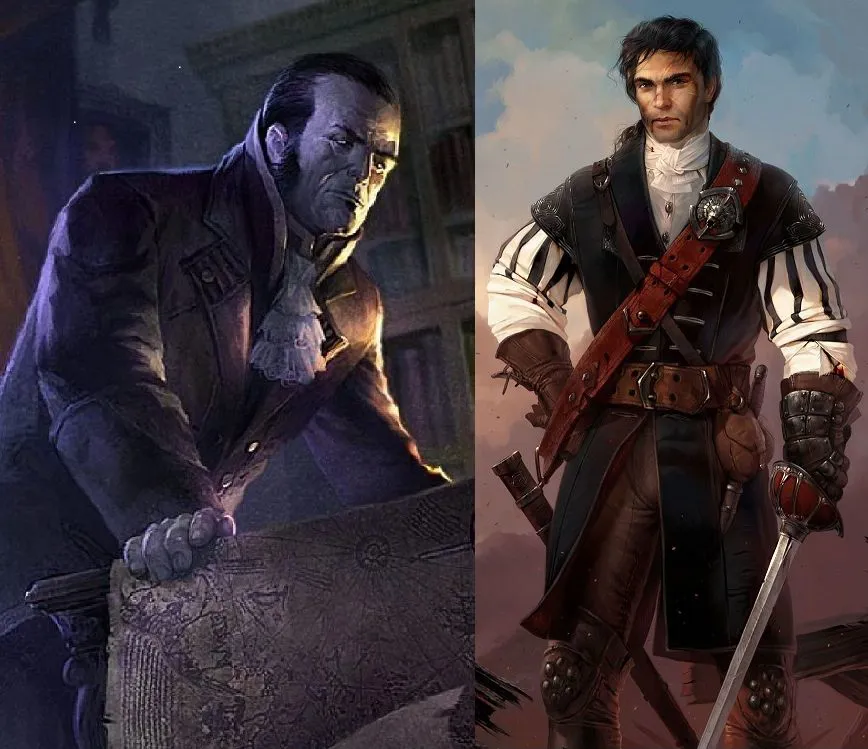
Quint Grelli
Attributes:
Strength - 10
Agility - 40
Perception - 35
Endurance - 20
Intelligence - 30
Willpower - 5
Skills:

One-Handed Weapon
Accuracy: +0.7 to accuracy for each point of agility
Thief: +5 to agility; character gains the ability to steal (agility vs. perception)
Lockpick: +5 to intelligence and agility; character gains the ability to pick locks (agility + intelligence)
Killer: attacking an unsuspecting character who fails a check (agility vs. perception) kills them

Giriza
4 to cunning for each point of agility
+1 to stealth for each point of intelligence
During non-aggressive actions, stealth is doubled
Membership in Giriza, access to the local cell's lair, Thief and Lockpick skills
✧ Scout ✧ The character automatically scoutes the area, learns about hidden places of the location, can detect traps, ambushes, hidden items
✧ Influential Friends ✧ When caught, the character gains a chance to avoid punishment for a committed crime

Assassin
Killer ability
Attacks from behind deal 5x damage
Ability to deal critical damage
The character can play dead
+1 to stealth for each point of intelligence
+0.5 to perception for each point of intelligence
Agility is doubled (or racial agility bonus)
✧ Hidden Strike ✧ The Assassin attacks an enemy outside of combat or during dialogue; a target that fails a check (dodge vs. precision) dies, otherwise receives 5x damage (x2)
✧ Poison Expert ✧ The Assassin gains the ability to craft poisons, antidotes, identify poisons used on allies, coat weapons with poison; +25% to health
Inventory: sword-cane, dagger, boot knife, yumi bow, arrows, poisons, money, various small items stored in abundance at home and in the lair.
Decimus Grelli
Attributes:
Strength - 10
Agility - 40
Perception - 40
Endurance - 15
Intelligence - 30
Willpower - 5

Firearm
Pierces enemy armor
Ability to deal critical damage
+0.5 to accuracy for each point of perception when using firearms
✧ Sniper ✧ A shot at an unsuspecting enemy kills it, and in the case of abilities protecting against stealth attacks, deals damage equal to 50% of maximum health and stuns (x2)
Giriza
4 to cunning for each point of agility
+1 to stealth for each point of intelligence
During non-aggressive actions, stealth is doubled
Membership in Giriza, access to the local cell's lair, Thief and Lockpick skills
✧ Sleep Powder ✧ The character uses a powder that puts an enemy to sleep (powder power vs. enemy endurance); can be used at a distance of no more than 10 cells, lasts for 3 turns in combat (cooldown: 2 turns)
Assassin
Killer ability
Attacks from behind deal 5x damage
Ability to deal critical damage
The character can play dead
+1 to stealth for each point of intelligence
+0.5 to perception for each point of intelligence
Agility is doubled (or racial agility bonus)
✧ Stealth ✧ The Assassin gains the ability to vanish from sight during combat; stealth lasts for 5 turns; area attacks break stealth; performing aggressive actions reveals the assassin
✧ Trap Expert ✧ The character can set traps that deal damage equal to their intelligence * 3 and inflict negative effects on the enemy; setting a trap in combat takes one turn; enemies do not see where the trap is set unless they have the appropriate abilities; the character can detect traps (cooldown: 1 turn)
Inventory: smallsword, dagger, musket, powder
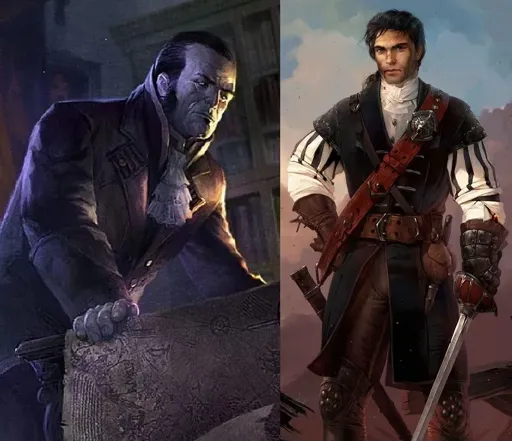
"Aaaah!" — howled the elderly Aesbulus Grelli and jumped up in bed, clutching the sides with his bony, strong fingers. His sunken eyes on his withered face made him look like a corpse, and in the dim candlelight he was terrifying.
It was hard to believe that this small, wiry old man was capable of such long and powerful howls. Truly, his last strength had left him with that cry, and he fell back onto the pillow again, trembling and whimpering from the pain that tormented him. His three sons — Hilas, Nicanor, and Antisius — stood shifting their feet by the sick man's bed.
"Oh, my sons… I'm dying."
"Hold on, father. The doctor will be here soon," Hilas said uncertainly.
"Doctor, kha… Call a priest, a priest, you fool!" the old man howled again. The brothers exchanged glances.
"He's delirious."
"Mercy, father! Where would a priest come from, in Axoth?"
"Get one! Call the sons-in-law…"
The doctor arrived half an hour later, accompanied by Nanna, Aesbulus's daughter, and her husband Belmont. The doctor was a reliable man. Besides his knowledge of medicine, this somewhat fat, unprepossessing man had only one virtue, but one that old Grelli valued highly. He didn't ask unnecessary questions. Always imperturbable, he helped anyone willing to pay, and to the questions that law enforcers sometimes liked to ask him, he would smile and modestly say, "Doctor-patient confidentiality."
With his usual calm, he strode into Aesbulus's room, chased out the brothers, and got to work. Half an hour later he came out and reported:
"I did what I could. Drained the pus, sewed up the stomach. Lord Grelli doesn't have long left. His entire intestines are corroded."
As if in proof, he presented a bucket in which sloshed about two liters of bloody pus mixed with what had once been Aesbulus Grelli's innards. Nanna, covering her mouth, rushed outside, and the doctor continued:
"The master wished to remain conscious. I gave him a triple dose of painkiller. He is asking for you. That'll be five hundred sen."
Hastily thrusting the money at the doctor, the four men rushed into the room. The old man was sitting, leaning against the wall, looking at them calmly and authoritatively. The agony he had been in for the past days had subsided, and he was once again the same powerful head of the Axoth branch of the Giriza, Aesbulus Grelli, as his sons and subordinates knew him. A man who had tripled the wealth left by his father, stolen more than a hundred laborers could earn in a lifetime, raised three sons and two daughters, Aesbulus loved life so much that he did not fear death.
"Now, Hilas, you will be the head," he took a gold ring from his hand and passed it to his eldest son. "My great-grandfather already led the Giriza! Never once did he soil his hands with work, taking everything for himself from those unworthy of wealth, just like my grandfather, my father, and I myself. Do not disgrace your ancestors, Hilas! The Grellis are strong in their mind, their pride, and their strong family—that is where our strength lies! The people here are rotten, corrupted in soul and body, they know no kinship and honor no fathers—that is why they are weak. Hold firmly to each other—then you will overcome everything. Do not give in to debauchery, keep measure in all things—in women, wine, and greed. You younger ones, listen to your elder. You, Belmont, look after my Nanna. With such sons, I can die in peace. I only regret I won't see my grandchildren… Remember my words, my sons…"
Old Grelli gave them his parting advice for a long time. He passed away in the morning, in his sleep, peacefully. The funeral was modest, among family and friends.
Four years had passed since the death of Aesbulus Grelli, and Hilas and Nicanor were already standing by another grave. A couple of meters beneath their boots, the boldest of the worm kind were already gnawing at their younger brother's coffin. They had retrieved his body from a filthy, disgusting tavern, where, amidst the squeals of local whores and the loud cursing of the owner, Antisius Grelli had ended his life in a drunken brawl. The cold wind tossed fallen leaves from side to side and made the men in their light cloaks shiver, but both were glad that the storm's fury masked their awkward silence.
"Well… We didn't keep an eye on him," Nicanor finally said.
"Father would be furious."
"At us or at him?"
Silence again. Shivering, Hilas said, addressing no one in particular:
"He set me up. They'll think badly of me."
"Thinking badly of the dead…"
"And did the dead man ever think of us once? He was in debt for twenty thousand. We'll have to gut the communal fund because of this scoundrel. And Belmont, that wolf in sheep's clothing, dreams night and day of supplanting me. The speeches he makes when he thinks I can't hear!"
"Maybe we should… you know? He is a relative, sure… But not really kin."
"Don't even think it!" – Hilas grabbed his brother by the shoulder, his gaze turning steely. – "How many have you already destroyed, Nicanor?"
"It's easier to steal from the dead," his brother grinned.
"Remember what father said? Unbridled murder will lead to no good. I know you have side jobs too. Quit that business, brother. I'm not afraid to get my hands bloody either, but you're going too far. Even our own people are looking at you askance."
"I won't break from their looks, I reckon."
Nicanor turned away from his brother and fixed his gaze on the city. Thousands of people were bustling there, each occupied with something they considered extraordinarily important. They were disgusting, and yet—useful. The heavy spirit of money thoroughly permeated this anthill. Take as much as you want! Take money, take women, take someone else's freedom, take someone else's life—everything, everything for you! Life is as simple as it is vile. If they all had a single throat, he would slit it. Nicanor respected his brother, respected his family, and respected the ideas that Aesbulus had hammered into him with fist and word. He had married early; his bride, like Hilas's, was chosen by his father. An exemplary family man, a loyal subordinate, he was not as outright dissolute as Antisius, but vicious greed had already put forth its first, still imperceptible, shoots in him. Perhaps, in these vague, heavy thoughts, born of Hilas's words, a conscience could have awakened in him, but he didn't know such a word.
"If anything happens to me, take care of my wife and children." Having said this, Hilas walked away.
"Now there's a true Grelli."
Nicanor suddenly felt warmth towards his brother. His own wife was also due to give birth soon. He looked again at the fresh grave of Antisius Grelli, topped with a simple stone headstone, completely faded in comparison to the bronze slab marking the resting place of his glorious father nearby.
"Everyone is rewarded according to their deeds. Someday our children will bury Hilas and me, and—what words will they speak over our graves?.."
The birth of a long-awaited heir brought no peace to the house of Nicanor Grelli; on the contrary, the head of the family became more irritable and impulsive with each passing day, and at times seemed not even to account for his own actions. Family life weighed on him. He was irritated by the constant crying of the child, who, in his words, "howled as if being gutted alive"—oh, the Grellis knew well how a man whose intestines have spilled out screams, and he definitely did not want to wake up to such sounds every night. He was irritated by his wife; the once attractive, buxom woman had imperceptibly turned into an eternally dissatisfied, whiny, and utterly unattractive crone. She blamed him for his bad temper and heavy hand making her that way, and he got even angrier at her words, striking her not with his palm anymore, but with a whip that by then was considered shameful to use even on slaves. After beating his wife yet again, heated and angry, he would head to a brothel. He strictly avoided drunkenness, mindful of Antisius's death and afraid of losing his strength and agility, so important in his line of work. Instead, he discovered a passion for a narcotic powder. Sometimes he would use it even before going on a job, and when his brother caught him, he swore it was "only for sharpening my eyesight." Hilas beat him then, ordered him tied up, and kept him in the den under guard for a week. It was humiliating, and although Nicanor acknowledged his brother was right, he continued using the drug.
Falling lower every day, he came to a predictable end—he got caught. It was a contract from a wealthy merchant on his brother, who shared the family business with him. It seemed simple—Nicanor arrived at the merchant's house with a flagon of good wine, introduced himself to the slave butler as his master's business partner, and when the merchant, sleepy and disheveled despite the late hour, came out to him in the living room, he beat the frail little merchant to death with the heavy bottle. About three years ago, he would probably have come up with something more refined than smashing the victim's skull with the thick bottom of a bottle, but now he didn't want to complicate things. The sound of cracking bone on the first blow, the vulgar squelch of brains on the second—it almost excited him, but many times over, Nicanor would hear those sounds in his nightmares.
He left the house through the window—and ended up in the unfriendly embrace of the city guard. His client, grinning with small, sugar-rotted teeth from behind the shoulders of the law enforcers, feigned extreme agitation and pointed pathetically towards his brother's house, exclaiming about his worries for his fate.
Hilas did everything to get his brother out. A witness and the judge were bribed; in court, it was argued that the merchant himself attacked the guest, offended by a sharp word; some unknown whore was found who stubbornly insisted that the deceased had a terribly violent temper and raised his hands at the slightest provocation; the prosecutor, trembling with fear upon realizing who he had gotten involved with, failed to appear in the courtroom, locking himself in his mansion with a dozen guards. The result — exceeding the limits of self-defense and four years in prison.
The enormous costs of the legal campaign destroyed Hilas Grelli's reputation, and the loss of his most reliable and at the same time most fearsome companion made him very vulnerable. Not even two years had passed since the ill-fated trial when he was found dead in his bed. His wife and children had vanished without a trace. Belmont was almost unanimously elected the new leader.
Nicanor emerged from captivity healthier, looking younger. Thick black beard, broad shoulders, his former strength and smoothness in his movements, the sparkle back in his eyes—yes, his friends had ensured his imprisonment was as comfortable as possible. Finding no one at his home, he carelessly thought his family had gone on business or moved, and went to his accomplices.
They welcomed him warmly, even gladly, but answered his questions listlessly and reluctantly, with painful awkwardness. Upon hearing about his brother, his brother-in-law, and that his wife, after the death of Hilas who had kept watch over her, had sold their children and become the kept woman of an old trader, Nicanor withdrew from everyone and was silent for a long time. Holding his head in his hands and staring at the floor, he replayed in his mind all the events that had led him to this point. You can't bring back the dead. But the living—they are in his power.
He left, and no one heard from him for two weeks. In the third week, members of the Giriza read the news about the murder of an elderly merchant and his concubine in Lovirg. Both found with their throats cut, all valuables stolen. The murderer was being sought throughout the city. They exchanged knowing glances.
A week later, he appeared on the doorstep of his sister's house. Nanna's joyful cry and outstretched arms for an embrace were met with a knife thrust to the stomach.
"How could you share a bed with the one who killed your brother, sister?" he asked quietly, but received only an incoherent groan in response. After finishing off the woman, Nicanor stayed to wait for the master of the house.
Belmont was an experienced thief, and his sense of danger was as unerring as his instinct for weakness. The silence immediately alerted him, and he reached for the hilt of his sword, but Nicanor was faster. Rushing at his opponent from behind, he threw him to the floor, twisting his arms, not letting him draw the blade. Grelli was larger, faster, and more experienced than Belmont, and the silent struggle did not last long. Soon he was sitting astride his enemy, pouring narcotic powder onto his face. The powder poured in an endless stream; the pouch contained a dose enough for several dozen people. Involuntarily swallowing and inhaling the drug, Belmont choked. Foam came from his mouth, his throat burned from the caustic substance, he helplessly flailed his unresponsive arms trying to reach his opponent. Consciousness quickly left him, but the agony did not end as quickly as he might have wished.
Nicanor gathered the excess powder and threw the pouch onto the table. Placing a knife in the dead man's hand, he let out a loud, heavy sigh. These murders did not evoke in him the joyful excitement, the feeling of total impunity he had enjoyed in his youth, but neither did he feel a hint of sadness or guilt.
"I guess that's what a good assassin should be like. You do what you have to do, and nothing more. Took me long enough to figure that out."
The next day, it was decided to give leadership to Bran, the husband of Adelicia, Aesbulus Grelli's youngest daughter. Bran is a very unremarkable man. This skinny man always behaves modestly, with a perpetually polite half-smile on his face, but his intelligent, clear eyes betray a cunning nature. He is rich—richer than everyone else in this cell—but lives in a poorly furnished one-story house. Bran loves money itself, not what can be bought with it, and that is why it comes to him.
What inclined the others towards this man—his wealth, his sober mind, the still-living respect for Aesbulus's family among them, alive despite Antisius's stupid death, Hilas's insane expenditures and his own willfulness and aggression—Nicanor did not know and did not want to know. His escapade from the previous day was met with understanding, many even with respect, but now he couldn't even dream of being first. It would be a long time before they stopped looking at him warily; it would be a long time before the name Grelli would evoke respect rather than fear.
Soon Nicanor remarried; his bride was Miranda, daughter of Jhalgar. An old acquaintance of the Grelli family, Jhalgar had joined the organization in the same year Aesbulus Grelli had taken leadership and, being a talented man, rose quickly. Addressing Nicanor only as "Lord Grelli," he approached him with his idea just a day after Belmont's murder:
"You see, the thing is, Lord Grelli… I have a daughter, nineteen years old already, and still unwed. So, Lord Grelli, I just can't seem to find her a husband. And you, so conveniently, are without a wife… oh, I mean, inconveniently. Well, you understand what I'm getting at, right?"
Familial pride suggested that, as the last bearer of the family name, Grelli needed an heir, and in this city of sluts, arranging a suitable marriage was not easy. He didn't particularly like his potential father-in-law: although he was wealthy and not stupid, Nicanor had always considered him unreliable and insignificant, but still, he was one of their own, and such an opportunity might not present itself again. Pondering this, Grelli said:
"I suppose you won't skimp on your daughter's dowry."
"Oh, of course, Lord Grelli! Come to dinner today, I'll introduce her to you…"
Nicanor found Miranda to be a thrifty, well-bred, and even quite pretty girl, and so within a month the marriage was arranged. The newlyweds rented a substantial house, and Nicanor instructed his wife as follows:
"I hear you're educated; that's good, but you won't work. No woman in my family has ever worked. I don't keep slaves because I can't stand strangers in my house. The household is your responsibility."
"Very well."
"Sometimes I'll have to leave unexpectedly and for long periods. Where and why is none of your business."
"Understood."
"I will not tolerate disobedience. Did your father tell you how my previous wife ended up?"
"No."
"Perhaps it's better you don't know. A woman's happiness is in ignorance," Nicanor softened slightly. "Alright, relax. There's one more main duty…"
He slapped her on the backside and led her to the bedroom.
After a year of marriage, Nicanor realized he could tell his wife absolutely everything—she was as silent as the grave. She herself almost never spoke to him, and it was hard to tell what thoughts were hiding in her. Every time Nicanor looked into his wife's dark eyes, he wondered: what does she feel for him? Fear? Respect? Indifference? She was impenetrable. Sometimes this woman scared him. Occasionally, she would wake up at night and pace the house with a candle in her hand, and during the day she would sit motionless in an armchair for hours, staring out the window, which could only show the unchanging courtyard with a blank red brick wall and a single lonely ash tree growing in the middle. The only thing Miranda asked of him, and the only thing she seemed to care about, was books. At her request, Nicanor brought a small library into the house.
"She reads and reads… Does she have her own thoughts, or only those from books?" he would sometimes think condescendingly, but in truth he was glad to have such a cultured, educated wife.
Two years after the wedding, Miranda bore him a son. The boy was named Quintus.
By the age of six, the boy's father's features were already unmistakably apparent. Thick black hair, low-set eyebrows, a broad jaw—he seemed a miniature copy of his father.
"Yes, the Grelli blood is strong," Nicanor thought with satisfaction, but something about his son troubled him. Calm, quiet, too quiet for his age, the boy seemed to have absorbed the silence of the gloomy halls of this house, where his silent mother and stern father lived apart. He learned to read early from his mother and spent much time among the books, picking up one then another, as if searching for something, though he himself didn't know what. He felt he was a burden to his mother, and spent most of the day wandering from room to room. He didn't like going out into the yard: the neighbor children were bigger and older than him, and Quintus was often beaten by them or fell victim to some prank.
"I need to take the boy in hand. His mother won't teach him anything good."
From that moment, the father began seriously preparing Quintus for his inevitable future. Noticing that his son didn't socialize with other children, Nicanor began taking him along to the Giriza. The boy sat next to him, listened to the criminals' conversations, and understood: they were afraid of his father. They behaved obsequiously with Quintus himself, calling him young Mr. Grelli to his face, and whispering behind his back: will he take after his father? his grandfather? will he blab anything? has old man Grelli lost his mind? Returning home, his father would ask him: what did he hear? What did he think of this or that person? Father would chuckle at Quintus's answers, then become serious and patiently explain how wicked and deceitful people were, that these were far from the worst of them, what money was, how it was obtained, and how one could get it for oneself. Earlier, Nicanor often told his son stories about clever and lucky heroes who tricked and robbed "bad" people; as Quintus grew older, these fairy tales turned into stories about the actual deeds of Hilas, Aesbulus, and other long-gone Grellis. Quintus gained an understanding of death early: his father took him on walks to the graves of relatives.
"Father, will I also die? Will you also die? And mother?.."
"Yes, everyone dies. Such is life, that everything passes. You know… what matters is how you die. How you live. Look," Nicanor led his son to the grave of Aesbulus Grelli. "Here lies your grandfather. He did not fear death because he lived a glorious life. You, my son, live by honor, by pride. The Grellis are renowned for their pride."
Quintus did not fully understand his father's words, but he was beginning to grasp that he and his father were better, higher than other people. Nicanor, day after day, continued to instill in his son the ideas his own father had bequeathed to him. When Quintus was twelve, he directly explained to him what his trade was and said that he would teach him everything too. Quintus was delighted. Finally, he would learn how to earn money! He would show all those fat, stupid rich people. Finally, he would be perceived as an equal, no, he would be feared, like his father.
His son's enthusiasm pleased Nicanor, even though he had to repeat again and again how important a cold and sound mind was in such matters. At least his fears that his son would grow up slow and indifferent were not confirmed. Sometimes the teenager was overly silent, sometimes he liked to immerse himself in reading, but Nicanor chalked this up to a lack of communication with peers.
Over these years, Miranda had two more children, both dying in infancy. Her last childbirth undermined her fragile health, and she died when Quintus was thirteen. This did not shake him too much; for the last seven years he had been raised solely by his father, and perceived his mother as a dark, distant figure from a distant past. Her death passed as unnoticed as her life, only new wrinkles appeared on Nicanor's forehead when, for the first time in many years, he lay down in an empty bed.
Quintus went on his first real job before he had even turned sixteen. His father pointed out his target: a wealthy house on the outskirts.
"Listen carefully. The master won't be home. The servants sleep in the annex. The guard is old and lazy, easy to fool. Two floors, the study and bedroom are on the second. The attic is not locked. Don't let me down."
"I'll do it, father."
"Be careful."
Slapping his son on the shoulder, the elder Grelli disappeared into the night. Quintus nervously licked his lips. Everything was simple in words, but imagining himself breaking into someone else's house, rummaging there like a fussy badger digging the earth for worms, and stuffing his pockets, the teenager hesitated. There was something unreal about it. And what a night! Stifling, moonless, it had laid an unbreakable seal of silence over the outskirts of Axoth. Having frightened the timid townsfolk, it favored Quintus. His father had told him that weak souls fear the night because they fear silence. During the day they bustle under the rays of the sun, recklessly generous, dissolving in the bustle of life, but when left in silence and darkness, they involuntarily look inside, see their own rotten essence and are frightened by it. And, aware of their weakness, they fear what might come from the darkness. Sometimes—not without reason.
Getting upstairs wasn't hard. Picking the locks was a bit harder. Calming his breathing and trembling hands was not easy at all, but he managed. Quintus was ready to leave, but his father's voice, coming from the first floor, changed his plans.
"Quintus, come down."
His breath caught with excitement, but putting on a show of resolve, he descended into the hall. The light was on; his father stood in the center of the spacious room, holding a knife to the throat of the old watchman. The old man was wheezing, his eyes rolling wildly, and he was pitiful compared to his formidable father. The armor and sword looked absurd alongside his freckles, bald head, and wispy beard.
"Kill him, Quintus," his father pushed the old man towards the teenager. Disapproving of the idea, apparently, the old man snarled like a beast and rushed at the elder Grelli with his sword. His broad, predictable swings had no chance of hitting Nicanor. Parrying the first two blows, Grelli struck the old man in the jaw with his fist, knocking him flat on his back. Three yellow teeth fell onto the expensive carpet, staining it with blood.
"You can't handle me, old man. Why would a house mutt snarl at an old wolf when even a wolf cub is too much for its teeth? Its teeth, heh."
Still snarling, the old man got up and lunged at Quintus. The raised sword, bulging, faded eyes, bloody spittle spraying from his mouth—from Nicanor's point of view he was ridiculous, but Quintus didn't find it funny. He closed his eyes, frightened, but his trained body made up for the momentary weakness of his mind. Ducking, he stepped towards the old man, thrusting his right hand with a dagger upward, and when he opened his eyes, he saw his enemy lying motionless with a hole in his throat. A bright scarlet liquid pulsed from it in a small fountain, and Quintus liked it.
"Well done," his father approached him. "Many would condemn me for this idea, but I decided you needed to feel it. The first time—it's the hardest. It gets easier from here. The first time is always hard. It's even unclear which is harder to kill, an attacker or a defenseless person. Some still carry such nonsense in their heads… that they don't have the right to take a life. Your mother read all sorts of things, in those books they described it this way and that. But I say—man is a wolf to man, and let them all be no worse than us in their main human essence, but each of them is ready to cut his neighbor's throat, only their nerve fails them. Such a person passes off his faintheartedness as kindness. And those who write books dream of a world of obedient cattle instead of people, while they themselves will fleece and beat those cattle. So they preach—don't you dare kill, don't you dare steal, while they themselves are the most despicable thieves… Alright, time to go. I think today you've earned a little celebration. I'll show you a rather decent place."
The decent place was a brothel, and it was indeed the best brothel in this city of brothels. The madam came out to greet them with an obsequious bow.
"An honor to receive you, Lord Grelli, a rare guest, but always welcome! Such a charming young man—your son, I presume? Oh, naturally, your exact copy! Well, then, whom do the gentlemen desire?"
She chattered incessantly, which was unpleasant for Quintus and embarrassed him. His father, with a lordly air, replied commandingly:
"Bring them all."
A minute later, about two dozen representatives of the world's oldest profession stood before Quintus, and having absolutely no experience with the opposite sex, he was somewhat daunted, but his father's encouraging presence and the still-buzzing thrill from the deeds already accomplished that night did their work. He straightened up, ran his gaze over the orc-women with a contemptuous smirk learned from the elder Grelli, squinted as if in disbelief surveying the slender, airy figures of the elves, and finally, settling his choice on a young girl of about seventeen or eighteen, said hoarsely:
"Her."
"Mmm, an excellent choice, young master! You – this way," the madam pointed to one of the many identical doors. "Would you like some wine or anything else?"
Quintus glanced at his father. He had always forbidden him to drink and often spoke of the destructiveness and depravity of loving spirits, but now, in response to his silent question, he merely inclined his head slightly—do as you see fit, from this day on I no longer decide everything for you.
"Yes… a little… wouldn't be bad."
"We'll take care of it! And what about you, my lord?"
"I am in mourning for my wife," Nicanor cut off decisively. In truth, the period of mourning would have been more than sufficient, but Grelli, nearing fifty, was already impotent and did not wish to reveal this to his son. Turning sharply, he left and headed to a tavern.
Since his wife died, Nicanor had begun frequently touching the bottle. Often he would sit in the tavern until late at night, returning home barely able to keep his balance. Collapsing onto the bed in his clothes, on such days he would fall asleep instantly and sleep without dreams. Usually, though, his sleep was restless. He would wake up in the middle of the night from vague nightmares, wander for a long time, and when he lay down again, it would all repeat. He grew very gaunt and went grey rapidly; his once stately figure became bent and shriveled.
Nicanor died when his son was just beginning his own career; three years had passed since the day he proudly presented him before everyone, introducing him as a full-fledged member of the organization and recounting his successful debut. For four days the elder Grelli did not leave his bed, and at the end of his agony, seemed to have gone completely mad:
"They're coming! They're coming for me! Help, Quintus! Help your father!" he cried out in a frenzy. There was genuine fear in his eyes. Clutching his son's sleeve, he muttered:
"They're coming… They want to take me with them… I won't give in! I don't owe them anything! Let go, you devils!!!"
Quintus did not leave his father's side day or night, disturbing all the doctors in the city, but Nicanor would not let anyone near him. Quintus, completely exhausted by the vigil, became more and more frightened by his father's words, which he did not understand then, and one day, breaking free from his parent's grip, he ran out of the room in panic, slamming the door shut. He fell asleep right there on the threshold, and when he woke up, Nicanor Grelli was already dead.
After burying his father, Quintus took to drinking. The rumors about his nightly escapades were most unflattering. In the Giriza, they whispered that he had threatened the mayor's relatives with a knife, incited robbery in drunken conversations, and killed the women he slept with by morning. Soon these stories grew fantastical details, like him devouring the hearts of his victims or buying slaves to assemble an army of terrorists. Some said his father was a demon, and his son would have half a dozen such demons inside him; others said his mother was a witch and her evil soul had entered first her husband, then her son; still others said he was just a dissolute and despairing boy since his parent's death who would soon end up on the gallows. That is most likely what would have happened, had Bran himself not intervened in his nephew's life. Catching him, as usual, dead drunk, Bran's men sent Quintus to pay homage to his uncle. A day of severe hangover, a week of educational conversations, and a month of house arrest—such was Quintus Grelli's path to a new life. Neat, clean-shaven, and sober, this young man of twenty now confidently made his way to the Grelli clan cemetery, not recognizing his recent drinking buddies and unrecognized by them. Climbing onto the grave mound, Quintus lightly patted his father's black headstone:
"Rest in peace, Nicanor Grelli."
Over the past year, the cemetery had taken on a neglected appearance. Adelicia, his aunt, rarely visited the graves of her brothers and father, and Bran avoided it altogether, saying that memories of the dead made him contemplate the inevitability of his own demise. Quintus tidied up here. The weather was fine: overcast, but warm and dry; the last year's leaves remaining after the snowmelt flew briskly under the measured sweeps of the broom, and Quintus, vaguely recalling the nightmares of the past year, was in a philosophical mood. The feeling of guilt that had initially oppressed him was receding, and looking at the graves, he thought defiantly:
"Am I so much worse than them?"
Quintus reproached himself for such thoughts regarding his honorable ancestors, but conversations with his aunt gave grounds for them. He knew for sure about the dark spots on the reputation of his father and uncles and suspected that his other ancestors also had some not-so-glorious moments in their history.
Grelli surveyed the results of his labor and found them quite satisfactory. He walked outside the city for a long time, enjoying the fine day, while in the Giriza they were already all abuzz that the young Grelli was back in business.
Comrade Quint appeared with the most unruffled demeanor, decisively sat down in the place his father had previously occupied, indignantly rejected all questions about his wild adventures, and threw himself into his affairs with such zeal and was so successful at first that for several months the others did nothing at all but carouse with the money he had obtained. Over time, his ardor cooled and luck began to falter, but his position was already secure. Quint bought back his father's old house; Bran and Adelisia arranged for him to marry Rianna, the daughter of Corett, a highly respected swindler and former pirate in Giriza. Life settled down, but Quint's soul was not at peace.
His wife bore Quint Grelli six children. His first son was stillborn; after a year's interval, daughters Nikia and Astoria were born; a couple of years later — the long-awaited heir, named Decimus; and another three years later — the twins Eveta and Evlia. Thus, Quint Grelli met his thirtieth year as the proud father of four daughters, for whom he would curse fate, and a son whom he adored. His house turned into a terrible madhouse, and Quint nostalgically remembered the solemn silence that had reigned there under his father. Grelli again took to drink, escaping the household bustle in taverns. He would return home in a foul mood, where he beat his wife, whom he believed had a bad influence on the children.
Rianna was a woman of independent spirit, and although she verbally obeyed unquestioningly, acknowledging her husband's supremacy and knowing his harsh temper, she never missed an opportunity to do things her own way. Quint would curse and beat her; once, when she decided to put money into circulation on the stock exchange without his knowledge and failed, he sold all her jewelry. Rianna would listen, eyes downcast, repent, and six months later would start being willful again, and everything would repeat.
"Tsk, truly — a pirate's daughter!"
And yet, she respected her husband and feared his wrath, and when it came to "the business," Quint could rely on her.
Quint tried to instill in his son the principles his father had bequeathed to him, although he was in no hurry to initiate him into the business. Every time he stepped onto the streets of Axoth, observing the cheap whores and their degraded clients, users of intoxicating substances giggling meaninglessly in dirty alleyways, the dull and sleepy faces of the guard, Quint shuddered with disgust and yet understood that he was just as much a part of this city as any of them. Easy money, quick pleasures, the feeling of impunity fueled by the blood of those he killed had corrupted him. Quint had long since stopped counting those he had killed; he knew the number had long since passed a hundred and many of his accomplices feared him, just as they had feared his father. He remembered Nicanor, Gilas, Esbul, and saw that each successive Grelli was more bloodthirsty and savage than the predecessor, and at the same time more depraved, enjoying less respect, and he did not want Decimus to fall into this pattern. He himself gave the children their primary education, and when his eldest daughters grew up, he sent them to the academy. Perhaps he would have sent his son there as well, but things turned out differently.
Quint was sitting in the library when his wife entered and declared seriously:
"Nikia is pregnant."
"What?! Are you sure?"
"I carried six children; would I be mistaken?"
"How far along?"
"About a month."
"I'll deal with her now."
Bursting into his daughter's room, Quint grabbed her by the hair and, striking her with the whip left by his father, demanded:
"Who?! Who is he, this scoundrel?!"
She screamed, struggled, begged for mercy; the rest of the family rushed at her cries, but Quint was relentless. He extracted a confession in less than five minutes: the father was her classmate Digor, a rootless louse, the son of a dockworker and a whore, who remained at the academy solely due to his natural talents in magic. Quint wiped the sweat from his brow.
"What a disgrace. Stand still," he lifted his daughter by the hair, looking into her wide-open, tear-wet eyes. Her body went limp; she could barely stand. Taking a good swing, Quint punched her in the stomach. Again. Again. A bloody clot landed on the floor with a squelch.
"Let this be a lesson to you!" he scolded his younger daughters. "And you — clean that up."
After this incident, Quint firmly decided that his son would not study in this hotbed of vice, and sent him to study in Deathmore. Digor mysteriously disappeared.
Quint Grelli
Attributes:
Strength - 10
Agility - 40
Perception - 35
Endurance - 20
Intelligence - 30
Willpower - 5
Skills:
One-Handed Weapon
Accuracy: +0.7 to accuracy for each point of agility
Thief: +5 to agility; character gains the ability to steal (agility vs. perception)
Lockpick: +5 to intelligence and agility; character gains the ability to pick locks (agility + intelligence)
Killer: attacking an unsuspecting character who fails a check (agility vs. perception) kills them
Giriza
4 to cunning for each point of agility
+1 to stealth for each point of intelligence
During non-aggressive actions, stealth is doubled
Membership in Giriza, access to the local cell's lair, Thief and Lockpick skills
✧ Scout ✧ The character automatically scoutes the area, learns about hidden places of the location, can detect traps, ambushes, hidden items
✧ Influential Friends ✧ When caught, the character gains a chance to avoid punishment for a committed crime
Assassin
Killer ability
Attacks from behind deal 5x damage
Ability to deal critical damage
The character can play dead
+1 to stealth for each point of intelligence
+0.5 to perception for each point of intelligence
Agility is doubled (or racial agility bonus)
✧ Hidden Strike ✧ The Assassin attacks an enemy outside of combat or during dialogue; a target that fails a check (dodge vs. precision) dies, otherwise receives 5x damage (x2)
✧ Poison Expert ✧ The Assassin gains the ability to craft poisons, antidotes, identify poisons used on allies, coat weapons with poison; +25% to health
Inventory: sword-cane, dagger, boot knife, yumi bow, arrows, poisons, money, various small items stored in abundance at home and in the lair.
Decimus Grelli
Attributes:
Strength - 10
Agility - 40
Perception - 40
Endurance - 15
Intelligence - 30
Willpower - 5
Firearm
Pierces enemy armor
Ability to deal critical damage
+0.5 to accuracy for each point of perception when using firearms
✧ Sniper ✧ A shot at an unsuspecting enemy kills it, and in the case of abilities protecting against stealth attacks, deals damage equal to 50% of maximum health and stuns (x2)
Giriza
4 to cunning for each point of agility
+1 to stealth for each point of intelligence
During non-aggressive actions, stealth is doubled
Membership in Giriza, access to the local cell's lair, Thief and Lockpick skills
✧ Sleep Powder ✧ The character uses a powder that puts an enemy to sleep (powder power vs. enemy endurance); can be used at a distance of no more than 10 cells, lasts for 3 turns in combat (cooldown: 2 turns)
Assassin
Killer ability
Attacks from behind deal 5x damage
Ability to deal critical damage
The character can play dead
+1 to stealth for each point of intelligence
+0.5 to perception for each point of intelligence
Agility is doubled (or racial agility bonus)
✧ Stealth ✧ The Assassin gains the ability to vanish from sight during combat; stealth lasts for 5 turns; area attacks break stealth; performing aggressive actions reveals the assassin
✧ Trap Expert ✧ The character can set traps that deal damage equal to their intelligence * 3 and inflict negative effects on the enemy; setting a trap in combat takes one turn; enemies do not see where the trap is set unless they have the appropriate abilities; the character can detect traps (cooldown: 1 turn)
Inventory: smallsword, dagger, musket, powder
E si sui vius, er mi grans benananza,
e si ieu muoir, er mi grans deliuriers
e si ieu muoir, er mi grans deliuriers