Kirikos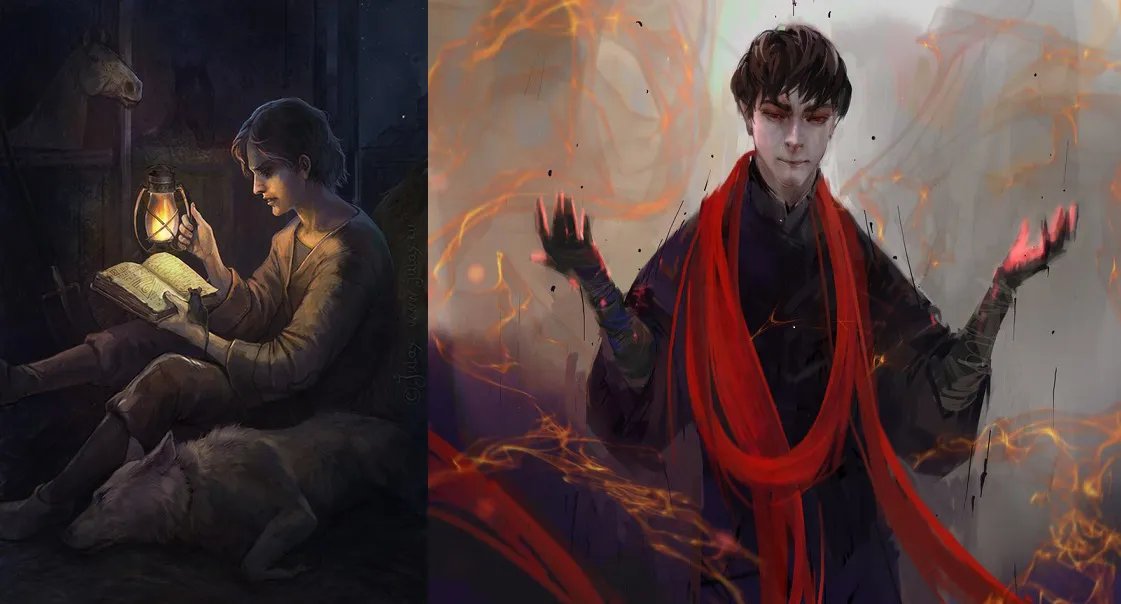
Kirikos was born in the city of Tratos, into an ordinary family of Halehids. He was raised just like other island children. From childhood, he was instilled with faith in the Dead God and later trained in the art of death. The youth naturally enjoyed magic, but he was more preoccupied with the theme of religion. He was interested in many aspects of faith, death, and what awaits people afterward, the differences between Gods, their authenticity, and other questions that gave him no peace. He read every book on these topics that he could find. Reading in general was his favorite activity.
In his teenage years, he began to devote time to more mundane things: socializing with friends, strolling, and various pranks. Some of these activities required money, so he had to work part-time from time to time. One day at the port, they encountered a visiting foreigner. He struck up a conversation with the boys and told them that he had come to the city for blue medilias. Kirikos and his friends had, of course, heard of this plant, which was considered an ingredient for a drug. But the stranger assured them that this was only a side effect and not as serious as it was usually portrayed. The main property of this potion, however, was the ability to increase magical power for a period of time. The teenagers believed the foreign guest, who shared the necessary knowledge with them, and after a couple of days, they decided to brew such a potion themselves. Each of the four decided to try the drink. In the end, two died, one suffered severe poisoning, while Kirikos experienced clinical death and then remained in a coma for several days. After waking up, the boy claimed that he had seen God and that He had spoken to him. The healers, of course, dismissed this as hallucinations and delirium, which often occur in such cases. The young Halehid tried to talk about this a few more times after being discharged, but he found no understanding even among his own kin. After that, Kirikos decided not to mention it anymore, but continued to think about what he had seen. Sometimes these visions repeated at night; he saw God in his dreams, and He told him that all religions were lies, only the Dead God was the true God, but the Halehids had forgotten His true dogmas and were now in error, following a false path and professing false scriptures. Kirikos listened carefully to the voice from his dreams, absorbing everything it said and learning from it.
A year later, Kirikos's family had to move to Seveseptim. Such cases were very rare, of course, but they still happened for certain reasons. It was difficult for the Halehid to get used to the new place, the new people, and especially the different faith practiced here. He was not forced to change his religion, of course, but he was advised not to speak of his beliefs. However, this lasted only until the youth decided to impress a girl named Aurora. She was also a Halehid, but had lived here her whole life and was therefore as pious as the locals. She was not impressed at all by the skeleton summoned by Kirikos's magic; rather, it horrified her. It was after this incident that the Church of the Creator turned its gaze toward the youth from the distant islands. After speaking with the boy's parents and the city administration, the churchmen decided not to punish Kirikos, but to set him on the right path. The Halehid was required to attend the school of the Creator, come to sermons, and carry out the assignments of a mentor appointed by the church. At first, everything went smoothly; the youth attended classes, including those on healing magic. He did not like it, but there was no other choice. He certainly did not forget his own God, although over time he began to remember Him less frequently. Eventually, Kirikos was inducted into the Church of the Creator and became an acolyte. Training in close combat was added to the sermons and magic lessons. The youth did not become a warrior, of course, but he did learn a thing or two. Time passed.
On one autumn night, the Halehid beheld God again, and He was terribly angry with the boy. He accused him of betrayal, frightened him with the consequences of such an act and the punishment awaiting him in the afterlife. On that same day, Kirikos committed an even greater offense than raising a single skeleton. When he was detained by the guards, he began to justify himself, claiming that he had done nothing or did not want to do it because he was not in his right mind. Confused testimony certainly did not help, especially since the fact of the law being broken was recorded. The islander was handed over to the church inquisitors, as the crime committed was not a murder and had a religious-magical nature. Since trying to reason with the boy nicely had failed, they decided to try more severe methods. The Halehid begged to be released, but the local laws proved harsh. After two months of forced therapy, Kirikos was released. He returned home silent, exhausted, and depressed. The youth ate little and generally did not leave the house, preferring to sit in his room rereading books. Only closer to spring did the Halehid begin to appear on the street, and even then he usually just sat on a bench by the house, although he was sometimes seen by the lake. Kirikos's sleep became even worse, as now he dreamed not only of the Dead God but also of the place where he had spent two months—the pain and horror he had been subjected to by the inquisitors. Waking up in the middle of the night in a sweat became more frequent, which contributed to chronic insomnia. Dark circles under his eyes were added to his thinness and pale skin; his speech became incoherent, and those around him began to notice that the boy sometimes muttered something under his breath, as if conducting a dialogue with himself and uttering strange, illogical phrases.
A month passed without significant changes; no deteriorations or seizures were observed until Kirikos accidentally learned about Aurora's wedding. He was not in love with her, nor did he practically remember her, but this news left a bitterness in his mouth. For the next few nights, the Dead God visited the Halehid, convincing the boy that the local residents were sinful and mired in vice, spreading false teachings and deserving of severe punishment. But the islander resisted and replied that he would be faithful to the Creator, for only He was the true God—so said the inquisitors, so says the church.
- Disobedience leads to punishment; only through punishment can a person be delivered from lies and sin, only through punishment is the truth revealed, - Kirikos repeated.
- They use the truth to deceive you. Do you really not understand?
- No, the truth cannot be used for lying. One cannot lie; it is forbidden.
- Fool! It most certainly can, and they are doing it to you, using the truth but for their own purposes, glorifying their imaginary God and denying my existence. I am the only one, and I cannot be replaced by some weak copy, neither this one nor any other. Deep in your soul, you understand this yourself, you feel it.
- No, they cannot be wrong, all of them... They cannot.
- They are wrong, and you know why. In their hearts, there is no particle of the spirit of the ancient world through which I can communicate with you. There are only a few like you, but the future of mankind depends on you. You are the heralds of truth, the heralds of new life.
- I must follow the commandments and not break them, help those in need, act justly, condemn sinners and godless people, be the voice of truth...
- They forced you to believe their lie through punishment, passing it off as truth. Now you must help them behold the truth, and you know how to do it, my herald.
- Yes, I know...
The next day, Kirikos found the building where Aurora's wedding was taking place. It was medium-sized and entirely wooden. When all the guests had gathered and the ceremony began, the Halehid used fire magic and set the building ablaze, having previously poured flammable liquid. Flames erupted around the entire perimeter and quickly engulfed the structure. Kirikos stood aside in the shadow of the trees and watched as the local residents rushed toward the burning house. After a few seconds, horror seized the boy and he realized what he had done. Fearing that his involvement in the mass murder would be established and punishment would follow, the Halehid hastily left the city, taking his favorite things with him.
For more than a year, he wandered the world, performing various acts obeying the voices in his head, until he eventually ended up in prison due to another crime.
Origin:Halehids: +5 Will; additional 4 skill points; free Art of Death skill;
Religion:Creator - +10 Will; immunity to paralysis and critical hits
Characteristics:Constitution - 25
Intelligence - 40
Strength - 15
Dexterity - 20
Speed - 30
Will - 50
Perception - 30
Skills and Abilities:Polearm WeaponsI Proficiency with polearms.
II Chance to parry an opponent's attack (dexterity).
Art of DeathSkeleton (100) Raises the skeleton of a killed opponent from the dead.
Decay (-) Extracts remaining life from a dead opponent, restoring magical energy to the caster or their ally (opponent's health*2).
Source of Knowledge (300) Extracts knowledge from the recently killed, giving a chance to increase a random characteristic of the caster by 3 points (will) (x2).
Healing MagicHealing (out of combat)I Restores target's health (+1 | 1) (x0.5).
Antidote (50) Removes negative effects from poisons and diseases (x0.5).
Protective Aura (?) The caster creates a magical barrier around themselves or an ally that absorbs damage and prevents the opponent from applying negative effects (barrier health = will*10). Characters with high will are capable of destroying the protective aura. The aura does not protect against the Assassin ability.
Elemental MagicFire Arrow (100|50) Deals fire damage to the opponent.
Fire Circle (50|170) The caster surrounds themselves with a ring of fire that deals damage to approaching opponents for five turns.
Battle Mage: +15 Strength, +15 Dexterity (x3).
Mirrorer: I Character gains a chance (70%) to reflect an opponent's spell in a random direction (x3).
Quick Mind: I The caster is able to use two spells per turn (x3).
Inventory: black clothing, Swedish quill, dagger, red scarf, religious symbol of the Creator (cross for the neck or whatever they have) and a religious symbol of the Dead God from the Halehid islands (exerts a positive effect on the character's magical abilities), wooden figurine of the Dead God from the dream, scripture of the Church of the Creator with added pages from a book about the dead God and personal notes (some parts are torn out entirely, some sheets glued in by himself, handwritten additions, etc.).


 Siverfale


 Ple-Sen