Connection ErrorBad RequestThis page went staleSession ExpiredSign in requiredForbiddenNot FoundToo Many RequestsServer ErrorBad GatewayService UnavailableGateway TimeoutHTTP Version Not Supported
Session Expired
Your session has expired. Please log in to continue.
Sign in required
You need an account to do that. Sign in or create one — it only takes a minute.
This page went stale
Your security token was rejected, usually because the page sat open too long or you signed in elsewhere. Nothing was saved. Reload the page and try again.
Request Failed
We encountered an issue while processing your request.
Please check your internet connection and try again.
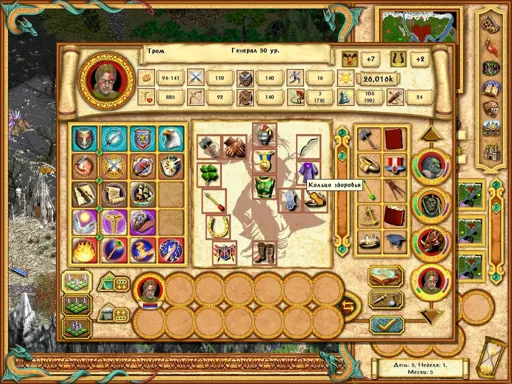
Dear forum members, let's share who had the most powerful hero (preferably with screenshots). I just broke my previous record (level 45), and now I have the strongest hero. On the "who will win" map, on the last day of the game (all castles are mine, and there are no companions nearby), he was exhausted and barely made it to two towns and 1 castle with Chaos Dragons and Magic Dragons. Here's what happened...
Wow, you're awesome! 50! My highest was 34 or 36, but everything was maxed out. It's kind of strange that at that level, no magic skill tree is fully upgraded.
What? There are only 70 levels, or am I missing something?
Didn't get the joke.
Yes, there are only 70, and besides, after level 50, it's almost impossible to level up without Wisdom Trees, Coliseums, or quest rewards, so it's hard to call it leveling up.
Pfft, I had a character at level 78; I played a lot and grinded back then.
Actually, the maximum level is 70. I checked using a code to increase the level (by the way, after level 68, you can't increase the level further using a code). After reaching level 70 (I got the last two levels using ancient wisdom), I visited the dragon coliseum, and another tree of wisdom – an inscription appeared with approximately the following content: "The hero has reached the highest level of experience." Perhaps this is possible in a pirated or original version of the game (I checked on Whirlwinds). But when hovering over the experience in the hero's parameters, a message appeared indicating a lack of experience for the next level: "-8389 experience units" or "-8389M experience units." So, through experimentation (although this maximum was known even before), the limit of development for a hero has been determined.
Наш мир полон тайн и чудес. Многие их ищут, многим они вовсе не нужны, а многие даже не замечают их, не понимают что они вокруг нас, каждый день, везде. А эти чудеса порой, сокрыты в обычных, привычных предметах.
Yes, I think I overlooked that. In Heroes of Might and Magic III, after level 75, there's a lot of back-and-forth with levels and experience. But here, I checked my notes and found nothing... Maybe I forgot where I put them? But, to be fair, it's more important to upgrade skills than levels. So, I don't remember if I had any heroes naturally leveled up beyond 40-42 (I've never tried artificially leveling them up). And in the points awarded for a game, only the hero's maximum level of 32 is taken into account; there's no need to level up further.
By the way, in the campaigns and RPG maps, I tried to develop the hero's skills in the early stages by sending him to universities, institutes, military academies, and libraries, so that by the time he reached a lower level, he would already have a certain level of skill, which would otherwise be much lower. Although this requires a considerable amount of gold, which is obtained either in battles (which, as you know, is directly related to leveling up) or through quests (I mean quest-RPG maps, where sometimes, in addition to money, the reward also includes experience - i.e., leveling up).
Наш мир полон тайн и чудес. Многие их ищут, многим они вовсе не нужны, а многие даже не замечают их, не понимают что они вокруг нас, каждый день, везде. А эти чудеса порой, сокрыты в обычных, привычных предметах.
My highest score was 41. While playing against the computer, I thought I was a pro. But when I tried playing online, I immediately realized I was a noob. That's why I decided to play Million http://million-club-slots.com/
Let's continue. I forgot to mention that although all the ships in the lists are seaworthy, approximately one third of them—sometimes more, sometimes less—are in timbering or awaiting repair.
For now, the wars have subsided. 1720
Great Britain Ships of the Line: 102-146,5 Frigates: 52-27,3 Small: 1-0,3 Small includes only those of at least 300 t.
France Ships of the Line: 27-44,8 Frigates: 6-3,3 - -
Netherlands Ships of the Line: 56-67,8 Frigates: 18-11,2 Small: 17-19,5
Sweden Ships of the Line: 24-33,9 Frigates: 9-4,4
Denmark Ships of the Line: 24-37,9 Frigates: 16-8,1
Venice Ships of the Line: 27-42,0
Spain Ships of the Line: 11-13,3 Frigates: 15-7,3 Small: 3-0,9
Russia, Baltic Fleet Ships of the Line: 33-42,1 Frigates: 11-5,6 Small: 2-0,6 Russia, Azov Fleet Ships of the Line: 7-7,1
Over the past 25 years, the picture has completely changed. Only one maritime superpower remains—Great Britain. The French fleet has decreased fourfold, and many ships required repair. The Netherlands moved into 2nd place; they had 25 Ships of the Line ready for sea, a number that could easily be increased to 40. Russia's Baltic Fleet became not only the strongest in the Baltic, but with 33 Ships of the Line, it took 3rd place; 21 out of 33 Ships of the Line were fit for sea service. However, the tonnage of Venice's 27 Ships of the Line was the same, meaning its Ships of the Line were larger.



 hunter98